


What is the after-tax cost of debt?
Borrowing is expensive. When businesses borrow money, they pay interest expense. However, businesses can also deduct their interest expense from their taxable income, which reduces their tax bill.
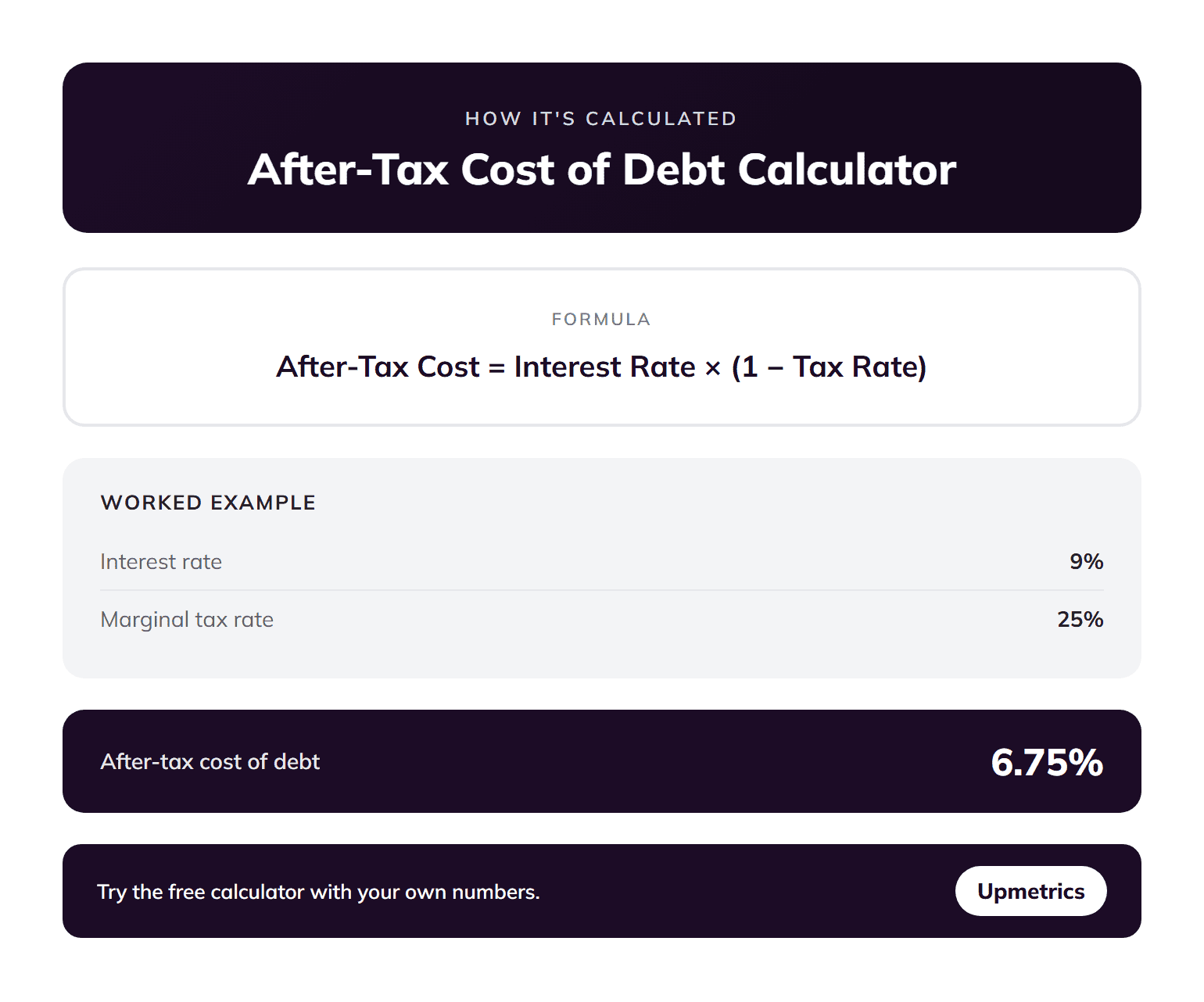
To calculate the after-tax cost of just borrowing money, multiply the loan’s interest rate by (1- tax rate).
For example:
A $100,000 loan at 9% interest with a tax rate of 25%
= 9% x (1 –0.25) = 6.75% aftertax
So while the lender is receiving 9% interest, the business effectively pays an after-tax borrowing cost of 6.75%.
The interest rate alone may not fully encompass the total dollar amount a business must repay. Take Two different companies that have identical loan amounts yet have different tax rates will pay different borrowings costs based solely on their tax situations. The after-tax cost provides the most accurate amounts for comparison.
How to use this calculator?
Enter three inputs to get the result:
1. Debt cost
The annual interest rate on the loan. Use the APR, not the monthly rate. If there are multiple loans, calculate a weighted average based on outstanding balances.
2. Net income
Used to calculate the effective tax rate. Take this from the most recent full-year income statement.
3. Pre-tax income
Earnings before tax for the same period. The calculator uses this with taxes paid to find the effective tax rate and adjust the debt cost.
Do not use the marginal rate. It can make the after-tax cost look lower than it actually is.
Why the after-tax cost of debt matters for business decisions?
When a business takes a loan or compares funding options, the key question is the real cost. The after-tax cost gives that answer.
Interest on loans can be deducted from income, but payments to investors cannot. This makes debt cheaper than it looks if tax is considered. Ignoring this can lead to wrong decisions.
The after-tax cost is also used in WACC (Weighted Average Cost of Capital), which is the minimum return a business needs to justify its funding. If a return is lower than WACC, the business loses value.
For example, a 10% loan with a 30% tax rate actually costs 7%. This difference can change whether a decision makes sense.