


What is a break-even analysis?
Every new business owner has to figure out how much they need to sell before they stop losing money. A break-even analysis helps you find that number. It is the point where the money you get from sales covers all your costs. You do not make a profit. You do not have a loss. You are even.
The break-even analysis is the process of finding that number. The break-even point is the number you find either in units, like how many products or hours you need to sell or in revenue like the exact amount your business needs to make each month.
Let us say you are starting a candle business. Before you sell a candle you are already spending $2,000 a month on rent and insurance and your website and Etsy fees. Each candle costs $4 to make and sells for $18. So every candle you sell helps cover those expenses by $14. That $14 is your contribution margin.
Now divide $2,000 by $14. You get 143 candles. If you sell less than 143 candles you are losing money that month. If you sell more you are making a profit. That number, 143, is your break-even point.
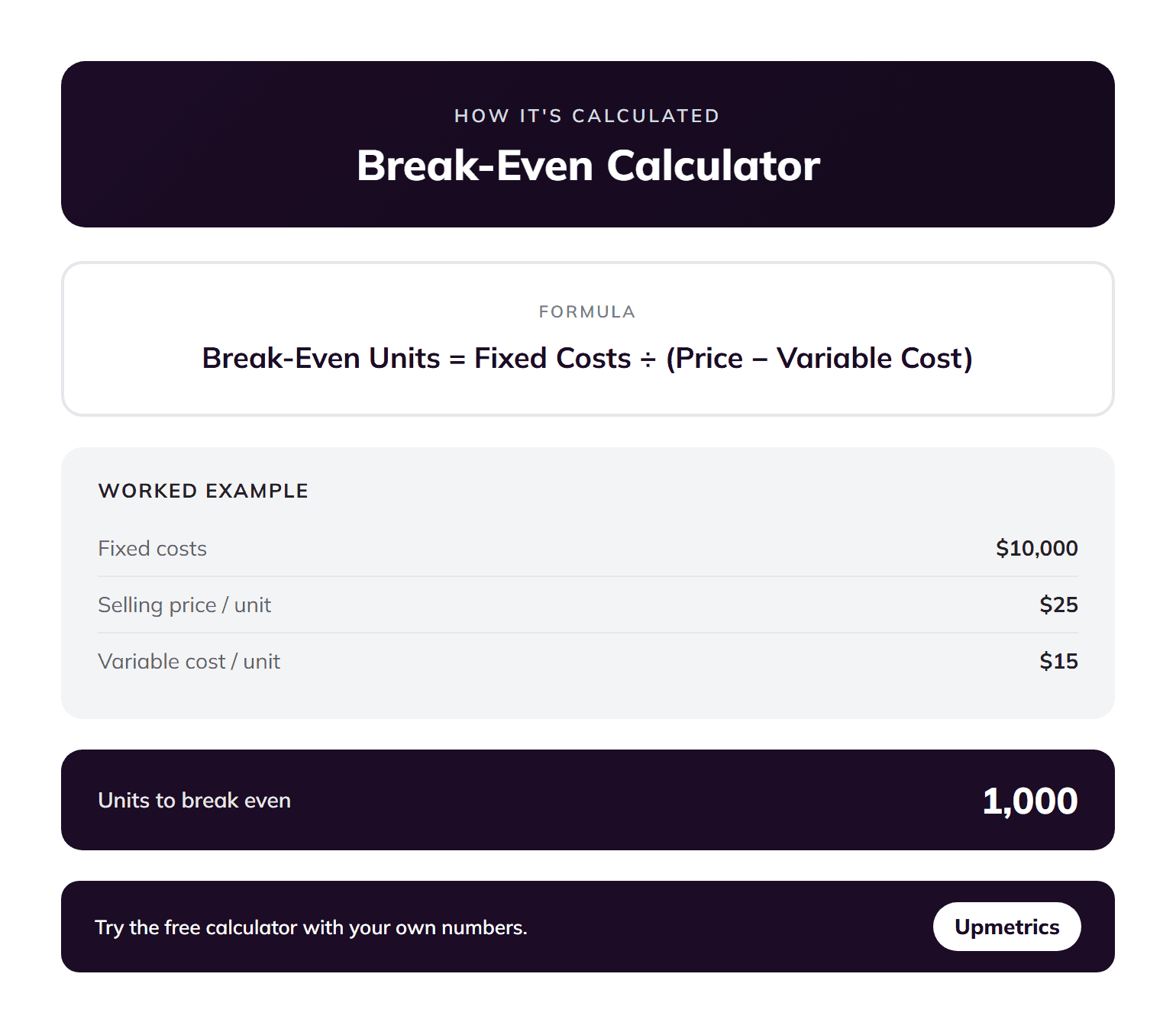
How to calculate your break-even point (using our calculator)?
Once you’ve entered all of the information, the calculator will return how many units you must sell in order to break even on your costs.
1. Fixed costs (monthly)
Fixed expenses are costs you pay every month no matter if you sell anything or not. Examples of these expenses include rent, salaries, insurance, loan payments and software or services you pay for regularly.
To find your fixed expenses for a month with no sales, add up all your fixed costs for that month. Don’t forget to include subscription costs, like software fees and small costs such as office supplies.
Check your bank statement from month to make sure you include everything. List all the expenses you see on your statement, as fixed costs.
2. Variable cost per unit
The variable cost of a unit is how much it costs you to analyze one unit of a product. The variable cost of producing one product/service includes on-going direct costs.
For example, if you clean houses and charge $35 for each house you clean, the cost of cleaning one house (i.e., the variable cost) is $35.00.
3. Selling price per unit
The selling price of a unit is the price you charge your customers for one item (product/service). If you’re not sure what to charge, try experimenting with different prices in the calculator, and you’ll see how the results change.
Pro tip: To help you understand how sensitive some of your costs will be to price changes, try changing the numbers a little bit to see how they respond. For example, increase your costs by 10% or decrease your sale price by $2. You will find that the results of these two inputs will far outweigh the individual number alone.
Break-even formula
To calculate your break-even point, you can use the formula:
Break-even point (units) = Fixed Costs ÷ (Selling Price – Variable Cost)
Where:
- Fixed Costs = the amount you pay out each month
- Selling Price = the price you are charging for your product
- Variable Costs = cost of each unit you produce
For example, if:
- Fixed Costs = $1,000
- Selling Price = $50
- Variable Cost = $30
Your break-even point would be:
$1,000 ÷ ($50 − $30) = 50 units.
You would need to sell 50 units in order to cover all of your costs and break-even.
What to do after you know your break-even point?
Once you know your break-even number, here’s how to use it:
1. Check if your idea makes sense
Compare your break-even sales with your actual demand.
If you need to sell 5,000 units but your market can only support 1,500, the idea may not work. It’s better to know this early.
2. Set the right price
Your break-even shows the lowest price you can charge without losing money.
Use it to:
- Avoid underpricing
- Test discounts before offering them
3. Set clear sales targets
Turn your break-even into a simple goal.
Example:
If you need 150 sales per month to break even, you now know your monthly target.
This helps you track if you are on the right path.
4. Adjust your plan
If your break-even feels too high, you can:
- Reduce your costs
- Increase your price
- Improve your sales volume