


What is cash flow?
Cash flow is the money that enters and leaves your business. It shows the cash you currently have in your bank account to pay rent, salaries, supplier bills, and other day-to-day costs.
Why isn’t it the same as profit?
Profit is the money left after you deduct business expenses from revenue. But profit does not always mean cash is in the bank. You may record sales in your books, but if customers have not paid yet, the money is still not available to pay bills or payroll.
Here is a simple example. A marketing agency completes a $12,000 project in February. The work is finished that month. The agency sends the invoice on March 1 with 60-day payment terms. The client pays in May.
But the business has regular expenses. Employees are paid every two weeks. Office rent is due at the end of the month. These payments must be made before the client’s payment arrives.
In the records, February shows revenue from the project. But the money is not in the bank yet. This is why a business can show profit and still struggle to pay bills. Profit shows what the business earned. Cash flow shows the cash available to spend.
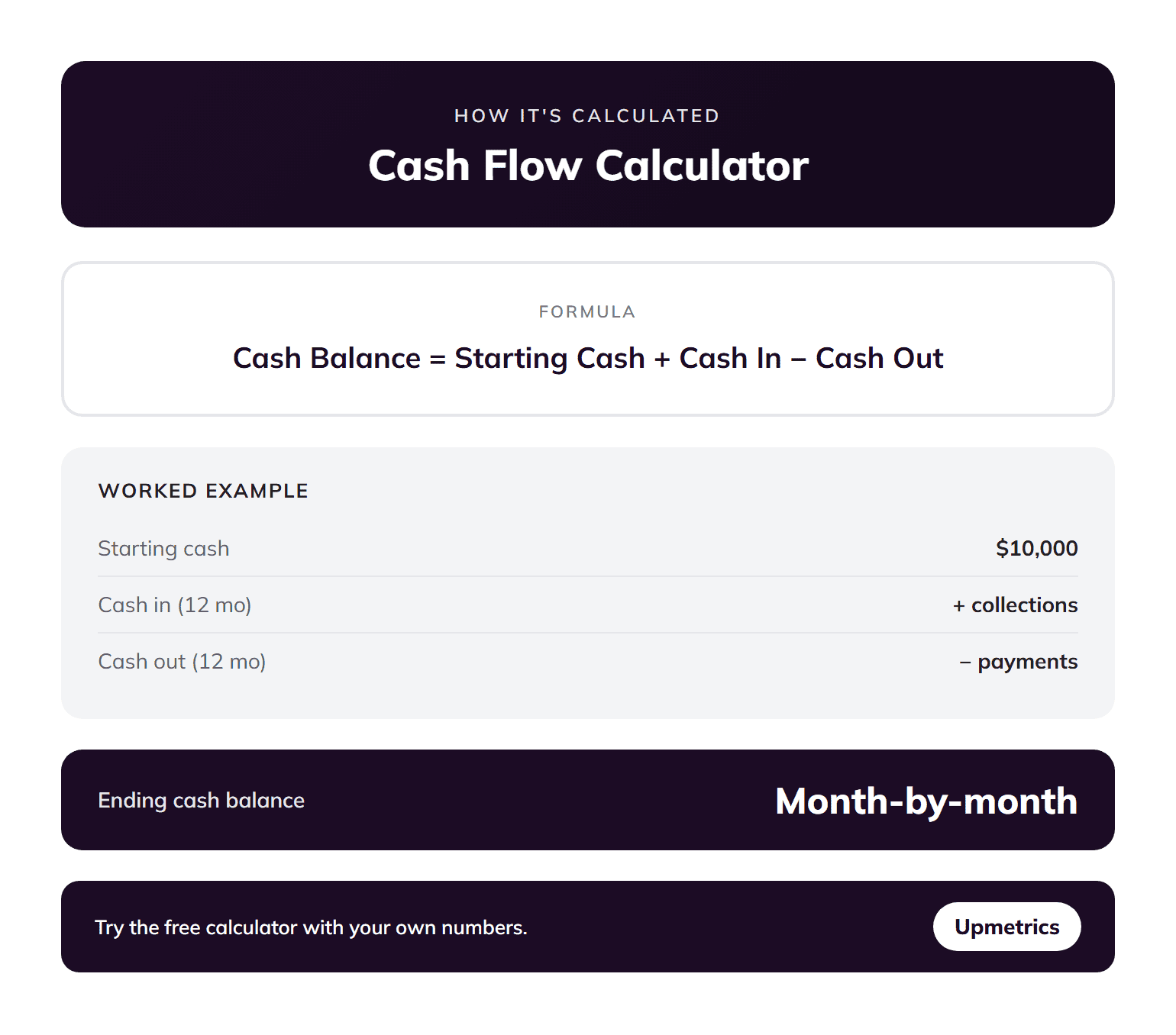
How to calculate your cash flow (using our calculator)?
This calculator projects your cash position for a full year, one month at a time. Instead of asking for a single cash-in and cash-out total, it builds the projection from your sales, costs, and how quickly money actually moves in and out of your account.
1. Starting point and growth
Enter your first month’s sales and the monthly growth rate you expect. Every other month in the projection is built from this starting number compounding at that growth rate.
2. Costs as a percentage of sales
Enter the cost to create what you sell (COGS) and your operating expenses, both as a percentage of sales. These scale automatically as your projected sales grow.
3. Credit terms
Enter what percentage of your sales are on credit rather than paid immediately, how many days customers typically take to pay you, and how many days you typically wait before paying your own suppliers. This is what creates the gap between when a sale happens and when the cash actually lands – or leaves – your account.
4. Starting balances
Enter your starting cash, starting inventory, how many months of inventory you keep on hand, and any money already owed to you or by you at launch (starting accounts receivable and accounts payable).
Once you’ve entered these, the calculator builds out all 12 months and shows your projected cash balance, accounts receivable, accounts payable, and inventory on hand at the end of the year.
Reading your cash flow: what the numbers mean
The calculator displays four cash position components: cash balance, accounts receivable, accounts payable, and inventory on hand.
1. Cash balance
Cash balance shows the money left in your bank account after all cash coming in and cash going out are counted for the period. A positive balance means more money came in than went out. A negative balance means your spending was higher.
2. Accounts receivable
Accounts receivable is the money customers still need to pay your business. It comes from invoices you have already sent but have not been paid for yet. When customers pay these invoices, the money will come into your business.
3. Accounts payable
Accounts payable is the money your business still needs to pay to suppliers or service providers. These are bills for goods or services you have already received but have not paid for yet. When you pay them, the money leaves your bank account.
4. Inventory balance
Inventory balance shows the value of products your business currently has in stock. These items are ready to sell but have not been sold yet. When the products are sold, they bring money into the business.