


What is days sales outstanding?
DSO measures the average number of days between making a sale and getting paid for it. It is a collections metric, not a revenue metric. Revenue shows how much was sold. DSO shows how long it actually takes to collect that money.
Lower is better. A DSO of 20 means customers pay 20 days after the invoice. A DSO of 55 means they take nearly two months.
Here is an example. A B2B software company has $45,000 in accounts receivable at the end of the quarter. Credit sales for that quarter were $180,000 over 90 days. DSO = ($45,000 / $180,000) × 90 = 22.5 days. For a business on net-30 terms, that is a healthy number.
DSO matters because the gap between invoicing and collecting is where cash flow problems begin. A business can look profitable on paper and still struggle with payroll if customers take 60 or 90 days to pay a 30-day invoice.
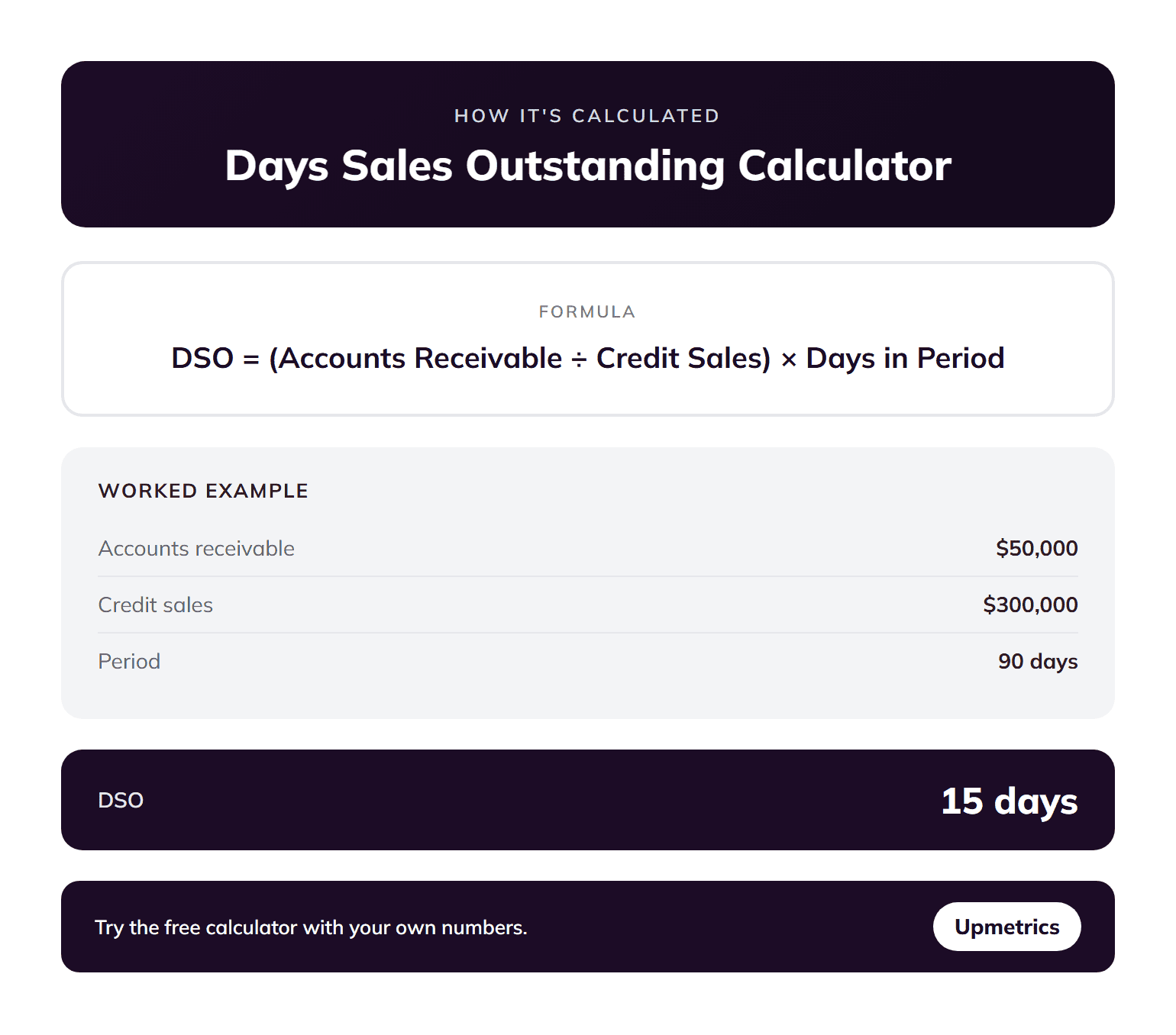
How to calculate your DSO?
The calculator needs three inputs:
1. Ending accounts receivable
This is the total amount customers owe at the end of the period. Find it on the balance sheet under current assets. Use the ending balance, not an average.
2. Total credit sales for the period
This is revenue from invoiced sales where payment comes later. Cash sales do not count. If a customer pays at the point of sale, that transaction does not create a receivable. Do not include it here. Mixing cash and credit sales is the most common mistake. It makes DSO look lower than it actually is.
3. Number of days in the period
Use 90 for a quarter, 365 for a full year, or the actual days in the month for a monthly calculation. Stay consistent. Quarterly DSO should only be compared to other quarterly numbers.
What your DSO number tells you?
The best way to read DSO is against two things: your payment terms and your previous DSO numbers.
Net-30 terms with a DSO of 28 means collections are working well. A DSO of 48 means customers are paying 18 days late on average. Is it one overdue account skewing the number? Or is it a pattern across the customer base? That distinction matters.
Trend is more important than any single number. A DSO moving from 30 to 38 to 46 over three quarters is a warning sign, even if 46 days does not sound extreme. Collections are slowing. The cash gap is growing.
A rising DSO can also flag customer financial trouble before it turns into a bad debt. A customer who used to pay in 25 days now taking 55 is worth a conversation before the invoice hits 90 days.
DSO varies by industry. Manufacturing often runs 45 to 60 days. Professional services sit at 30 to 45. Retail is close to zero. Compare your DSO to your own prior periods and your industry range for the most useful read.
If you are building a 12-month cash flow forecast, tools like Upmetrics factor receivables timing into projections so you can see the cash impact of a high DSO before it hits your account.