


What is EBITDA?
EBITDA measures the financial performance of a business by removing interest, taxes, depreciation, and amortization from earnings. This shows how the business performs based on its core operations.
EBITDA is a financial metric used to measure a company’s operating profit from all forms of business operations within a specific period and indicates the business’s ability to generate cash from operations.
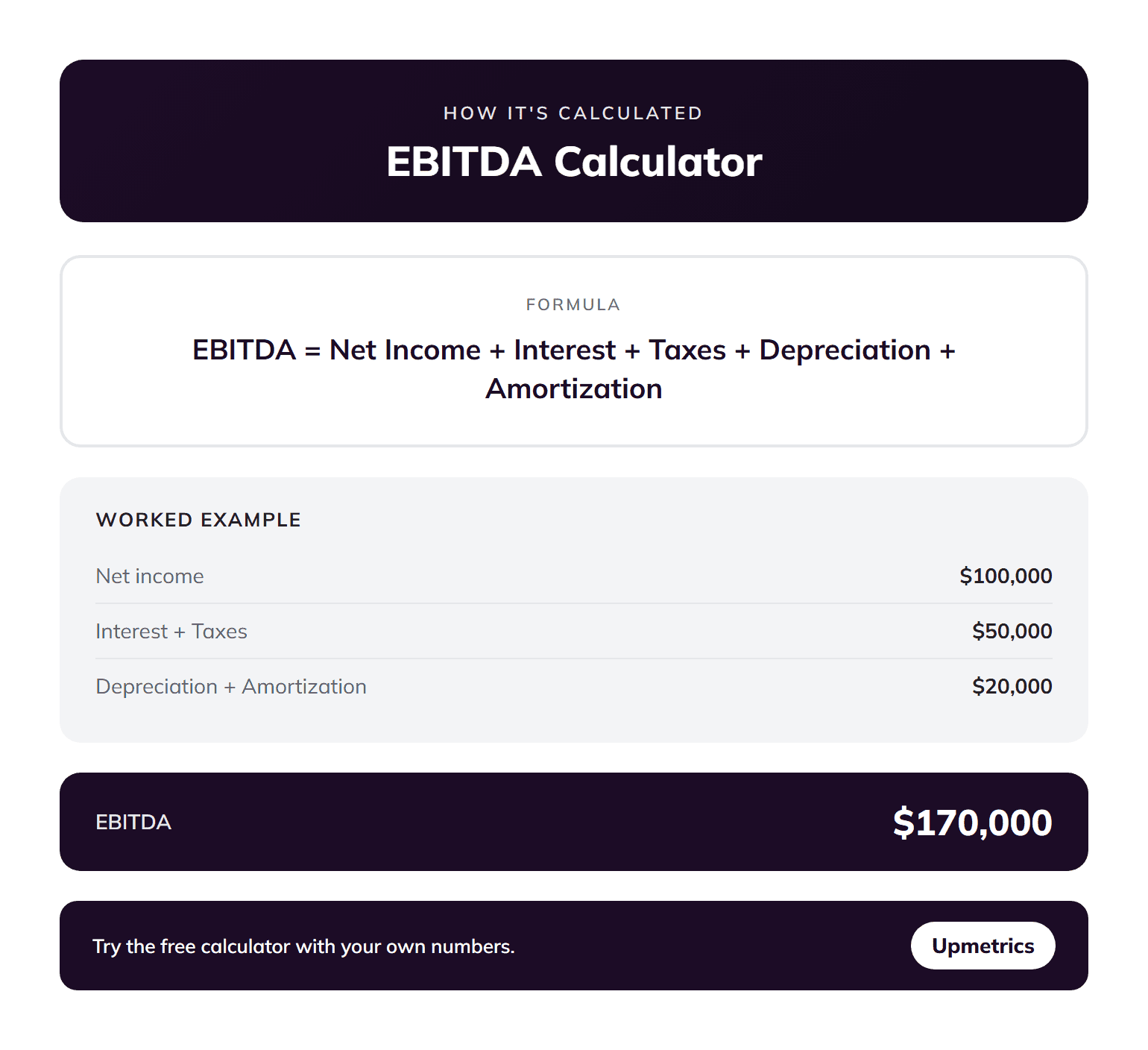
For example, a business has $100,000 in net income, $20,000 in interest expense, and $30,000 in taxes. Add those together and you get $150,000 of EBIT. Add back $15,000 in depreciation and $5,000 in amortization, and EBITDA comes to $170,000.
EBITDA allows for operating performance comparison between two businesses without regard to any differences in their financing structures or accounting methods.
How to calculate EBITDA using this calculator?
The calculator requires several inputs from your income statement. Each value represents a different part of your business revenue or expenses.
1. Net income
Net income is your profit after every expense, interest payment, and tax has already been deducted from revenue. You will find it at the bottom of your income statement. If you haven’t calculated that figure yet, start with a net income calculator, since EBITDA works backward from it.
2. Sales / Revenue
Total sales or revenue for the period. This number is not part of the EBITDA formula itself – it is used afterward to calculate your EBITDA margin (EBITDA as a percentage of revenue).
3. Interest and taxes
Interest expense is what the business paid to borrow money: loan interest, credit line fees, and similar costs. Taxes are income taxes paid or accrued for the period. Both values are typically listed separately on the income statement.
4. Depreciation and amortization
When the business buys things like machines, vehicles, or equipment, they lose value over time. This loss in value is called Depreciation.
The business also buys things that you cannot touch, like software licenses or patents, and these things also lose value over time. This loss in value is called Amortization.
Depreciation and amortization are important because they help the business understand how/what value it is losing over time.
After entering these inputs, the calculator adds net income, interest, taxes, depreciation, and amortization together to find your EBITDA.
What does EBITDA represent?
EBITDA represents the amount of income generated by a company through its normal operations without considering interest, taxes, depreciation, and amortization.
EBITDA is also presented as a % of total revenue. It is referred to as EBITDA margin. It is calculated by: (EBITDA/ Revenue) x 100 = EBITDA Margin.
To illustrate, if EBITDA is $170,000 and revenue is $500,000, the calculation is (170,000/500,000) x 100 = 34%. EBITDA margins in industries are different.
The EBITDA margins of manufacturers tend to be high compared to other businesses, and retail businesses tend to have lower margins. A low EBITDA margin indicates that the company has had to spend more in its operations than it earns.
The greater the EBITDA margin, the more the business can meet its operating expenses and invest in expansion. EBITDA margins are used by investors and lenders to compare the efficiency of various companies.