


What is return on investment (ROI)?
ROI tells you whether an investment was worth it. It measures how much you earned back compared to what you spent, expressed as a percentage.
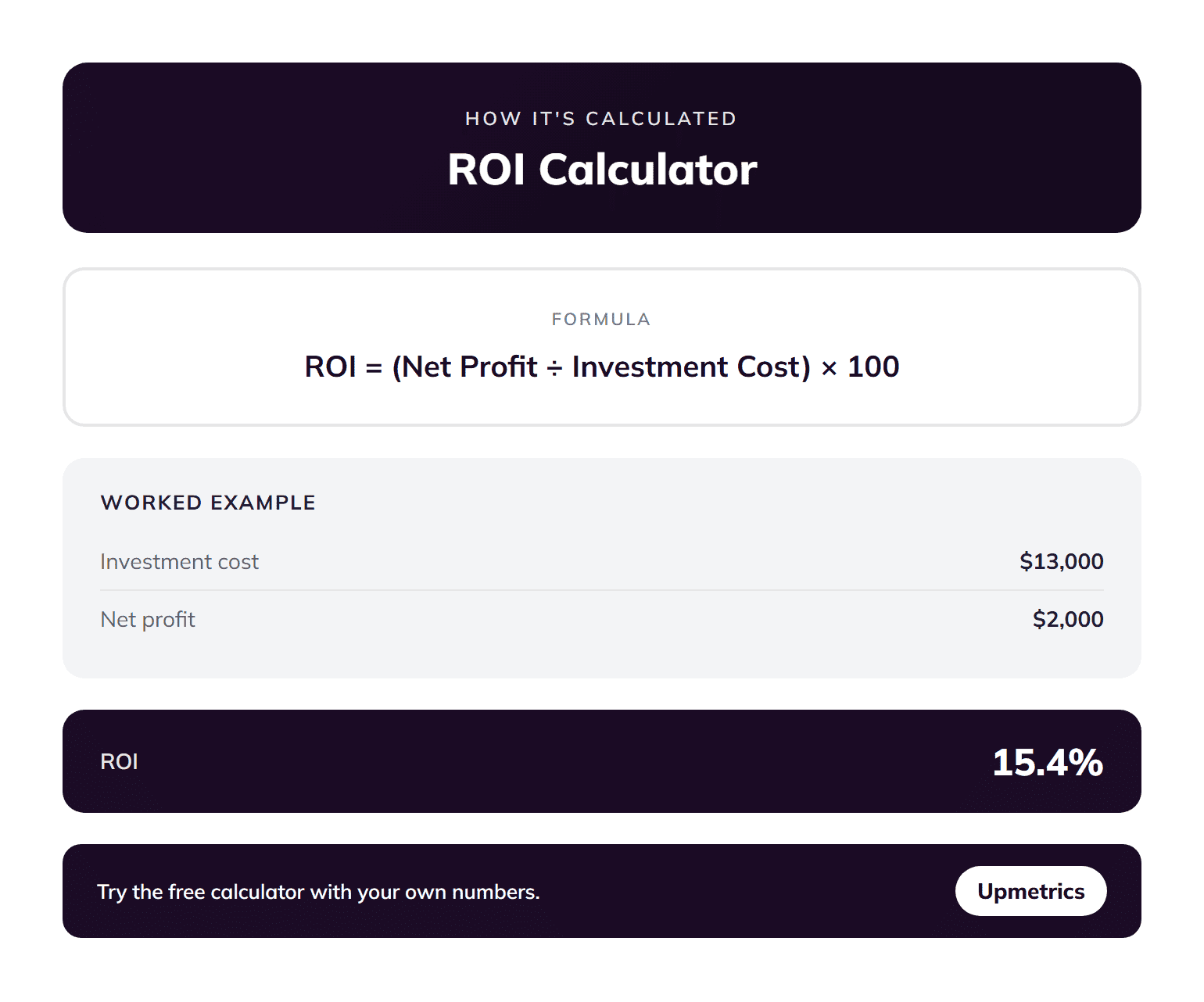
The formula is:
ROI = ((Net Return − Investment Cost) ÷ Investment Cost) × 100
Here’s a simple example. A gym spends $5,000 on a marketing campaign. It attracts 30 new customers who each pay $200, bringing in $6,000 in revenue. Subtract the $5,000 spent from the $6,000 earned, and the gym made $1,000. Divide that by the $5,000 investment, multiply by 100, and the ROI is 20%.
That 20% means for every dollar the gym spent, it got $1.20 back. A positive ROI means the investment paid off. A negative ROI means it costs more than it returns.
How to calculate your ROI?
The calculator needs a few numbers. Here is what each one means and what people commonly get wrong.
1. Initial investment
The upfront capital you put in to make the investment happen. For a marketing campaign, this is your ad spend, design fees, and staff time managing it. For equipment, it’s the purchase price, installation, and training.
The most common mistake is undercounting costs. If your time has a value, include it. Use your effective hourly rate as a reference.
2. Total revenue / return
Enter the full, gross revenue or return the investment generated – do not subtract costs from this number yourself. The calculator subtracts your costs separately, so netting them out here would deduct them twice.
3. Operating costs, taxes, and maintenance
Enter any ongoing costs tied to running or maintaining the investment in their own fields: operating expenses, taxes paid on the return, and maintenance or upkeep costs. If a campaign generated $18,000 in sales but required $6,000 in product costs to fulfill them, enter $18,000 as your return and $6,000 as an operating cost – not $12,000 as a single combined number.
4. Investment period
How many years the investment covers. This doesn’t change your ROI percentage, but the calculator uses it to show an annualized return you can compare against typical long-run market returns.
Run the calculator with your actual numbers first. Then try reducing the investment cost by 15% or increasing the return by 10%. Small changes in ROI show what matters most and where to focus.
How to use ROI to make better business decisions?
This calculator helps you compare different options. Here is how to use ROI in common situations.
1. Marketing spend
Estimate the return before running a campaign. If you spend $3,000 and expect $4,500 in revenue, the ROI is 50%. Compare this with past campaigns to decide where to spend.
2. Equipment purchase
Check if the investment pays back. A $12,000 oven that adds $3,500 in monthly revenue with $500 in costs gives $3,000 net return. This helps you decide if the purchase is worth it.
3. Hiring
Measure the return from a new hire. If a salesperson costs $4,500 per month and brings $9,000 in sales, the ROI becomes clear once they start generating revenue. Track that revenue growth over the following months to see if the hire’s ROI holds up.