


What is sales tax?
Sales tax is a percentage added to the price of goods and some services. The customer pays for it. The seller collects it and sends it to the tax authority.
Who is responsible for it?
The business does not pay this from its own money. It holds the customer’s tax and passes it on when due. But if the wrong rate is charged or the payment is late, the penalty falls on the seller, not the customer. That’s different from a corporate tax rate, which the business pays on its own profit, not on what customers hand over at checkout.
Rates are not the same everywhere. The US has no federal sales tax. Each state sets its own rate. Counties and cities stack their rates on top of that.
A shop in Austin and a shop in Houston charge different combined rates even though both sit in Texas. Before collecting anything, the exact combined rate for the business location needs to be confirmed.
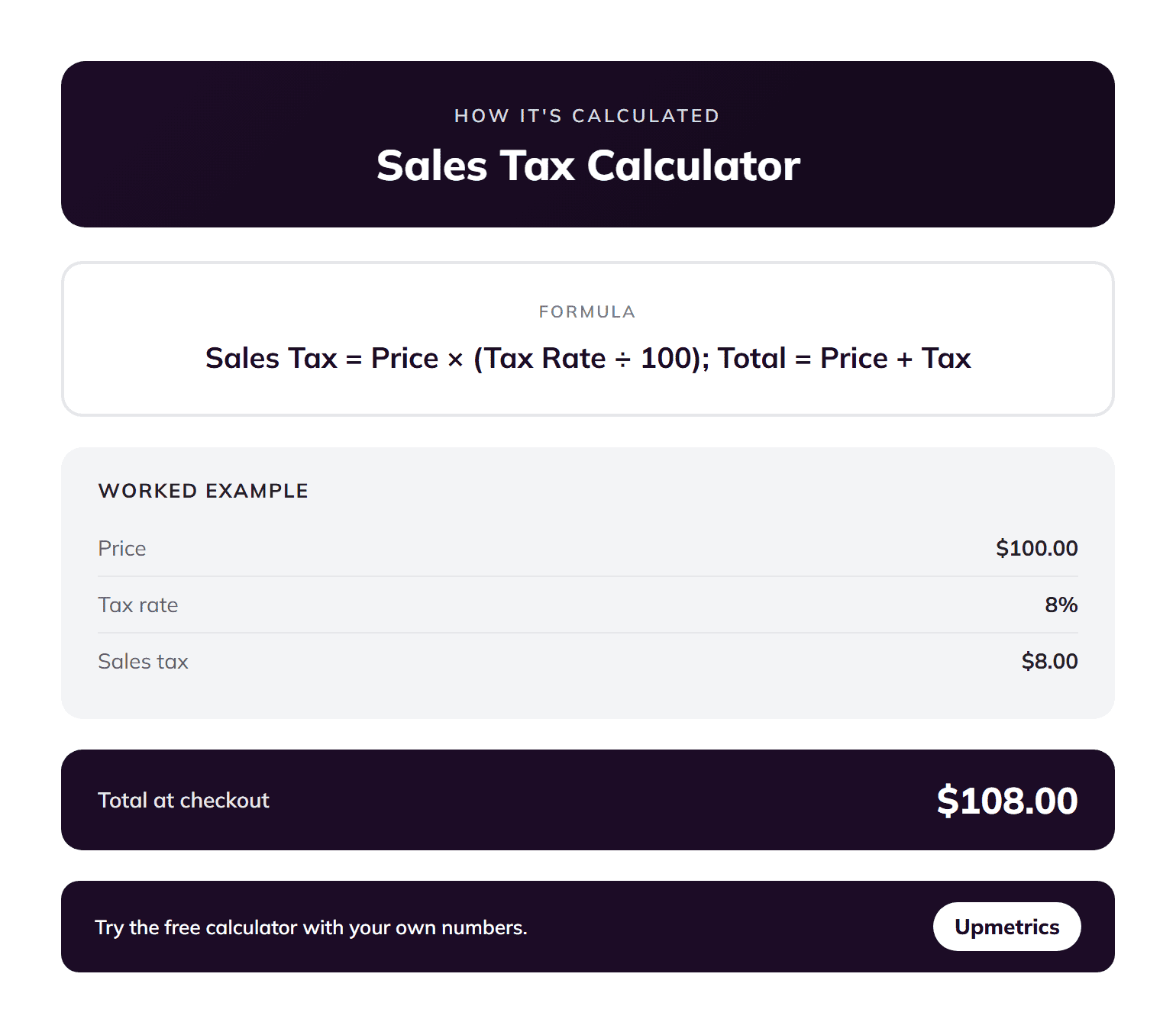
How to use this calculator?
This calculator does two things, switched with the “Price includes tax?” toggle.
1. Adding tax to a price. Leave the toggle off, then put in the product price and the tax rate. The calculator shows the tax amount and what the customer pays in total. Use this when pricing products or writing a quote.
2. Extracting tax from a tax-inclusive price. Turn the toggle on, then put in the total price and the tax rate. The calculator splits it into the pre-tax price and the tax amount. Use this when a price was quoted with tax included and the figures need to go into the books separately.
Retailers use the first most. Bookkeepers use the second when reconciling tax-inclusive receipts.
When do you need to collect sales tax?
Sales tax is collected when a business has a connection to a state. This is called tax presence.
If a business has a physical location in a state, it must collect sales tax there. This includes a store, office, or warehouse. Even storing inventory in a warehouse in that state counts.
For online sales, tax is required once a certain limit is reached. In many states, this starts at $100,000 in sales or 200 orders in a year. After crossing this, the business must register and start collecting tax in that state.
Groceries are often not taxed. Prescription medicines are usually not taxed. Some states also do not tax certain items like clothing. Before collecting tax, check what is taxable in each state where the business sells.