


What does “business valuation” actually mean?
Business valuation means finding out how much a business may be worth if it is sold. It helps owners, buyers, and investors understand the estimated price of the business in the market. The value is usually not one exact number. It is often a range based on factors such as profit, assets, industry conditions, and expected growth.
Two businesses can earn the same revenue but still have different values. Profit levels, number of customers, dependence on the owner, and market demand can change the value.
Revenue shows how much money the business brings in. Valuation shows how much someone may be willing to pay to own the business.
Business value is based on both financial data and market comparisons. Financial data includes earnings, assets, and cash flow. Market comparisons look at what similar businesses have sold for. This calculator gives an estimate using common small business valuation methods.
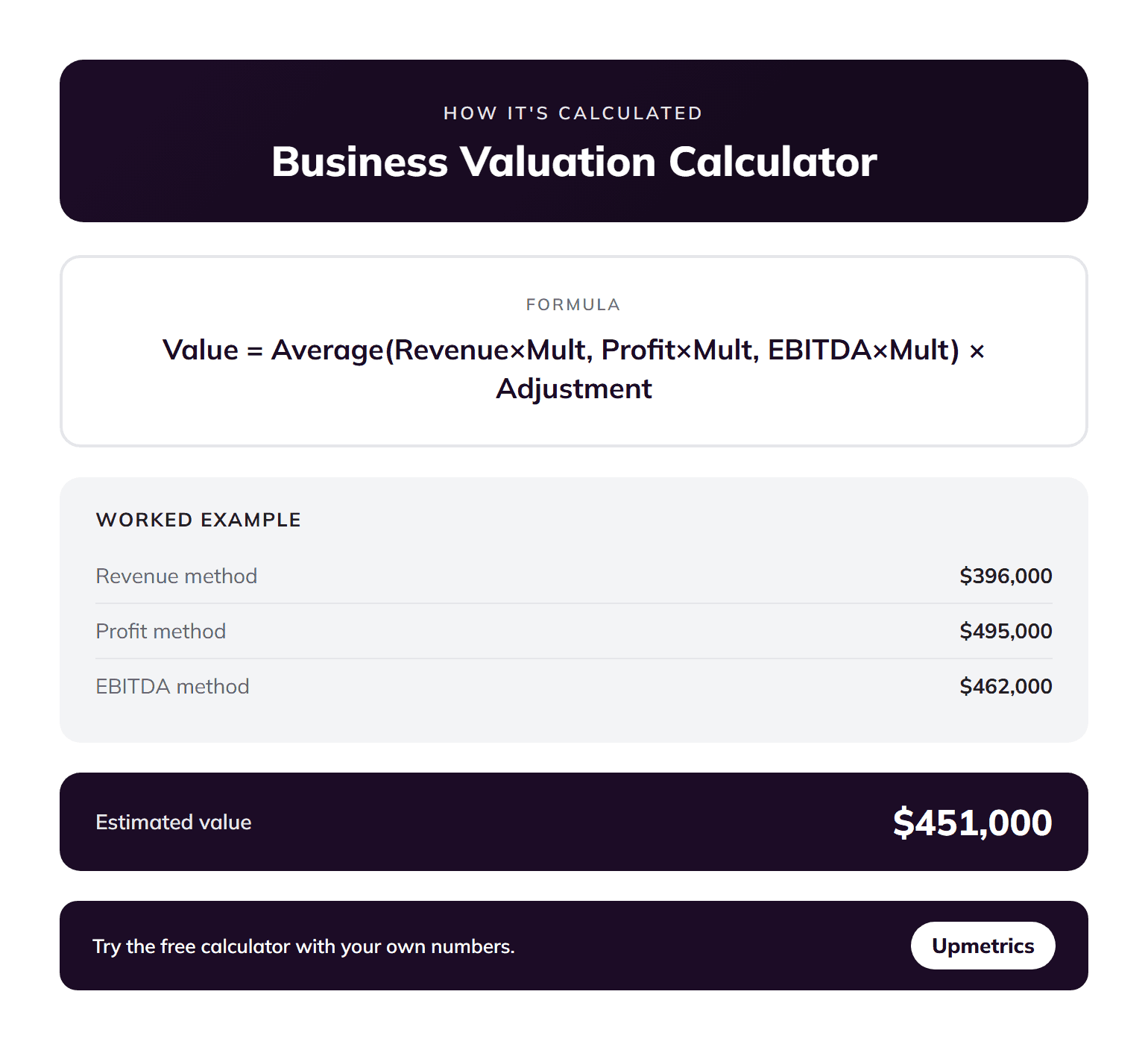
How to estimate your business’s value using this calculator?
The calculator has three steps. Each one asks for a different type of information. Here’s what to enter and what it means.
Step 1: Business financials
Enter three numbers from your business: Annual revenue, Annual net profit, and EBITDA.
Annual revenue is the total money your business brought in over the past year, before any expenses. Annual net profit is what’s left after you’ve paid all your costs. EBITDA is your profit before accounting for interest, taxes, depreciation, and amortization.
Think of it as a cleaner version of profit that makes it easier to compare businesses.
Not sure where to find these? Check your last year’s income statement, or add up 12 months of income and expenses from your bank records.
Step 2: Industry multipliers
A multiplier is basically a number that tells you how much buyers in your industry are willing to pay, relative to what a business earns.
For example, if your profit is $100,000 and the typical profit multiple in your industry is 3x, the estimated value comes out to $300,000. You enter separate multipliers for revenue, profit, and EBITDA.
If you don’t know your industry’s typical range, sites like BizBuySell or DealStats list average sale multiples by business type.
Step 3: Business factors
This step adjusts your valuation based on the bigger picture. Enter your business age, how fast it’s growing, how much it depends on you personally, and where it stands in the market.
The owner dependency piece matters a lot. If the business can’t run without you, buyers will discount the price. Low dependency commands a higher multiple.
Once you fill in all three steps, the calculator shows you three estimates side by side: one based on revenue, one on profit, and one on EBITDA. Use them together to get a realistic range, not just a single number.
Why knowing your value matters (even if you’re not selling)?
Many owners only think about valuation when they plan to sell the business. It is better to understand the value earlier. It helps in several ways.
Assists in decision-making
Knowing the value of your business helps you make better decisions. For example, reducing owner dependency or improving systems can increase the value of your business.
Better position when raising capital
Investors and lenders look at business value before investing or lending money. If you know your value, you can discuss funding with better preparation.
Helps with partnership planning
If a business has partners, valuation helps decide a fair price if one partner wants to exit. Agreeing on a valuation method early avoids conflicts later.
Clear growth target
Valuation gives a clear goal. Instead of saying “grow the business,” you can aim to increase the business value over time by improving profit, growth margin, and stability.
Here’s to note that this calculator gives you an estimate, not a certified appraisal. It’s useful for planning, goal-setting, and early conversations. If you’re actually selling your business or dealing with legal or financial matters, talk to a professional appraiser.