


What is return on invested capital?
ROIC shows how much profit a business earns from the capital used in the business. This includes loans, owner investment, and retained earnings.
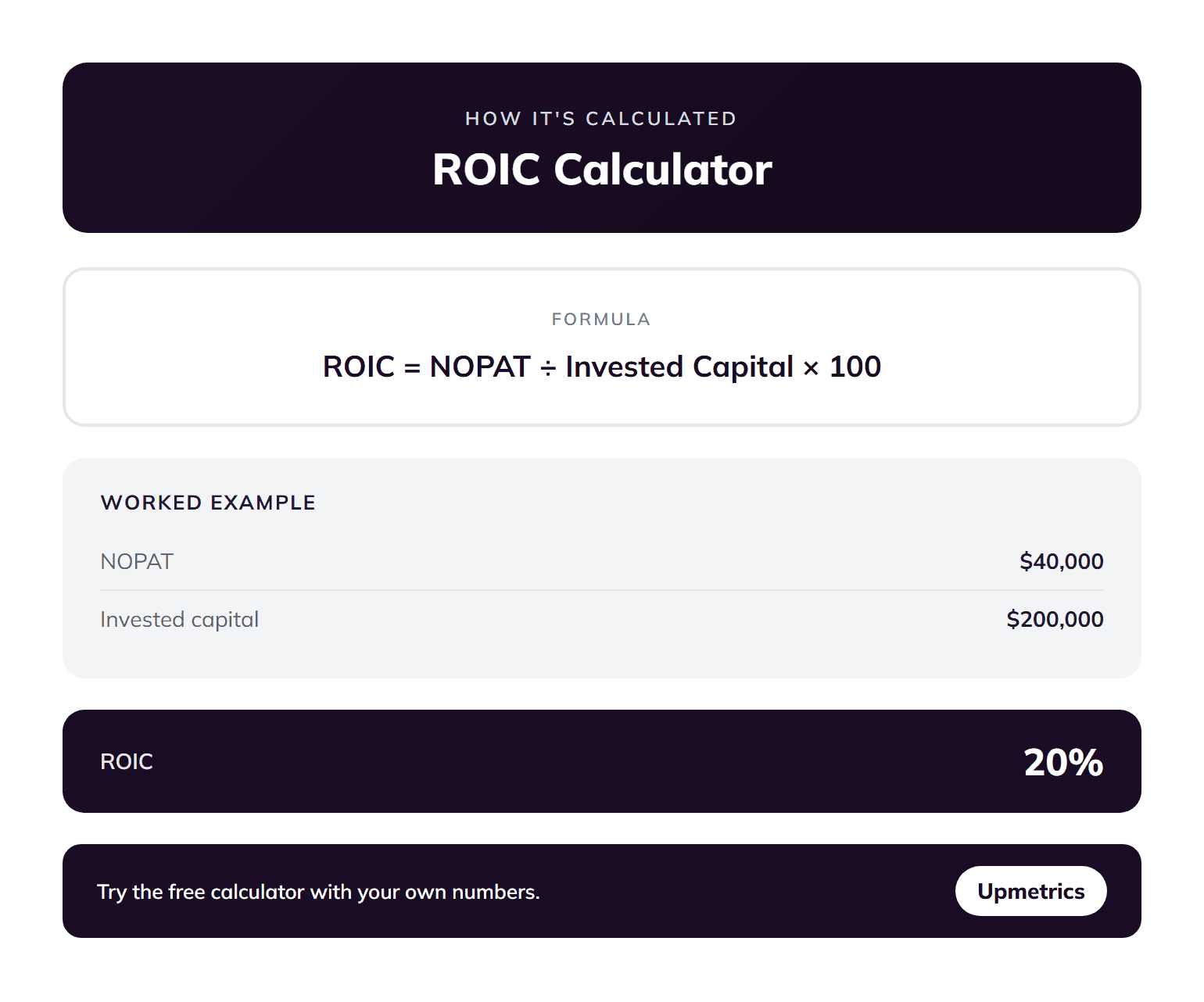
A 15% ROIC means the business earns $15 for every $100 of capital. A 6% ROIC means it earns $6. The higher the ROIC, the more efficiently the business is using its capital.
ROIC is not the same as ROI. ROI measures the return on one specific investment. ROIC measures the return across the entire business. It answers one question: Is the business using all its capital efficiently?
Here is an example. Two manufacturing companies both earn $80,000 in profit. The first has $500,000 in capital. Its ROIC is 16%. The second has $900,000 in capital. Its ROIC is 8.9%. Same profit. The first company is clearly more efficient with its capital.
How to calculate ROIC (and what goes into each input)?
The calculator needs four numbers. Here is what each one means and where to find it.
1. Operating income (EBIT)
Operating income (EBIT) is earnings before interest and taxes. You can find it on the income statement. It reflects profit from core operations, before financing costs and taxes.
Do not use net income. It already includes interest and taxes, which makes comparisons inaccurate.
2. Tax rate
The calculator uses your tax rate to convert EBIT into NOPAT (Net Operating Profit After Tax). NOPAT is profit after tax from operations. Use your effective tax rate, not the statutory rate. For example, $18,000 tax on $100,000 income equals an 18% rate.
3. Invested capital
Invested capital is the money used in the business. Calculate it as total debt plus total equity, minus cash. Cash is excluded because it is not used in operations.
Do not use total assets. They include cash and non-operating items, which can make the number appear higher than it is.
4. Cost of capital (WACC)
This is your weighted average cost of capital, or hurdle rate – what it costs you to raise money through debt and equity combined. It is not part of the ROIC formula itself, but the calculator uses it to tell you whether your ROIC is actually creating value: a ROIC above your WACC means yes, below means the capital is costing more than it earns.
When investors and lenders use ROIC (and why it matters for you)?
When an investor or lender reviews your business, one of the first things they want to know is whether it earns more than it costs to run. ROIC answers that directly.
Investors compare your ROIC to your cost of capital. If your ROIC is 14% and your cost of capital is 9%, the business is creating value. If ROIC is 7% and cost of capital is 9%, the business is destroying value. This is true even if it shows a profit on paper. That gap matters more to investors than the profit number alone.
Lenders look at it differently. They want to see that the business generates enough return to service its debt without difficulty. A steady, improving ROIC shows them the business is using borrowed capital responsibly.
For a business plan or a funding conversation, ROIC is one of the cleaner ways to show you understand your own numbers. It is not just about how much you earn. It is about how efficiently you earn it. If you are building a full financial plan, tools like Upmetrics calculate ROIC automatically as part of your projections.
It’s also worth running this calculator every quarter, not just once. If your ROIC is going up, that’s a good sign. Your business is becoming more efficient over time. If it’s going down even when revenue is growing, your costs are outpacing your returns. The sooner you catch that, the easier it is to fix.