


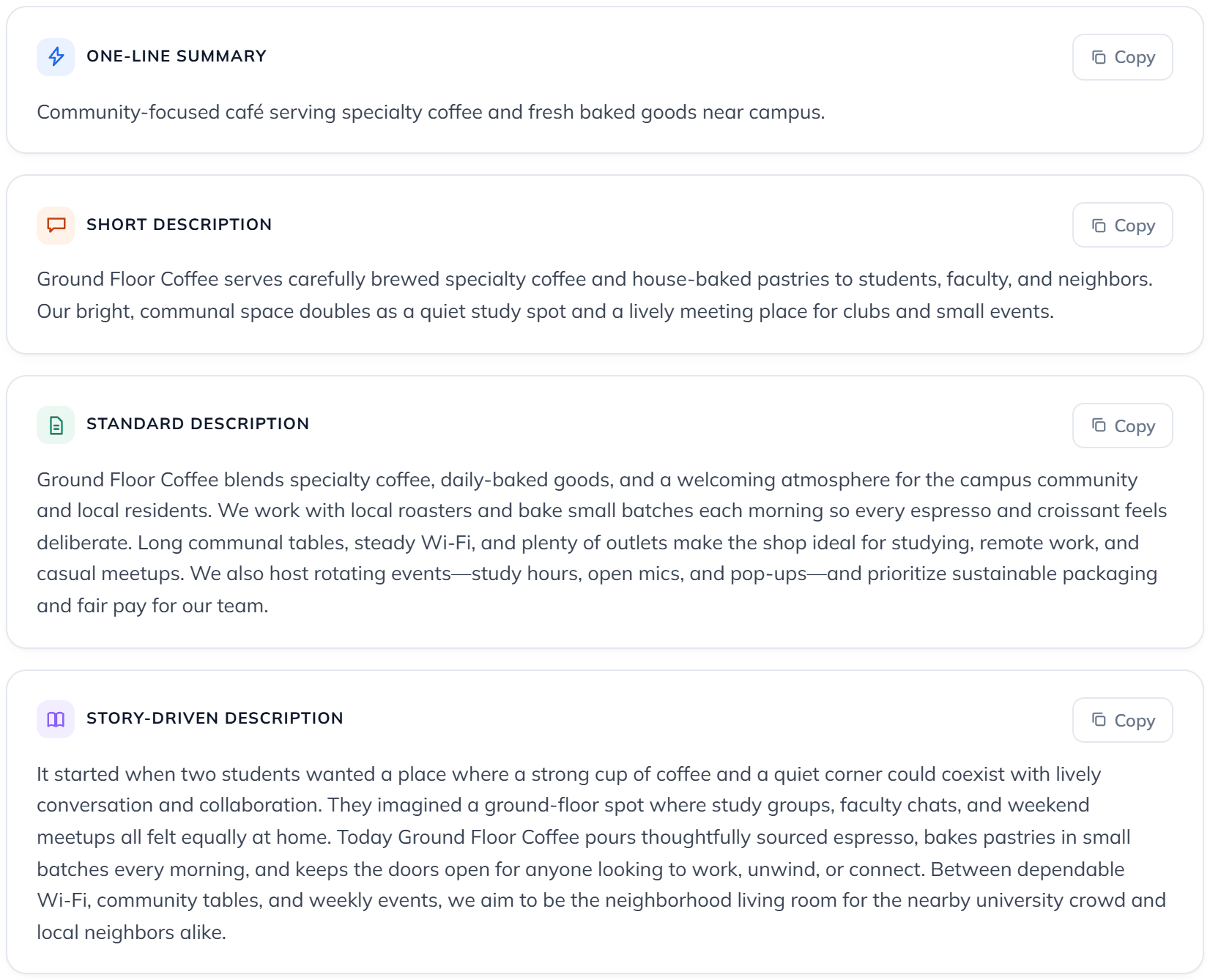
What a business description needs to do
A business description has to work for two different audiences at once: a customer deciding whether to buy, and a lender or investor deciding whether to fund you. Both need the same three things, just with different depth: what you do, who it’s for, and what makes you different.
The common mistake is writing a description that lists features without explaining the outcome. “We offer bookkeeping, payroll, and tax filing” tells a reader what you do. “We handle the financial admin so small business owners can spend their time running the business, not the books” tells them why it matters.
How to use this generator
Describe your business, your target customer, and what sets you apart, in plain language. The more specific the input, the less generic the output. “A bookkeeping service for restaurant owners who hate spreadsheets” will get you a sharper description than “an accounting business.”
You’ll get a draft to edit, not a finished description. Swap in your actual numbers, locations, and specifics; a description with concrete details reads as more credible than one full of general claims.
Where your business description gets used
In a business plan
This is usually the first section a reader sees after the executive summary. It needs to answer “what is this business” clearly enough that someone unfamiliar with your industry understands it in two or three sentences.
On your website’s About page
Here, the description can be warmer and more detailed, including your story and why you started. This is less about proving viability and more about building trust with a customer who’s already interested.
In funding conversations
Lenders and investors read dozens of these a week. A description that gets to the point, states the market clearly, and avoids jargon stands out more than one trying to sound impressive.
Common business description mistakes
Leading with the founding story instead of the business
Save the personal story for later in the pitch. Open with what the business does and who it’s for; readers need that context before the story means anything to them.
Using industry jargon that assumes prior knowledge
A reader outside your industry should still understand what you do. If a description only makes sense to people already familiar with your field, it needs simplifying.
Describing the product instead of the problem it solves
“We make ergonomic office chairs” is a product description. “We make office chairs for people who sit 8+ hours a day and deal with back pain” explains why the product exists. The second version is more persuasive in almost every context.
Once your description is solid, pair it with a clear value proposition that spells out exactly why a customer should choose you, and check it against a competitor analysis to make sure what makes you different is actually true, not assumed.