All 26 pitch deck examples
The decks these companies actually raised on. Each one is reviewed slide by slide on its own page.
Airbnb
Raised $600K · 2008Seven investors, five noes and two who never replied, for $150,000 at a $1.5 million valuation. The deck that came out of that rejection still sets the standard for a problem slide.
Read the full Airbnb breakdownTesla
Raised $192M · 2003Not mass-market cars. A Roadster on a Lotus chassis, built to kill the golf cart stereotype. Every claim arrives with a chart, a contract or a milestone attached.
Read the full Tesla breakdownNotion
Raised $2M · 2013Fewer than ten people and a product already rebuilt more than once. The problem slide was a screen of scattered app logos, which needed no explaining.
Read the full Notion breakdownOpenAI
2015A nonprofit research lab with no product and nothing to sell. The pitch was whether artificial general intelligence could be built safely, and it names its own risks out loud.
Read the full OpenAI breakdownStripe
Raised $4.5BTwo founders at Y Combinator solving a headache developers hated. The cover slide is the company name on a plain background, and the rest is just as restrained.
Read the full Stripe breakdownCanva
Raised $3M · 2012No product, no users, no revenue. A team in Australia with a student yearbook tool behind them, raising $3 million on the strength of the vision alone.
Read the full Canva breakdownDoorDash
Raised $120K · 2013Four Stanford students, a website called PaloAltoDelivery.com, and deliveries they ran themselves between classes. Something small that worked, rather than something large that might.
Read the full DoorDash breakdownUber
Raised $200KAn early deck with a real problem and a plan to solve it, from a company that went public at an $82 billion valuation.
Read the full Uber breakdownFacebook
Raised $500K · 2004TheFacebook.com: no revenue, no business model, and a user base spreading across Ivy League campuses faster than anyone could account for.
Read the full Facebook breakdownSnapchat
Raised $50M · 2011Launched as Picaboo by Stanford students. Photos that vanish, no timeline, no profile. The deck had to make the case that impermanence was the feature.
Read the full Snapchat breakdownAnthropic
2021Founded by researchers who left OpenAI, led by siblings Dario and Daniela Amodei, over concerns that product speed was beating safety. The deck argues that position rather than avoiding it.
Read the full Anthropic breakdownPerplexity
Raised $25M · 2022An answer engine taking on a search giant. Large language models plus live web search, returning cited answers instead of ten blue links.
Read the full Perplexity breakdownFigma
Raised $3.8M · 2012Field and Wallace met at Brown. A Thiel Fellowship funded a drone company first. The better idea came second, which happens more often than founders admit.
Read the full Figma breakdownSpotify
2006Piracy ruled and iTunes wanted $0.99 a song. Spotify had to argue that a legal service could be faster and cleaner than stealing.
Read the full Spotify breakdownNetflix
Raised $30M · 1998A bet on DVDs when barely one percent of American households owned a player. 925 titles, delivered by post, with no late fees.
Read the full Netflix breakdownLinkedIn
Raised $10M · 2003Friendster had buzz and MySpace ruled. Reid Hoffman and four co-founders argued there was no network for the professional half of your life.
Read the full LinkedIn breakdownYouTube
Raised $3.5M · 2005Weeks old at the time. A basic site that let people upload video and watch it in Flash, pitched by three engineers straight out of PayPal.
Read the full YouTube breakdownDropbox
Raised $1.2MCloud storage was not mainstream. People emailed files to themselves or carried flash drives. The insight was that this was not a niche problem but a universal one.
Read the full Dropbox breakdownIntercom
Raised $600K · 2011Four founders, four years running a different company, and a category that did not exist yet. At the time this went out, Intercom was an idea and a beta.
Read the full Intercom breakdownMixpanel
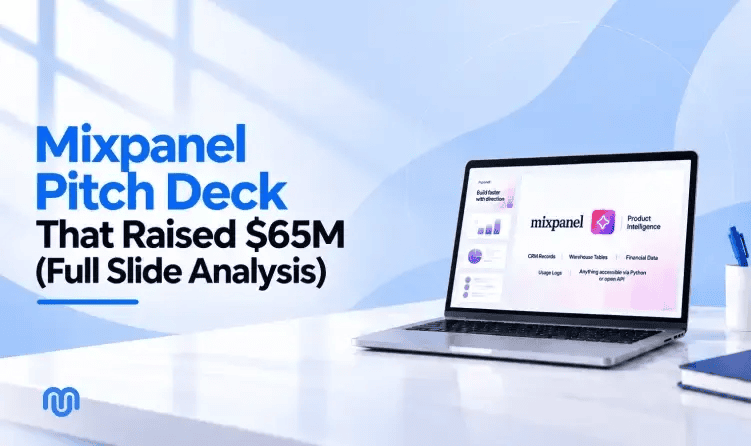
Raised $65M · 2009Event analytics before event analytics was normal, counting what people did instead of how many pages they loaded. Traction later carried a $10.25 million Series A led by Andreessen Horowitz.
Read the full Mixpanel breakdownElevenLabs
2022Two friends from Poland, one out of Google machine learning and one out of Palantir, united by badly dubbed film. A deck that sells one specific irritation.
Read the full ElevenLabs breakdownBrex
2017They entered Y Combinator building virtual reality and left building corporate cards. The pivot is visible in the deck, and it is the most useful part of it.
Read the full Brex breakdownTinder
2012Before the swipe there was a thumbs up. The rule that you only match when both people say yes, so a rejection never stings, was the whole product and later a patent.
Read the full Tinder breakdownBuffer
Raised $500K · 2010Joel Gascoigne built a landing page to test demand before writing a line of code. The deck carries that discipline: validate first, then build, then pitch the evidence.
Read the full Buffer breakdownNot a real fundraise. Kawasaki's 10-slide framework is the blueprint most decks end up measured against, which makes it worth reading as a rubric rather than a story.
Read the full Guy Kawasaki breakdownPeloton
2011Not the polished 23-slide deck that circulates online. This is a rougher set of roughly 16 slides that surfaced through a legal filing, from before Peloton was formally a company.
Read the full Peloton breakdown






Every deck on this page is real. These are the slides Airbnb, Tesla, OpenAI, Stripe and twenty-two others actually put in front of investors, with a full slide-by-slide review of each one.
They are worth studying because most of them are not impressive to look at. Canva pitched with plain slides and no product. Stripe’s cover slide is the company name on a blank background. What they have in common is not design. It is that an investor could follow the argument.
What is a pitch deck?
A pitch deck is your first step toward securing financial backing and partnerships. It’s a short presentation introducing your business plan, important metrics, and vision to potential investors or clients. The goal is to capture the audience’s attention and encourage them to take the next step with you.
Most successful startups use a hard and fast rule: Keep it simple and focus on key metrics. A good pitch deck typically consists of a few key elements, including the traction slide, solution slide, and competition slide, summarizing your financial projections and showcasing your competitive landscape. Each slide plays a role in bringing your business to life.
It answers the big questions like: What makes your business idea so unique? Why is now the right time for your business? Why should potential investors believe in your business idea?
Now that we’ve covered what a pitch deck is, let’s explore some of the winning pitch decks that will help you impress investors.
What the best pitch decks have in common
Reading all twenty-six back to back, the same handful of things keep showing up. None of them are about how the slides look.
They make the problem felt, not described
Notion’s problem slide was a screen of scattered app logos. No copy, no explanation, and anyone who has juggled four tools understood it instantly. Dropbox made a similar move by arguing that emailing files to yourself was not a niche annoyance but something nearly everyone did. The weakest problem slides describe a problem. The best ones make you recognise your own week.
They show something already working
DoorDash pitched with a single scrappy website and deliveries the founders were running themselves between classes. That is a small thing, but it was real, and it beat a larger thing that might work later. Tesla did the same at a different scale, backing claims with charts, contracts and milestones rather than ambition alone.
They answer the obvious objection before it is asked
A new carmaker will be asked about manufacturing. Tesla’s deck got there first. OpenAI, pitching a research lab with no product, named privacy, bias and transparency out loud instead of managing around them. Raising the hard question yourself reads as confidence. Waiting for it reads as a gap you had not noticed.
Design does not rescue a weak argument, and plainness does not sink a strong one
Canva had no product, no users and no revenue, and raised three million dollars with slides that were nothing special to look at. The lack of polish made the pitch feel honest. Meanwhile plenty of beautiful decks raise nothing at all, because a clear narrative is the thing being bought, and decoration cannot supply one.
Rejection is the normal case
Airbnb approached seven investors for one hundred and fifty thousand dollars. Five said no and two never replied. Peloton’s early deck was turned down by close to three thousand people. Both companies are now used as examples of great pitching, which should tell you something about how the examples were made.
How do you create a pitch deck for your startup?
Every great startup begins with a story, and your startup pitch deck is the key tool that tells yours. Whether it’s your first time creating your own pitch deck or an updated version, building one that highlights your value proposition and addresses the target market is important.
Luckily, you don’t need to reinvent the wheel. Here are two ways to create a good pitch deck and impress potential investors.
1. AI-powered pitch deck builder
Artificial Intelligence (AI) has introduced significant advancements across industries, including how you create investor pitch decks. With an AI pitch deck generator, entrepreneurs can design stunning, professional decks that clearly communicate their vision to investors.
Here’s what an AI pitch deck generator can do:
- Offers pre-designed templates for essential slides like problem, solution, traction, and financial projections, ensuring your pitch deck is well-structured and impactful.
- Creates a polished, visually appealing deck that convinces investors without needing a professional designer or advanced design skills.
- Ensures your deck addresses investor priorities by including key elements like your value proposition, target audience, competitive advantage, and market opportunity.
- Provides a collaborative space for multiple stakeholders to contribute and refine the pitch deck easily.
- Gives intelligent recommendations to enhance your content, ensuring clarity, conciseness, and relevance to your audience.
- Integrates financial projections, market analysis, and other data into your slides and makes visually appealing graphs and charts for better investor engagement.
However, if you don’t want to use an AI-powered pitch deck generator, there’s another alternative, i.e., free pitch deck templates.
2. Free investor pitch deck templates
If you’re worried about how much pitch deck design costs, you can go for this option. Free pitch deck templates are a fantastic way to get started if you’re looking for a structure without spending money.
These templates come with pre-designed slides like the problem slide, solution slide, and financial projections, giving you a solid foundation.
Why consider using free pitch deck templates?
- Cost-effective: Free pitch deck templates are ideal for startups with limited budgets, providing a professional framework without additional costs.
- Built-in structure: Pitch deck templates ensure your pitch deck includes all the critical elements potential investors expect, helping you stay organized.
- Customizable: You can tweak the pitch deck template as per your brand identity, tailoring the design and tone to suit your audience.
However, with pitch deck templates, all the work of customizing content and design falls on you. This method is cost-effective but time-intensive, requiring significant effort to align the presentation with your brand and story.
Start preparing your investor pitch deck
A great pitch deck is the story of your business and the people behind it. Your pitch deck also evolves with your company. As you grow and prepare for future funding rounds, you can use the successful decks we discussed as a foundation to refine and build an investor deck.
But it all starts with clarity, strong design, and concise content to make the right impression now. And Upmetrics helps you do just that. Our AI deck generator streamlines the process of creating investor-ready presentations. Auto-generate sections, integrate data from your business plan seamlessly, and present with confidence using our intuitive pitch builder.
Let Upmetrics help you craft a pitch that sets you apart.
Prepare Your Pitch Decks in Less Than an Hour with Our
AI Pitch Deck Generator
Plans starting from $14/month