


Something I hear from founders more often than you’d think…….
“Business is doing well. Revenue is up. My accountant isn’t worried. But cash is tight this month, and I don’t know why.”
The answer is almost always the same. And simpler than most founders expect.
A business can be profitable and broke at the same time. Happens more often than people realize, and the reasons are almost always hiding in plain sight.
Here’s what most founders miss
Profit and cash aren’t the same number.
Profit is what you’ve earned on paper. Cash is what’s actually in your account. When they drift apart, you don’t notice until payroll Friday and the bank account is short.
Mostly it’s a timing thing. On your P&L, revenue can show up the moment you’ve earned it. The customer pays whenever they feel like it.
Stretch that across a few clients, some inventory, one hire made too early… and a profitable business can run dry fast.
None of this makes profit unimportant — a business that consistently spends more than it makes has a different (and bigger) problem. But that’s not this problem.
We’ve broken down cash flow vs profit in more detail right here, with a practical example so you can see exactly how the two numbers diverge
So where’s the cash actually going?
Honestly? A lot of places. Taxes, loan payments, equipment, that software subscription nobody remembers signing up for.
But three situations catch founders off guard more than the rest.
1. Your revenue lands on paper before the money lands in your bank
You finish $20,000 worth of work for a client in January. Send the invoice. Your P&L celebrates.
Client pays on March 30th. After a follow-up. And a second follow-up. And one slightly awkward reminder.
For 75 days, you looked profitable and had none of that money.
Do that with three or four clients on net-60 terms, and you’re running the business on money that hasn’t shown up yet.
What to do: shorten payment terms, ask for deposits upfront, and chase overdue invoices.
2. Inventory eats your cash long before it sells
If you sell physical products, this one’s brutal.
You place a $40,000 order. Pay upfront. That $40K sits on your balance sheet as inventory. But the cash? Already gone.
Some of it sells fast. Some sits for months. A little bit never moves.
What to do: watch how fast your inventory turns, not just how much you’re holding.
3. Growth costs money before it makes money
This one’s sneaky, because it usually shows up when things are actually going well.
You land a bigger client. Hire someone to handle the workload. Hire starts in April. Client pays in June.
Between April and June, you’re paying a full salary against revenue that hasn’t arrived.
Same with a new location. New equipment. A marketing push. Growth almost always costs cash upfront and returns it later. Sometimes… much later.
What to do: before you spend to grow, check that your cash can cover the gap until the growth pays for itself.
This is why forecasting matters
Everything above is only a problem if it catches you off guard.
If you can see the crunch coming, three weeks or two months out, you have time to do something about it. Push a hire back. Renegotiate a supplier term. Chase the late invoice a week earlier.
But if you’re only looking at your P&L and your bank balance, you’re driving using the rearview mirror.
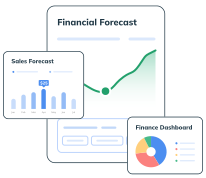
A cash flow forecast changes that. It plots out what’s coming in, what’s going out, and when, so you can see the gaps before they hit. Even a rough spreadsheet forecast beats no forecast.
If you’d rather not build one from scratch, Upmetrics has cash flow forecasting built in, separate from your P&L. It maps your expected inflows and outflows week by week, so a shortage shows up in your forecast long before it hits your bank account.
In a nutshell
Watch your cash. Not instead of profit. Alongside it.
The founders sleeping well aren’t the ones with the biggest margins. They’re the ones who know what’s in the account today, and what’s landing on Friday.
Until the next time,
Happy business planning 🙂

Vinay Kevadia
Vinay Kevadiya is the founder and CEO of Upmetrics, the #1 business planning software. His ultimate goal with Upmetrics is to revolutionize how entrepreneurs create, manage, and execute their business plans. He enjoys sharing his insights on business planning and other relevant topics through his articles and blog posts. Read more
