Starting and expanding an accounting firm takes more than technical expertise. As clients increase, the business will need to invest in professional office infrastructure, accounting technology, and additional staff to service more clients while growing the firm, which requires more than technical expertise.
When seeking financing for expansion, lenders expect to know about the firm’s current operation, client base, revenue model, whether it is recurring or not, and how additional staff and office capacity will lead to measurable growth.
Here’s a sample plan of FutureBooks Accounting Services to guide you. It’s a Denver-based accounting firm that is expanding from a home-based practice into a professional office with additional staff.
This example shows how an accounting business can present its operations, financial structure, and growth plan in a clear and practical format for lenders.
Accounting & Bookkeeping Business Plan (FutureBooks Accounting Services)
Executive Summary
FutureBooks Accounting Services is an accounting and bookkeeping company at 2045 Midtown Boulevard, Suite 102, Denver, Colorado. The firm is owned and managed by James Peterson, CPA, who has over ten years of experience in financial management services for small businesses.
FutureBooks started as a home-based accountancy practice that was serving local companies over cloud accounting platforms. Over the past 3 years, the business has built a stable base of 15 active clients, small business clients providing bookkeeping, payroll processing, tax preparation, as well as financial advisory support clients. Most clients use the firm for recurring monthly service agreements, which make for constant revenue and long-term working relationships.
The firm’s approach integrates practical bookkeeping support with financial guidance at the CPA level to enable small businesses to keep financial records straight and also help them with tax planning, budgeting, and financial reporting. This combination offers a level of professional oversight that is difficult for many small businesses to justify through a full-time internal accounting team.
As the client base has grown, demand for services has reached the operational limits of a single-person home practice. The next stage of development is the transition of the firm into a professional office setting and adding more service capacity through the hiring of staff accountants. This expansion will help the business to provide services to a larger number of clients while still maintaining the quality of service and timeliness of financial reporting.
Demand for outsourced accounting services is increasing as more small businesses adopt cloud accounting systems and rely on external financial professionals rather than maintaining in-house accounting teams. According to the U.S. Bureau of Labor Statistics, employment of accountants and auditors is projected to grow by about 5% from 2024 to 2034, reflecting steady demand for financial reporting, tax compliance, and financial management services among businesses.
FutureBooks fills this need by offering CPA-led accounting services backed by cloud-based financial systems in which clients can keep financial records up-to-date while receiving continuous financial advice.
For expansion, the firm seeks $250,000 of capital.
| Source | Amount (in $) |
| Small Business Term Loan for 5-yr at 7.25% (Wells Fargo Bank, N.A.) | 200,000 |
| Owner Equity Contribution | 50,000 |
| Total Funding | 250,000 |
The financing will be used to lease and equip a professional office, implement accounting technology infrastructure, hire accounting staff, and provide support to the working capital during the expansion phase.
The expansion is projected to increase the firm’s client capacity from 15 active clients to approximately 45 clients in the first year of expansion, with further growth as additional accounting staff are hired. Based on projected service fees and client growth, the business expects to generate sufficient operating income to support loan repayment while maintaining stable cash flow.
Company Description
Business Legal Structure
FutureBooks Accounting Services is a single-member Limited Liability Company (LLC). The business is registered with the Colorado Secretary of State and has all of the state and local business registrations necessary for providing accounting and bookkeeping services in Denver, Colorado.
As a licensed Certified Public Accountant, the owner follows the professional rules and license requirements set by the Colorado State Board of Accountancy. The firm adheres to relevant financial reporting standards and tax compliance practices that are mandated in the field of professional accounting services.
In order to both protect the business and its clients, FutureBooks has professional liability (errors and omissions) insurance, which includes accounting and advisory services. The firm also carries general business insurance suitable for professional service operations.
Location and Operational Advantages
The firm is based at 2045 Midtown Boulevard, Suite 102, Denver, Colorado 80204. It is a commercial business district that serves many local companies and professional offices throughout the Denver metro area. This location allows it to meet clients in person when needed while continuing to work remotely with many clients through cloud accounting platforms.
Ownership
James Peterson owns 100% of the company. He is a Certified Public Accountant with more than 10 years of experience working with small businesses. He handles client relationships, offers financial advice, and oversees the day-to-day work of the firm. As the company expands, he will continue to handle advisory duties, oversee staff accountants, and drive the company’s general growth.
Mission and Vision
FutureBooks Accounting Services’ mission is to provide accurate bookkeeping, reliable financial reporting, and actionable financial advice to small businesses so that they can be organized, compliant, and make good financial decisions.
The firm’s vision is to establish itself as a respected accounting firm in the Denver area that helps local small businesses maintain financial stability through service dependability and long-term client relationships.
Business Model
FutureBooks operates as a service-based accounting firm built on recurring client relationships. Revenue is generated through a combination of monthly service retainers and periodic engagements.
Primary revenue sources include:
- Monthly bookkeeping services for ongoing financial record management
- Financial advisory services, including budgeting, forecasting, and tax planning
- Payroll processing services for small business clients
- Tax preparation and filing for individuals and small businesses
This mix of recurring monthly services and seasonal tax work provides consistent cash flow throughout the year.
Business Goals
FutureBooks Accounting Services has established clear growth targets for the first three years of expansion.
- Year 1: From an office at home to a professional office, and then increase the number of clients to about 45 clients. Hire 2 staff accountants and part-time administrative assistants to help with day-to-day operations.
- Year 2: Grow the client base to approximately 69 clients and add additional advisory services. Hire a third staff accountant midway through the year, and hit the break-even point of around 56 active clients.
- Year 3: Grow to about 87 clients, with four accountants and administrative assistance, and build the firm into a consistent business for small businesses in the Denver area.
These goals center on steady growth, maintaining high quality of service, and creating a reliable client base through regular bookkeeping and advisory relationships.

Service Offerings
FutureBooks Accounting Services provides a set of accounting and financial support services designed for small businesses, freelancers, contractors, and startups. The firm focuses on recurring accounting support combined with advisory services that help clients maintain organized financial records and manage their businesses more effectively.
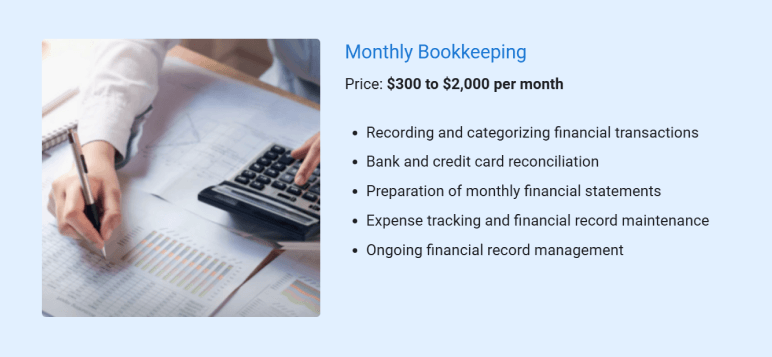
Monthly Bookkeeping
Monthly bookkeeping services are for small businesses that need consistent management of their financial records but prefer to outsource routine accounting tasks rather than maintain an in-house accounting function.
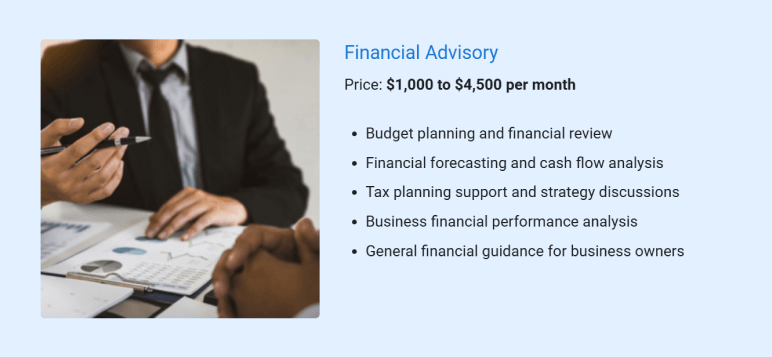
Financial Advisory
Financial advisory services are intended for business owners who want guidance in understanding their financial performance and making informed decisions for their businesses.
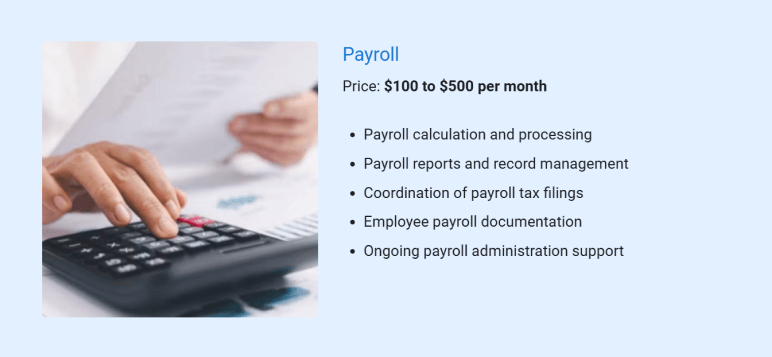
Payroll Services
Payroll services are offered for small businesses that employ staff and need reliable payroll processing while avoiding the administrative burden of handling payroll internally.
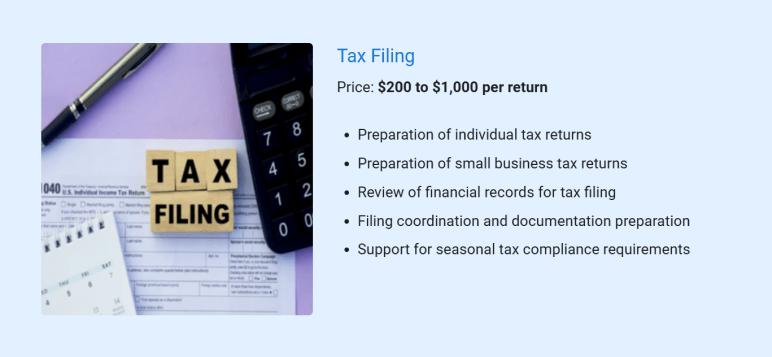
Tax Filing Services
Tax filing services are provided for individuals and small businesses that require assistance preparing and submitting their tax returns in compliance with federal and state requirements.
Use of Technology and AI Tools
To ensure that efficiency is maintained as the client base increases, FutureBooks will utilize cloud-based accounting software with AI-assisted tools used to automate routine financial tasks.
It includes:
- Automated categorisation of transaction
- Extracting receipt and invoice information from uploaded documents
- AI-assisted reconciliation of financial transactions
- Automated financial reporting dashboards
These tools reduce manual data entry and allow staff accountants to focus on financial review, reporting accuracy, and client advisory support.
By combining technology automation with CPA oversight, FutureBooks can oversee a larger client base while ensuring reliable financial reporting and timely financial support for small businesses.
Pricing Strategy
FutureBooks Accounting Services will implement a service-based pricing model geared to meet the needs of small businesses in various stages of growth. Instead of having one fixed fee for services, pricing will be based on the scope of accounting support that each client requires.
Monthly service plans will generally involve bookkeeping, payroll support, financial reporting, and periodic advisory guidance. Pricing will depend on other factors like the size of the business, transaction volume, the number of employees, and the complexity of financial reporting.
Typical pricing is:
- Basic bookkeeping services: $400 – $800
- Bookkeeping with payroll support: $800 – $1,500
- Full accounting support and advisory services: $1,500 – $4,500
This pricing structure allows the business to start with basic bookkeeping services and expand its service package as the operations grow. It also provides predictable monthly revenue for the firm while ensuring clients receive ongoing financial support.
Market Analysis
Denver Small Business Landscape
FutureBooks Accounting Services operates in a market where small businesses form the backbone of the local economy. Colorado has over 730,887 small businesses, which account for approximately 99.5% of all businesses in the state, and these businesses employ approximately 1.2 million workers. This huge base of small companies provides steady demand for bookkeeping, payroll services, and tax preparation services.
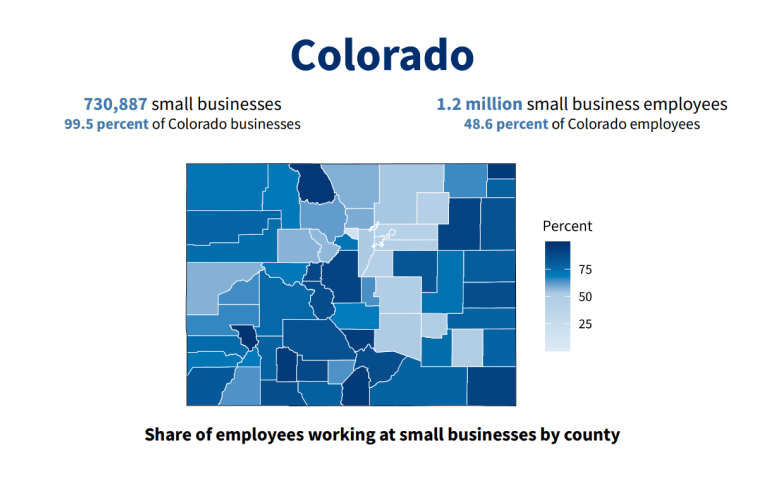
Due to the mid-sized team of many small firms, they frequently outsource their accounting instead of hiring full-time financial personnel. This leads to constant demand for bookkeeping, payroll, and tax services offered by companies such as FutureBooks.
Record-High Business Formation and “Good Standing” Volume
As of January 2026, the number of Colorado businesses in “good standing” has surpassed 1 million for the first time in state history. New business registrations in Q4 2025 have grown by 4.5% year-on-year, and the 12-quarter rolling sum of new entity filings is up 9.7%.
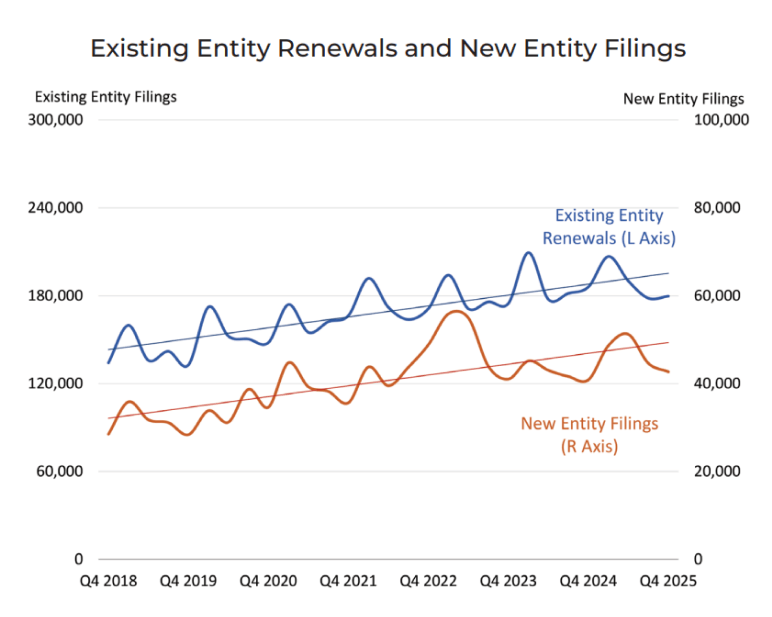
This sustained business formation leads to an increased pool of companies that need accounting, tax compliance, and financial reporting services.
FutureBooks can focus on newly registered businesses that need to establish organized bookkeeping systems, payroll setup, and compliant financial reporting from the start of their operations.
Market Size and Opportunity
The accounting services market available to FutureBooks can be understood through three levels of opportunity.
(1) Total Addressable Market (TAM)
As mentioned earlier, Colorado’s 730,000+ small businesses represent the broad market for bookkeeping, payroll, and tax services.
(2) Serviceable Available Market (SAM)
FutureBooks focuses on small businesses located in the Denver metropolitan area, which includes approximately 100,000+ small businesses across sectors such as professional services, construction, retail, and technology.
This represents the portion of the total market that the firm can realistically serve based on its geographic location and service focus.
(3) Serviceable Obtainable Market (SOM)
From this market, FutureBooks targets a small, realistic share based on its current capacity and expansion plan.
Following expansion, the firm expects to serve approximately 45 active clients, up from 15 currently. This represents less than 0.05% of the Denver small-business market, reflecting a conservative and achievable client acquisition strategy during the initial growth phase.
Local Tax and Compliance Complexity
Denver businesses operate in a layered tax environment of state taxes, local city taxes, and industry-specific requirements. For instance, businesses located in the state of Denver are subject to the Occupational Privilege Tax (OPT), which taxes employers who have employees earning at least $500 per month on a monthly basis, and withhold a percentage of the employee’s wages.
Colorado also uses a destination-based sales tax system, where tax rates depend on the location where goods or services are delivered rather than where the business is located.
Combined state and local sales tax rates are around 11.2%, depending on the jurisdiction, and create additional record-keeping requirements for businesses operating in multiple jurisdictions.
Because Denver businesses must cope with multiple tax rules, payroll requirements, and financial reporting obligations, many small companies use professional bookkeeping and accounting support to keep abreast of compliance. FutureBooks can help these businesses keep accurate records, track payroll taxes, and prepare financial records required for tax filings and compliance with regulations.
Target Market
The firm serves business owners who want to outsource accounting processes to free up their time to focus on operations and growth and rely on a professional service provider. These businesses generally require persistent bookkeeping, payroll administration, tax preparation, and financial reporting support to keep exact records and satisfy control demands.
Primary target segments include:
- Small business with 1-20 employees in service industries
- Freelancers and independent professionals needing bookkeeping and tax advice
- Startups and early-stage companies setting up financial systems and reporting structures
- Service-based industries like consultants, marketing agencies, contractors, and real estate professionals
These segments usually need accounting services on an ongoing basis and place value on ongoing financial guidance as their businesses grow.
Competitive Positioning
FutureBooks Accounting Services focuses on small and growing businesses that require reliable bookkeeping along with professional CPA oversight, positioning the firm between large accounting firms and basic bookkeeping providers.
| Competitor | Competitor Type | Core Services | Typical Clients | Market Position |
| EKS&H (Plante Moran) | Direct | Tax planning, advisory, and accounting services | Mid-sized businesses and established companies | Large regional CPA firm with higher pricing |
| Anton Collins Mitchell LLP | Direct | Accounting, tax, and advisory services | Businesses and high-net-worth individuals | Established CPA firm with broad service offerings |
| Gordon, Hughes & Banks LLP | Direct | Accounting, tax, and consulting services | Businesses and professional firms | Full-service accounting firm serving regional clients |
| Bench Accounting | Indirect | Online bookkeeping services | Small businesses nationwide | Technology-driven bookkeeping platform |
| QuickBooks Live | Indirect | Remote bookkeeping support | Small businesses using QuickBooks | Software-based accounting support |
| Independent Local Bookkeepers | Indirect | Basic bookkeeping services | Small businesses and freelancers | Lower-cost service providers |
| In-House Bookkeeping | Indirect | Internal accounting management | Established small businesses | Businesses managing accounting internally |
Competitive Edge of FutureBooks
FutureBooks Accounting Services stands out because of the professional accounting experience and easy services offered specifically for small businesses.
Key competitive advantages are:
- CPA-led service model providing professional financial guidance beyond basic bookkeeping
- Integrated services including bookkeeping, payroll, tax preparation, and advisory support
- Local presence in Denver for in-person consultations and better client relationships
- Use of cloud accounting systems, which offer real-time financial visibility to clients
Marketing & Sales Plan
FutureBooks Accounting Services will increase marketing efforts as the business moves from a home office to a professional office with more staff.
Brand Positioning
FutureBooks Accounting Services will be positioned as a financial partner for small businesses in a practical manner. It will concentrate on reliability, clarity, and accessibility.
Rather than providing complicated corporate-level accounting services, FutureBooks will focus on easy-to-understand financial management suited to growing businesses that need to have record-keeping in place and reliable financial advice.
Key positioning elements include:
| Brand Attribute | Meaning for Clients |
| Practical financial support | Clear bookkeeping and reporting that helps owners understand their finances |
| CPA-led expertise | Professional oversight from a licensed accountant |
| Small business focus | Services designed specifically for smaller companies |
| Long-term partnership | Ongoing support rather than one-time transactions |
Local Search and Demand Capture
FutureBooks will strengthen its visibility in local search results so businesses looking for accounting services in Denver can easily locate the firm. It will focus on appearing in local online search results across the Denver area for queries such as:
- CPA Denver
- small business accountant Denver
- bookkeeping services Denver
- payroll services Denver
To get this visibility, the firm will maintain a fully optimized Google Business Profile with accurate business information, office location, services offered, and client reviews.

The company website will also have dedicated pages that will describe each service, which helps the search engines link the firm with relevant searches.
FutureBooks will also have consistent business listings across trusted business directories and professional platforms, to make it easy for potential clients to find and verify the firm online.
In addition to service-based searches, the firm will publish practical resources related to common financial tasks that business owners are facing (such as the need to set up bookkeeping systems, prepare financial records for tax filing, or understand payroll requirements in Colorado).
Professional Referral Network
FutureBooks will build working relationships with professionals who regularly engage with small businesses to receive introductions to business owners who already need accounting support.
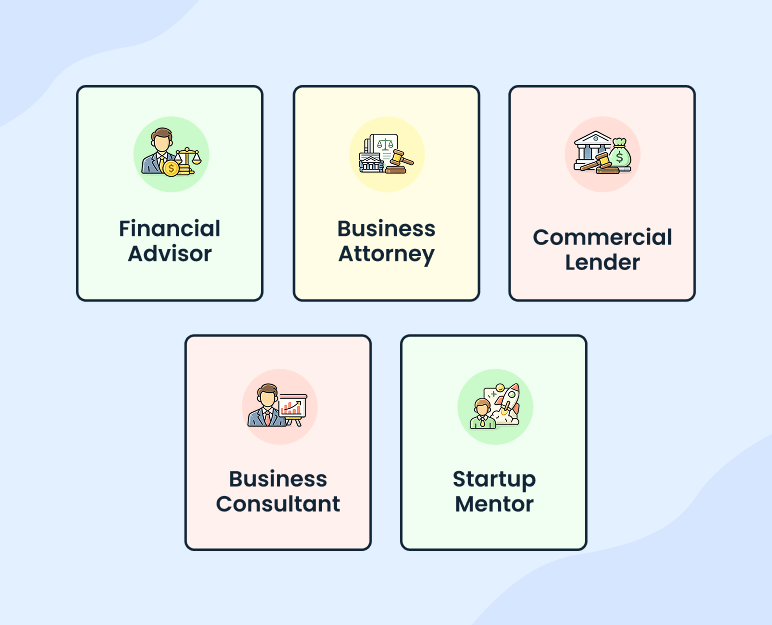
Over time, these relationships can be a constant source of new clients because business owners often look to their trusted advisors to choose an accounting firm.
Community Networking and Local Visibility
The move to a professional office opens up opportunities for FutureBooks to be more involved in the local business community in Denver. The firm owner, James Peterson, will attend networking events, engage in professional associations, and host occasional educational sessions for small business owners.
Key activities include:
| Activity | Purpose |
| Participation in local business networking events | Build relationships with small business owners |
| Membership in chambers of commerce and professional groups | Increase visibility within the local business community |
| Attendance at startup and entrepreneur meetups | Connect with early-stage businesses that need financial guidance |
| Educational sessions for small business owners | Share practical accounting knowledge while introducing services |
Client Retention and Long-Term Relationships
FutureBooks will focus on consistent communication and reliable service to ensure that clients stay satisfied and continue to use the firm’s services as their businesses grow.
Clients will get frequent financial reports that can help them understand their business performance, such as income summaries, expense tracking, and cash flow reporting. Periodic review meetings will also provide an opportunity for the firm to address financial trends, future tax obligations, and potential improvements in financial management.
As client businesses grow, often the need for their accounting grows as well. By maintaining strong relationships and reliable service, FutureBooks can continue to support these clients with additional services such as payroll management, advisory support, and tax planning.
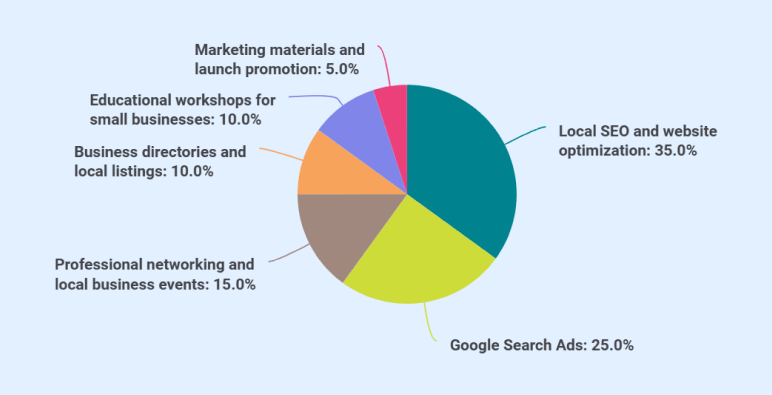
Marketing Budget Allocation
FutureBooks will allocate approximately $10,000 for its initial marketing launch campaign as the business transitions from a home-based practice to a professional office.
| Channel | Budget Allocation |
| Local SEO and website optimization | $3,500 |
| Google Search Ads | $2,500 |
| Professional networking and local business events | $1,500 |
| Business directories and local listings | $1,000 |
| Educational workshops for small businesses | $1,000 |
| Marketing materials and launch promotion | $500 |
Sales Strategy
As an established accounting firm serving small businesses in Denver, the firm already receives inquiries from business owners who want bookkeeping, payroll, and tax support.
While working as a home-based practice, the owner had willingly restricted the number of new clients taken each year to provide quality service as a one-person operation. The planned expansion into a professional office and hiring of staff accountants will help the firm scale while maintaining organized financial systems and consistent reporting standards.
Sales Focus Areas
FutureBooks will concentrate its sales efforts on businesses most likely to require ongoing accounting support.
Priority client types include:
- Businesses transitioning from self-managed bookkeeping to professional accounting
- Startups establishing formal financial reporting systems
- Small companies preparing for financing or expansion
- Service businesses that require payroll and regular financial reporting
Lead Generation and Conversion Expectations
With expanded marketing efforts and increased capacity for services, the firm anticipates a steady flow of qualified business inquiries. The sales process usually progresses from the initial inquiry to a signed service agreement in one to three weeks, depending on the speed with which the business sends financial records and agrees on the scope of service.
| Metric | Estimate |
| Average new inquiries | 15–20 leads per month |
| Expected consultation rate | 60–70% of inquiries |
| Estimated close rate | 30–40% of consultations |
| Average time from inquiry to signed engagement | 1–3 weeks |
Revenue Expansion Within Existing Clients
In addition to bringing in new clients, the firm expects to see revenue growth due to broadened services for existing clients. As client businesses expand, there is often a need to expand financial management services provided to include payroll processing, tax planning, and advisory services.
With more staff capacity after expansion, FutureBooks will be able to offer these expanded services in addition to the support of long-term client relationships.
Operations Plan
The expansion outlined in this plan will allow FutureBooks to formalize its operations in a newly leased office by establishing a dedicated professional office environment and hiring accounting staff.
Office Hours
The office will be open during regular business hours, usually Monday to Friday, 9.00 am to 5.00 pm. Client consultations will normally be carried out during these hours, but appointments can be arranged outside normal business hours when needed.
With the addition of accounting staff, responsibilities will be split between the owner and employees in order to enhance efficiency and add to the number of clients the firm can serve.
Management and Staffing
James Peterson is responsible for client relationships, financial advisory services, financial statement review, and general business management. He oversees bookkeeping operations, examines financial reports, coordinates tax preparation, and offers advisory services to clients.
As a part of the expansion, FutureBooks will hire staff accountants to assist in the daily accounting operations.
| Role | Primary Responsibilities |
| Owner/CPA | Client advisory, financial review, tax planning, business management |
| Staff Accountants | Bookkeeping, payroll processing, financial record maintenance, and report preparation |
The firm will recruit candidates with experience in small business accounting and familiarity with cloud accounting platforms. Newly hired staff will complete a structured onboarding process that includes training on the firm’s accounting workflows, client reporting standards, and data security practices. This training ensures that financial records are handled consistently across all client accounts.
Transition and Continuity
FutureBooks will record operational procedures and standardize accounting processes as the firm grows from a single-owner practice to a staffed office. It keeps all the client financial data safe in cloud-based accounting systems, so that authorized staff can access financial records and continue their accounting work without interruption.
If the owner becomes temporarily unavailable, the routine bookkeeping, payroll processing, and financial reporting activities already established for clients will be continued by staff accountants. For those services that require the oversight of a licensed CPA, the firm will hire an outside CPA professional to provide oversight and review on a temporary basis as needed.
Technology and Accounting Systems
FutureBooks will rely on accounting software to manage financial data and reporting efficiently. These systems allow the firm to organize financial transactions, generate reports, and maintain accurate financial records for clients.
Primary technology tools include:
| System | Purpose |
| Cloud accounting software | Manage bookkeeping records and financial reporting |
| Payroll management systems | Process employee payroll and payroll taxes |
| Secure document management | Store and share financial documents with clients |
| Financial reporting tools | Generate monthly and quarterly financial reports |
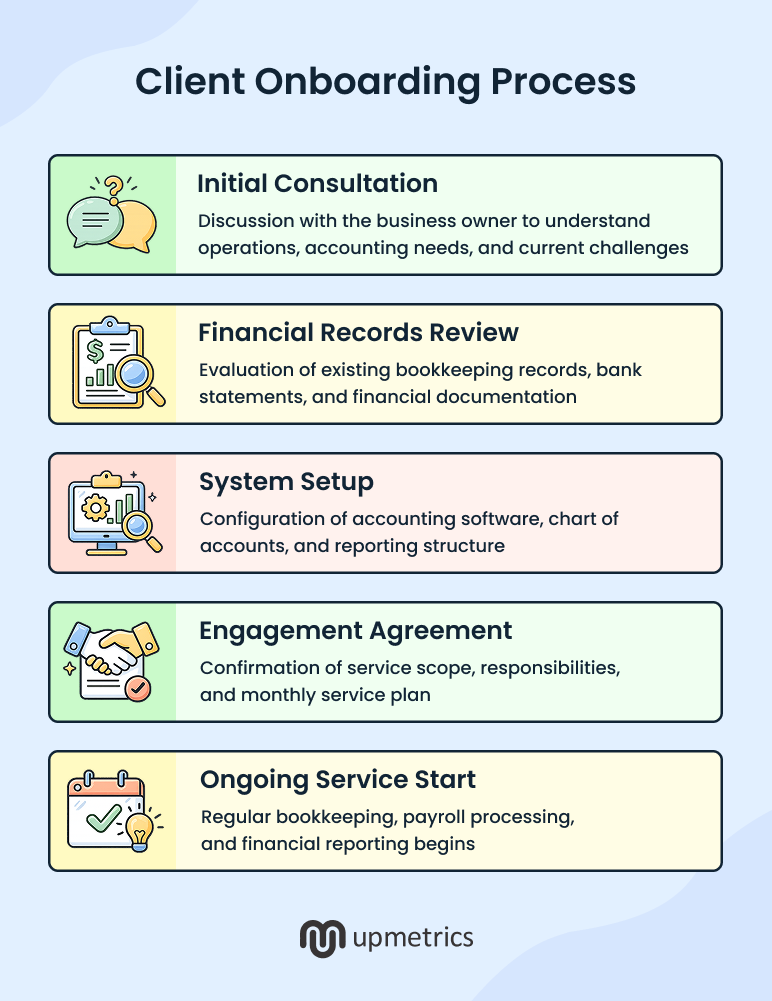
Client Onboarding Process
After a potential client makes contact with the firm, James Peterson will take the client through a simple onboarding process to understand the business and get its financial records organized as quickly as possible.
Operational KPIs
FutureBooks Accounting Services will monitor operational performance through specific indicators that measure efficiency, service delivery timelines, and client satisfaction as the firm expands.
| KPI | Target Standard |
| Monthly financial report delivery | Within 5 business days after the month-end |
| Client inquiry response time | Within 24 business hours |
| Average client onboarding completion | 1–2 weeks |
| Bank and credit card reconciliation accuracy | 100% completed before report delivery |
| Client retention rate | Above 90% annually |
Quality Control Standards
FutureBooks will maintain formal review procedures to ensure the accuracy and reliability of financial records and reports prepared for clients. Quality control practices include:
- All financial statements and reports will be reviewed by James Peterson, CPA, before giving them to clients.
- Staff accountants will adhere to standardized bookkeeping procedures and templates for the reports to all client accounts.
- Monthly reconciliation checks will ensure bank accounts, credit cards, and other financial records are correct before reports are finalized.
- Accounting documentation and supporting records will be kept in secure accounting systems to ensure clear audit trails are maintained.
Data Security and Confidentiality
Since accounting firms deal with sensitive financial data, data security will be a priority for FutureBooks. The firm will implement security access controls and encrypted document storage in order to safeguard client information.
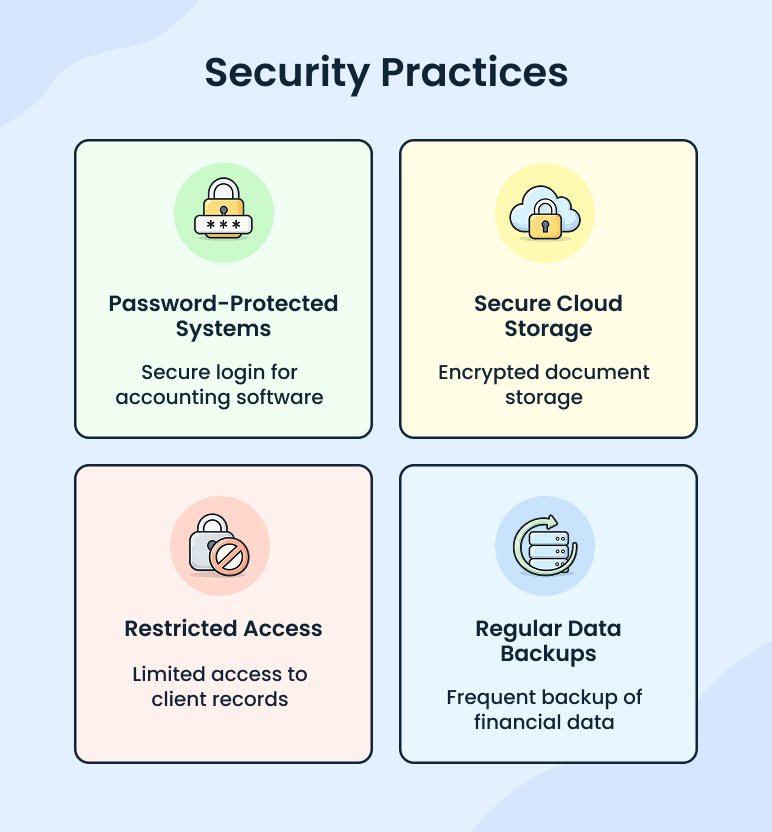
These practices help ensure that financial records remain confidential and protected from unauthorized access.
Financial Plan
FutureBooks Accounting Services operates with a professional service model built on recurring accounting engagements. Revenue comes from monthly bookkeeping, payroll support, tax preparation, and financial advisory services to small businesses in the Denver metro area.
Company History
During its early years of operation, the firm slowly built a clientele of repeat accounting clients by making use of professional connections and local business relationships. The business has 15 active clients today with bookkeeping, payroll support, tax preparation, and financial reporting services.
The firm has been producing a steady revenue stream over the last three years, both from repeating monthly service agreements and through a low-cost operating structure.
Due to the growing demand for services, the business grew to the operating level of a one-owner practice. The expansion, as outlined in this plan, will help the firm hire more accounting employees and improve its infrastructure to support the expansion.
Historical Revenue
FutureBooks saw a consistent increase in revenues during the early home-based operations.
| Year | Year 1 | Year 2 | Year 3 |
| Revenue (in $) | 50,000 | 75,000 | 95,000 |
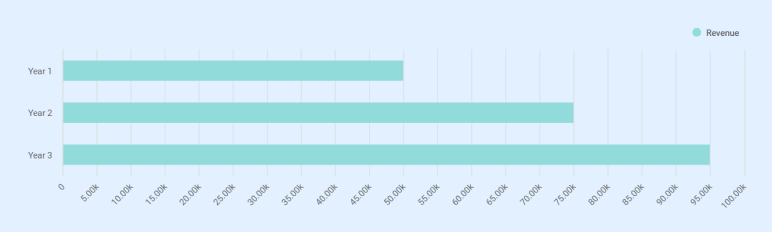
Revenue growth has mostly been driven by recurring bookkeeping engagements and additional payroll and tax services to existing clients.
Historical Profit & Loss Statement
| Category | Year 1 ($) | Year 2 ($) | Year 3 ($) |
| Revenue | 50,000 | 75,000 | 95,000 |
| Cost of Services (~28-30%) | 14,000 | 21,000 | 27,000 |
| Gross Profit | 36,000 | 54,000 | 68,000 |
| Operating Expenses | 28,000 | 38,000 | 48,000 |
| Net Profit | 8,000 | 16,000 | 20,000 |
The business has maintained positive profitability throughout its initial operating period due to its low fixed-cost structure as a home-based accounting practice.
Startup Costs
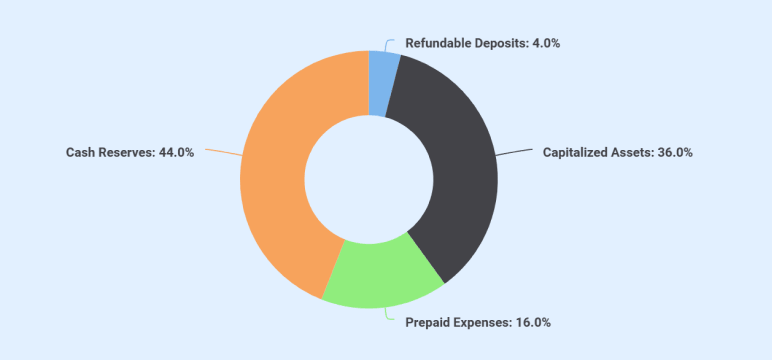
FutureBooks Accounting Services needs $250,000 in startup capital to cover office setup, technology infrastructure, staffing, and working capital during the early stages of expansion.
| Category | Cost |
| REFUNDABLE DEPOSITS | |
| Office lease deposit | $10,000 |
| Subtotal — Deposits | $10,000 |
| CAPITALIZED ASSETS | |
| Office furniture & build-out | $30,000 |
| Computers & software | $50,000 |
| Cloud storage & data security | $10,000 |
| Subtotal — Fixed Assets | $90,000 |
| PREPAID EXPENSES | |
| Prepaid rent (6 months) | $15,000 |
| Prepaid insurance (12 months) | $8,000 |
| Licenses, permits & legal fees | $7,000 |
| Marketing launch campaign | $10,000 |
| Subtotal — Prepaids | $40,000 |
| CASH RESERVE | |
| Working capital reserve | $110,000 |
| Subtotal — Cash | $110,000 |
| TOTAL STARTUP COSTS | $250,000 |
Key Financial Assumptions
Financial projections rely on defined assumptions regarding pricing, client volume, and operating expenses.
| Item | Assumption |
| Forecast period | Year 1, Year 2, Year 3 (post-expansion) |
| Core revenue streams | Bookkeeping, payroll services, tax preparation, advisory services |
| Average monthly bookkeeping client fee | Avg $800/month per client (blended $300–$2,000; Denver market) |
| Average advisory / expanded services fee | Avg $2,750/month per client (blended $1,000–$4,500) |
| Payroll Services | Avg $275/month per client (blended $100–$500) |
| Tax Filing | Avg $500 per return; seasonal Q1 concentration |
| Starting client base | Y1: +30; Y2: +28; Y3: +25 |
| Client churn | Y1: 0; Y2: 4; Y3: 7 |
| Ending clients | Y1: 45; Y2: 69; Y3: 87 |
| Average clients during the year | Y1: 30; Y2: 57; Y3: 78 |
| Office rent ($2,500/mo) | $30,000 (Y1: $15,000 — 6 months prepaid at startup) |
| Marketing & advertising | Y1: $15,000; Y2: $20,000; Y3: $25,000 |
| Client acquisition/networking | Y1: $4,000; Y2: $6,000; Y3: $8,000 |
| Marketing launch (one-time) | $10,000 Y1 only |
| Licenses, permits & legal | Y1: $7,000; Y2–Y3: $2,500 |
| Accounts receivable | 15-day cycle (Revenue ÷ 24) |
| Accounts payable | Y1: $2,000; Y2: $3,000; Y3: $4,000 |
These assumptions prioritize sustainable growth and manageable client capacity rather than maximum utilization.
Revenue growth is driven by an increase in the number of active clients as the firm hires staff accountants and expands its operational capacity.
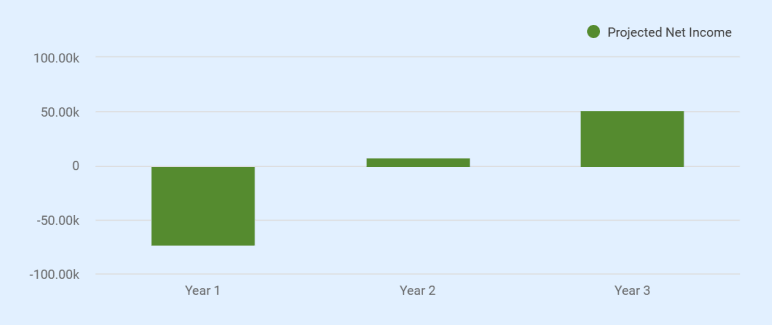
Projected Profit & Loss Statement (3 Years)
| Line Item | Year 1 | Year 2 | Year 3 |
| REVENUE | |||
| Monthly Bookkeeping (48%) | $120,000 | $206,400 | $276,000 |
| Financial Advisory (27%) | $67,500 | $116,100 | $155,250 |
| Payroll Services (14%) | $35,000 | $60,200 | $80,500 |
| Tax Filing (11%) | $27,500 | $47,300 | $63,250 |
| Total Revenue | $250,000 | $430,000 | $575,000 |
| COST OF SERVICES (COGS) | |||
| Client software & cloud tools | $10,800 | $20,160 | $27,360 |
| Total COGS | $10,800 | $20,160 | $27,360 |
| GROSS PROFIT | $239,200 | $409,840 | $547,640 |
| Gross Margin % | 95.7% | 95.3% | 95.2% |
| OPERATING EXPENSES | |||
| Owner salary | $60,000 | $72,000 | $90,000 |
| Staff accountant salaries | $82,500 | $137,500 | $192,500 |
| Admin assistant wages | $21,667 | $26,000 | $26,000 |
| Payroll taxes & benefits (20%) | $32,833 | $47,100 | $61,700 |
| Office rent | $15,000 | $30,000 | $30,000 |
| Insurance | $8,000 | $8,000 | $8,000 |
| Marketing & advertising | $15,000 | $20,000 | $25,000 |
| Client acquisition / networking | $4,000 | $6,000 | $8,000 |
| Marketing launch (from prepaid) | $10,000 | $0 | $0 |
| Licenses, permits & legal | $7,000 | $2,500 | $2,500 |
| Software subscriptions (firm-level) | $6,000 | $6,000 | $6,000 |
| Office supplies & miscellaneous | $5,000 | $5,000 | $5,000 |
| Telephone & internet | $3,600 | $3,600 | $3,600 |
| Professional development & CPE | $4,000 | $4,000 | $4,000 |
| Cybersecurity & IT maintenance | $5,000 | $5,000 | $5,000 |
| Total Operating Expenses | $279,600 | $372,700 | $467,300 |
| EBITDA | ($40,400) | $37,140 | $80,340 |
| Depreciation | $18,786 | $18,786 | $21,286 |
| EBIT (Operating Income) | ($59,186) | $18,354 | $59,054 |
| Interest Expense | $13,687 | $11,044 | $8,196 |
| Net Income (Pre-Tax) | ($72,873) | $7,310 | $50,858 |
Projected Cash Flow Statement (3 Years)
| Line Item | Year 1 | Year 2 | Year 3 |
| CASH FROM OPERATIONS | |||
| Net Income | ($72,873) | $7,310 | $50,858 |
| Add back: Depreciation | $18,786 | $18,786 | $21,286 |
| (Increase)/Decrease in Accounts Receivable | ($10,417) | ($7,500) | ($6,041) |
| (Increase)/Decrease in Prepaid Expenses | $40,000 | $0 | $0 |
| Increase/(Decrease) in Accounts Payable | $2,000 | $1,000 | $1,000 |
| Cash from Operations | ($22,504) | $19,596 | $67,103 |
| CASH FROM INVESTING | |||
| Fixed asset purchases (startup) | ($90,000) | $0 | ($20,000) |
| Lease deposit (refundable) | ($10,000) | $0 | $0 |
| Prepaid expenses (startup) | ($40,000) | $0 | $0 |
| Cash from Investing | ($140,000) | $0 | ($20,000) |
| CASH FROM FINANCING | |||
| Loan proceeds | $200,000 | $0 | $0 |
| Owner equity contribution | $50,000 | $0 | $0 |
| Loan principal repayments | ($34,145) | ($36,788) | ($39,636) |
| Cash from Financing | $215,855 | ($36,788) | ($39,636) |
| NET CHANGE IN CASH | $53,351 | ($17,192) | $7,467 |
| Beginning Cash | $0 | $53,351 | $36,159 |
| Ending Cash | $53,351 | $36,159 | $43,626 |
Spreadsheets are exhausting & time-consuming
Build accurate financial projections w/ AI-assisted features
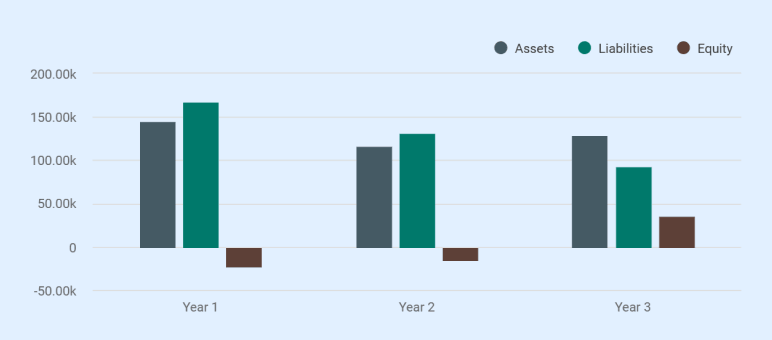
Projected Balance Sheet (3 Years)
| Line Item | Year 1 | Year 2 | Year 3 |
| ASSETS | |||
| Current Assets | |||
| Cash | $53,351 | $36,159 | $43,626 |
| Accounts Receivable | $10,417 | $17,917 | $23,958 |
| Prepaid Expenses | $0 | $0 | $0 |
| Total Current Assets | $63,768 | $54,076 | $67,584 |
| Non-Current Assets | |||
| Lease Deposit (refundable) | $10,000 | $10,000 | $10,000 |
| Gross Fixed Assets | $90,000 | $90,000 | $110,000 |
| Less: Accumulated Depreciation | ($18,786) | ($37,572) | ($58,858) |
| Net Fixed Assets | $71,214 | $52,428 | $51,142 |
| Total Non-Current Assets | $81,214 | $62,428 | $61,142 |
| TOTAL ASSETS | $144,982 | $116,504 | $128,726 |
| LIABILITIES | |||
| Current Liabilities | |||
| Accounts Payable | $2,000 | $3,000 | $4,000 |
| Current Portion of Loan | $36,788 | $39,636 | $42,715 |
| Total Current Liabilities | $38,788 | $42,636 | $46,715 |
| Long-Term Liabilities | |||
| Long-Term Loan Balance | $129,067 | $89,431 | $46,716 |
| Total Long-Term Liabilities | $129,067 | $89,431 | $46,716 |
| TOTAL LIABILITIES | $167,855 | $132,067 | $93,431 |
| EQUITY | |||
| Contributed Capital | $50,000 | $50,000 | $50,000 |
| Retained Earnings | ($72,873) | ($65,563) | ($14,705) |
| Total Equity | ($22,873) | ($15,563) | $35,295 |
| TOTAL LIABILITIES + EQUITY | $144,982 | $116,504 | $128,726 |
Projected Break-Even Analysis
| Item | Value |
| Monthly fixed costs (Y2 basis) | $31,378 |
| Variable cost ratio | 10.7% of revenue |
| Contribution margin | 89.3% |
| Monthly break-even revenue | $35,138 |
| Annual break-even revenue | $421,656 |
| Break-even client count | ~56 active clients |
| Break-even timing | Month 19–20 (mid-Q3 of Year 2) |
Loan Amortization Table
| Year | Opening Balance | Principal Paid | Interest Paid | Total Payment | Closing Balance |
| Year 1 | $200,000 | $34,145 | $13,687 | $47,832 | $165,855 |
| Year 2 | $165,855 | $36,788 | $11,044 | $47,832 | $129,067 |
| Year 3 | $129,067 | $39,636 | $8,196 | $47,832 | $89,431 |
| Year 4 | $89,431 | $42,715 | $5,117 | $47,832 | $46,716 |
| Year 5 | $46,716 | $46,716 | $3,116 | $49,832 | $0 |
| Totals | $200,000 | $41,160 | $241,160 |
Funding Requirements
FutureBooks Accounting Services requires $250,000 in expansion funding ($200,000 from the bank and $50,000 from the owner)
| Item | Details |
| Loan Amount | $200,000 |
| Bank | Wells Fargo Bank, N.A. |
| Loan Type | Small Business Term Loan |
| Term | 5 years |
| Interest Rate | 7.25% fixed |
Loan proceeds will be used to lease and equip a professional office, purchase technology infrastructure, hire staff accountants, and provide working capital during the expansion phase.
Owner Investment
The owner will contribute personal capital of $50,000 towards the expansion. This contribution will be used for office set-up, equipment purchase, and working capital requirements.
Loan repayment will be supported primarily through operating revenue generated from bookkeeping, payroll services, tax preparation, and financial advisory engagements rather than additional borrowing or outside capital sources.
Repayment Capacity
FutureBooks generates monthly recurring revenues from bookkeeping and accounting service contracts. This revenue model gives a predictable cash flow to meet the operating costs and the repayment obligations of loans.
| Loan Detail | Value |
| Monthly payment | $3,986 |
| Total interest over the life of loan | $41,160 |
| Total payments over the life of loan | $241,160 |
Because business is already engaged in having an active client base and a positive operating history, the expansion is more about expanding the service capacity than it is about creating demand from scratch.
The Quickest Way to turn a Business Idea into a Business Plan
Fill-in-the-blanks and automatic financials make it easy.

Upmetrics
Upmetrics is the #1 business planning software that helps entrepreneurs and business owners create investment-ready business plans using AI. We regularly share business planning insights on our blog. Check out the Upmetrics blog for such interesting reads. Read more