


 Download Now: Free Organization Chart Template
Hiring your first employee usually happens when doing everything yourself starts feeling difficult. You’re missing customer follow-ups. You’re answering emails at midnight. You’re pushing important work aside because you’re busy handling daily tasks. And you end up working longer hours just to keep things moving.
That’s the point where many small business owners realize they need help.
But once you decide to hire, it gets bigger than you thought. A new set of questions starts piling up.
- What kind of role do you need first?
- Can the business afford this right now?
- Where do you even find candidates?
- What legal paperwork, payroll setup, and tax steps to handle?
That can feel like a lot, and many first-time employers get stuck. Not because hiring is complicated, but because you have no clear process to follow.
In this guide, I’ll walk you through how to hire employees step by step, from deciding whether you are ready to hire to writing the job post, interviewing candidates, and onboarding your new employee properly.
Before you hire: are you actually ready?
Most owners answer “am I ready to hire” by looking at how busy they are. I get it, but being busy isn’t what decides this. What decides it is whether the business can carry this person through a slow month, not just a good one.
The busy part, you already know. It usually looks like a few of these:
- You’re turning down paying work because you don’t have enough people to do it.
- You’ve been working 50-plus-hour weeks for months, and it’s not slowing down.
- You’re spending hours on tasks like bookkeeping or marketing, doing them slowly because they’re not your strength.
- Your growth plan only works if you make this hire; you’ve already written numbers that assume someone is in this role.
If a few of those land, the question of workload is settled. That was never the hard one anyway.
Now, the very important part that many owners do wrong: the financial readiness check.
Here’s the rule I’d suggest using. Before you hire, make sure you can pay that person’s full cost for six months straight, from money in the bank or income that’s locked in (signed clients, confirmed contracts). Not a hopeful pipeline.
Why six months? Because hiring takes a few weeks and undoing it is brutal.
Let someone go at month four, and you lose the training time, you’re hiring from scratch again, you might owe severance, and you’ll second-guess the next hire. Six months of cushion keeps a slow season from becoming a layoff.
What’s the cost of hiring an employee?
That six-month rule only works if you know the true cost of the hire. Most owners assume that’s the wage and stop there. But the wage is only part of what an employee costs. The rest doesn’t show up until the bills do.
Let me show you with a real example. Say you run a one-person cleaning business, and you’re hiring your first cleaner at $20 an hour, full-time.
You’d do what almost everyone does: multiply it out, $20 × 40 hours × 52 weeks, and budget around $41,600. The number you’ll actually pay is closer to $47,000 to $49,000. Same wage. Here’s what fills that gap.
| Cost | What it is | Annual |
| Base wages | $20/hr × 2,080 hrs | $41,600 |
| Social Security + Medicare | Your half of FICA, 7.65% of wages, on top of their paycheck | ~$3,182 |
| Federal Unemployment Tax Act (FUTA) | 0.6% on the first $7,000 of wages | ~$42 |
| State Unemployment Tax Act (SUTA) | Set by your state; new employers start at a fixed rate | ~$150–$450 |
| Workers’ comp insurance | Required in nearly every state; priced by job risk | ~$1,200–$2,500 |
| Equipment, supplies, and onboarding | Tools, uniforms, and your own training hours | ~$500–$1,500 |
| What you’ll really pay (before benefits) | ~$47,000–$49,000 |
When you put someone on payroll, you pay 7.65% of their wages to the government on top of their paycheck. That’s your half of Social Security and Medicare.
Unemployment taxes are smaller, but new employers pay a default state rate until they have a track record. So check what your state assigns you rather than guessing.
The one line that swings from business to business is workers’ comp, because it’s priced by risk.
A cleaner hauling gear through clients’ homes is a far riskier class than a desk job. The same $20/hr hire might cost a software company a few hundred dollars a year, while a cleaning business pays $1,200 to $2,500. Call an insurer, get your class rate, and price it in before the first job.
For one employee, federal law doesn’t require you to offer health insurance (this only applies once you hit 50+ employees). A few states have their own rules, and some industries or contracts may add their own, so check before you skip them.
And the real question was never “can I pay $20 an hour?” It’s “can the business carry close to $50,000 a year against work I can count on.”
Run that through 12 months of cash flow before you commit, model it here, and see what it does to your runway first.
Employee or independent contractor: which are you hiring?
Everything in the last section only applies if you’re hiring an employee. If they’re a contractor, the math changes completely. So settle this first: which one are you actually hiring?
I’ve seen many first-time hirers reach for “contractor” because it looks cheaper and simpler. No payroll taxes, no workers’ comp, no forms, just a 1099 at year-end. But it doesn’t work that way. The IRS decides based on how the work happens, and the contract you write doesn’t override it.
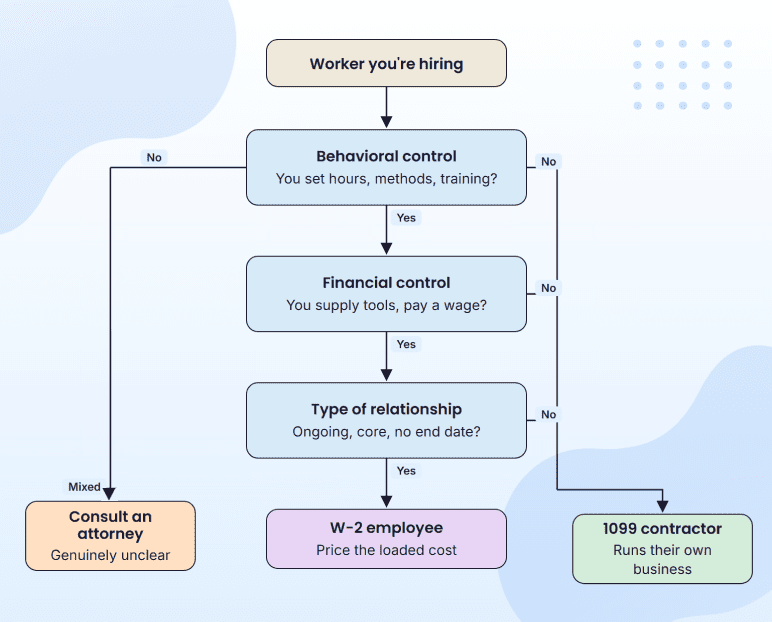
It really comes down to one thing: control. The IRS looks at it three ways:
- Do you control how and when the work gets done?
- Do you supply the tools and pay a steady wage?
- Is the role ongoing and core to your business?
The more “yes” answers, the more clearly you’re looking at an employee.
Rather than keep that in your head, just walk your hire down this:
One thing worth knowing before you move on: this gets expensive if you’re wrong. If you misclassify an employee as a contractor, the IRS can claw back the skipped payroll taxes plus penalties. A single complaint can pull every contractor you’ve ever paid into an audit.
For most first hires, though, there’s no real doubt. If the person works on your schedule, with your tools, doing your core work, they’re an employee.
If your answers are genuinely mixed (some say employee, some say contractor), that’s the time to pay for an hour with an employment attorney before deciding.
So that’s the groundwork business owners mostly overthink. The rest is just execution, so here’s the full process.
How to hire your first employee (step-by-step guide)
You don’t need an HR person or a lawyer to do this right. You need to work through these seven steps in the correct order, without missing the deadlines. Here’s how:
Step 1: Decide the role you need to hire for
First of all, spend an hour on this before anything else. Think about what kind of person you actually need.
There’s a big difference between someone who can work on their own from day one and someone you’ll need to train. The pay won’t be the same, and you won’t find them in the same places either.
Then list the real tasks they’ll handle every day. The customer emails you’re stuck on, the operations work taking up your afternoons, and the parts of the job only you’ve been doing. “Help out around here” gets you nothing. Create the exact list you require.
Next, set the pay. Look at what comparable jobs go for locally. Check what the business can carry as the real cost once you add taxes and insurance on top (math in the cost section above).
Decide the number first, as mid-interview decisions either overpay or lose strong candidates.
And yes, be clear on what you want this person to have done by 90 days in. Otherwise, there’s no way to tell if you got the right person.
Step 2: Set up your business as an employer
You can’t legally pay anyone until your business exists as an employer on paper. This is a one-time setup, and the order matters: you need the EIN before you can open state accounts, and both before you can run payroll.
Get your employer identification number (EIN)
This is your business’s tax ID, the number the IRS tracks your payroll under.
Apply free at irs.gov, have your SSN and entity type (LLC, sole prop) ready, and the number comes up on screen in about ten minutes.
Skip the third-party sites that charge for this; the IRS does it for free.
Register with your state’s tax and labor agencies
Two registrations, usually on two different sites: one with your state’s tax agency for income-tax withholding, one with the labor or workforce agency for unemployment insurance.
This is the slow part; state portals aren’t fast. So start it the week you decide, not the week someone begins.
Get workers’ compensation insurance
Nearly every state requires this the moment you have one employee (Texas is the main exception; a few states allow narrow carve-outs for tiny employers, so confirm yours requires it before assuming). And it has to be active before they start work, not after something goes wrong.
Since you already priced this earlier, there’s no decision left here. Just call an insurer or an agent, tell them your industry, and get the policy active before day one.
Step 3: Write a job description that attracts the right candidates
You’ve already decided the role you need to hire. Now it’s just turning those decisions into a post that candidates will actually respond to.
A good one does two jobs: it pulls the right people in and quietly filters the wrong ones out. A generic post does the opposite. You’ll spend the next week reading fifty resumes that could be anyone.
So when you write it, cover what matters:
- Title: “Residential Cleaner, solo routes (part-time),” not “Cleaning Help Wanted”
- Brief on what the role is: 2 lines on the actual scope, “running scheduled home cleans on a north Phoenix route, supplies provided”
- Day-to-day work: “3-4 homes per day on a set route,” not “various cleaning duties”
- Must-haves: “valid license, weekday daytime availability, 1+ year cleaning experience,” not “reliable”
- Nice-to-haves: Spanish, prior solo-route experience
- Pay range (if applicable): “$20-$22/hr, ~30 hrs/week”
The pay part isn’t always optional; many states (California, New York, Washington, and others) now require a range in the posting, so check yours.
Step 4: Post the job and source candidates
Where you post matters more than how many places you post. For a first hire, two or three solid channels are enough.
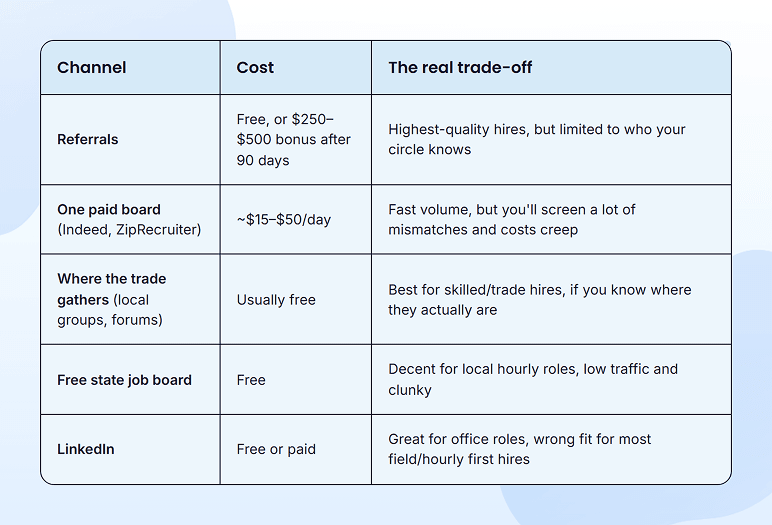
Start with referrals; they’re free, fast, and usually your best applicants. Don’t just say you’re hiring, tell people exactly who you’re looking for. ‘I need someone’ gets shrugs; ‘I need a reliable cleaner who can work a solo route’ gets you names.
Offer a $250 to $500 bonus if the person stays 90 days, which gets people really thinking about who they know.
If referrals don’t turn up the right person quickly, you’ll need to look wider, paid boards like Indeed or ZipRecruiter, your state’s workforce site, places where your trade gathers, and LinkedIn if the role suits it. They’re not equal.
Each has a real upside and a real catch:
But here’s the part some first-timers skip: posting is passive; you wait for people to come to you. For a lot of roles, the person you want isn’t job-hunting. So go to them.
Message people in the local trade groups, ask your best contacts, “Who’s the reliable person you’ve worked with?” If you’ve watched someone do this job well somewhere else, just ask if they’re open.
Whatever you do, stay on it. Check daily, reply fast. Posting everywhere just gives you more inboxes to ignore.
Step 5: Interview, screen, and select the right candidate
You’ve got applicants now. The whole job here is getting down to one person you’d trust enough to put on payroll, without going on a gut feeling, and without asking something you’re not legally allowed to. It moves in three passes:
Resume screening and phone interviews
Start by going through resumes fast. Give each one about five minutes, and only check the must-haves; the nice-to-haves don’t matter yet.
Anyone who clears that, get them on a quick phone call, fifteen minutes is plenty. You’re checking three things:
- Whether they can actually do the work
- Whether they’re available when you need them
- Whether your pay lines up with what they want
That last one matters more than people think. It stops you wasting an afternoon interviewing someone who was never going to take the rate.
Conducting a structured interview
For the actual interviews, ask everyone the same five or six questions. Some about what they’ve done, a couple of “what would you do if.” Score each answer 1 to 5 right after, while it’s fresh.
It feels mechanical, I know. But it matters. Without scores, you’ll just pick whoever you liked best. But the person you got along with isn’t always the person who’ll do the job well. Writing a score down forces you to judge how they answered, not how much you liked them.
And there’s a second reason: if someone you didn’t hire later complains it wasn’t fair, those notes are your proof that the decision was about the work.
Background checks and reference verification
Once you’ve picked someone, tell them they’ve got the job, but it depends on references and a background check. Get their written okay, that one’s the FCRA requirement, not just a formality.
Then call two people who actually worked with them and just ask it straight: “Would you hire them again?” Listen for the pause. The ones who go quiet for a second before saying “yeah, of course” are telling you something.
Step 6: Make the offer and complete new-hire paperwork
Checks came back clean? Now you make it official. Earlier, you set the business up to employ people at all; this is the paperwork for this one person, and these have real deadlines. Miss one and you’ll get a letter from the IRS or your state.
Job offer and acceptance
Put the offer in writing: “You’re hired.” Not on the phone. Include the title, pay, start date, anything it’s contingent on, and at-will wording if your state uses it. Give them two to five days to accept, so it doesn’t sit open.
I-9 employment eligibility verification
This one has a tight deadline that people often miss. The new hire fills out their half by their first day, no later. You complete yours, checking their ID, within three business days of that first day.
They choose which documents to show you from the approved list; you don’t get to demand a specific one, and asking for a particular document is itself a violation. Keep I-9s in their own folder; it makes an audit painless.
W-4 tax withholding form
Get this before you run the first paycheck. It’s the form that tells you how much income tax to hold back.
If an employee doesn’t hand one in, you’re legally stuck withholding at the highest single rate. They’ll notice the smaller check fast. So collect it up front and skip the awkward conversation.
State new-hire reporting
I think this is the one almost nobody knows exists. Every state runs a new-hire registry (it’s how child-support orders get enforced). And you’re required to report the hire to it.
The federal deadline is 20 days from their start date, and some states give you less, so don’t leave it. For many owners, it’s a five-minute online form.
Step 7: Set up payroll, benefits, and onboard your new employee
The paperwork’s done. This last step decides whether you’re doing this again in four months. It comes down to paying them right and not abandoning them in week one.
Choose a payroll system
Running payroll by hand means calculating withholding, filing payroll taxes, and producing year-end W-2s yourself. Get one wrong, and it’s a penalty.
For a single employee, a provider like Gusto, OnPay, QuickBooks Payroll, or ADP runs roughly $40-100 a month plus a small per-employee fee and does all of that automatically.
Set up direct deposit from the first run; paper checks get lost and make every late or wrong payment visible to the new person.
Required and optional benefits
You’re not required to offer health insurance for a single hire, and most first-timers don’t. You already saw why in the cost section.
The one thing I’d suggest is to set a few paid days off a year. It costs little, and it’s a real edge over the many small employers who offer nothing.
Design an effective 30/60/90 onboarding plan
Most early quits aren’t about the work; they’re someone spending week one with no desk, no logins, and no clue what they’re meant to be doing.
| When | What you do | Why it matters |
| Day 1 | Desk, logins, paperwork ready before they arrive | A first day spent waiting says they’re an afterthought |
| Week 1 | Show them the systems, give one real task, 15-min daily check-in | Small early wins build confidence; daily contact catches problems |
| Day 30 | Honest feedback, both directions | Surfaces a mismatch while it’s still fixable |
| Day 60 | Hand them something bigger to own | Ownership turns a hire into a contributor |
| Day 90 | Real talk: how it’s going, where the role heads | The point early quitters check out |
If you skip the plan, you’re not saving time. You’re just hiring all over again in a few months.
The bottom line
Hiring your first employee isn’t about being smart or organized enough. It’s about doing the right things in the right order, and not missing the deadlines that come with penalties.
You won’t get every part perfect on a first hire. The owners I see come through well are the ones who do the thinking up front, figure out if they’re really ready, what the role costs, and whether the person’s an employee or a contractor, then work the seven steps in order. That’s what decides how it goes.
Once that’s done right, the next hire gets a lot easier. The setup is built, the paperwork is familiar, and the only decision left is who.
If you’ve been sitting on this a while, start with the EIN. It takes ten minutes, and nothing else can move until it’s done.
The Quickest Way to turn a Business Idea into a Business Plan
Fill-in-the-blanks and automatic financials make it easy.

Frequently Asked Questions
How long does it take to hire an employee?
Can I hire employees as an LLC?
Should I hire a part-time employee before a full-time employee?
How do I hire remote employees in different states?
What do I need before hiring my first employee?
What should I do if my first hire does not work out?
How do I hire my first employee in California?

Joe Onderko
Joe Onderko is a manufacturing and business management expert with over 35 years of experience in operations, product development, and leadership. He’s worked with global companies in the consumer products, automotive, and industrial sectors, helping them modernize operations, improve efficiency, and grow stronger. He also writes about manufacturing, leadership, and smart business strategy. Read more