


 Download Now: Financial Statements Template
You might be making sales and still feel unsure about how much cash you’ll actually have next month. That usually happens because customers don’t always pay right away, while bills such as payroll, rent, and supplier payments still need to be paid on time.
A cash flow forecast helps you plan for that.
It shows how much cash you expect to receive, how much you’ll pay out, and what your cash balance could look like over the coming weeks or months.
In this guide, I’ll show you how to build one step by step using a simple business example. So you can see exactly how the numbers work together.
What is a cash flow forecast?
A cash flow forecast is a simple estimate of the cash you expect to receive and spend over a future period. It helps you see how much cash you may have available from one week or month to the next.
The basic formula is:
For example, if you start the month with $15,000, receive $12,000, and pay out $14,000, you’ll finish with $13,000 in cash.
That $13,000 then becomes the opening cash balance for the next month.
For a deeper explanation of how the process works, you can read our guide on cash flow forecasting.
Now, let’s focus on how to create the cash flow forecast using a direct approach.
How to forecast cash flow in 7 simple steps
Before you start, pull together the basic numbers you’ll need: your current cash balance, expected customer payments, unpaid invoices, regular expenses, taxes, loan payments, planned purchases, and any expected funding.
If some numbers are still uncertain, particularly in a new business, use your best estimate for now and note the assumptions behind them. You can update those numbers later as actual results come in.
To make the process easier to follow, here’s a quick look at the seven steps you’ll work through:
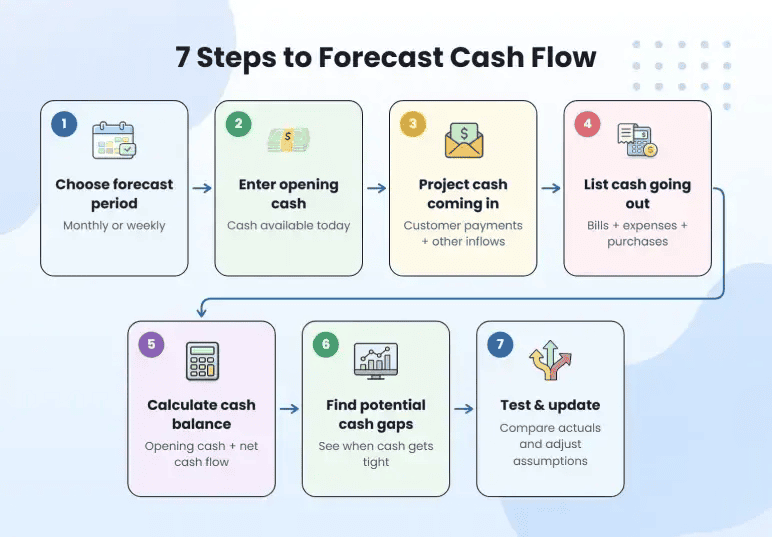
Here, I’ll use a small commercial cleaning business as an example throughout to show how each step works.
Step 1: Decide how far ahead to forecast
The first step is to determine the length of time ahead you need to look at your cash position.
If you are writing a business plan or planning your year, my recommendation for most small businesses is to begin your plan with a forecast for the next 12 months, on a monthly basis.
That’s usually enough to plan for upcoming expenses, slower months, and larger payments without making the forecast too detailed.
A weekly forecast makes more sense when cash is tight or the exact timing of payments matters. For instance, if you need to know whether you’ll have enough cash to cover payroll six weeks from now, looking week by week will give you a clearer picture.
For our cleaning business, we’ll use a monthly forecast.
Step 2: Enter your opening cash balance
Your opening cash balance is the amount of cash your business actually has available at the start of the forecast period.
For an existing business, this usually means the cash available in your business bank accounts. For a new business, it may come from your own investment, funding already secured, or other cash available at launch.
For our cleaning business, let’s say January starts with $15,000 in cash.
Only include money you already have available. Don’t count:
- Unpaid invoices
- Future sales
- Inventory value
- Expected profit
- Other money you haven’t received yet
Those may affect future cash, but they are not part of your opening balance.
So that $15,000 becomes the starting point for the rest of the forecast.
Step 3: Estimate when cash will come in
Next, figure out how much cash you expect to receive during each period.
This may include:
- Customer payments
- Cash sales
- Subscription or recurring payments
- Loan proceeds
- Investor or owner contributions
- Other cash receipts
The key is to record the cash when you actually expect to receive it, not when you make the sale.
For our cleaning business, let’s say January includes:
- $8,000 from customers who pay immediately
- $4,000 from older invoices
- $3,000 from January invoices that customers are expected to pay in February
That means January cash inflow is $12,000, not $15,000. The remaining $3,000 belongs in February because that is when the business expects to receive it.
If customers pay by invoice, use your payment terms and actual payment patterns where possible. If some customers usually pay late, reflect that in the forecast instead of assuming every invoice will be paid on time.
What if you don’t have historical sales?
If your business is new and you do not have past sales to work from, build the estimate from the factors that drive sales.
For example:
80 customers × $100 average purchase = $8,000 in expected monthly sales
Then place that cash in the month you realistically expect to receive it.
You don’t need perfect data. Use assumptions you can explain and update as you learn more.
Step 4: List out when cash will go out
Next, list the payments you expect to make during each period.
I’d group these payments into three simple categories:
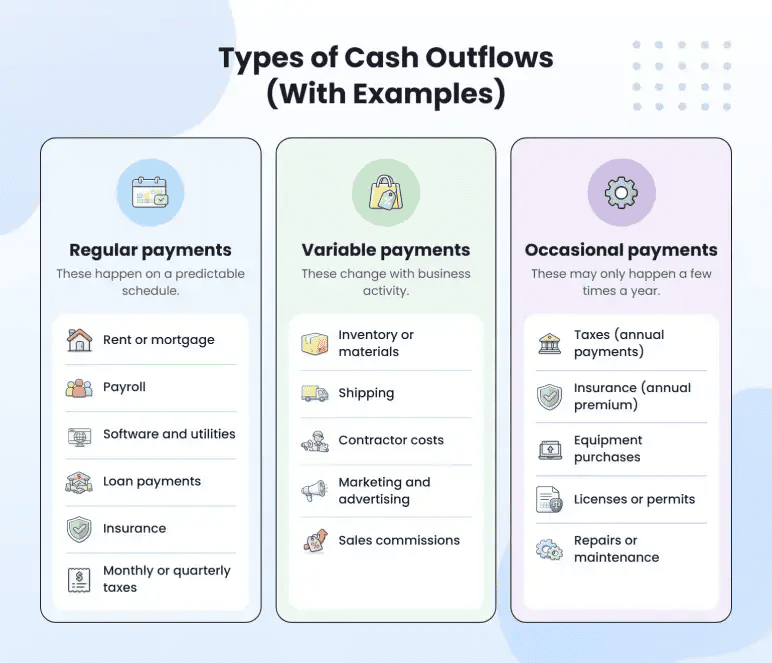
For our cleaning business, January payments might look like this:
| Payment | Amount |
| Payroll | $7,000 |
| Rent | $2,000 |
| Software and utilities | $1,000 |
| Marketing | $1,500 |
| Loan payment | $1,000 |
| Equipment | $1,500 |
| Total cash paid | $14,000 |
Just like cash coming in, record each payment in the period when the money actually leaves your account.
For example, if a $6,000 annual insurance payment is due in March, include the full amount in March rather than spreading it evenly across the year.
Also watch for payments that are easy to miss, such as loan principal repayments, taxes, or one-time equipment purchases. They still reduce your cash even if they do not look like normal monthly expenses.
Step 5: Calculate net cash flow and closing cash
At this point, you have the three numbers you need:
- Opening cash: $15,000
- Cash received: $12,000
- Cash paid: $14,000
First, calculate net cash flow:
Cash received − cash paid = net cash flow
So:
$12,000 − $14,000 = −$2,000
That means the business paid out $2,000 more than it received during January.
Next, calculate the closing cash balance:
Opening cash + net cash flow = closing cash
So:
$15,000 − $2,000 = $13,000
Here’s the full calculation:
| January | Amount |
| Opening cash | $15,000 |
| Cash received | $12,000 |
| Cash paid | $14,000 |
| Net cash flow | -$2,000 |
| Closing cash | $13,000 |
That $13,000 becomes February’s opening cash balance, and you repeat the same calculation for each month in the forecast.
One important thing I’d point out here: negative net cash flow does not automatically mean the business has run out of cash.
In this example, January net cash flow is negative $2,000, but the business still ends the month with $13,000 because it started with enough cash. What matters more is whether the closing balance eventually gets too low or turns negative.
Step 6: Check where cash could get tight
Once you’ve projected a few months, don’t just look at the final balance. Look across the forecast and identify where cash gets lowest.
I’d focus on three questions:
- When is your cash balance at its lowest?
- What is causing that drop?
- Will you still have enough cash to cover what’s coming next?
For example, let’s say our cleaning business drops from $13,000 in cash to $2,000 in March.
The next step is to look at what changes that month. Maybe:
- A tax payment is due
- You’re buying new equipment
- Several customers won’t pay until April
- Payroll or supplier costs increase
Once you know the reason, you can decide whether you need to act before the shortage arrives.
That might mean collecting invoices sooner, delaying a nonessential purchase, reducing spending, changing payment timing, or arranging additional funding.
The goal here is not just to spot a low balance. It’s to understand why it happens and what you can do about it before cash becomes a problem.
Step 7: Test your assumptions and update the forecast
Your forecast will not match reality perfectly, and that’s normal.
What I’d do instead is test the assumptions that could have the biggest effect on your cash.
For example:
- What if sales are 15% lower than expected?
- What if your largest customer pays 30 days late?
- What if a major expense is 10% higher?
You don’t need to test every possible scenario. Focus on the few changes that could put the most pressure on your cash balance.
Then, as actual results are received, compare actual results against your forecasts.
If you had anticipated receiving $12,000 in January cash receipts but ended up with $10,500, see what the discrepancy was. Perhaps it was a drop in sales or delayed payments, or maybe it was a single large payment that was late.
If this trend is expected to persist, update the future months instead of making no change to the original assumptions. This will make your forecast more useful over time since it begins to show what’s really happening in the business.
After completing these steps, you’ll have a working forecast that will help you see how your cash balance will fluctuate over time. However, one important thing to note is that you can identify possible cash shortages at an early stage and plan for them.
Let’s now combine all the numbers and create a full cash flow forecast.
Cash flow forecast example
Here’s what the first three months could look like for the cleaning business:
| Cash flow | January | February | March |
| Opening cash | $15,000 | $13,000 | $15,500 |
| Cash received | $12,000 | $17,000 | $14,000 |
| Cash paid | $14,000 | $14,500 | $18,000 |
| Net cash flow | -$2,000 | $2,500 | -$4,000 |
| Closing cash | $13,000 | $15,500 | $11,500 |
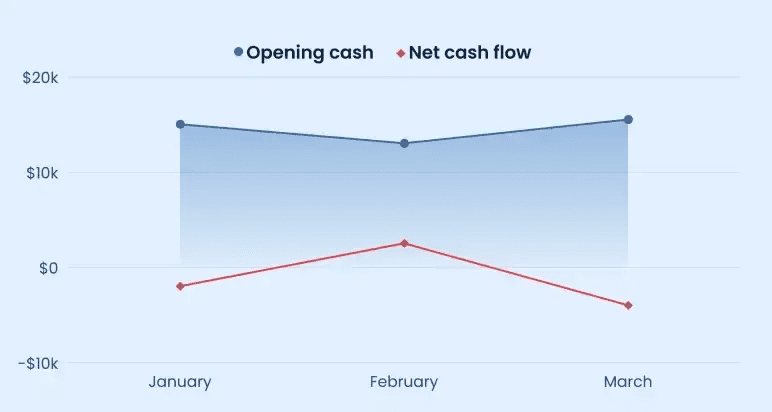
January ends with $13,000 in cash even though the business paid out more than it received.
February improves as customer collections increase, bringing the closing balance to $15,500.
In March, payments rise to $18,000, which pushes the balance back down to $11,500. The important question is why that happens.
- If it’s a planned one-time purchase, the drop may be temporary.
- If cash keeps falling in the following months, the owner may need to adjust spending, collections, or funding.
That’s what you should look for in your own forecast: where cash changes, what is causing the change, and whether you need to act before the balance gets too low.
Create and update your cash flow forecast with Upmetrics
Once the forecast is built, the harder part is keeping it useful as sales, expenses, payment timing, and other assumptions change.
You can manage all of this in a spreadsheet. But as your numbers change, keeping sales, expenses, payment timing, and cash balances updated manually can become time-consuming.
That’s where Upmetrics’ financial forecasting software can make the process easier.
You can build sales and expense forecasts, project cash flow, adjust assumptions, and see how those changes affect the rest of your financial plan without rebuilding everything manually.
I’d still recommend understanding the basic logic first. The software can handle the calculations, but you still need to decide what assumptions make sense for your business.
And if you’re building a business plan, Upmetrics helps keep your cash flow forecast connected with your other financial projections instead of managing everything in separate spreadsheets.
Build Better Financial Forecasts
Build accurate forecasts to manage your cash flow better.

Frequently Asked Questions
Is a cash flow forecast the same as a cash flow statement?
How accurate does a cash flow forecast need to be?
Can a profitable business still face cash flow problems?
Is a cash flow forecast the same as a budget?
What makes a cash flow forecast credible to a lender or investor?

Vinay Kevadia
Vinay Kevadiya is the founder and CEO of Upmetrics, the #1 business planning software. His ultimate goal with Upmetrics is to revolutionize how entrepreneurs create, manage, and execute their business plans. He enjoys sharing his insights on business planning and other relevant topics through his articles and blog posts. Read more