


When a lender or angel investor reads your business plan, they’re not just trying to understand your idea. They’re trying to figure out if the people behind it can actually make it work.
Well, that’s the purpose of the management team section. And it’s where the reader decides whether to take your plan seriously or set it aside.
For many founders, this section is uncomfortable to write. Maybe you are a solo founder, your team is still small, or you do not yet have every leadership role filled.
The goal is not to make your team look perfect. The goal is to present your current strengths clearly, show how responsibilities are covered, and address any gaps with a practical hiring or advisory plan.
In this guide, I’ll walk you through what to include in this section, how to structure it, and how to write strong bios, including real examples to guide you.
What is the management team section? (and isn’t)
The management team section is the part of your business plan that answers a simple question: Who is going to run this business, and why should anyone believe they can? It sits next to your complete business plan’s operations plan (which covers how the business runs day to day).
Your pitch deck team slide is the same content as the management team section, just compressed onto one page for investors.
It isn’t your full résumé, an HR document, or a list of roles you’re hoping to fill someday with no plan to fill them. If a sentence in this section doesn’t help a reader believe your team can execute, it doesn’t belong here.
What do investors and lenders actually look for?
When an SBA lender or angel investor reads this section, they’re checking whether your team can deliver what the plan promises.
The SBA business plan guide lists an organizational chart and résumés of key team members as the basics, along with how each person’s experience will contribute to the business.
But what investors and lenders usually weigh comes down to a few things:
Does this team have relevant experience for this business?
Not just any experience. The strongest fit is running the same kind of business or doing the exact job you’re now hiring for. Cross-industry experience still helps, though.
A 15-year corporate marketing professional opening a fitness studio brings real budgeting and hiring skills, but the plan still needs to show real fitness industry experience, either through your own background, a key hire, or an advisor.
Has the founder put their own money in?
Lenders and investors want to see real commitment, in numbers. That means personal capital invested, equity at risk, deferred or below-market salary, or assets pledged. If you’ve invested your own money, write the actual figure.
Are you upfront about what your team lacks?
This is the one I’ve noticed founders get wrong most often. Hiding weaknesses doesn’t make you look stronger. But it does the opposite. “Strong on operations, weaker on sales, which is why I’ve brought on an advisor” is the kind of line that lands.
Do you have a plan to fill those gaps?
You need an answer to “how are you handling it?” A named advisor with real engagement, a hire tied to a funding milestone, or a course you’re already enrolled in all work. “We’ll figure it out” or “we’ll hire as we grow” fails this test.
Here’s something I want you to know: SBA officers weigh questions 1 and 2 hardest. Because those two let them map 2 of the 5 Cs of Credit that lenders use: Capacity (can you run this business) and Capital (do you have your own money in it). That’s how they decide if you can repay.
Investors weigh 3 and 4 more since they’re betting on what you can still learn.
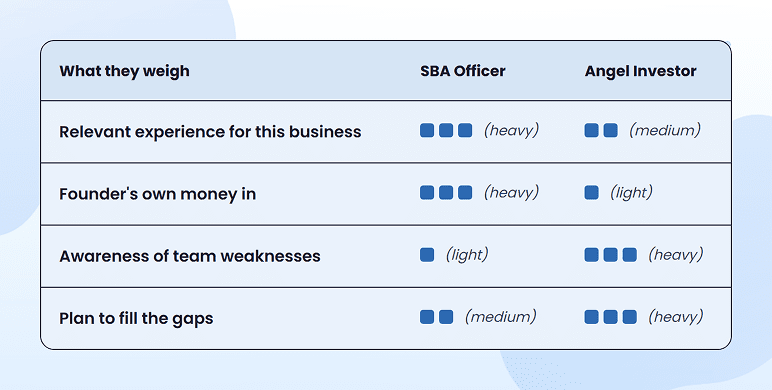
Strong sections answer all four, but you can lean into the one that matches who’s reading. The same logic applies to what investors look for in a pitch deck.
How much detail is enough?
In my experience, founders fail the management team section in one of two ways. They either dump a full résumé into the founder bio (life story, every job since 2010), or they list names and titles with nothing underneath.
Both are easy to fix once you know the rule:
- Key person: 100 to 150 words.
- Founder/CEO: 200 to 300 words.
- Advisors: One or two lines each.
- Future hires: A row in a table, not a paragraph.
The reason is simple. An SBA officer or investor reads dozens of plans a week. They scan for the relevant facts in the first 30 seconds, and those word counts fit that window.
Here’s a quick way to check your draft:
- More than five bullets per person, or sentences starting with “passionate about…” or “results-driven…”, means you’re overwriting.
- A section that fits on half a page despite having multiple key people, or bios that read as name + title + nothing, means you’re underwriting.
Either way, fix it by rewriting each bio to the right length, with specific details.
What to include: The 6 building blocks
Now that you know how much to write, here’s what to write. The section has six blocks. The order given below works for most plans, but you can adjust it based on your team and audience.
Each one answers a different question a lender or investor will have, so skipping a block leaves a gap they’ll notice.
Below is the full list, with what to include in each:
1. Founder / CEO bio
This bio carries the most weight in the section, so give it enough space. Cover your name and current title, what you own at this business, two or three quantified wins from your past, and the credentials that connect to what you’re doing now.
Write it as a short paragraph in third person, not a bulleted list. The same structure works for your team slide if you’re building a pitch deck alongside your plan.
2. Key managers
Use the same structure as the founder bio, but cap each one at around 70 words. Write one bio for every person running a specific area of the business (ops, sales, kitchen, finance).
If you’re handling more than one role yourself, just say so: “Founder also covers finance until the Month 9 hire.” Don’t write yourself in twice to make the team look bigger.
3. Organizational structure
Not every business plan needs an org chart, and forcing one in usually makes the section weaker. Add one only if you have three or more people with distinct or overlapping roles.
For solo or two-person teams, skip the chart entirely and use a one-line note instead: “Co-founders share decision-making, with [Name] leading [scope] and [Name] leading [scope].”
4. Advisory board
Of all the blocks, this is the one I see go wrong very often. Advisors usually get treated as a name-drop, which is why investors don’t take them seriously.
To make yours count, write four details for each one: name, current role, what you meet about (e.g., “monthly 1:1 on supplier negotiations”), and how they’re paid. Equity, retainer, or pro bono all count.
5. Compensation overview
Founders tend to overcomplicate this block and try to detail every dollar. You don’t need to. Lenders and investors aren’t looking for a payroll spreadsheet, just a clear picture of how the founders are paid.
Cover these things:
- Your salary (or deferred salary)
- Equity split among co-founders
- Compensation structure (market-rate, below-market with equity, etc.)
- The shift in pay once funding lands
They also check for a clear majority owner. A 50/50 split makes them wonder who’s in charge. So if you’re evenly split, name who has the final say on key decisions in your plan.
6. Hiring plan/role gaps
I’ve found many founders bury this block at the bottom and treat it like a placeholder. That’s a missed opportunity.
This is where you show investors you’ve thought past the funding round. Be specific. “Hiring a junior bookkeeper in Month 9, once retainer clients reach 18,” or “Adding a pastry lead in Month 4, funded by SBA close” is the kind of line that feels specific and credible.
“We’ll hire as we grow” is filler. Tie each hire to a funding stage so investors understand how the team grows with the money.
If you’re a solo founder or a 2-person team
The blocks above tell you what to write. This part is about how to approach it.
A small team isn’t a fact you need to hide. It’s just one you write around honestly. The solo founders who get funded aren’t the ones who dress up their team. They’re the ones who own it on the page, back it up with one or two real advisors, and show a clear hiring plan.
The biggest mistake I see solo founders often make is padding the team to look bigger than it is:
- Listing a spouse as a co-founder because they help on weekends.
- Calling a friend an advisor when you’ve never actually sat down with them about the business.
- Writing yourself into two roles to fill space.
Lenders catch this every time. It makes the rest of the plan harder to trust.
The same goes for future hires. If the role isn’t filled, it belongs in your hiring plan with a trigger and a date. Not in a bio.
The example coming up next shows what honesty looks like on the page.
Two worked examples
Reading about how to write the management team section is one thing. Seeing what it looks like on the page is another. Below are two examples, one solo and one for a small team. Pick the one that matches your situation and use it as a starting point to write yours.
Example 1 — solo founder, bookkeeping services
Founder & CEO: Emily Thompson
Emily founded ClearBooks Bookkeeping in 2024 after five years of progressive experience in small business accounting.
Credentials & achievements
- QuickBooks Online ProAdvisor (active)
- Xero ProAdvisor, Advanced level (active)
- Led an internal process redesign at Reynolds & Co. that reduced quarterly close time for a 22-person retail client from 8 days to 3
Role
Emily owns all client-facing engagement, monthly bookkeeping operations, financial reporting, and pricing decisions. She personally manages every client relationship.
Compensation
Emily has invested $35,000 of personal capital and defers her salary for Year 1. Salary begins at $48,000 in Month 13, once retainer revenue covers operating costs.
Hiring plan
A part-time junior bookkeeper will be added in Month 9, contingent on reaching 18 active retainer clients. The hire will be funded entirely from operating revenue.
Single-owner risk
All client work is currently handled by Emily. To protect continuity, she has a standing agreement with a vetted freelance bookkeeper (Anita Cole, QuickBooks-certified) who can step in for up to 4 weeks if needed. Loan repayment is not dependent on Emily’s active labor in any single month.
Example 2 — 3-person team, neighborhood cafe
Management team
Lantern Cafe is led by three owner-operators, each managing a distinct area of the business: finance and operations, kitchen, and front-of-house.
Founders & key managers
(1) Lisa Hayes, Co-founder & CEO
Lisa brings eight years of cafe operations experience, most recently as Operations Manager at Wildflour Coffee in Portland, where she grew weekday revenue 28% over three years. She holds a B.S. in Hospitality Management from the University of Oregon. At Lantern, she leads finance, suppliers, hiring, and strategy.
(2) David Romano, Co-founder & Head of Kitchen
David has 12 years of professional kitchen experience, most recently as Sous Chef at Café Noria in Seattle, where he developed seasonal menus and managed a four-person back-of-house team. He apprenticed at Tartine Bakery in San Francisco. At Lantern, he owns the menu, kitchen operations, food costs, and back-of-house hiring.
(3) Jessica Walker, Co-founder & Front-of-House Manager
Jessica has six years of front-of-house experience in independent cafes. Most recently, she led the floor at Brookline Coffee Bar in Eugene, where her customer loyalty program drove 38% of sales by year three. She is SCA-certified. At Lantern, she owns customer experience, floor operations, scheduling, and the loyalty program.
Organization structure
Advisory board
Mark Chen (Owner, Hillside Roasters)
Monthly 60-minute call on supplier negotiations and coffee program. Pro bono compensation.
Compensation
Equity splits 50% (Lisa), 25% (David), 25% (Jessica), reflecting Lisa’s lead role and capital contribution. Lisa has invested $40,000 personally and defers her salary for 12 months. David draws $52,000 from launch; Jessica draws $42,000.
Hiring plan
| Role | Trigger | Target month |
|---|---|---|
| Full-time barista | Weekday foot traffic exceeds 120 customers/day for 2 weeks | Month 4 |
| Weekend pastry lead | Saturday revenue clears $4,500 | Month 8 |
Write your first draft faster with Upmetrics
You’ve got the framework now. You know what to write, how much of it, and in what order. The two examples above show how it lands on the page. The thinking is mostly done.
What’s left is the writing itself, and that’s where first-time founders lose the most time. That’s where Upmetrics helps.
Its AI business plan generator walks you through every section of your plan, including the management team, with the kind of questions a lender would ask. founder bio, key managers, org structure, advisors, compensation, and next hire. Answer in your own words, and it pulls a first draft together that you can edit.
Upmetrics also lets you invite advisors and partners into the same workspace to weigh in on the rest of the plan. Because every section, your financials, market analysis, and pitch deck, lives in the same place, you don’t have to retype anything.
Build a Stronger Management Section
Organize your roles, experience, compensation, and hiring needs in one place.

Frequently Asked Questions
What if my business doesn't have a full management team yet?
How do I show that my team is qualified to run this business?
Do I need an org chart if I'm a solo founder or a 2-person business?
What skills and experience should be highlighted?
I don't have any advisors yet; can I leave this section blank?
How often should the management team section be updated?
Should I include the founder's photo or LinkedIn profile in the management team section?

Upmetrics
Upmetrics is the #1 business planning software that helps entrepreneurs and business owners create investment-ready business plans using AI. We regularly share business planning insights on our blog. Check out the Upmetrics blog for such interesting reads. Read more