


 Download Now: Free Business Plan Template
A business plan competition can be a real funding opportunity. It can also burn 40 hours of your week if you pick the wrong one.
So I built this list around fit. Whether you’re a college student with a business idea or a pre-seed founder with a working prototype, this list covers 20 of the most credible competitions running in 2026, with prize amounts, deadlines, eligibility, and how to apply for each.
The competitions on this list put more than $3.8 million in combined prizes on the table in 2026, ranging from $1,500 milestone grants up to the $1.4 million-plus awarded at the Rice Business Plan Competition. The median first prize is around $25,000, which is a more realistic target than the headline numbers suggest.
Let’s get started!
At-a-glance — 2026 business plan competitions compared
Here’s the quick-reference table before we get into the full profiles.
Use this to compare prize money, eligibility, and deadline status across all 20 competitions. Shortlist 2 to 3 that fit your stage, your industry, and the time you can actually spare.
| Competition | Prize pool | Eligibility | 2026 deadline/status | Stage |
|---|---|---|---|---|
| Rice Business Plan Competition | Over $1.4M in cash, investments, and in-kind prizes | Graduate student-led startups | Applications closed Jan 31; competition held Apr 9–11, 2026 | Pre-seed to seed |
| Edward L. Kaplan New Venture Challenge | $1M+ invested annually | University of Chicago-affiliated ventures | Finals typically late May / early June | Pre-seed to seed |
| TechCrunch Startup Battlefield 200 | $100,000 equity-free prize | Early-stage startups with a working MVP | Applications close May 27, 2026 | Pre-seed to Series A |
| MIT $100K LAUNCH | $100,000 grand prize; $150,000+ total prizes | At least one full-time MIT student; non-MIT collaborators welcome | Semi-finals Apr 30; finals May 12, 2026 | Pre-seed |
| Baylor New Venture Competition | $200K+ in cash prizes and resources | Collegiate student-led ventures worldwide | 2026 finals held Mar 27–28 | Idea to pre-seed |
| MIT Climate & Energy Prize | $100,000 grand prize plus other prizes | Student climate and energy startup teams | Final deadline Jan 11, 2026 | Pre-seed |
| Global Student Entrepreneur Awards (GSEA) | $100,000 global prize package | Student founders running active businesses | Deadlines vary by region | Early-revenue |
| New York Business Plan Competition | $100,000 total; $25,000 grand prize | Student startups from New York colleges | Finals Apr 22, 2026 | Idea to pre-seed |
| tecBRIDGE Business Plan Competition | $10,000 cash + $100,000+ in in-kind services per division winner; plus a $5,000 audience-selected Wild Card prize | NEPA student teams and early-stage entrepreneurs | Awards event Apr 29, 2026 | Idea to early-stage |
| Stu Clark New Venture Championships | $72,000+ in cash prizes | Student entrepreneurs worldwide | Applications closed Mar 10; event Apr 30–May 2, 2026 | Idea to pre-seed |
| Mayo Business Plan Competition | $60,000 total; $30,000 first prize | TCNJ student teams | Finals Mar 25, 2026 | Idea to pre-revenue |
| CodeLaunch USA | $50,000+ investment capital plus tens of thousands in in-kind services; finalists advance to Nov 11, 2026, Dallas World Championship for an additional $50K+ | Early-stage tech founders, pre-Series A | The Regional comps active (rolling); World Championship Nov 11, 2026, Dallas | Pre-seed |
| Wisconsin Governor’s Business Plan Contest | Cash and in-kind prizes; amount varies | Wisconsin entrepreneurs, students, and innovators | Phase 1 deadline Jun 15, 2026 | Idea to early-stage |
| Florida Atlantic Business Pitch Competition | Up to $10,000 plus services and accelerator access | FAU students, veterans, accelerator startups, and community founders | Event held Apr 1, 2026 | Idea to early-stage |
| New York StartUP! Business Plan Competition | $7,500–$15,000 cash prizes | Bronx, Manhattan, or Staten Island-based entrepreneurs | 2026 cycle TBD; 2025 cycle complete | Idea to startup |
| NIBS Worldwide Business Plan Competition | €2,600 cash prize pool + incubator opportunity for winners | Undergraduate and master’s students at NIBS member schools (max 2 teams per school, 2 to 5 students per team) | Final held May 14, 2026; next cycle opens Nov 2026 | Idea to pre-revenue |
| HATCH Pitch | Pitch coaching, investor feedback, and founder exposure | Innovative startups solving social, economic, or environmental problems | Rolling / next event TBD | Pre-seed to early-stage |
| Dempsey Startup Competition | $90,000+ total; $25,000 grand prize | Students at colleges in WA, OR, ID, AK, or BC | Application deadline Apr 6, 2026; finals May 21, 2026 | Idea to pre-seed |
| Get Seeded (Lassonde Institute) | $500 to $1,500 milestone grants | University of Utah student founders | Monthly / semester-based | Idea to prototype |
| IoT-WT / Innovation World Cup | Partner support, visibility, and business connections | IoT, wearable, deeptech, and industrial startups | 2026 cycle closed; next deadline Feb 11, 2027 | Prototype to early-revenue |
Last verified: May 14, 2026. Deadlines and prize pools change. Always check the official competition page before preparing your application.
What is a business plan competition?
A business plan competition is a contest where founders present a written business plan, pitch deck, or live presentation to a panel of judges in exchange for mentorship, investor exposure, and non-dilutive funding.
Americans were still filing 59% more applications to start new businesses in October 2023 than before the pandemic, according to Harvard Business Review, and competitions are one of the few places where new founders can get validation, capital, and a network from a single application.
The format varies. Some competitions judge a written plan, some run a live pitch, some use a hybrid. Either way, the deadline forces you to finish, and the judging forces you to defend what you wrote.
| Format | How it works | Best for |
|---|---|---|
| Pitch-only | You submit or present a short pitch, usually with a slide deck or 60–90 second video. | Founders with a clear idea and a strong story, but limited financial data. |
| Written-plan | Judges review a full written business plan before selecting finalists. | Founders who can prove market demand, operations, and unit economics on paper. |
| Hybrid | You submit a written plan first, then pitch live if you make the final round. | Startups preparing for grants, accelerators, or seed rounds. |
Judging criteria differ from contest to contest, but the questions are usually the same: Is there a real problem? Is the market big enough? Can this team actually build it? My advice is to write your plan to answer those three before you even look at the rubric.
How to find a business plan competition?
Most founders skim a “Top 50 Competitions” list, bookmark the biggest prizes, and apply to none of them. A $100,000 prize doesn’t help you if the contest is only open to graduate students with a working prototype and you’re neither.
Start with your location, your stage, your industry, and your eligibility. That narrows the list fast. Here are five places I’d look first:
| Search path | What to look for |
|---|---|
| University entrepreneurship centers within 200 miles | Many colleges run startup competitions for students, alumni, or local founders. Search “business plan competition near me,” “[state] university startup competition,” or “[city] entrepreneurship center pitch competition.” |
| SBDCs and state economic development programs | Your local Small Business Development Center is a good start. State commerce departments, regional EDCs, and chambers of commerce often run their own pitch contests and grant programs. Useful if you’re not a student. |
| Industry-specific competitions | If you’re in healthtech, climate, fintech, food, biotech, or social impact, search by sector. These contests usually have judges who already understand your market, which means sharper feedback. |
| Aggregator platforms | F6S, Gust, and FoundersBeta let you filter open competitions by region, industry, deadline, and funding type. Good for finding regional and one-off contests you’d never surface through Google. |
Before investing a weekend into an application, ask yourself 5 questions about each competition:
- Do I qualify? Verify the age of the founders, whether the students are working in the business, the location, the stage of the business, and industry limitations.
- Is the schedule realistic? If you have less than 2 weeks and you don’t have any plan or pitch deck created, then go ahead and get it if the application is simple; otherwise, don’t bother.
- Does the prize justify the effort? If you have a better chance of success, you might be better off in a smaller local contest instead of a national one.
- What does the competition reward? Some judge on the written plan; others on pitch delivery, traction, or customer proof.
- Is the organizer credible? Look for named past winners, real judges, university or corporate backing, clear rules, and transparent prize details.
The 20 best business plan competitions (full profiles)
Use these profiles to go beyond prize size. Before applying to any of them, I’d run three quick checks: are you eligible, does your stage fit, and is the application work worth the expected return?
1) Rice Business Plan Competition
The Rice Business Plan Competition is the largest and richest graduate-student startup competition in the world. Rice alumni teams have raised more than $6.1 billion in follow-on capital over 25 years, mostly because the judges are active early-stage investors, not academics.
- Prize pool: $1,476,600 awarded in 2026, including investment, cash, and in-kind prizes.
- Eligibility: Graduate student-led startups.
- Stage: Pre-seed to seed.
- 2026 deadline: Applications closed January 31, 2026.
- Status: 2026 competition held April 9-11; next application cycle opens late 2026.
- Organizer: Rice Business Plan Competition
Apply if: you’re a graduate student-led startup with a serious venture, a strong team, and an investor-ready story.
Skip if: you’re not graduate-student-led, still at the raw idea stage, or your business doesn’t fit the venture-scale category.
2) Edward L. Kaplan New Venture Challenge
This is a University of Chicago Booth startup accelerator and business plan competition. This is a strong fit if you’re tied to the University of Chicago and want more than a one-day pitch event. The NVC is an organized venture-building program; previous NVC startups include Grubhub, Braintree/Venmo, and Simple Mills.
- Prize pool: More than $1 million invested in startups each year.
- Eligibility: University of Chicago-affiliated ventures.
- Stage: Pre-seed to seed.
- 2026 deadline: Tied to the NVC application cycle (program-specific).
- Status: 2026 classroom phase active.
- Organizer: Polsky Center NVC
Apply if: you’re affiliated with the University of Chicago and ready for a multi-month venture-building program with structured mentorship.
Skip if: you have no U Chicago affiliation, or you want a one-day pitch event rather than a quarter-long commitment.
3) TechCrunch Startup Battlefield 200
It’s the pitch competition that runs alongside TechCrunch Disrupt, with national press, investor visibility, and a $100,000 equity-free prize. The competition is ideal for startups looking to gain media coverage, investor interest, and national exposure.
- Prize pool: $100,000 equity-free prize.
- Eligibility: Early-stage startups with a working MVP and a clear product demo.
- Stage: Pre-seed to Series A (Series A reviewed case-by-case).
- 2026 deadline: May 27, 2026.
- Status: Applications open; Disrupt event Oct 13-15, 2026, in San Francisco.
- Organizer: TechCrunch Startup Battlefield
Apply if: you’re a venture-scale tech startup with a working MVP, a clear demo, and an interest in media and investor exposure.
Skip if: you’re pre-product, building a lifestyle or local business, or unprepared to pitch under live press conditions.
4) MIT $100K LAUNCH
This is MIT’s flagship business plan competition for student and researcher-led ventures. Semi-finalists will be asked to provide full business plans instead of prototypes, and finalists will pitch live for a $100K. This is true, of course, of the MIT requirement, and it won’t work unless you have at least one full-time MIT student on the team.
- Prize pool: $100,000 grand prize; $150,000+ total prizes.
- Eligibility: Teams with at least one full-time MIT student; non-MIT collaborators welcome.
- Stage: Pre-seed.
- 2026 deadline: Application deadline March 31, 2026; semi-finals April 30; finals May 12.
- Status: 2026 finals completed.
- Organizer: MIT $100K
Apply if: you have at least one full-time MIT student on the team and a business case that goes beyond a prototype.
Skip if: you have no MIT affiliation, or your venture is still at the technical demo stage with no commercial story yet.
5) Baylor New Venture Competition
The Baylor New Venture Competition runs its venture presentations and elevator pitch awards in parallel, which gives collegiate teams two separate shots at placing in the same event.
- Prize pool: $200,000+ in cash prizes and resources.
- Eligibility: Collegiate student-led ventures.
- Stage: Idea to pre-seed.
- 2026 deadline: Finals held March 27-28, 2026.
- Status: 2026 competition completed.
- Organizer: Baylor New Venture Competition
Apply if: you’re a collegiate team that wants structured feedback on both a written plan and a live pitch.
Skip if: you’re a non-student founder or already past pre-seed.
6) MIT Climate & Energy Prize
The MIT Climate & Energy Prize is the climate-and-energy-specific competition on the list, and that focus is the point. Every judge already understands the space, so feedback is technical and substantive in a way generalist competitions can’t match.
- Prize pool: $100,000+ in prize money.
- Eligibility: Student-led climate and energy startup teams.
- Stage: Pre-seed.
- 2026 deadline: Final deadline January 11, 2026.
- Status: 2026 cycle closed.
- Organizer: MIT Climate & Energy Prize
Apply if: you’re a student-led climate, clean energy, hardtech, or sustainability startup that needs technical feedback and non-dilutive funding.
Skip if: you’re outside the climate/energy space or not student-led.
7) Global Student Entrepreneur Awards (GSEA)
GSEA is the only competition on the list with an operating-business eligibility threshold (active company, at least 6 months of trading history, real revenue or investment). That filter eliminates most applicants before judging starts.
- Prize pool: $100,000 global prize package.
- Eligibility: College or university students running an active business with at least 6 months of operating history.
- Stage: Early-revenue.
- 2026 deadline: Varies by country and regional chapter.
- Status: 2026 regional cycles active in multiple markets.
- Organizer: Entrepreneurs’ Organization GSEA
Apply if: you’re a student already running and selling—real customers, six months of trading, verifiable revenue.
Skip if: you’re idea-only, pre-revenue, or your business isn’t truly operating yet.
8) New York Business Plan Competition
NYBPC splits its statewide pool into six industry tracks, so founders compete against ventures in their own category rather than against the entire applicant base. That structure meaningfully improves the odds of placing.
- Prize pool: $100,000 total prizes; $25,000 grand prize.
- Eligibility: Student startups from New York colleges and universities.
- Stage: Idea to pre-seed.
- 2026 deadline: Finals held April 22, 2026.
- Status: 2026 finals completed.
- Organizer: New York Business Plan Competition
Apply if: you’re a New York state college or university student looking for regional mentorship and statewide visibility.
Skip if: you’re not enrolled at a New York institution.
9) tecBRIDGE Business Plan Competition
tecBRIDGE is the regional Pennsylvania option, and it’s structured differently from most: a collegiate track for 14 NEPA colleges runs alongside a non-collegiate track for early-stage entrepreneurs.
- Prize pool: $10,000 cash + $100,000+ in in-kind services per division winner; plus a $5,000 audience-selected Wild Card prize
- Eligibility: NEPA student teams and early-stage founders.
- Stage: Idea to early-stage.
- 2026 deadline: Awards event held April 29, 2026.
- Status: 2026 competition completed.
- Organizer: tecBRIDGE
Apply if: you’re a student or early-stage founder based in northeastern Pennsylvania who wants regional visibility.
Skip if: you’re outside NEPA, or you need a national platform rather than a regional one.
10) Stu Clark New Venture Championships
The Stu Clark New Venture Championships is the international option on this list. Hosted by the University of Manitoba’s Asper School of Business, it brings together student teams from across the U.S., Canada, and abroad, with the final round held in Winnipeg.
- Prize pool: $72,000+ in cash prizes.
- Eligibility: Graduate and undergraduate student entrepreneurs.
- Stage: Idea to pre-seed.
- 2026 deadline: Applications closed March 10, 2026.
- Status: 2026 competition held April 30 to May 2.
- Organizer: University of Manitoba
Apply if: you’re a student team with a formal business plan ready and open to an international competition format.
Skip if: you’re not student-led, or your venture is still pre-plan.
11) Mayo Business Plan Competition
The Mayo Business Plan Competition at TCNJ is the strongest single-school option on the list for its students, with a clear tiered prize structure ($30K / $20K / $10K). The required deliverables—a written plan plus a short investor video—also double as preparation material for larger national competitions later.
- Prize pool: $60,000 total: $30,000 first, $20,000 second, $10,000 third.
- Eligibility: TCNJ student teams.
- Stage: Idea to pre-revenue.
- 2026 deadline: Finals held March 25, 2026.
- Status: 2026 competition completed.
- Organizer: Mayo Business Plan Competition
Apply if: you’re a TCNJ student with a written plan and willing to record an investor video.
Skip if: you’re not at TCNJ and use this as a prompt to find the equivalent competition at your own school.
12) CodeLaunch
CodeLaunch pairs cash with product help. Each regional finalist is matched with a product-development firm that builds an MVP during a 48-hour hackathon, on top of the $50,000+ investment. For software founders blocked on shipping the first version, that’s worth more than the prize money.
- Prize pool: $50,000+ in investment capital per regional winner, plus tens of thousands in in-kind seed services. Finalists advance to the Nov 11, 2026, Dallas World Championship for an additional $50K+.
- Eligibility: U.S.-based startup founders or co-founders for CodeLaunch USA (Canada and LATAM have separate regional events).
- Stage: Pre-seed to pre-Series A.
- 2026 deadline: Applications opened October 15, 2025, with rolling regional deadlines; the USA fast-track for Startup Mania closed January 31.
- Status: 2026 regional competitions active; World Championship Nov 11, 2026, in Dallas.
- Organizer: CodeLaunch
Apply if: you’re a software, app, or tech-product founder whose biggest blocker is shipping the first usable build.
Skip if: you already have a working product and don’t need development help, or you’re outside the software/tech category.
13) Wisconsin Governor’s Business Plan Contest
This is one of the few competitions on the list that doesn’t require you to be a student. Since 2004, the contest has received about 4,805 entries and awarded $2.9 million in cash and in-kind prizes which is rare for a state-level program.
- Prize pool: Cash and in-kind prizes; 2025 finalists shared about $180,000 in cash and service prizes.
- Eligibility: Wisconsin residents 18+, or teams intending to base/expand in Wisconsin. Must not have received more than $100,000 in private equity for the plan in its current form.
- Stage: Idea to early-stage (tech-based businesses).
- 2026 deadline: Phase 1 (executive summary) closes June 15, 2026; Phase 2 (pitch deck) July 17–August 14, 2026; finals October 2026.
- Status: 2026 cycle active.
- Organizer: Wisconsin Governor’s Business Plan Contest
Apply if: you’re a non-student Wisconsin founder building a tech-enabled business, and the multi-phase structure fits your timeline.
Skip if: you’re outside Wisconsin and have no plans to relocate or expand there, or you’re not building a tech-based business.
14) Florida Atlantic Business Pitch Competition
FAU’s competition runs separate tracks for students, veterans, accelerator startups, community founders, and Spanish-language founders. That track structure makes it unusually accessible compared with single-audience university competitions.
- Prize pool: Track-based awards, funding, mentorship, and business support.
- Eligibility: FAU students, veterans, community accelerator startups, and Spanish-language founders.
- Stage: Idea to early-stage.
- 2026 deadline: Event held April 1, 2026.
- Status: 2026 competition completed.
- Organizer: Florida Atlantic University
Apply if: you’re a non-traditional founder in South Florida who fits one of the tracks—student, veteran, community accelerator, or Spanish-language.
Skip if: you’re outside South Florida or don’t fit any of the eligibility tracks.
15) New York StartUP! Business Plan Competition
The NYPL StartUP! competition is on the list for what surrounds the prize money—structured workshops, mandatory mentor meetings, and access to NYPL Business Center research librarians. For first-time NYC founders without an MBA network, that infrastructure is the actual value.
- Prize pool: $15,000 first-place grant; $7,500 runner-up grant.
- Eligibility: Bronx, Manhattan, or Staten Island-based startup entrepreneurs.
- Stage: Idea to startup.
- 2026 deadline: 2026 cycle dates not yet published; 2025 competition page remains live.
- Status: 2026 organizer update pending. Verify before publishing.
- Organizer: New York Public Library
Apply if: you’re an NYC founder in the Bronx, Manhattan, or Staten Island who needs library research support and seed funding.
Skip if: you’re not based in one of those three boroughs.
16) NIBS Worldwide Business Plan Competition
The NIBS Worldwide Business Plan Competition is the only fully virtual international competition on the list with a structured judging process. Teams build a complete business plan and a seven-minute investor pitch video, then defend it live in front of a panel from across the NIBS member network.
- Prize pool: €2,600 cash prize pool plus incubator opportunity for top-three teams.
- Eligibility: Undergraduate and master’s students at NIBS member institutions; max 2 teams per school, 2–5 students per team.
- Stage: Idea to pre-revenue.
- 2026 deadline: Registration closed January 23, 2026; qualifying submissions due March 16; finals held May 14, 2026.
- Status: 2026 cycle complete; next cycle opens November 2026.
- Organizer: Network of International Business Schools
Before you commit, three things worth knowing. The €150 team fee is per team, not per student. Each NIBS member institution can enter a maximum of two teams, so your school’s internal selection matters as much as the NIBS competition itself. And the NIBS manual is clear that feasibility matters as much as creativity — a novel idea without a realistic execution path doesn’t score well.
Apply if: your school is a NIBS member institution, you’re undergrad or master’s level, and your idea has a feasible execution path.
Skip if: your school isn’t a NIBS member, or your business is purely conceptual with no path to actually run.
17) HATCH Pitch
HATCH Pitch is the impact-focused option on the list, and the most unusual: there’s no cash prize. Winners get mentorship, investor feedback, and exposure, so it only makes sense if your bottleneck is network access rather than capital.
- Prize pool: Mentorship, investor feedback, and founder exposure (non-monetary).
- Eligibility: Startups solving environmental, economic, or social problems.
- Stage: Pre-seed to early-stage.
- 2026 deadline: Next event TBD.
- Status: Active site; 2026 deadline not clearly posted. Verify before publishing.
- Organizer: HATCH Pitch
Apply if: you’re an impact-focused startup whose biggest blocker is mentor and investor access, not cash.
Skip if: you need prize money, or your business doesn’t sit in the social, environmental, or economic-impact category.
18) Dempsey Startup Competition
The Dempsey Startup at the University of Washington runs a four-stage format—Screening → Investment Round → Sweet 16 → Final — that gives you multiple feedback rounds before you ever pitch live. Over 28 years, the competition has awarded more than $2.9 million to 250+ student companies, with 300+ entrepreneurs and investors serving as judges each year.
That’s deeper mentor exposure than most regional competitions offer.
- Prize pool: $90,000+ in 2026: $25,000 grand prize (BECU), $15,000 second (WRF Capital), $10,000 third (iSpot TV), $7,500 fourth, plus a dozen $2,500 to $5,000 specialty prizes.
- Eligibility: Undergraduate and graduate students at accredited colleges in the Cascadia Corridor (Washington, Oregon, Idaho, Alaska, and British Columbia). At least one student must be on the team.
- Stage: Idea to pre-seed.
- 2026 deadline: Application deadline April 6, 2026; final round May 21, 2026.
- Status: 2026 competition active; investment round April 30.
- Organizer: Dempsey Startup Competition
Apply if: you’re a student founder at an accredited college in Washington, Oregon, Idaho, Alaska, or British Columbia who wants sustained mentor exposure across multiple feedback rounds.
Skip if: you’re outside the Cascadia Corridor, or you’d rather have one decisive pitch than four feedback stages.
19) Get Seeded by Lassonde Entrepreneur Institute
Get Seeded is the only entry on this list that isn’t really a competition in the traditional sense. It’s a rolling milestone-grant program for University of Utah students, with smaller awards but monthly cycles.
- Prize pool: $500–$1,500 milestone grants.
- Eligibility: University of Utah students.
- Stage: Idea to prototype.
- 2026 deadline: Monthly or semester-based application cycles.
- Status: 2025–26 cycle active.
- Organizer: Lassonde Entrepreneur Institute
Apply if: you’re a University of Utah student needing small grant funding for a specific early milestone—prototype build, website test, customer experiment.
Skip if: you’re not at the University of Utah, or you need a single larger award rather than incremental small grants.
20) Innovation World Cup
The IoT-WT / Innovation World Cup is the hardware and IoT specialist option. Winners get partner introductions, distribution opportunities, and visibility at HANNOVER MESSE — useful if you’re building in IoT, wearables, deeptech, or industrial categories where market access matters more than seed capital.
- Prize pool: Partner support, business connections, visibility, and special category prizes (non-monetary).
- Eligibility: Tech startups and scaleups with IoT, wearable, deeptech, or industrial solutions.
- Stage: Prototype to early revenue.
- 2026 deadline: 2026 cycle closed; next deadline February 11, 2027.
- Status: 2026 finalist event completed at HANNOVER MESSE; next cycle accepting applications for 2027.
- Organizer: Innovation World Cup
Apply if: you’re a hardware, IoT, wearable, or industrial-tech startup whose biggest blocker is distribution and partner credibility, not cash.
Skip if: you’re software-only, pre-prototype, or need prize money rather than partner introductions.
Not a student? Most competitions here are student-restricted. The open-stage and non-student-eligible options are TechCrunch Startup Battlefield 200, Wisconsin Governor’s / Launch Wisconsin, CodeLaunch, Florida Atlantic, the Innovation World Cup, HATCH Pitch, and New York StartUP!
Beyond this list, your local SBDC, chamber of commerce, and state economic development office often run small business competitions with smaller prizes but much better odds.
How to win a business plan competition
The odds of serious startup competitions are low, and the workload is high. Rice accepted just 42 of 550 applicants in 2026, a 7.6% acceptance rate, per the Rice Alliance announcement, and only one team took the grand prize. This isn’t easy money. Treat it like a fundraising deliverable.
The fastest way to lose a judge in the first 60 seconds is to open with features. Open with the customer’s pain instead: who has the problem, how they solve it today, why that solution falls short, and why now is the right time for a better one.
In the dozens of competition pitches that I have attended, the winners are the ones that make it easy for the judge: the problem is defined, the customer is clear, the market is understandable, the financials are reasonable, and the team appears to have what it takes to pull it off.
Everything below maps to that one principle.
What judges actually score
Judging rubrics vary, but most pitch-judged competitions weigh five areas heavily. The table below is the synthesized version I’ve put together from the published rubrics at Rice, MIT $100K, Dempsey, and Wisconsin Governor’s:
| Criterion | What judges want to see | Where to show it |
|---|---|---|
| Problem clarity | A painful, specific problem faced by a clearly defined customer group. | Opening slide, executive summary, customer section |
| Customer validation | Proof that real people want this solution, not just the founder’s belief. | Customer interviews, waitlist, pilots, signed LOIs, early revenue |
| Market opportunity | A market large enough and reachable, with a defensible entry point. | Market analysis, beachhead, growth plan |
| Business model | A clear path to revenue, margin, and repeat purchase. | Pricing, unit economics, and financial projections |
| Team strength | Relevant skills, demonstrated speed, and credible commitment. | Team slide, milestones to date, operating plan |
The mistake most first-timers make is treating the plan like a school assignment. Judges don’t grade length or polish. They ask one question: would this business work, and do these founders understand what it’ll take?
Business plan competition winners — 3 case studies
Looking at past winners is the single best research you can do before applying. The competitions publish finalist videos, winner pages, and full prize breakdowns, but most founders don’t read them.
Below are three I’d start with, each chosen for what it teaches rather than how famous the company became.
BRCĒ — Rice Business Plan Competition (2026)
- Competition: Rice Business Plan Competition
- Stage: Graduate student-led startup
- Total awards: $611,500 across 11 stacked prizes
BRCĒ, a material-tech startup from Michigan State University, won the 2026 Rice Business Plan Competition with a polymer composite technology designed to replace failure-prone industrial textiles. Their patented Lattice-Grip technology solves a specific industrial problem: textiles that slip or lose strength under extreme conditions.
What makes BRCĒ a useful case isn’t just the win. It’s the path the founders took to get there. Co-founder and CEO Madhav Aggarwal credited watching a fellow Michigan State alum win the 2024 RBPC as the spark for his entrepreneurial journey. The team then competed in smaller competitions to sharpen their pitch and build momentum before targeting Rice.
BRCĒ won the $200,000 Goose Capital Investment Grand Prize plus 10 additional stacked prizes for a total of $611,500. The pitch worked because the problem was concrete (textile failure in industrial settings), the technology was patented and demonstrable, and the team could explain a chemistry-heavy product to investors who weren’t materials scientists.
You can borrow two things here. First, watch the winners from your target competition the year before you apply. Second, treat smaller competitions as training. The teams that win Rice usually don’t show up cold; they’ve already pitched and lost at five smaller events.
SolHex — NIBS Worldwide Business Plan Competition
- Competition: NIBS Worldwide Business Plan Competition
- Stage: Student business plan competition
- Prize: First place, 2026 (prize amount varies by year)
SolHex from Technological University Dublin won first place in the 2026 NIBS Worldwide Business Plan Competition. NIBS is worth studying because it’s fully virtual and judged on the quality of the written plan and investor-style video. The plan has to stand on its own before judges ever meet the team.
In written-plan competitions, clarity earns more points than creativity. Teams have to show a viable product or service, a clear market, and a realistic execution path. NIBS specifically asks teams to present the idea as if they’re convincing investors, which forces students past classroom-style business writing into making a practical case for why the business should exist.
If I were entering NIBS, I’d build the written plan and the video around the same story, in the same order. The fastest way to lose a judge is to have a plan that says one thing and a video that sells another. Pick one narrative and run it through both formats.
BioticsAI — TechCrunch Startup Battlefield (2023)
- Competition: TechCrunch Startup Battlefield
- Stage: Early-stage startup
- Prize: $100,000 at Startup Battlefield 2023
BioticsAI won TechCrunch Startup Battlefield in 2023 with an AI product for detecting fetal abnormalities in ultrasound scans. The case is worth including because of what happened after. In January 2026, TechCrunch reported that BioticsAI had received FDA clearance for its AI-powered fetal ultrasound product, three years after winning Battlefield. That moved the company from “competition winner” to genuine commercial validation.
Winning gets attention, but following the win, there are operational challenges to overcome. In the healthcare industry, it translates to clinical trust, regulatory clearance, collaboration, and a long sales cycle.
BioticsAI’s pitch worked because the problem was urgent, the product was specific, and the market need was easy for judges to understand, even without a medical background.
The thing I’d take from BioticsAI is the discipline of building toward what comes next. The pitch deck should prove urgency. The business plan behind it should prove execution. Most teams over-invest in the first and underinvest in the second, then wonder why the trophy didn’t translate into customers six months later.
For more examples broken down by industry, see our sample business plans library.
Should you enter? The time, cost, and ROI of a business plan competition
A serious entry takes 40 to 60 hours once you include research, financial projections, the application form, deck revisions, video recording, and practice rounds. If the prize is $25,000 and your realistic shot at winning is 5%, the expected cash value of your application is $1,250. It’s roughly $25 per hour for a low-probability funding path compared with more direct options.
That math is real, and I still tell founders to consider competitions. My reason is prize money is the wrong number to optimize for.
The true value is in the work around the competition: customer interviews, sharper financial assumptions, judge feedback, mentor introductions, and pitch reps. All of that feeds back into a cleaner plan you can reuse for grants, lenders, investors, and accelerators.
Plus, most prizes are non-dilutive. That’s the structural advantage over raising angel money too early: you keep all your equity.
Before you commit a week of your life, ask yourself four questions in this order:
- Am I eligible and competitive? If the contest is built for graduate deeptech startups and you have an early service business, skip it. This is the first filter because it kills the most applications fastest.
- Will this force me to improve my business plan? If it is, then even if you don’t win, the time could be worth it. Treat it as a strategy sprint that is imposed by a deadline.
- Will I receive genuine feedback, mentorship, or exposure from investors? A $5,000 local competition with strong judges may be more useful than a national contest where you’re unlikely to advance or receive meaningful feedback.
- Can I reuse the work? If the same plan, deck, and financials can support three to five different applications (other competitions, SBA loans, accelerator programs, investor meetings), the time cost drops to a fraction of the headline number.
A quick guide on where you are right now:
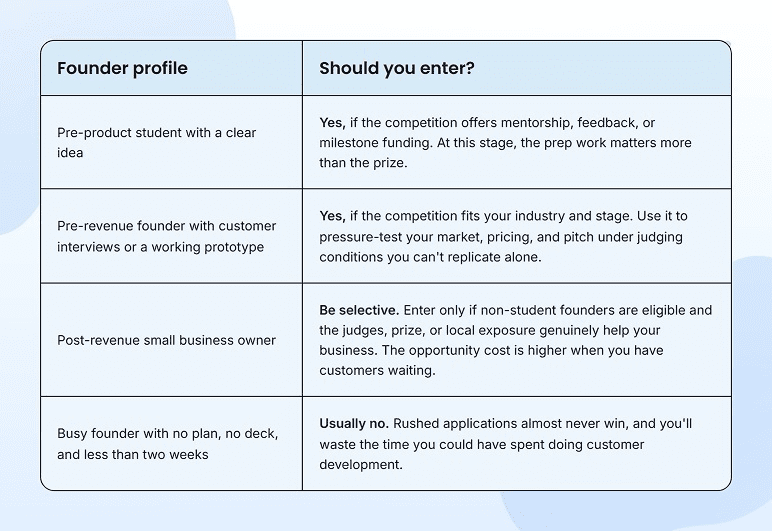
What I’d do is simpler than the math suggests. Enter when the work itself will make your business stronger, win or not. Skip it when the only thing pulling you in is the prize money. Those 40 to 60 hours usually do more for your business in customer conversations, unit economics, or shipping the next feature.
How to apply — a generic playbook for any business plan competition
If you plan to enter more than one competition, do not build everything from scratch each time.
Most founders lose the competition before the judging even starts. They miss a deadline, submit the wrong document format, or realize on application day that their team isn’t eligible. Here’s the order I’d actually work through if I had four weeks before the deadline.
Register early, even if your plan isn’t ready
Don’t wait until your business plan is polished to create an account. Some competitions have a limit on the number of applications accepted, require an account to be approved before you can submit anything, or require eligibility documents to be submitted prior to any submission. Make sure you register first and then work backwards from the deadline.
Read the rules carefully before writing anything
This is the one thing that gets the most teams disqualified. Verify eligibility (founder age, student status, geographic restrictions, restrictions on industry, etc.), required documents, length of video, intellectual property terms, and type of prize (cash, services, investment, etc., or reimbursement). If you can read the rules in 30 minutes, you won’t be spending 30 hours writing a plan that you won’t be able to submit.
Build one master business plan and pitch deck
Most competitions ask for the same story: problem, customer, solution, market, business model, traction, team, competition, financials, and funding use. Build one master version, then adjust it for each competition you enter.
Prioritize audio quality in the pitch video
If a pitch video is required, prioritize audio quality. Bad audio sinks a video faster than weak lighting or a busy background. Use a clear microphone (a $30 lavalier mic works), record in a quiet room, and do at least three takes.
Most pitch videos run 90 seconds to 4 minutes, so don’t try to cram the full business plan into a video. The goal is to make the judges want to read the rest of your application.
Submit at least one week early
Last-minute submissions go wrong in predictable ways: portal overload, files corrupt during upload, or a team member misses a signature deadline. Build in a one-week buffer before the actual deadline so you have time to fix upload issues, missing signatures, broken links, or formatting problems.
Methodology
Every competition on this list earned its spot through the same review. I went straight to the organizer’s official page for each one and pulled the following data:
- 2026 deadline
- prize structure
- who’s actually eligible
- how judging works
- whether the organizer has been active in the last two years
- whether the format makes sense for students, early-stage founders, or small business owners.
Prize size alone didn’t decide rankings. A six-figure prize means very little if the contest only takes graduate students from one school, or if half the “prize” is in-kind services. So I weighted the experience around the prize as heavily as the headline number: judge quality, mentor access, investor exposure, pitch feedback, and whether the winner walks away with a usable plan they can take to a lender or accelerator.
Where the prize blended cash, equity investment, and services, I broke those apart so readers can see what they’re actually competing for.
Four competitions didn’t make the cut. Pistoia Alliance President’s Startup Challenge and Oregon’s New Venture Championship had no active 2026 organizer page at publish time. U.Pitch was replaced with the Dempsey Startup Competition for the same reason. HATCH Pitch and the New York StartUP! Business Plan Competition stayed on the list because they remain relevant, but readers should verify the latest dates on the official page before applying.
Competition details shift constantly, so I’d recommend treating this list as a starting point rather than a final word. Last verified: May 14, 2026.
Conclusion
If you take one idea from this article, take this: the value of a business plan competition isn’t the prize. It’s the structure. The deadline forces a tighter plan. The application form forces you to articulate your customer. The judging panel forces you to defend your numbers in real time. Done seriously, a single competition application can compress six months of customer development into 60 focused hours.
I would use this lens to select which competitions I would enter. The eligibility, stage fitting, and maturity of the game are more important than the prize amounts. For the most part, it’s better to win a local $5,000 competition with a lot of feedback from the judges than it is to win a national $100,000 competition that you don’t fit the audience into.
So pick your two or three. Block the time on your calendar before you start writing. And if you don’t have a plan yet, grab our free business plan template and start there. The application form is much easier to fill out when the underlying plan already exists.
Ready to Enter a Business Plan Competition?
Put your business idea, numbers, and strategy into a clear plan.

Frequently Asked Questions
What should be included in a business plan for a competition?
Do I need to have a complete business to enter a business plan competition?
What are the benefits of participating in a business plan competition?
How do I prepare for a business plan competition?
Can business plan competitions help me get investors?
How much money can you win in a business plan competition?
Are business plan competitions worth it?
What do judges look for in a business plan competition?
Who can participate in a business plan competition?

Vinay Kevadia
Vinay Kevadiya is the founder and CEO of Upmetrics, the #1 business planning software. His ultimate goal with Upmetrics is to revolutionize how entrepreneurs create, manage, and execute their business plans. He enjoys sharing his insights on business planning and other relevant topics through his articles and blog posts. Read more