


 Download Now: Business Startup Checklist Template
You’ve got a business idea, maybe even a name picked out, and you’re ready to make it official.
The truth is, forming an LLC is simpler than it seems once you know the steps and the order. Most people get through it in a day or two, without a lawyer.
In this guide, I’ll walk you through how to form an LLC in 7 steps, the real costs (filing fees, registered agent, hidden ones), how long it takes, and what to handle after filing.
What is an LLC?
An LLC, or Limited Liability Company, is a business structure that separates you from your business legally.
If the business runs into trouble, like a lawsuit or unpaid debt, your personal assets, such as your house, car, and savings, are usually protected. The business is responsible, not you.
Why should you form one?
Most small business owners pick an LLC for four reasons:
1) It protects your personal assets
As a sole proprietor, you and your business are treated as the same. If a customer sues, your personal bank account and property can be used to cover it.
An LLC creates a clear separation, so your personal finances are not directly exposed.
2) You can choose how you’re taxed
By default, single-member LLCs are taxed like sole proprietors, and multi-member LLCs like partnerships. Profits go to your personal tax return, so there’s no separate business tax.
Later, you can choose to be taxed as an S-corp or C-corp if needed.
3) It makes your business look more serious
Adding “LLC” to your name builds trust. For example, “Acme Designs LLC” carries more weight than “John Smith, freelancer.”
Banks, suppliers, and larger clients tend to take registered businesses more seriously. Some will not work with sole proprietors at all.
4) Access to business banking, loans, and payment tools
Most banks won’t open a business checking account or hand you a business credit card without an LLC. The same goes for payment processors like Stripe and Square, business lenders, and platforms like Shopify or QuickBooks.
Without an LLC, you’re stuck running everything through personal accounts. That makes bookkeeping messy and weakens the legal wall between you and your business.
Who should NOT form an LLC?
An LLC isn’t always the right move on day one. You can probably wait if:
- You’re still testing the idea and not making money yet
- You’re a low-risk solo service provider with no employees, products, or physical setup
- You plan to raise venture capital (investors usually want a Delaware C-corp)
For most small business owners, forming an LLC makes sense once the business is active and earning.
How much does LLC formation cost?
LLC formation usually costs between $50 and $500, depending on your state. Most states fall in the $50 to $200 range, but a few charge more because of higher fees or taxes. That’s just the filing cost. Your total bill depends on how you set things up and how much help you use along the way.
There are four parts to the cost:
- State filing fee: The main cost to officially register your LLC.
- Registered agent: Every LLC needs one to receive legal documents. You can be your own agent for free or pay a service.
- Operating agreement: This explains how your LLC will run. You can write it yourself using a free template or pay a lawyer.
- Optional formation help: If you don’t want to handle the paperwork, you can pay a service to do it for you.
Here’s the cost breakdown:
| Cost Item | Low (DIY) | Medium (Basic Help) | High (Full Service) |
| State filing fee | $50 | $150 | $500 |
| Registered agent | $0 (self) | $100/year | $300/year |
| Operating agreement | $0 (free template) | $200 (online service) | $2,000 (attorney) |
| Formation help | $0 | $300 | $1,500+ |
| Total (Year 1) | $50 | ~$750 | $4,300+ |
Mid-tier costs assume you use online services for the operating agreement and formation. Attorney work runs significantly higher.
Are there any hidden or recurring fees I should know about?
Yes. This is where first-time LLC owners often get tripped up. The filing fee is a one-time charge, but most other costs come back every year.
- Annual or biennial report fee: $0 to $500, depending on the state. The Chamber of Commerce has a state-by-state breakdown if you want exact numbers.
- Franchise tax: Varies by state. California charges $800 every year, even if your business made nothing. Most states charge less or nothing at all.
- Registered agent renewal: $50 to $300 per year if you hire a service.
- Foreign LLC registration: If you form your LLC in one state but run your business in another, you’ll pay filing fees and a registered agent in both.
- New York publication requirement. If you form your LLC in New York, state law requires you to publish a notice in two newspapers (one daily, one weekly) for six consecutive weeks within 120 days of formation. Total cost: $600 to $2,000, depending on the county, plus a $50 Certificate of Publication fee.
How to form an LLC in 7 steps
Let’s walk through the actual process of forming one:
Step 1: Choose your state of formation
You’ve probably heard you should form your LLC in Delaware because of its business-friendly courts, low filing fees, strong privacy protections, and decades of corporate case law.
Don’t fall for it. This is the Delaware myth, and it’s the most expensive mistake first-time business owners make.
The rule is simple: form your LLC where you actually run your business. If you live and operate in Texas, form in Texas. If you live in Ohio, form in Ohio. This keeps you from paying for a registered agent and foreign LLC registration in two states.
A few cases where filing outside your home state makes sense:
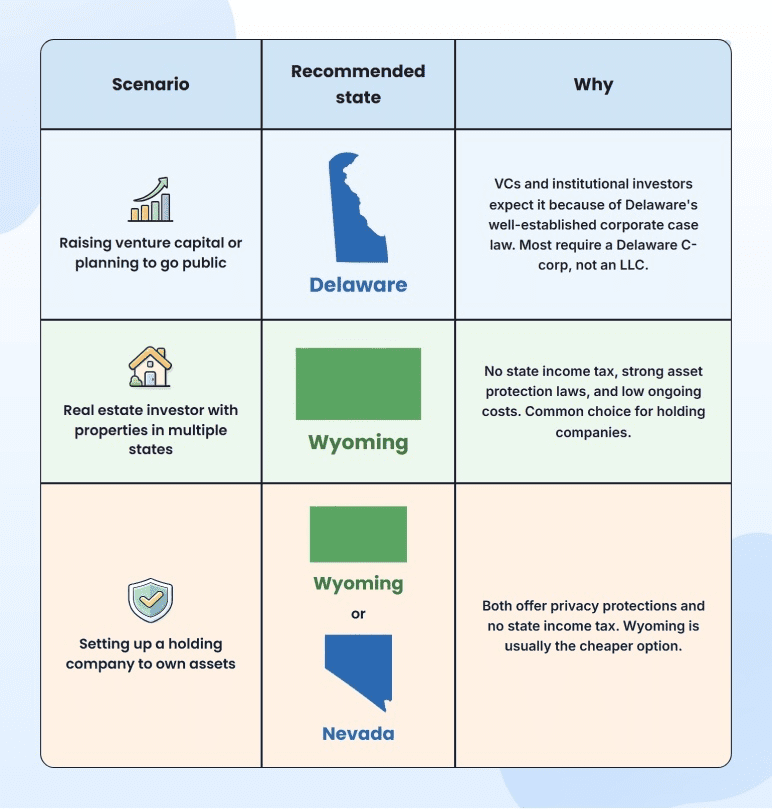
What happens if I choose the wrong state?
You pay twice. If you form your LLC in one state but run your business from another, you have to register as a “foreign LLC” in the state where you actually operate. That means:
- Filing fees in two states
- Annual reports in two states
- Registered agents in two states
- Franchise taxes or business taxes in both states
There’s also a legal risk most people miss. If you operate in a state without registering as a foreign LLC, that state can block you from suing in its courts. So if a customer or vendor stiffs you, you may not be able to take them to court until you sort out the registration.
This is why Wyoming and Nevada follow the same trap. They’re great if your business is genuinely based there. They’re a costly detour if it isn’t.
Can I change my LLC state later?
Yes, but it’s a hassle. You have two options:
- Dissolve and re-form. Close your original LLC and form a new one in your preferred state. You lose your formation date and have to redo all the paperwork (EIN, bank account, contracts).
- Domesticate or convert. Move your LLC from one state to another without dissolving it. Not all states allow this, and the process usually costs $200-$500 plus filing fees.
Easier to get the state right the first time.
Step 2: Name your LLC
Your LLC name is not just for branding. It must follow your state’s rules and be available in the state’s business registry. If your name doesn’t meet both, the state will reject your application.
Most states have three main rules:
- Must include “LLC” or “Limited Liability Company.” Some states also allow “L.L.C.” or “Ltd. Liability Co.” Check what your state accepts.
- Must be different from existing business names. Names like “Acme Designs LLC” and “Acme Design LLC” are usually too similar. Small changes like adding “the” or making it plural won’t work.
- Cannot use restricted words. Words like bank, insurance, university, attorney, and trust often need special approval. Some states also restrict words like FBI or Treasury. If you’re not licensed, avoid these.
How to check if your name is available?
Once you’ve got a name you like, run these four checks before you get too attached to it:
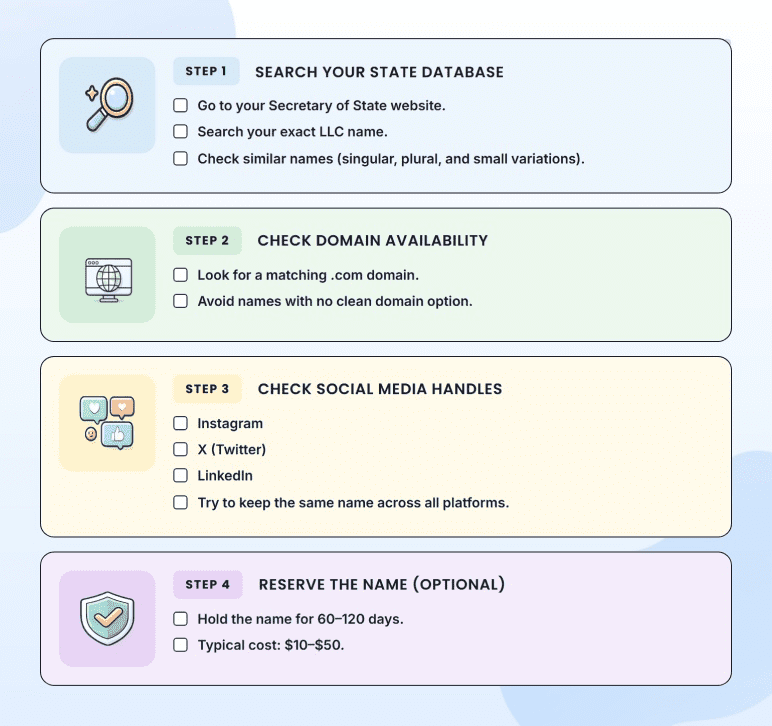
What happens if my name gets rejected?
Your filing comes back, and you have to pick a new name and start over. Most states won’t refund the filing fee either, so a rejection can set you back anywhere from $50 to $500, depending on where you live.
I covered the three naming rules above. Most rejections come from breaking one of them.
When a name gets rejected, the state usually spells out the reason. Fix the problem, file again, and you should be approved within the normal processing window.
Step 3: Appoint a registered agent
A registered agent is the person who receives the lawsuit if your business gets sued. They also receive tax notices, government letters, and any other official mail your LLC needs to handle.
Here are your three options:
| Option | Cost | Pros | Cons |
| Be your own agent | Free | No extra cost. Full control over the mail. | Your address becomes public record. You have to be available during business hours, every business day. |
| Appoint a trusted individual | Free or low cost | Cheaper than a service. Someone familiar handles your documents. | If they move, miss mail, or get unreliable, your LLC is at risk. Their address becomes public too. |
| Hire a commercial service | $100-$300 per year | Keeps your home address private. Documents are scanned and forwarded reliably. Professional handling. | Annual cost. One more service to renew. |
So which one should you pick? It comes down to your setup:
- If you have a public business address and you’re there during business hours → be your own agent.
- If you don’t want your home address on public record, or you’re not always around during business hours → hire a commercial service.
- If a reliable family member or attorney with a stable address is willing to do it → appoint them.
For most first-time business owners, a commercial service is the right call. The privacy alone is usually worth $100 to $300 a year.
Step 4: File your articles of organization
This is the step where your business actually becomes an LLC. You fill out a short form (usually 1-2 pages) and file it with your state’s business office, usually the Secretary of State.
One quick note: Not every state calls this form “Articles of Organization.” Texas, Delaware, and Mississippi call it a “Certificate of Formation.” New York calls it an “Articles of Organization.” Same form, different name.
Before you start, have these things ready:
- Your LLC name (you already picked this in Step 2)
- Your main office address
- Your registered agent’s name and address
- Names of the members or organizers
- Your management structure (member-managed or manager-managed)
- The effective date (today, or a future date if you want to delay the start)
You should already have most of this from earlier steps. Once everything is in front of you, the form takes about 15 to 30 minutes to fill out.
When the form is ready, you’ve got three ways to send it in:
- Online (recommended). Most states let you file through the Secretary of State website. It’s the cheapest and fastest way to do it, plus you get confirmation right away.
- By mail. Print the form, fill it out, and mail it in with a check. This adds at least a week to your wait time, and there’s no instant confirmation.
- In person. Some state offices take walk-ins. Only worth it if you live close by and want a same-day stamp on your paperwork.
How long it takes to get approved depends on the state and how much you want to spend. Standard processing runs 1 to 2 weeks in most places.
If you pay an extra $25 to $200 for expedited service, you can get it back in 1 to 3 business days. A couple of states, like Delaware and Nevada, will even do same-day processing for a higher fee.
Once it’s approved, the state sends back a stamped copy of your filing or a certificate of formation. Keep it safe. You’ll need that document to open a business bank account, sign contracts, and file your taxes.
Step 5: Create an operating agreement
An operating agreement isn’t required in every state, but skipping it is a mistake many new LLC owners make.
It works as the internal rulebook for your LLC. It explains who owns what, how decisions are made, and what happens if someone leaves.
Five states (California, Delaware, Maine, Missouri, New York) require it by law, but every LLC should have one.
Here are the 8 sections every operating agreement should include:
| Section | What It Covers |
| Member names and ownership | Who owns the LLC and their share |
| Capital contributions | What each member contributed (cash, equipment, services) and how future capital calls are handled |
| Management structure | Member-managed (owners run it) or manager-managed (a hired manager runs it) |
| Profit and loss distribution | How profits and losses are shared (usually based on ownership, but can be changed) |
| Voting and decision-making | How decisions are made (majority or unanimous) |
| Buy-sell provisions | Right of first refusal, valuation method, and triggers for buying out a departing member |
| Member changes | What happens if a member leaves, dies, or sells their share |
| Dissolution | How the LLC is closed if members decide to end it |
You don’t need a lawyer for this. Free templates work for most single-member and simple multi-member LLCs. Just sign it, date it, and keep it with your LLC records.
What happens if I don’t have an operating agreement?
Two things can happen, and both are problems.
First, your state’s default rules take over. Profits may be split equally, even if contributions are different. Decisions may require everyone to agree. Adding or removing members can get complicated.
Second, your liability protection can weaken. Without a written agreement showing the LLC is separate from you, a court may treat the business and the owner as the same. This is called “piercing the corporate veil,” and it can put your personal assets at risk.
Step 6: Get an EIN from the IRS
Your LLC needs one more thing before you can open a bank account: an EIN. Getting an EIN for LLC is free and takes 5 minutes.
An EIN (Employer Identification Number) is your LLC’s tax ID. Think of it like a Social Security Number (SSN) for your business. The IRS uses it to track taxes, banks need it to open accounts, and clients use it to send tax forms at the end of the year.
You only need an EIN if you have employees, more than one member, or plan to choose S-corp or C-corp taxes. But it’s better for every LLC to get one. Most banks won’t open a business account without it.
Also, using your personal SSN for business can blur the line between you and your LLC, which defeats the purpose of having one.
Here’s how to get one in 5 minutes:
- Go to IRS.gov and click “Apply for an EIN online.“
- Answer the questions about your LLC (name, address, member info, what kind of business).
- Submit the form.
- Get your EIN immediately on the confirmation screen. Save the PDF.
The application is only available Monday-Friday, 7 a.m. to 10 p.m. Eastern. If you’d rather apply by mail, fill out Form SS-4 and send it in. That route takes 4-5 weeks.
Don’t pay anyone for this. Third-party services charge $50-$300 to “help” you get an EIN, but they’re just filling out the same free form on your behalf. Same number, same processing time, hundreds of dollars out of your pocket.
Step 7: Open a business bank account
You’ve got your LLC and your EIN. The last setup step is separating your money.
A business bank account keeps your LLC functioning as a real, separate legal entity. Without one, you’re paying business expenses and receiving client payments through a personal account. That’s the same risk we covered in the operating agreement section: a court can decide your LLC isn’t really separate from you.
To open one, most banks will ask for:
- Your EIN confirmation letter (the IRS sent you a PDF after Step 6)
- Your filed articles of organization (the stamped copy from your state)
- Your operating agreement (signed and dated)
- A government-issued photo ID for every owner
Most banks will get you set up in 30 to 60 minutes, either in person or online. While you’re there, ask for a business debit card too. It’s free with most accounts and lets you pay for business expenses directly from the LLC’s funds.
Once the account is open, consider applying for a business credit card. Even if you don’t use it heavily, it starts building your LLC’s credit history, which matters when you apply for a loan, a lease, or vendor terms down the road.
Let AI draft your first business plan

What to do after forming your LLC?
Your LLC is formed. Now you need to keep it in good standing. Here are the 5 things to handle in your first 30-90 days:
| Task | Deadline | Where to File |
| File annual or biennial reports | Every year or every 2 years (depends on state) | Secretary of State |
| Get business licenses and permits | Before you start operating | City, county, and state offices |
| Understand your tax options | Before your first tax filing | IRS and your CPA |
| Get business insurance | As early as possible | Any business insurance provider |
| Confirm BOI reporting status | U.S. LLCs are currently exempt | FinCEN.gov |
File annual reports
Most states require a report every year or every two years to keep your LLC active. This report confirms your business name, address, registered agent, and members. Fees can range from $0 to $800.
The deadline is usually based on your formation date. If you miss it, you may have to pay a late fee. If you delay too long, the state can dissolve your LLC, which means you lose your liability protection.
Get business licenses and permits
Forming an LLC makes your business legal, but it doesn’t give you permission to operate. Business licenses and permits are a separate step.
What you need depends on your business and location:
- General business license
- Professional license
- Health permit
- Zoning permit
Check with your city, county, and state to see what applies.
Understand your LLC’s tax options
By default, single-member LLCs are taxed as sole proprietors (Schedule C), and multi-member LLCs as partnerships (Form 1065). Both are pass-through: profits flow to your personal tax return.
Two other options once you start making real money:
- S-corp election (Form 2553). Useful when LLC profits exceed $40,000 to $50,000 a year. Reduces self-employment tax by splitting income between salary and distributions.
- C-corp election (Form 8832). Rarely useful for small businesses. Mostly for LLCs raising outside investment.
Talk to a CPA before changing anything. The wrong election can cost you more than it saves.
Get business insurance
An LLC protects your personal assets. It doesn’t protect the business itself. If someone sues your business or gets hurt on the job, your business’s money and assets are still at risk.
The two policies most owners start with:
- General liability: Covers injury and property damage to others (about $400 to $800 per year)
- Professional liability (E&O): Covers claims related to your work
You may also need:
- Workers’ comp (if you have employees)
- Commercial auto (if you use a vehicle for work)
- Cyber liability (if you handle client data)
A commercial insurance broker can walk you through options from different providers and help you compare.
Confirm BOI reporting status
Beneficial Ownership Information (BOI) reporting used to require most LLCs to file ownership details with FinCEN within 30-90 days of formation.
As of March 26, 2025, FinCEN issued a rule that exempts all U.S.-formed LLCs. As of this writing, U.S. LLCs are still fully exempt.
If your LLC is formed in the U.S., you don’t need to file. Foreign-formed entities registered to do business in the U.S. still need to file.
This rule may change. Check FinCEN.gov/boi to stay updated.
LLC vs. other business structures
An LLC is not the only option, but for most small businesses, it gives a good balance of protection and simplicity. Here’s how it compares to other common structures:
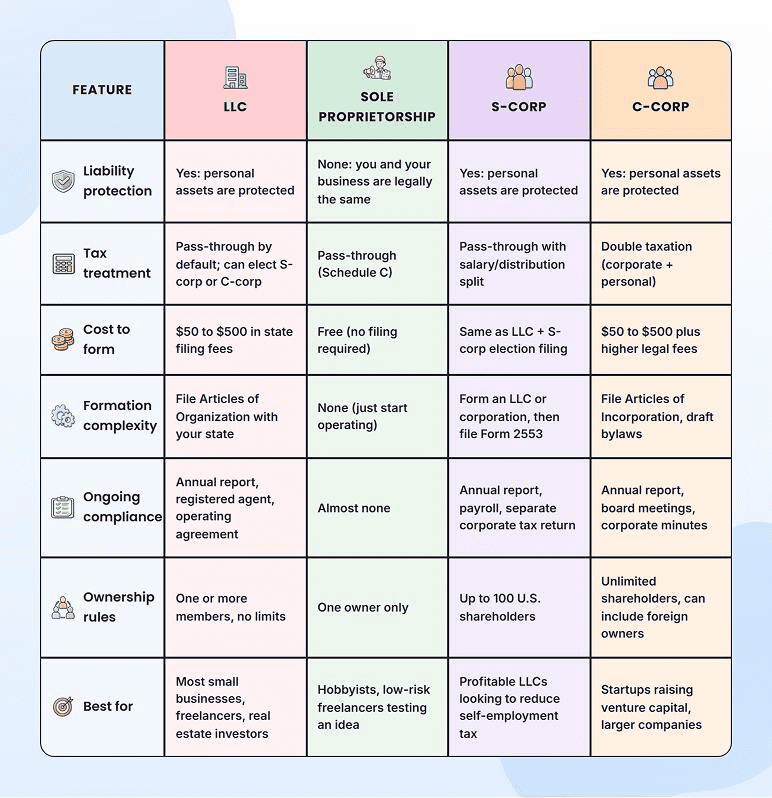
When you compare it to other structures, it stands out as a practical choice. You get liability protection similar to a corporation, but without the complexity of heavy paperwork or the issue of double taxation. That’s why many small business owners prefer it.
For more details, see the SBA’s business structure guide.
Can I switch structures later?
Yes, but how easy it depends on the change.
Changing how your business is taxed is simple. For example, to switch your LLC to S-corp taxation, you file Form 2553 with the IRS. Your legal structure stays the same.
Changing the legal structure is harder:
- Going from a sole proprietorship to an LLC means filing new paperwork and starting fresh
- Changing from an LLC to a C-corp usually means closing the LLC and forming a corporation (unless your state allows a direct conversion)
Pick the structure that fits your business today. You can change it later if needed.
Plan your LLC’s future with a business plan
Forming your LLC makes your business legal, but a business plan makes it viable. Most new business owners skip this step and regret it within the first year.
A business plan forces you to answer the questions you’ve been avoiding: How much do you need to make to break even? Who’s going to buy from you? What happens if your first marketing channel doesn’t work?
Three things every new LLC owner should plan:
- Financial projections. How much do you need to make to break even, at what price, and how soon?
- Market analysis. Who’s your customer, and who else is already selling to them?
- Funding strategy. Are you paying for it yourself, getting a loan, or pitching investors?
You don’t need a long document at the start. A one-page plan is enough. You can expand it later for a loan or investors. If you don’t want to start from scratch, Upmetrics offers 400+ sample plans and a financial forecasting tool for new LLC owners.
Common mistakes to avoid
Most LLC mistakes happen because of bad online advice or skipped steps. Here are the four most common ones to avoid:
1) Forming in Delaware “for the tax benefits.”
People file in Delaware after watching a random YouTube video, not realizing they’ll have to pay fees in two states. The “tax savings” don’t exist for most small businesses. (See Step 1.)
2) Skipping the operating agreement because it’s not legally required.
Most states don’t require one, so people skip it. Then a partner leaves, profits get disputed, or a court treats the LLC as the same person as its owner. (See Step 5.)
3) Using one bank account for both personal and business spending.
It seems harmless when revenue is small. But if the LLC ever gets sued, mixing funds is what convinces a court to ignore the LLC entirely. (See Step 7.)
4) Treating the LLC as “set and forget.”
People file the paperwork, then never think about it again. Then the annual report deadline hits, the state dissolves the LLC, and the protection they paid for vanishes. (See the post-formation section.)
Conclusion
That’s the whole process. Seven steps, an afternoon of paperwork, and you’re a legal LLC owner.
The path from here is simple. Open your state’s Secretary of State website, check that your business name is available, and start filing. Most people are done within a week.
Once the LLC is in place, planning what comes next matters just as much as the steps you just read about. A business plan turns your idea into something you can run, fund, and grow. That’s where the work actually begins, and where Upmetrics can help.
The Quickest Way to turn a Business Idea into a Business Plan
Fill-in-the-blanks and automatic financials make it easy.

Frequently Asked Questions
Can I form an LLC by myself without a lawyer?
How long does it take to form an LLC?
Do I need a registered agent for my LLC?
What is the cheapest state to form an LLC?
Can a single person form an LLC?
What is the difference between an LLC and a sole proprietorship?

Joe Onderko
Joe Onderko is a manufacturing and business management expert with over 35 years of experience in operations, product development, and leadership. He’s worked with global companies in the consumer products, automotive, and industrial sectors, helping them modernize operations, improve efficiency, and grow stronger. He also writes about manufacturing, leadership, and smart business strategy. Read more