


OpenAI started in 2015 without a product or business model. What it had was a mission and backers willing to commit $1 billion.
Today, it’s one of the biggest names in technology.
So I reviewed a 13-slide sample deck based on OpenAI’s GPT-4-era business, to see how it sells such a complex idea so simply.
Because that’s the real lesson here: a strong pitch doesn’t explain everything. It makes a big idea easy to understand.
Let’s get into it.
OpenAI pitch deck analysis (slide-by-slide)
For each slide, I’ll cover what it presents, what works, what falls short, and what you can apply to your own deck.
Slide 1: Title
The deck opens clean and confident: “Introducing Chat GPT-4,” with the OpenAI brand front and center.
The minimal approach feels deliberate. It suggests authority without over-explaining, and sets a serious, premium tone from the first slide.
Takeaway: Don’t overthink your title. A strong product name and brand carry weight on their own.
Slide 2: Introduction
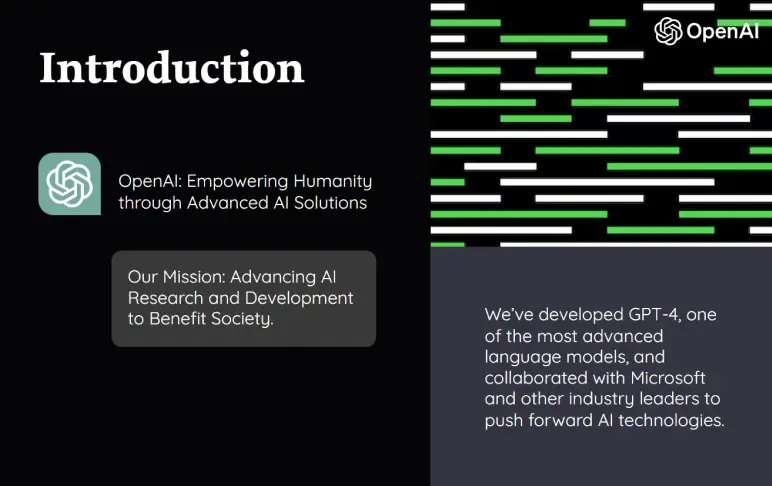
This slide sets a mission-driven tone right away, leading with OpenAI’s goal of “empowering humanity through advanced AI solutions.”
What makes it land is the proof behind the mission. GPT-4 shows technical leadership, and the Microsoft mention signals real backing. Vision on its own can feel thin; vision plus proof feels credible.
Takeaway: Pair a mission-led intro with proof, like a major partner or result, to build trust and align investors with the bigger purpose.
Slide 3: Problem
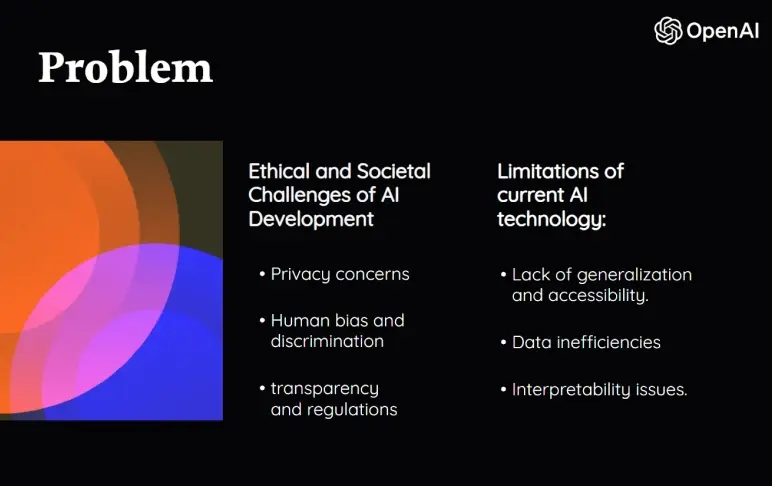
For me, this is one of the strongest slides. It doesn’t shy away from the real issues: privacy, bias, transparency, and regulation.
It also names the technical limits, like poor generalization, data inefficiency, and interpretability. That makes the problem feel tangible and serious, and shows there’s real work (and real value) in solving it.
Takeaway: Naming the hard challenges builds trust and proves there’s a meaningful problem worth solving.
Slide 4: Solution
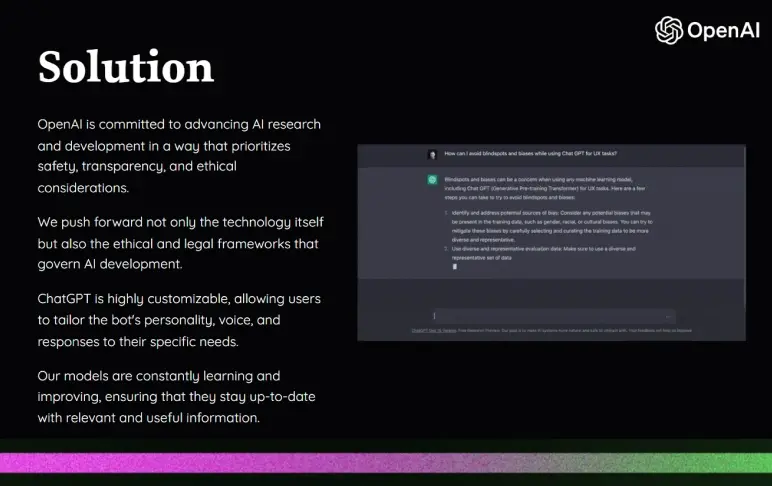
This slide shows how OpenAI tackles the problem, with a focus on safety, transparency, and ethics.
What I like is that it’s not just about building powerful tech. It’s about making that tech responsible and customizable. The slide signals they understand the risks and take doing AI the right way seriously.
Takeaway: A thoughtful, ethical solution helps investors trust both the technology and the team behind it.
Slide 5: Product
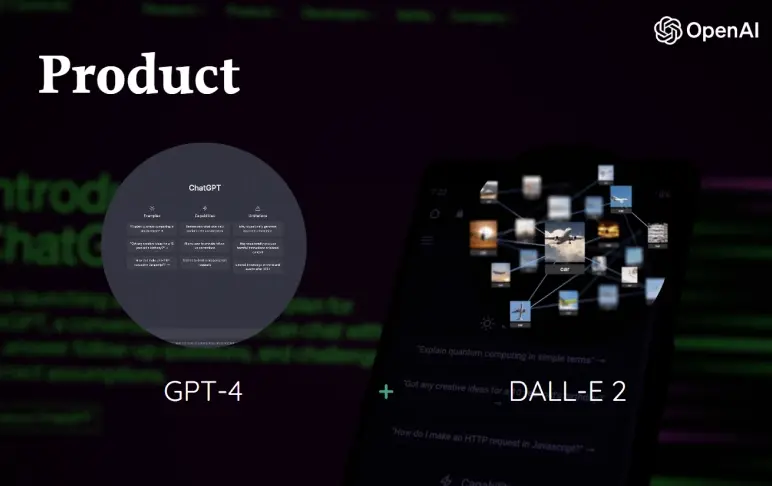
Here, the deck highlights two flagship products: GPT-4 for text and DALL·E 2 for images.
The “+” between them is a small but smart touch. It shows the two work together, proving range across language and visuals. It positions OpenAI as a versatile platform, not a single-product company.
Takeaway: When your product is strong, let it speak for itself. Show the core.
Slide 6: Market Size
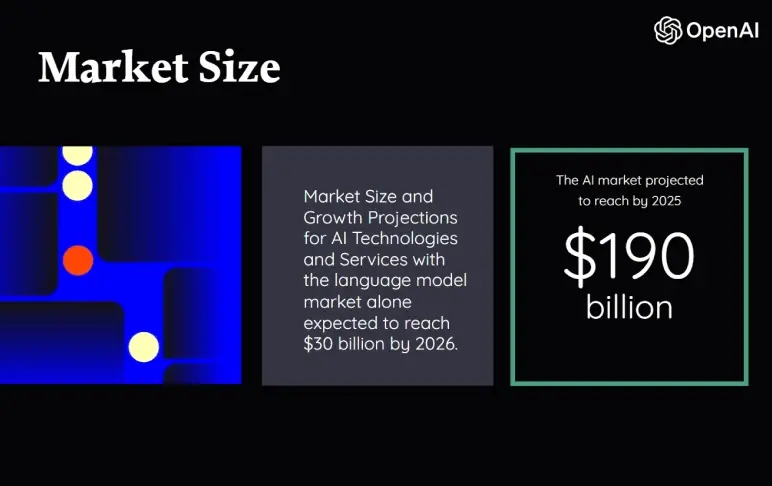
This slide leans on big numbers: a $190 billion AI market by 2025, and $30 billion for language models alone by 2026.
I think the numbers work because they feel believable, not inflated. They show serious room to grow and give investors a reason to buy into the ambition.
Takeaway: Use real, believable market numbers to show there’s enough room for your business to grow.
So what’s next?
Take these lessons back to your own pitch deck.
Check the basics: is your title clear, does your solution answer the problem, is it obvious which product makes the money? Small fixes like these are often what turn a maybe into a meeting.
And if you don’t know where to start, Upmetrics can help. Our AI pitch deck generator turns your idea into a clear, investor-ready deck in minutes.
(Also, here’s the link to OpenAI’s original pitch deck, if you’d like to have a look.)
Until the next time,
Happy business planning 🙂

Vinay Kevadia
Vinay Kevadiya is the founder and CEO of Upmetrics, the #1 business planning software. His ultimate goal with Upmetrics is to revolutionize how entrepreneurs create, manage, and execute their business plans. He enjoys sharing his insights on business planning and other relevant topics through his articles and blog posts. Read more
