


Business plan template you can fill in today
Eleven chapters across 31 pages, written in plain language, with instructions in every one so you are never staring at a blank page. Built to the format SBA lenders expect. No email required.
- Fill-in-the-blank prompts in every section
- Financial tables already structured
- Word, Google Docs or PDF, whichever you work in
 Word
 Google Docs


Eleven chapters across 31 pages
Every section opens with an explanation of what belongs there and prompts to answer. You are filling in blanks, not inventing a structure.
The quick pitch: executive summary
The page a lender reads first. Write it last, once the other ten give you something to summarise.
- Vision statement
- Market opportunity
- Financial highlights
Business overview
What the business is, who owns it, and how it is registered.
- Legal structure
- Mission statement
- Goals and objectives
Market analysis
Who buys, how many of them there are, and what rules you trade under.
- Market size and growth
- Target market
- Regulatory compliance
Competitive analysis
Its own section, not a paragraph inside market analysis. Lenders read this one closely.
- Key competitors
- SWOT analysis
- Competitive advantages
Product and services
What you sell, what it costs you, and what you charge for it.
- Benefits to customers
- Pricing strategy
- Future expansion
Sales and marketing strategies
How people find out you exist, and what happens between interest and payment.
- Unique selling proposition
- Marketing plan
- Customer retention
Operations plan
The day-to-day: what has to happen every week for the business to run.
- Staffing and training
- Suppliers and vendors
- Technology and tools
Management team
With no trading history this section carries more weight than any forecast.
- Owner profile
- Organizational structure
- Advisory board
Financial plan
The longest section, and the one with the tables already laid out for you.
- Profit and loss, cash flow, balance sheet
- Break-even analysis
- Funding needs and use of funds
Risk management
What could go wrong and what you would do about it. Often the section that separates a serious plan from an optimistic one.
- Risk identification
- Mitigation strategies
- Legal compliance risks
Exit strategies
How you or an investor eventually get your money back out.
- Acquisition targets
- Succession planning
- Public offering
This is what you are actually getting
Three real pages from the file, not a mockup. Most template pages ask you to download thirty-one pages sight unseen.
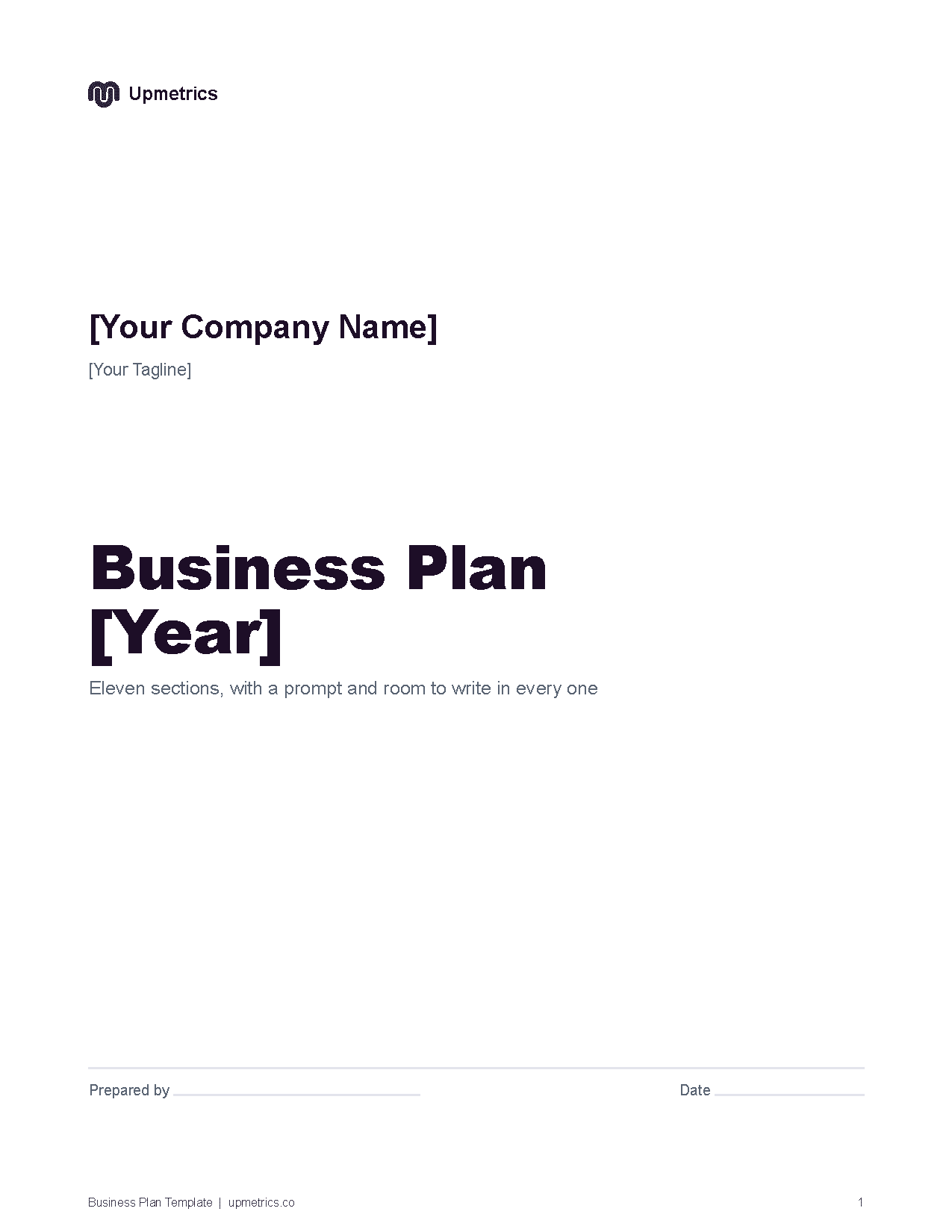
The cover
Your name, tagline and logo drop straight in. Page one of thirty-one.
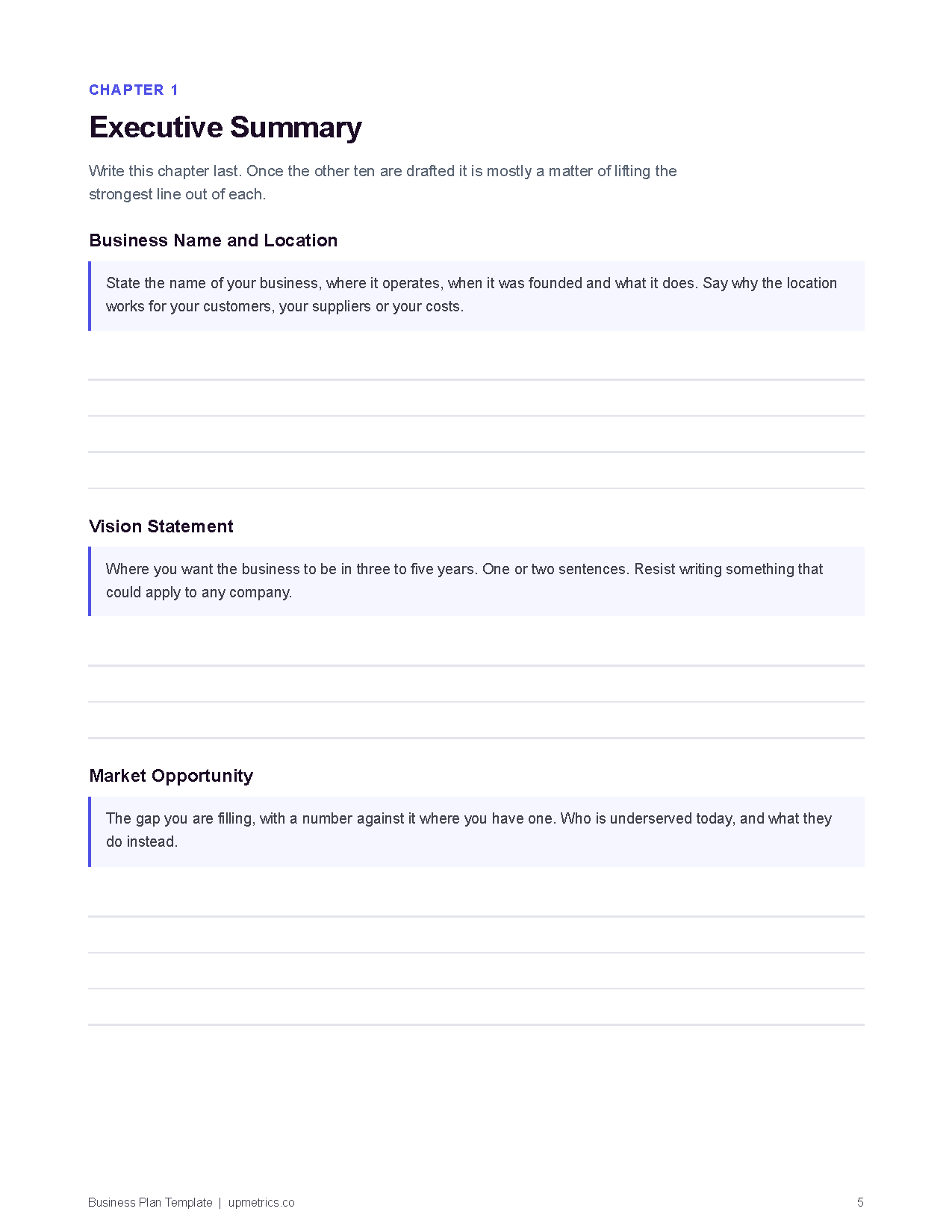
Every chapter has prompts
A Help Tip under each heading saying what belongs there, so you are never looking at a blank page.
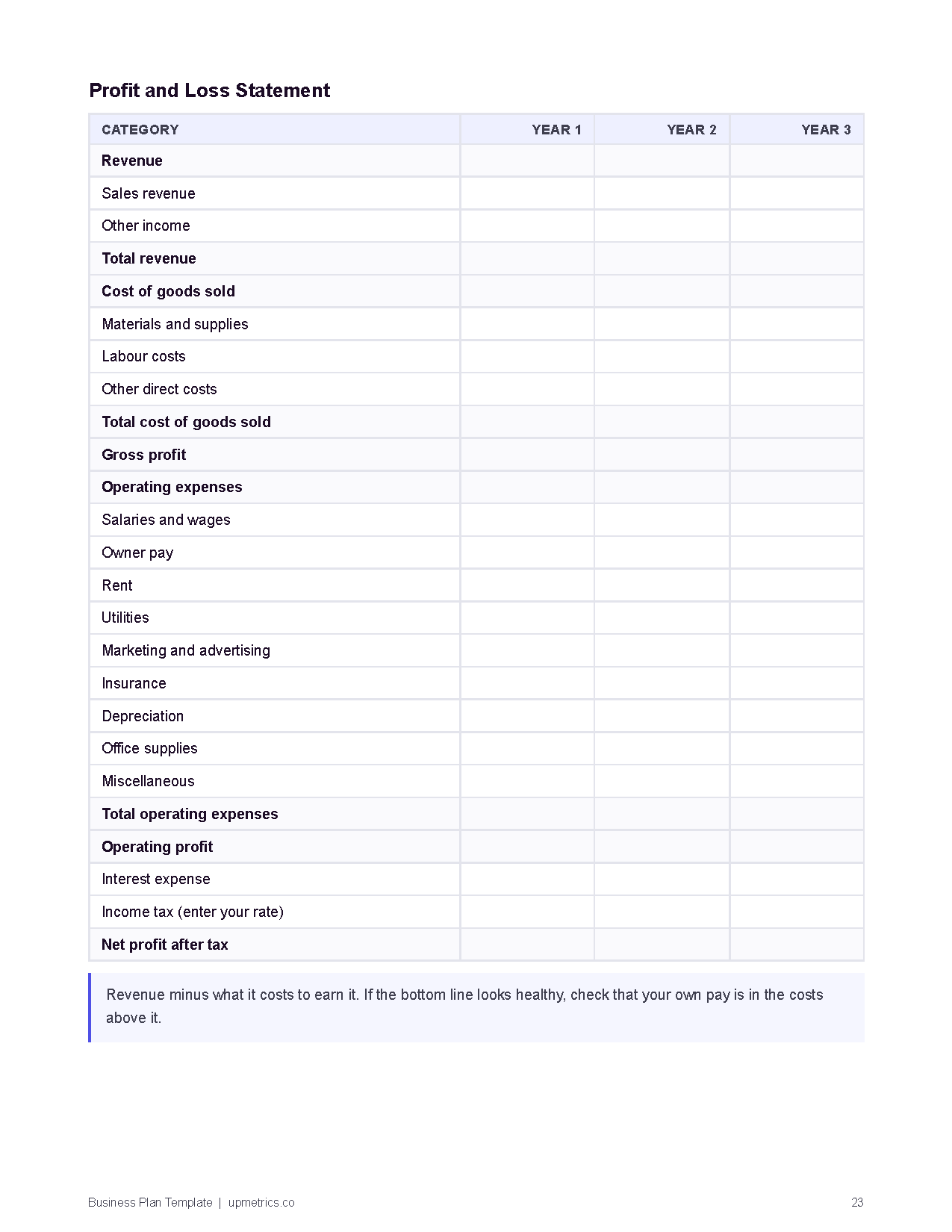
The financial tables are built
Profit and loss, cash flow and balance sheet each get their own page, laid out as tables already. You fill in numbers, not formatting.
How to fill it in without stalling halfway
The sections are numbered in the order a reader wants them. That is not the order you should write them in.
Start with the facts, not the thinking
Company overview, products and services, and the team section are mostly things you already know. Fill those in first. They take an evening, they get three of the eleven chapters done, and you stop staring at a blank document.
Do the market section with a browser open
Competitor pricing, how many similar businesses trade nearby, what customers say in reviews about what is missing. This is research, not recall. An hour of actually looking produces a stronger section than a day of guessing.
Build the financials from one unit upward
What you charge for one thing, what that one thing costs you, how many you sell in a week. Everything in the financial plan scales from those three numbers. Starting from a revenue target and working backwards produces figures nobody believes, including you.
Write the executive summary last
It sits at the front and gets read first, which is why people write it first and then rewrite it three times. Once the other ten sections exist, the summary is largely a matter of lifting the strongest line from each.
Do not skip risk management and exit strategies
They are the last two sections and the first two people leave out, usually because the business has not failed yet so the risks feel hypothetical. A lender reads them as evidence you have thought past the optimistic case. Half a page each is enough.
What a finished executive summary looks like
Section one of eleven, written out for a made-up bakery, with a note on what each paragraph is doing. Five short paragraphs is the whole thing. Length is not what makes it work.
That is 190 words. Write it last, once the other ten sections have given you something to summarise, and it takes about twenty minutes.
PDF, Word or Google Docs
Same template either way. Choose the one that matches what you are about to do with it.

Business plan template PDF
Print it, or write into it with any PDF reader. The format to hand across a desk at a bank meeting.
Best for printing and sharingBusiness plan template in Word
A real .doc, not a PDF with a different name. Headings, tables and spacing stay editable.
Best for writing and editingBusiness plan template for Google Docs
One click copies the template straight into your Drive, formatting intact. Share it with a co-founder and you can both write in it at once.
Best for working with someone elseWriting it yourself? Upmetrics gets you there 2x faster.
A template is not always the right tool
Two of these are free and one of them is this page. Worth two minutes before you spend a weekend writing the wrong document.
| Best for | What it costs | Where it runs out | |
|---|---|---|---|
| A blank document | Thinking something through for yourself, where nobody else will read it | Free, and about three times longer | You will forget sections. Everyone does. The ones people skip are competitive analysis and risk, which are the two a lender checks. |
| A spreadsheet | When the real question is only the numbers and you already know the business | Free, if you can build a cash flow | No lender accepts a spreadsheet as a business plan. It is the financial section, not the plan, and it says nothing about who buys or why. |
| This template | Most cases. You need the full structure and you are willing to write it | Free, roughly a weekend of work | It gives you the structure and the prompts. It will not check your arithmetic, and the financial tables are yours to fill in by hand. |
| Planning software | When the financials are the hard part, or the plan has to stay current after it is written | Paid, a few hours | Overkill if you need one document once. Worth it if the projections have to hold together while you keep changing them. |
Is this the right template for you?
It suits most situations, but not all of them. Here is where it fits and where something else would serve you better.
A good fit if
- You are applying for a bank or SBA loan and have been asked for a plan
- You are starting out and want to pressure-test the idea before committing money
- You need a document a landlord, supplier or licensing body will accept
- You are running an existing business and want a plan you can review quarterly
- You want the financial tables laid out rather than building them yourself
Look elsewhere if
You are pitching investors in a meeting
A pitch deck does that job; a written plan is the follow-up document
You want something you can finish in an afternoon
The one page version covers the same ground in far less detail
You want to see a finished plan before writing your own
You would rather not write it at all
Where business plans usually go wrong
Six things a lender or investor notices immediately, and what to do instead. Worth a read before you send yours anywhere.
Quoting the size of the whole industry.
A reader does not care that the sector is worth billions. They care how many people within a few miles of you will buy, how often, and at what price. Narrow it until the number is one you could defend.
Revenue that rises in a smooth line with nothing behind it.
Name the cause of every step up: a second member of staff, a price rise, a new channel. If a line moves and you cannot say why, flatten it.
Claiming there is no competition.
There always is, even if it is people doing nothing or doing it themselves. Saying otherwise reads as not having looked. Name three and say honestly what each does better than you.
Treating a sale and getting paid as the same event.
Profitable businesses run out of money in the gap between invoice and payment. Put your real payment terms into the cash flow, including the customers who pay late.
Opening with the company history.
Lead with what the business does, who buys it, and what you are asking for. A lender decides whether to keep reading in the first paragraph.
Writing it once and never opening it again.
The plan is most useful as something you check against. Diarise a review every quarter and compare what happened to what you wrote.
Looking for something more specific?
The template above works for most businesses. These cover the cases where the standard version is not quite the right fit.
Startup business plan template
For a business that has not started trading. How to forecast from assumptions and what to put in the team section with no track record behind it.
Small business plan template
For a business that already trades. Writing from your own accounts rather than assumptions, and what a lender, a landlord and a partner each read first.
Simple business plan template
Six chapters instead of eleven, for when the decision in front of you does not need forty pages. Says which four to cut and why.
One page business plan template
The whole business on a single sheet, with a sentence budget per box and a worked example. Good for deciding, not for a loan application.
Nonprofit business plan template
Programs instead of products, a funding mix instead of revenue, plus the governance and impact sections grant committees score directly.
5 year business plan template
Year one month by month, years two to five as annual totals, with the financial tables already set up for the longer horizon.
400+ filled-in examples
Complete plans with real financials, sorted by industry. Useful when you want to see what a finished section looks like before writing your own.
Writing a plan for an SBA loan
What lenders look for section by section, and the parts applications usually fall down on.
Template for students
A lighter version for coursework and competitions, without the lender-facing financial detail.
E2 visa business plan
The additional evidence an immigration case needs on top of a standard plan.

The template gives you the structure. Upmetrics builds the financials.
Three-year projections, cash flow and a balance sheet that update themselves as you change a number.
- No risk
- Cancel at any time
- 15 Day money back guarantee