


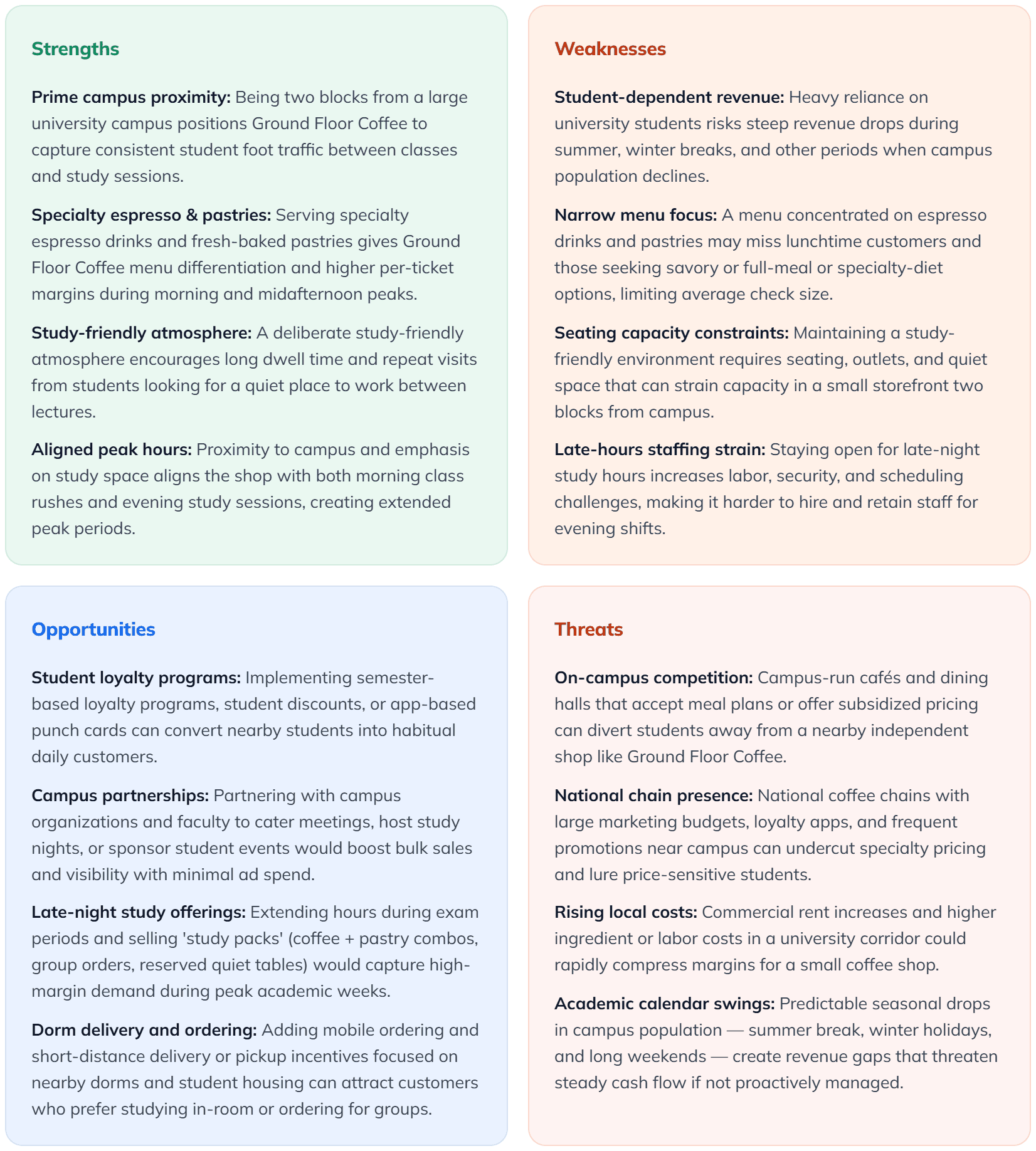
What is a SWOT analysis?
A SWOT analysis is a simple framework for sizing up a business or a decision. It breaks things into four categories: Strengths, Weaknesses, Opportunities, and Threats. Strengths and weaknesses look inward, at what the business already controls. Opportunities and threats look outward, at the market around it.
Say you run a coffee shop near a college campus. A strength might be steady foot traffic from students. A weakness might be limited seating during peak hours. An opportunity might be a new office building opening two blocks away. A threat might be a chain coffee shop moving in down the street – worth checking with a competitor analysis if you want to go deeper on that side.
The four categories only become useful once you connect them to each other, not just list them separately.
How to use this generator
Describe your business or the specific situation you want to analyze in a sentence or two. Specific input gets a specific result: “a coffee shop near a college campus, open 7am to 3pm” works better than just “a coffee shop.”
The generator returns four short lists, one for each SWOT category, based on what you described. Treat the output as a starting draft, not a finished analysis. Edit out anything that doesn’t actually apply to your business, and add anything specific to your situation that the generator couldn’t know about.
What to do with your SWOT analysis
1. Match strengths to opportunities
Look for places where a strength puts you in a good position to capture an opportunity. A coffee shop’s steady student foot traffic is a strength that lines up directly with the opportunity of a new office building nearby, both are built-in demand you don’t have to go find.
2. Address weaknesses that threats could expose
A weakness becomes urgent when a threat targets it directly. Limited seating is a minor weakness on its own. It becomes a real problem once a chain competitor with more space opens nearby, since customers now have a reason to go elsewhere.
3. Keep it specific
“Good customer service” is not a strength you can act on. “Average wait time under 90 seconds” is. Generic items in any SWOT category are a sign to dig one level deeper before using the analysis to make decisions.
Common mistakes to avoid
Treating it as a one-time exercise
Markets shift. A SWOT analysis from a year ago may list opportunities that are already gone or threats that never materialized. Redo it when something meaningful changes: a new competitor, a new location, a new product line.
Listing too many items per category
Three to five entries per category is usually enough. A list of fifteen “weaknesses” dilutes the ones that actually matter and makes the analysis harder to act on.
Skipping the opportunities and threats
Many business owners are comfortable listing their own strengths and weaknesses but skip the external categories, since they take more research. Opportunities and threats are what turn a SWOT analysis from a self-assessment into a planning tool. Carry them into a one-page business plan to put that thinking to work.