


Every other day, there’s some AI company launching a new feature or model or rolling out some kind of update.
- ChatGPT can do deep research now
- Gemini can now generate music
- Claude’s writing can now beat humans to dust
These tools keep getting better, and most of them are still free.
So when writing a business plan, you have to wonder: what could a dedicated tool like Upmetrics possibly do that these AI tools can’t?
And, I genuinely think, it’s a fair question.
I spent a few hours last week, testing what it’s like to use these AI tools to create an actual, lender-ready plan.
While they impressed me initially, I was frustrated at times with back-and-forth prompting, hallucinated numbers, and copy-pasting.
In this article, I’m comparing Upmetrics and generative AI tools feature by feature so you can see exactly where the gaps are and decide what makes sense for your plan.
What generative AI tools can (and can’t) do for business planning?
I’ll have to give credit where it’s due. If you’re starting from square one, don’t know where to start, what questions to ask, what sections to plan, AI tools are genuinely helpful. I mean, if you ask ChatGPT to create a plan outline or draft an executive summary, you’ll get a usable first draft, almost instantly.
Or if you need to brainstorm revenue streams for your bakery? Claude will give you ten ideas before you finish typing.
These tools are great for getting words on the page quickly, brainstorming ideas you hadn’t considered, rewriting sections in a different tone, and providing a rough starting point for market research.
For overcoming that blank-page paralysis, they’re hard to beat.
But the moment you try to use them as an actual planning tool, you’ll notice how much back-and-forth is involved.
Imagine:
- You generate a section in ChatGPT, then paste it into a doc.
- You ask for financial projections, but the numbers are just text, with no formulas behind them.
- You spot a wrong growth rate, say you planned for 20% monthly but need to bring it down to 10%. In a tool like Upmetrics, you change one number and everything recalculates.
In ChatGPT, you reprompt and get an entirely new response, sometimes with different assumptions you didn’t ask for.
- Then there are the charts that don’t match your numbers,
- the market stats that look real but can’t be verified, and the constant jumping between your AI tab, spreadsheet, and document.
And if you’re on a free tier, the responses get even less reliable. It all adds up to a process that feels productive but keeps circling instead of moving forward.
Before we break down all these can’ts, let me clarify what gen AI tools I’ll be referring to throughout this article and what they’re known for.
The three Gen AI tools entrepreneurs use most
When someone says using Gen AI tools for business planning, they usually mean one of these three tools.
- ChatGPT (OpenAI) is the most popular, known for its conversational depth and deep research capabilities.
- Google Gemini stands out for generating visuals and pulling in real-time search data.
- Claude (Anthropic) is arguably the strongest writer of the group, producing refined, well-structured text.
Each one has its strengths, and this comparison applies to all of them, not just ChatGPT.
Where ChatGPT, Gemini, and Claude fall short for business planning
I experienced these first hand while testing these tools for my video, and you’ll most likely hit the same walls as you try. Feel free to test these with your own business idea and see what happens. Anyways let’s discuss these in detail:
Note: for each issue associated with these tools, I’ve mentioned how that aspect is handled differently within Upmetrics. (For your reference)
1) The copy-paste workflow: generate in AI, paste into Docs, financials in Excel, charts somewhere else
The most annoying thing about using these tools is that you’ll end up managing five different tabs at once. You draft in ChatGPT, paste into Google Docs, build your projections in a spreadsheet, create charts somewhere else, and try to format all of it into something presentable.
Every time you update a number, you’re checking three places to make sure everything still matches.
2) No structured template that follows what funders expect (Prompts matters the most)
These tools generate whatever you prompt. They don’t know what an SBA lender requires, what sections you’re missing, or whether your plan is actually complete.
For instance, when I tried ChatGPT, halfway through, I realized there was no cover page, no table of contents, and no way for the tool to tell me what I’d missed. You’re guessing and hoping you’ve covered everything.
3) No formula-based financial model. Change one number, and redo everything
Try this: give all your financial assumptions (revenue, expenses, etc.), and ask it to build a 3-year revenue forecast. Now ask it to recalculate if you change your monthly growth rate from 20% to 10%. It won’t update the table. It’ll generate an entirely new one, often with different assumptions you didn’t ask for.
You can’t just edit one cell. You reprompt, and the tool hands you an entirely new set of numbers, sometimes with assumptions you never asked for.
4) No single export. You’re assembling a plan manually from five different sources
Once you’re done writing, you still need to stitch everything together into a presentable format. It’s not that I didn’t try. While Claude is good at creating .DOCX files, ChatGPT and Gemini still quite aren’t there.
In ChatGPT, what I got was raw text I had to manually move into a doc, format, add a cover page to, and design myself. There’s no “download as PDF” that gives you something a lender would take seriously.
5) You can’t invite a co-founder or advisor to work on the same plan
There’s no shared workspace. If your co-founder wants to edit the financials while you work on the market analysis, you’re back to emailing documents and merging changes manually. So hectic.
Upmetrics vs generative AI tools — feature-by-feature comparison
To help you get more clarity on what Upmetrics brings to the table as a comprehensive business planning software, here’s a feature-by-feature comparison table.
| Feature | ChatGPT / Gemini / Claude | Upmetrics |
|---|---|---|
| Generate plan sections fast | (✅) Yes | (✅) Yes (built-in AI assistant) |
| Structured business plan template | (❌) You format it yourself | (✅) SBA-aligned guided sections |
| Working financial model (3-statement) | (❌) No formula-driven forecasts | (✅) Income, cash flow, balance sheet, all linked |
| Projections update automatically | (❌) Reprompt every time | (✅) Change one assumption, all statements update |
| Visual building blocks (charts, cover pages) | (❌) Limited | (✅) Built-in charts, visuals, and formatting blocks |
| 400+ industry-specific sample plans | (❌) No | (✅) Yes |
| Pitch deck creation | (❌) No | (✅) AI pitch deck builder |
| Lender/investor-ready PDF export | (❌) Only in Claude | (✅) One-click export |
| Plan vs. actual tracking | (❌) No | (✅) Yes |
| QuickBooks / Xero integration | (❌) No | (✅) Yes |
| Collaboration (multiple users) | (❌) No shared workspace | (✅) Invite team, assign sections |
| Price | $0 (free) / $20/mo (Plus) | From $14/mo (annual billing) |
While these gen AI tools are of great help when used along with a planning tool like Upmetrics, but in isolation, there’s so much that you’d need external assistance about. Solely, these tools cannot help you put together a document that you can actually take to a lender.
So what does working in Upmetrics actually look like?
You’ve seen the gaps. Now let’s see how Upmetrics fills them, and what the experience is actually like once you’re inside the tool.
Plan guidance: prompting free planning
Unlike ChatGPT, Claude, or Gemini, Upmetrics walks you through a structured workflow where you answer questions about your business, review a generated outline, and build your plan section by section.
You refine as you go, add visual elements, rearrange sections. Everything is guided. And if you ever get stuck, there are support docs for every step.
Structured forecasting w/ built-in formulas
With Upmetrics’ forecasting tool, you plan your revenue streams, add expense categories, set assumptions, and the platform builds a real forecast with linked financial statements.
When you need additional assistance figuring out what to include, AI suggests relevant revenue and expense categories based on your business model.
Further, you can connect QuickBooks or Xero, compare your plan against actual performance, and adjust your assumptions anytime without rebuilding anything from scratch.
AI assistance at every step
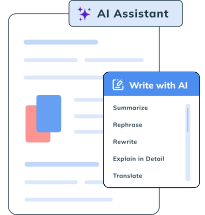
It’s not like you lose AI by choosing Upmetrics. There’s a built-in AI assistant that helps you write and rewrite sections, brainstorm ideas, get forecasting suggestions, answer business-related questions, and even run competitor analysis.
Think of it as having an in-built ChatGPT inside your planning software.
Collaboration that reduces back-and-forth
With Upmetrics, you can add up to 5 team members, share your plan via link, let others leave comments, and assign sections. Your co-founder, advisor, or consultant can work inside the same plan without the usual mess of emailed Word files and version confusion.
Human help when needed
Sometimes you just need to talk to a person. With Upmetrics, a real human is a scheduled call away. Book a free demo or a support call with the team whenever you need a hand.
Get AI + planning + financials in one tool
What do real users say about Upmetrics?
“Hands down, the best business plan software I have ever used. It is easy to use, intuitive, incorporates AI, guides you through it step by step, and it’s extremely easy for others to collaborate.” — Cindy Kennedy
“I had a wonderful experience, I was able to cut down the time it takes me to write a business plan because the layout was already done and the AI feature was also really helpful.” — Athena R.
“Upmetrics amazed me with its solid financial forecasts and numerous options. The AI writer excels at creating impressive content with minimal input.” — Diala El Achkar
Use Upmetrics or Gen AI, but start planning!
If you can spend $15 to $20 a month on your business, I’d say a dedicated planning tool is worth it. Not because AI tools are bad, but because you don’t want to pay for “free” tools with hours of your time juggling tabs, fixing formatting, and rebuilding forecasts from scratch.
That said, if you’d rather go the GenAI route, that’s completely fine too. What matters more than which tool you pick is that you actually start. Don’t let the perfect setup stall you. Don’t let that idea sit in your head for another month.
If you go with Upmetrics, you can try it free and have a basic plan to get started. If you want to do it on your own, check out our free resources on writing a business plan. And if you have questions about whether Upmetrics is the right fit, schedule a free call with our team. They’ll give you an honest answer.
Frequently Asked Questions
Can ChatGPT write a complete business plan?
What's the difference between Upmetrics and ChatGPT?
Is Upmetrics better than ChatGPT for financial projections?
Can I use ChatGPT and Upmetrics together?
What can't generative AI tools do for business planning?

Vinay Kevadia
Vinay Kevadiya is the founder and CEO of Upmetrics, the #1 business planning software. His ultimate goal with Upmetrics is to revolutionize how entrepreneurs create, manage, and execute their business plans. He enjoys sharing his insights on business planning and other relevant topics through his articles and blog posts. Read more