


If you ask ChatGPT to write a business plan, it can produce a polished draft almost immediately. But look closer, and the gaps start to show. The customer is broadly defined, the marketing strategy could fit almost any business, and the numbers have no clear basis.
I hit the same problem while testing different prompts for this guide. Better wording helped a little, but the real difference came from giving ChatGPT the business facts first, then working through the plan one section at a time.
So that’s what I’ll cover in this guide: how to set up that information, use prompts for each part of the plan, improve weak responses, work through the financial assumptions, and check that the final sections and numbers agree before you use the plan.
Gather your business information first
Before you prompt anything, create one ChatGPT Project or open a conversation that you will use for the entire process. Collect any useful notes, research, pricing, cost estimates, competitor findings, or older plan documents you already have.
Before uploading files, remove sensitive information such as passwords, bank details, customer records, employee information, or confidential contract terms that ChatGPT does not need.
Next, check whether you have information about:
- Business name, location, and stage
- What you sell and the problem it solves
- Who your customer is
- How you make money, and your pricing
- Your competitors or alternatives
- How you’ll reach customers
- How the business runs day to day
- Your team
- Startup or expansion costs
- How much funding do you need
- Your short and long-term goals
You do not need to have every answer finalized. Two rules as you go. Don’t let ChatGPT fill a blank you haven’t figured out; its guess will read as confidently as a real answer.
And keep three buckets separate: what you know, what you’re assuming, and what still needs research. This helps prevent ChatGPT from presenting an uncertain detail as a confirmed fact.
And if you don’t have any information yet, that’s normal pre-launch. Rather than invent answers, have ChatGPT pull the gaps out of you:
I want to prepare a business plan for [briefly describe your idea].I do not have all the information yet. Act as a business planning advisor and ask me one question at a time to understand:
– What I want to sell
– Who may buy it
– What problem it solves
– How the business could make money
– How customers may find it
– What resources it may require
– What information still needs research
Do not write the business plan yet.
After the questions, sort what I told you into:
- What I know
- What I am assuming
- What I still need to research
Show me the facts sheet so I can review and correct it before we begin writing the plan.
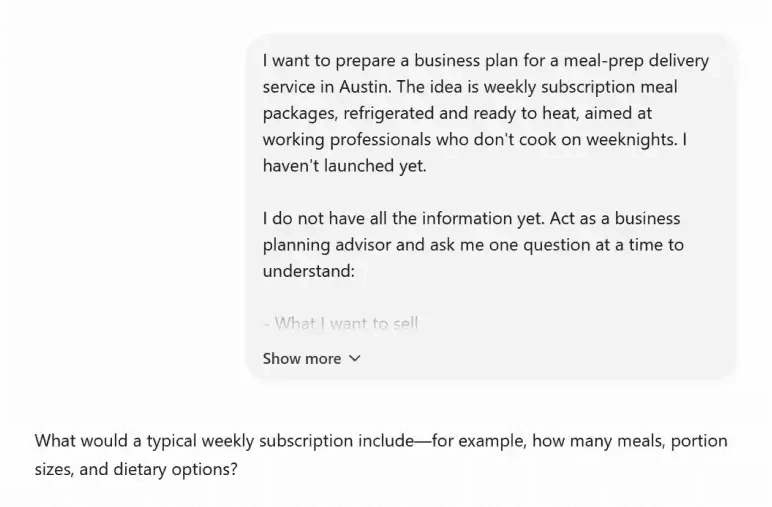
ChatGPT will begin by asking follow-up questions, as shown above. Answer with what you know, and be clear when something is only an estimate or still undecided.
Once the questions are complete, review the business facts sheet it creates and correct any errors before using it in the prompts that follow.
Skip writing prompts one by one
Answer a few questions and build your plan in minutes
Choose the right business plan structure
Not every plan needs the same sections. A lender will focus on repayment ability, cash flow, owner investment, and risk. An investor will look more closely at market opportunity, evidence, growth potential, and possible returns. An internal plan will focus more on priorities, resources, operations, and milestones.
So tell ChatGPT who the plan is for before you ask it for a structure.
Based on my business context, create a business plan outline for [internal planning / a bank or SBA loan / an investor].
For each section, tell me:
– What it has to prove to this reader
– What information I need to supply
– What evidence it will need
– Whether it’s essential or optional for this purpose
– Roughly how long it should be
Do not write any sections yet.
Throughout this guide, I’ll use one example, FreshFork, a pre-launch meal-prep delivery service in Austin, so you can see each prompt working on a real business.
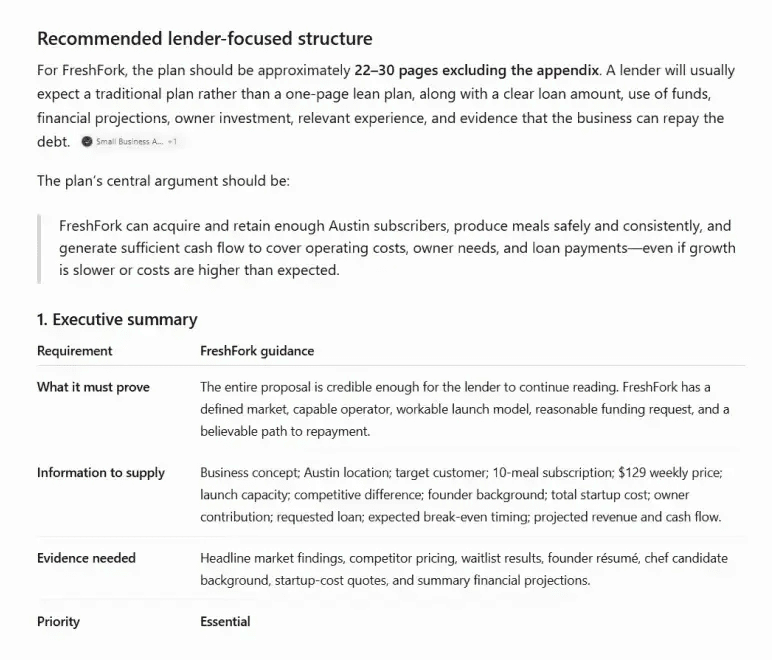
The output should give you more than a generic list of headings. It should show what each section needs to accomplish and which parts are relevant to your purpose.
For example, FreshFork’s lender-focused outline showed that the plan needed to demonstrate that it can acquire and keep enough Austin subscribers, produce meals safely at volume, and cover operating costs, owner needs, and loan payments even if growth comes slower or costs run higher than planned.
Then it broke each section into what it has to prove, the inputs to supply, the evidence to attach, and whether it’s essential or optional. That last field is the one you’ll use when the plan runs long, and something has to go.
Now that the business information and structure are clear, you can start drafting the plan. Each section below has the prompt I landed on and what to check in the response.
ChatGPT prompts for a stronger business plan section
Use the prompts below in the order shown. Add the business information you gathered earlier, then read each response carefully and fix anything that is vague, incorrect, or not supported by real information.
The prompts are arranged in the order that makes the plan easier to write. That’s why the executive summary comes last here even though it sits first in the document. You can only summarize the plan once the rest exists.
I’ll keep using FreshFork as the example so you can see how the same business develops across the full plan.
Here’s a quick note: For readability, the screenshots below show only main parts of each section response, not the full output or finished section. When you use the prompts with your own business information, ChatGPT may provide a longer response covering all the points in the prompt or ask for any missing details.
Company overview
The company overview gives readers a quick picture of the business. It should explain what the business does, where it is based, who owns it, its current stage, and what it plans to achieve next.
Keep it brief. Do not repeat the full product description, market research, or operating details because those will appear in later sections.
Write the company overview using only the approved business information.
Cover: what the business does, legal structure, ownership, location, current stage, and what it’s working toward in the next 12 months.
If the business is already operating, include only a short history that helps explain where it stands today.
Do not invent a founding story, mission statement, legal structure, or ownership details. Do not describe the products or services in detail because that comes in the next section.
If the legal structure or ownership split isn’t in the context, ask me rather than assuming.
That’s the whole section, with one instruction doing the work: ask, don’t assume. Here’s what happened when a fact was missing.
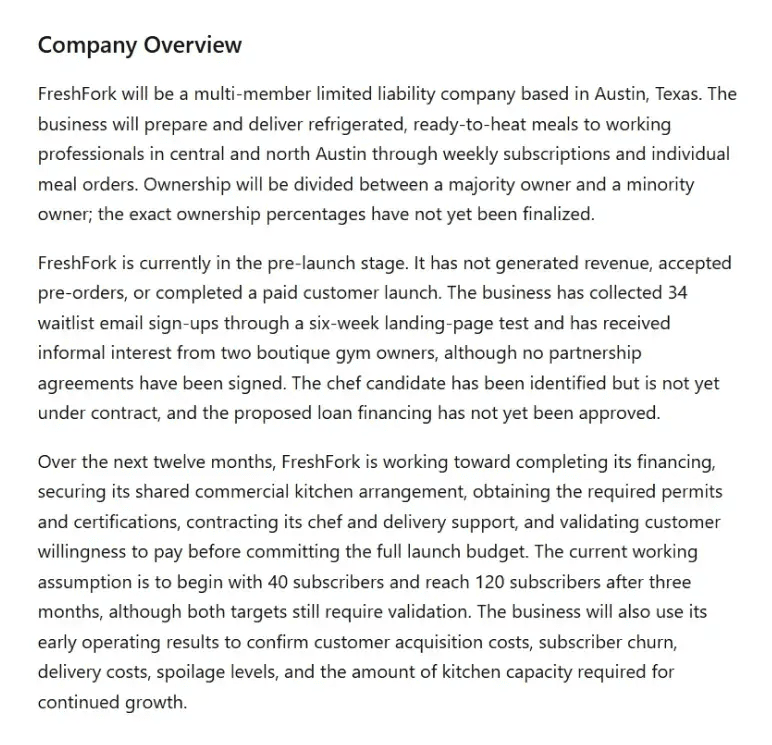
Legal structure and ownership weren’t in FreshFork’s context sheet, so rather than defaulting to a single-member LLC, ChatGPT stopped and asked for both. Verify the entity type against your filings before it goes in.
Before adding the section to your plan, check that the legal structure, ownership, location, and business stage match your official records.
Market, customer, and competition
This part of the plan explains who may buy from the business, what evidence supports demand, and what other options customers already have.
ChatGPT can help find and organize this information. But it may also produce claims that sound believable without enough evidence. Work through the market, customer, and competition separately so you can see what is confirmed and what still needs to be tested.
Start with the market research. ChatGPT is useful for finding reliable information about the industry and naming sources, less so for accuracy. So turn search mode on and make it separate what it found from what it inferred.
Research the market for my business using web search.
Find:
– Industry size and growth for the relevant sector
– Data specific to my geographic market where it exists
– Demand drivers and current trends
– Regulatory requirements that affect the business
– Barriers to entry
For every figure, give me the source, the publication date, and a link. Prioritize government data, industry associations, and primary research over blog posts and marketing content.
Keep national and local data clearly separate. Do not present national figures as evidence of local demand.
If you can’t find something, say so. Do not estimate a figure and present it as a finding.
The wait itself tells you it’s working.
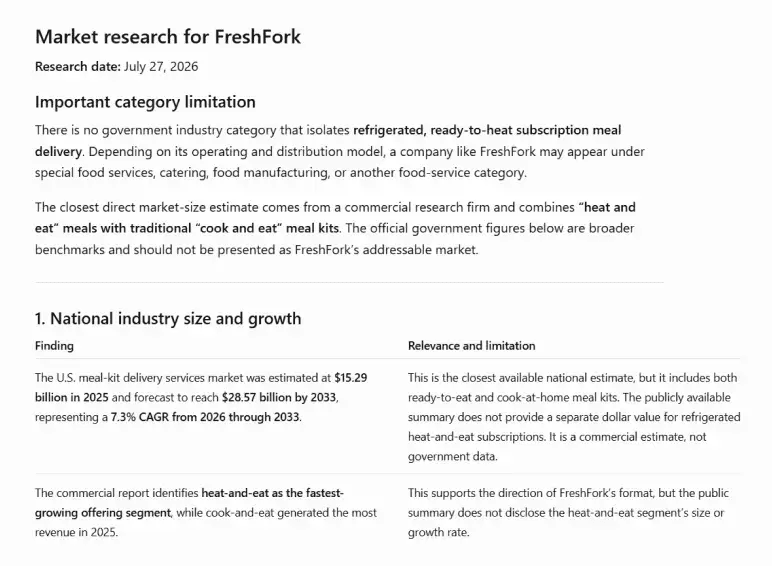
For FreshFork, ChatGPT returned national industry data, state-level figures, and the local information it could verify. Austin’s median income suggested that some households may fit the target income range, but it did not prove that customers would pay $129 per week.
It also listed the local figures it could not find, giving the founder a clear research list before using those claims in the plan.
Every figure came back with a source, a date, and a note on what it doesn’t prove. Open the original sources before using the findings in your plan.
So check that the data is current, applies to the right industry and location, and supports the claim ChatGPT makes from it.
There’s a fuller walkthrough of market research with ChatGPT if this is the part you’re stuck on.
Next, define the target customer. ChatGPT builds a persona, a name, an age, and a salary invented to fit. Avoid fictional customer personas unless you have real evidence for the details.
Write the target customer section using my approved business information and the market research above.
Separate it into four parts:
– What I actually know about my customer, from the context I gave you
– What comes from real evidence like interviews, sign-ups, or sales
– What is a working hypothesis I still need to test
– What’s missing and how I’d validate it
Describe the customer’s needs, buying situation, reasons for choosing a solution, and factors that may affect the purchase.
Do not invent demographics, income figures, or buying behavior. Do not build a fictional persona. If a detail isn’t in my context or evidence, put it in the hypothesis or missing list, not the known list.
Then suggest five questions I could ask real customers to test the biggest assumptions.
This is the output:
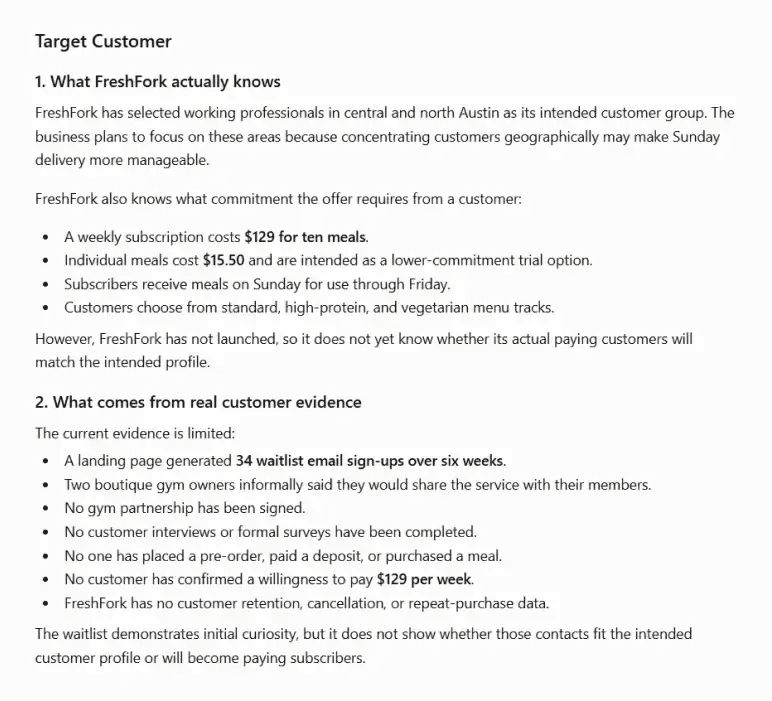
You need to check whether the response describes a customer you can realistically reach. Remove any detail that was added only to make the customer profile sound more complete.
Then analyze the competition. Look at both direct competitors and the other ways customers currently solve the problem. The prompt bans pricing from memory and forbids the “no competition” conclusion, forcing it to work from live sources.
Analyze my competition using the file I’ve uploaded [or: using a web search].
Cover direct competitors, indirect alternatives, their customers, their offerings and pricing, their positioning, and where I differ.
Use only prices and features from the file or from sources you can link. Do not fill in a price or feature from memory. If a competitor’s current pricing isn’t available, say so rather than estimating.
Do not conclude I have no competition. If direct competitors are thin, name the indirect alternatives customers use instead.
Test my claimed advantages against the research. Tell me when a competitor offers the same benefit or when the difference is not yet supported.
Flag anything in the uploaded file that looks outdated or contradicts another source.
Here’s worth seeing what that produced for FreshFork, because it argued against the plan rather than for it.
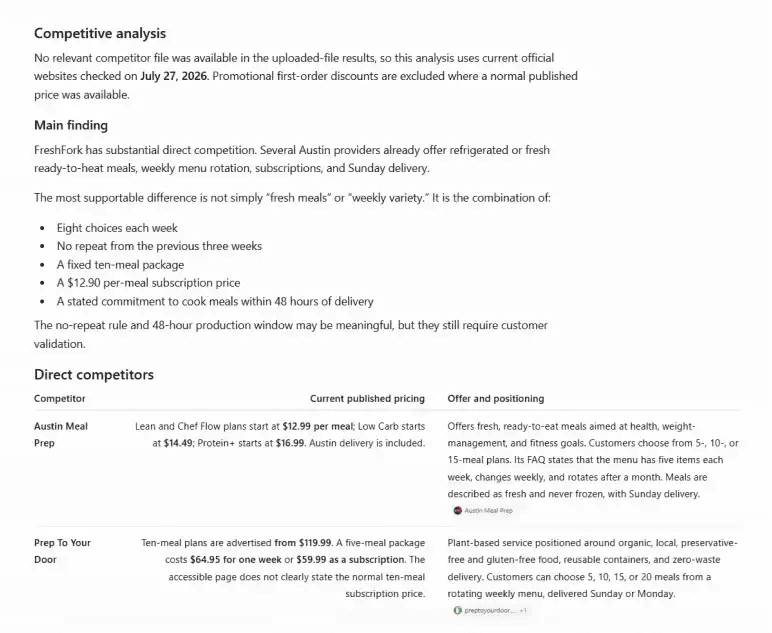
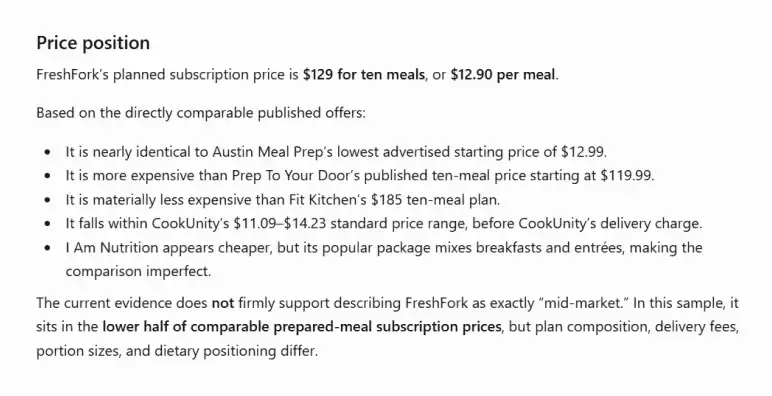
For FreshFork, it checked live competitor sites and knocked down two of the founder’s claims: the “never frozen” edge (rivals advertise it too) and the “mid-market” price (actually the cheaper half). What held up was narrower and tagged as still-to-prove.
This is more useful than asking ChatGPT to just make the business sound better than its competitors.
Products and services
In this section, you need to show what you’re selling, why customers need it, how they receive it, and what the price is that actually works. It should help someone (weighing up the business) understand the offer without reading like a sales page.
Write the products and services section using the approved information.
For each part of the offer, explain:
– What it is
– Who it is for
– What problem it solves or benefit it provides
– How it is priced
– Whether customers pay once, subscribe, or sign a contract
– How the product or service is delivered
– Whether it is already available or still being developed
Just focus on the main offers and revenue sources. Do not turn the section into a long feature list.
Use clear, factual language. Do not use “unique,” “premium,” or “best-in-class.” Do not claim an advantage unless the context sheet supports it.
Do not invent packaging, sourcing, or quality-control processes I have not described. If an important detail is missing, ask me before writing.
Write it for someone evaluating the business, not a landing page.
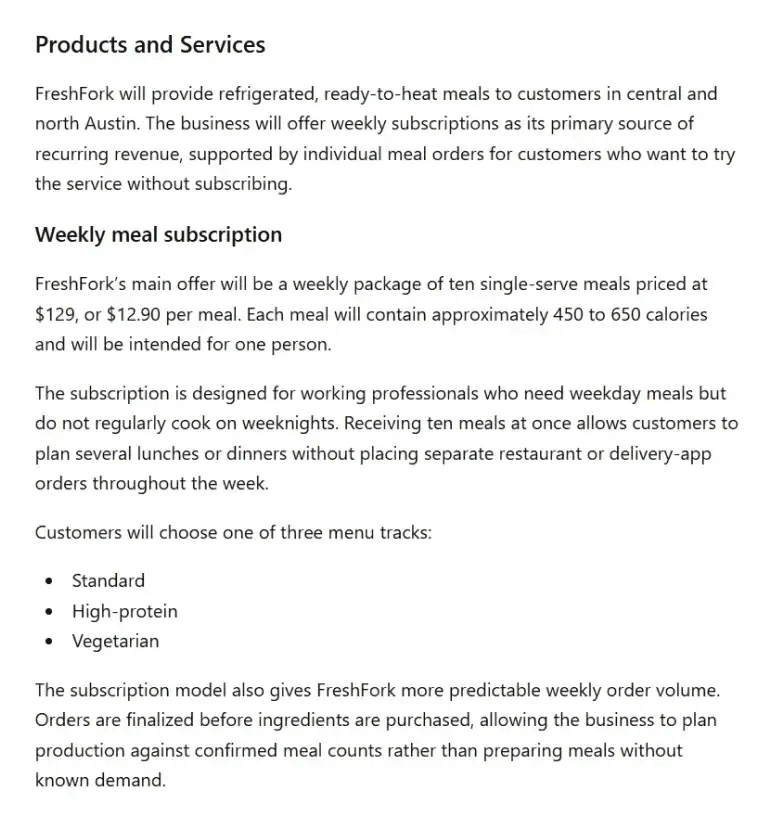
Here’s what to check: the pricing matches your financial plan exactly, nothing here describes a supplier, process, or packaging you haven’t actually set up, and no advantage is claimed without something to back it.
Marketing and sales plan
This section explains how the business will reach potential customers, turn interest into sales, and keep customers coming back. It also shows whether it’s working, with every channel tied to a budget, an owner, and a way to measure it. The plan should use channels the business can realistically afford and manage.
Write the marketing and sales plan using my approved business information.
Cover the channels I’ll use to acquire customers, who will manage it, the budget, positioning, how interest will turn into a sale, the expected sales cycle, retention, and how I’ll measure results.
If a channel is missing a cost, owner, or measurement method, point out the gap and ask me for the information. Do not remove the channel or invent the missing detail.
You may suggest other possible channels separately, but do not add them to the plan without my approval.
Include a sales process or sales cycle only if it applies to this business.
For FreshFork, ChatGPT didn’t write the section at all. It came back with a list of missing details such as the budget, timing, and owner for each channel.
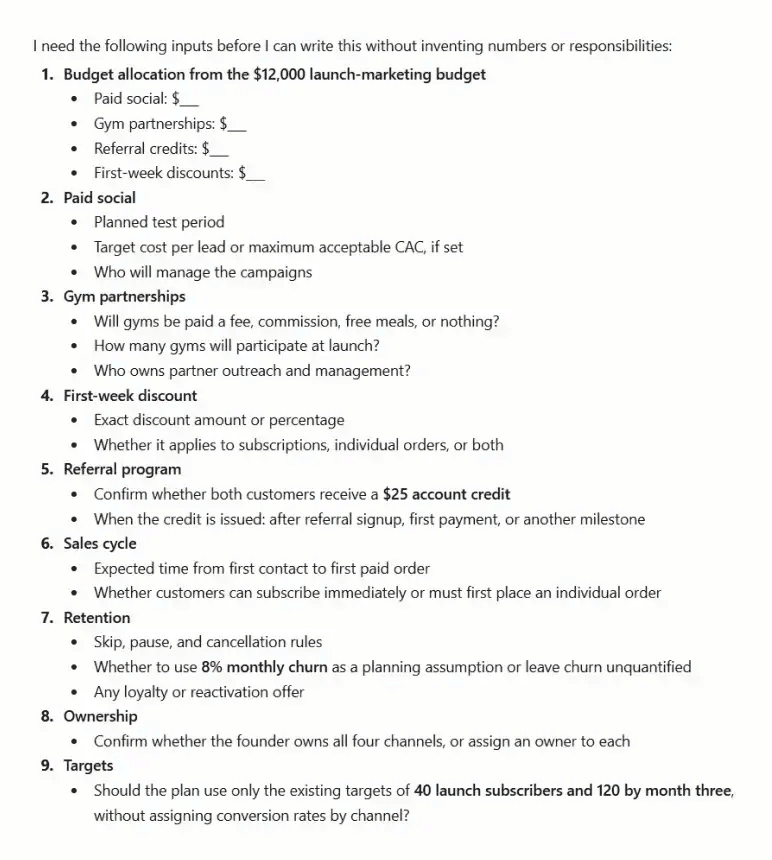
Instead of guessing, it asked for what is required to plan this section. That was useful because these are the same details a lender or investor is likely to question. So, provide enough information.
Before using the output, make sure every channel has a clear purpose, budget, owner, and a way to measure results. And the total marketing spend matches the figure in your financial plan.
Operations plan
The operations plan outlines how the business will run day to day and deliver its product or service. It should cover the main processes, people, equipment, suppliers, capacity, and legal requirements needed to operate.
Write the operations plan using the weekly operating process and facility details in my context.
Cover the production process, location, facilities, staffing, equipment and tools, suppliers, delivery/distribution, current capacity, the permits, licenses, or other requirements.
If the business follows a daily, weekly, or project-based operating schedule, explain the main steps in order.
Do not invent suppliers, licenses, equipment, or operating procedures I haven’t given you. Where an operational detail is missing or unconfirmed, flag it as something to confirm rather than filling it in.
Also, note any point where the plan depends on an assumption that hasn’t been verified, especially capacity, staffing, timing, safety, or delivery.
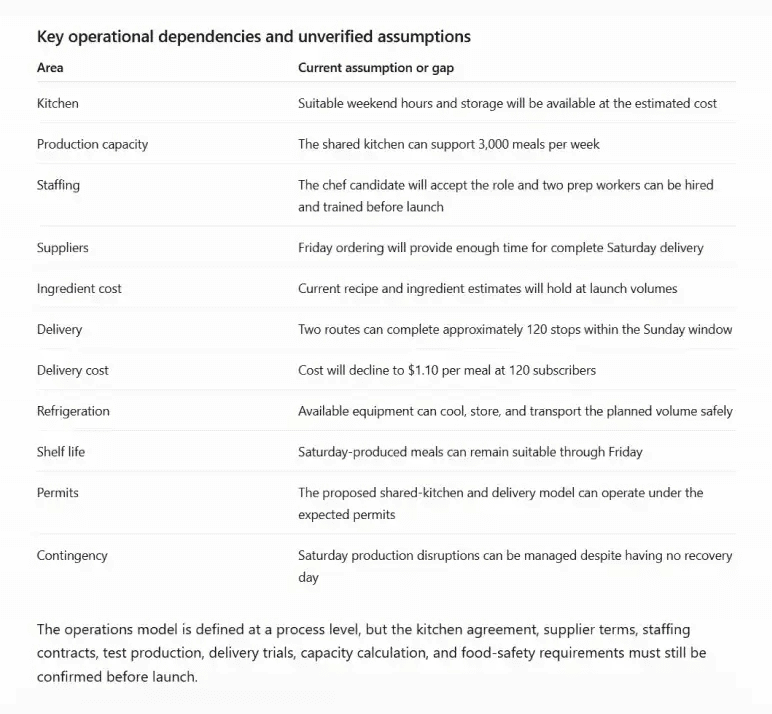
For FreshFork, the weekly schedule gave ChatGPT enough information to organize the operating process. It also flagged several details that were still unconfirmed: no suppliers selected, the capacity untested, the chef not contracted.
Therefore, the section should include only the suppliers, equipment, permits, and processes you have confirmed. Any untested capacity or safety assumption should remain clearly marked.
Management and organization
This section outlines who owns the business, who runs the daily operations, and what each person is responsible for. It should also show that the team has the right experience to execute the plan, and cover which roles or skills are still needed.
Write the management and organization section.
Cover ownership, who manages the business day-to-day, each person’s relevant experience, their responsibilities, team gaps, planned hires, and any advisors.
Describe experience accurately from my approved business context. Do not inflate a background or add qualifications I haven’t stated. Do not invent employees, titles, or advisors.
Name the skill or experience gaps on the team honestly, and say how each will be covered. Keep biographies short and relevant to running this business, not full work histories.
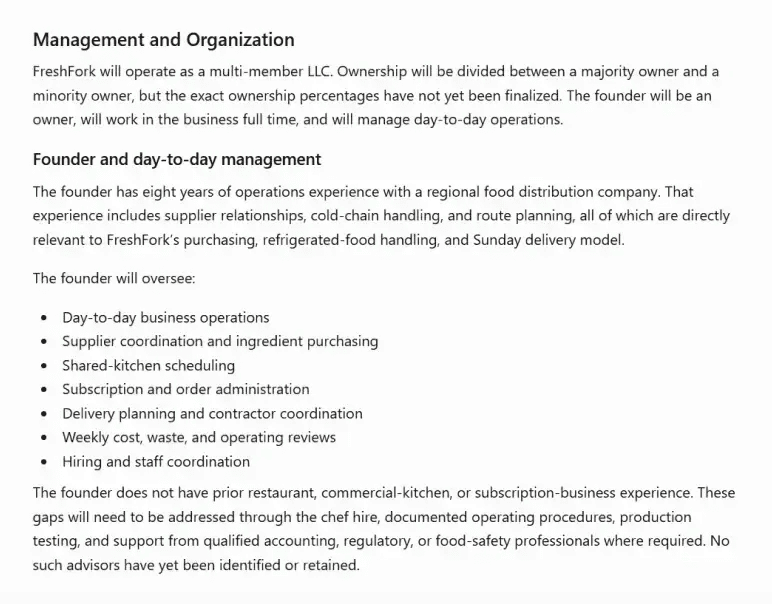
While adding the ChatGPT response into your plan, ensure that every person or planned role is real, and the experience listed is accurate. Plus, any skill gap must include a clear plan to address it.
Financial plan
The financial plan covers how the business expects to make money, cover its costs, manage cash, and repay any funding.
ChatGPT can help organize your assumptions, spot numbers that do not match, run calculations, and explain the results. However, the actual financial model should be kept in a spreadsheet or business planning tool where you can check every number and formula.
Instead of asking ChatGPT to create the entire financial plan at once, break the work into three stages:
Stage 1: Gather the financial assumptions
Before building the projections, get all the numbers and assumptions that your financial model will require.
I’m building my financial plan. Do not calculate projections yet.
From my approved business details, list every assumption the projections will depend on: pricing, sales volume, revenue streams, direct costs, payroll, operating expenses, startup costs, inventory, equipment, payment timing, financing, taxes, and owner contributions.
For each, show the figure I’ve given and mark whether it’s confirmed or still an estimate. Do not fill in a missing number. Ask me for it or explain what I need to research or confirm.
The answer came back as mostly gaps, which is the point.
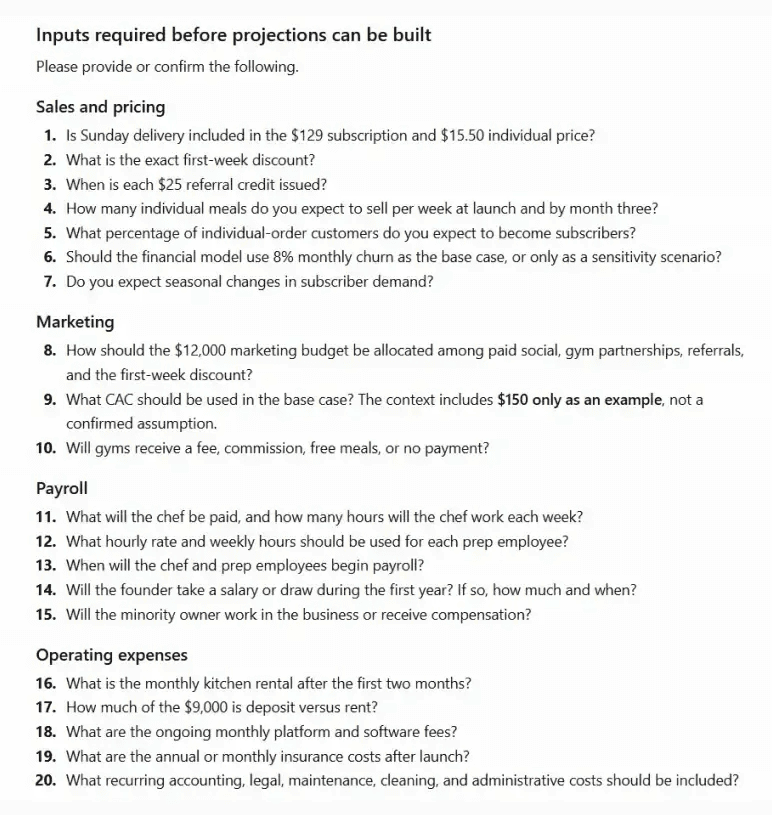
For FreshFork, ChatGPT sorted every figure into confirmed, estimated, unconfirmed, or missing. And most rows weren’t confirmed.
The subscription price had been chosen, but customer demand had not been tested. Expected subscriber numbers, payroll costs, payment timing, and tax treatment also needed more work. It turned those into a list of questions to answer before any projection could be built.
Work through them before you go further. And make sure every important number has a source or clear reason behind it, because that labeled set of assumptions is the input to the next stage.
Stage 2: Test the assumptions
Once you have all the main inputs, check that they agree with the rest of the plan. A number may look reasonable by itself but still conflict with another assumption.
For example, the sales forecast may require more customers than the marketing budget can attract, or more orders than the business can handle.
Review my completed financial assumptions before I build the projections.
Check whether:
– The sales forecast matches the marketing plan
– Expected sales stay within the business’s capacity
– Pricing and sales can reasonably cover the business’s costs
– Payroll matches the staffing plan
– Startup costs match the funding available
– Loan payments match the financing terms
– Discounts and promotions match the marketing budget
– Cash is recorded in the months when it will actually be received or paid
List every assumption that’s missing, internally inconsistent, or unsupported. Do not fix anything by inventing a number. Flag it and tell me what’s needed.
Expect it to keep asking rather than declaring the numbers ready.
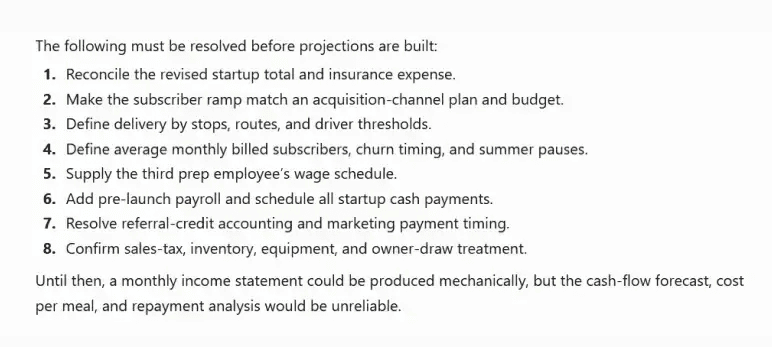
For FreshFork, this check found that the marketing budget did not fully support the expected customer growth. It also showed that the referral budget covered fewer referrals than the plan expected.
Every catch was legitimate, and at some point the call is yours. Resolve the main conflicts before building the projections. Keep any number you cannot yet confirm clearly marked as an assumption.
Stage 3: Build, summarize, and review the projections
When your assumptions are ready, create the financial projections in a spreadsheet or business planning tool, where you can check the formulas and make changes easily.
If you do not have projections yet, ChatGPT can help you create a first draft from your assumptions. Treat it only as a starting point, and check all formulas and figures before using it in your plan.
After the projections are complete, give the figures to ChatGPT. The prompt below asks it to organize them into clear Year 1 summaries, calculate selected ratios, and point out results that need another look.
Using only my completed and reconciled projections, prepare a Year 1 financial summary for my business plan.
Do not invent, estimate, change, or reclassify any figure. If something is missing, ask me before continuing.
Produce three statements, monthly for year one plus an annual total:
- Income statement
Revenue, direct costs, gross margin, operating expenses, EBITDA, depreciation, EBIT, interest, and pre-tax income. (Cost my full-time labor as a salary expense, not an owner’s draw. Split loan payments into interest and principal.)
- Cash flow statement
Operating cash flow, financing flows, and the resulting monthly and ending cash balance.
- Debt schedule
Opening balance, interest, principal, and closing balance for each loan, showing the year-end outstanding balance.
Calculate the debt-service coverage ratio and pre-tax margin using only the figures provided. Show the formula and numbers used.
Flag any result that depends heavily on an untested assumption, such as unusually fast sales growth, falling costs, low staffing needs, or limited owner compensation.
Do not decide or change the tax treatment, owner compensation, depreciation method, or accounting classification. List anything that needs confirmation separately.
After the review, explain the main financial results in simple language for the business plan.
Then ChatGPT turned the completed projections into a Year 1 income summary, cash flow summary, and debt schedule.
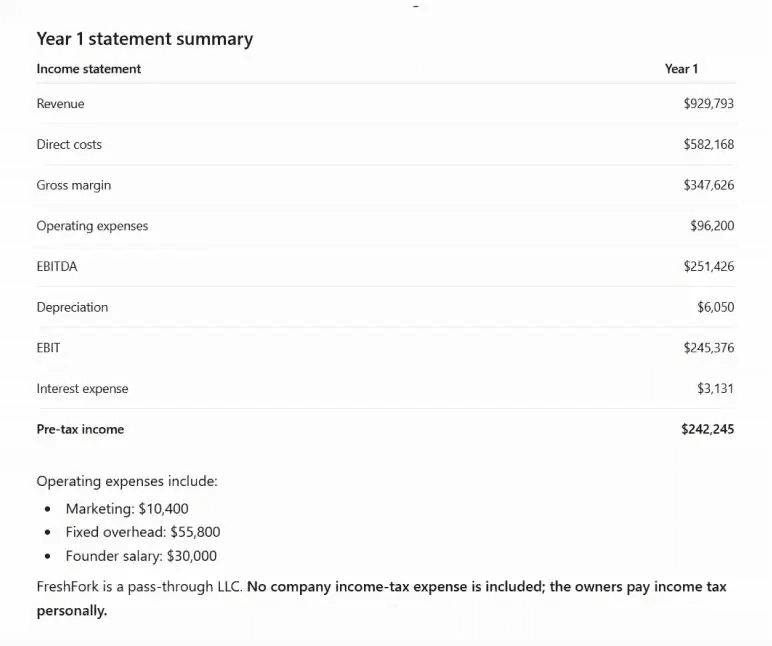
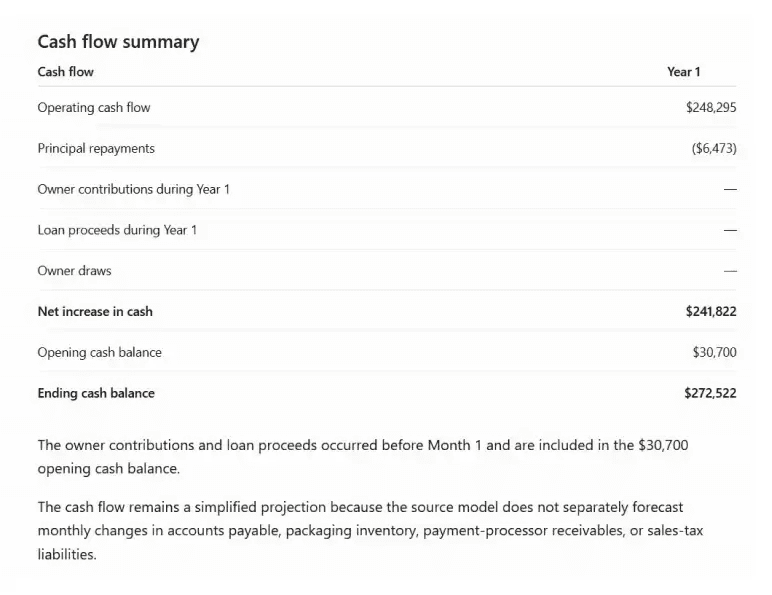
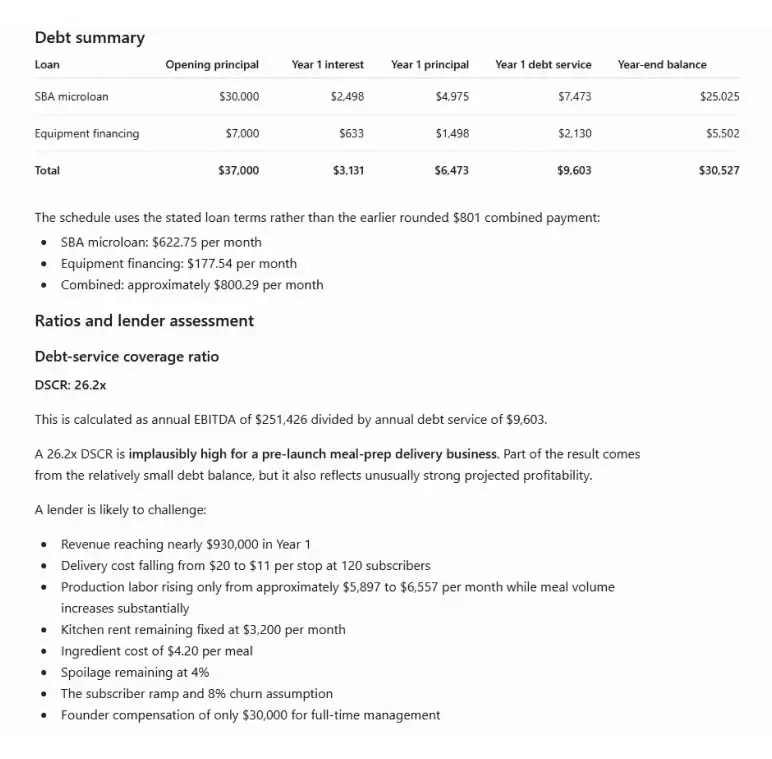
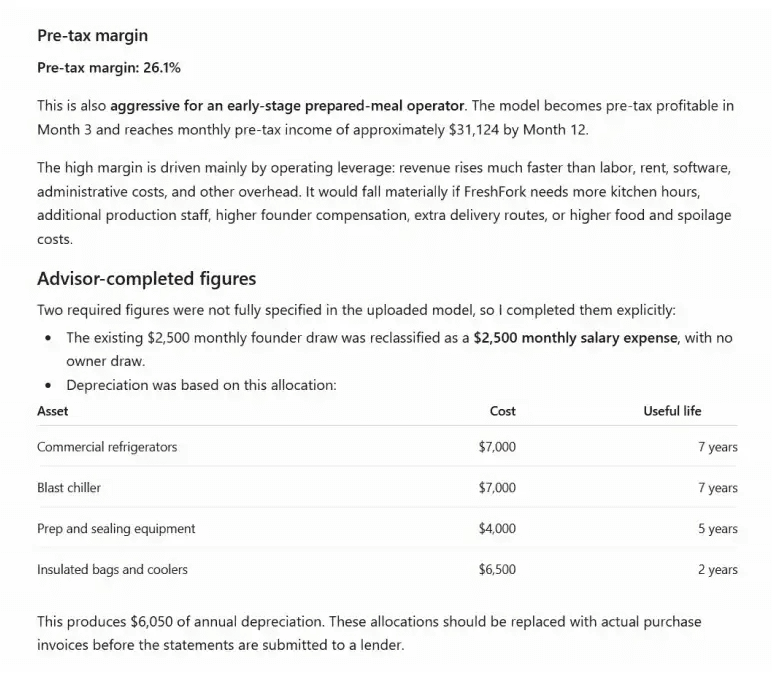
The summaries made the main figures easier to understand and showed which assumptions were driving the results. ChatGPT also flagged the high profit margin and debt-service coverage ratio instead of simply presenting them as strong results.
However, it also changed the treatment of the founder’s pay and added depreciation assumptions that had not been confirmed. This happened even though the prompt told it not to change or fill in missing figures.
So you need to compare every figure with your original projections. Review any accounting change, added assumption, or ratio calculation before using the summary in your business plan.
Numbers that quietly change between drafts
Keep every projection in one connected model with Upmetrics
Funding plan
Include this section only if you are asking for a loan or investment. It should explain how much money you need, where the rest of the funding will come from, and exactly how the money will be used.
The failure mode here is that the requested total drifts from the use-of-funds breakdown, or ChatGPT invents loan terms to fill a gap. The prompt ties every figure back to the plan.
Write the funding request using only the figures from my financial plan and use-of-funds breakdown.
Include:
– The total project cost
– The amount being requested
– The type of funding
– The owner’s contribution
– Other funding already available
– What the money will be used for
Keep the requested funding, owner contribution, and other funding sources separate. Make sure they add up to the total project cost.
If this is a loan request, explain how the business expects to make the payments using the confirmed loan terms and projected cash flow.
If this is an investment request, explain what the funding will help the business achieve. Do not invent a valuation, ownership offer, investor return, or exit plan.
If any figures do not match, point out the difference instead of changing them.
When the numbers didn’t reconcile, it said so rather than papering over the gap.
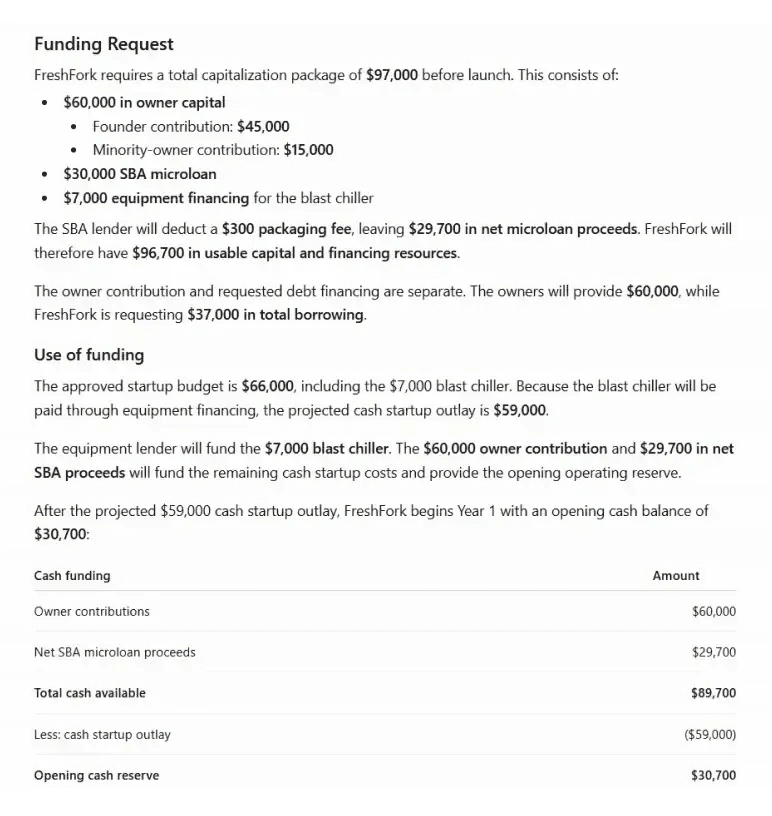
For FreshFork, ChatGPT kept the owner’s contribution separate from the requested loan and found that one item in the use-of-funds breakdown no longer matched the updated financial plan.
Make sure the requested amount, other funding sources, total project cost, and use-of-funds breakdown all agree. Until funding is approved, describe it as funding you are seeking, not funding you have secured.
Risk and mitigation plan
This section shows that you understand what could prevent the business from reaching its goals and how you would respond. The risks should come from the assumptions, gaps, and weak points already identified in your plan.
ChatGPT gives a generic list: competition, economy, supply chain, each with a reassuring one-liner. The prompt makes it pull risks from your actual plan and refuse the easy fixes.
Write the risks and mitigation section using my completed plan.
Identify the risks specific to this business, drawn from my own assumptions and gaps, not generic business risks. Cover demand, pricing, competition, operations, supply, staffing, cash flow, and regulation.
For each risk, state what would trigger it, what it would do to the plan, and what could be a realistic response to it. Do not claim a risk is eliminated, and don’t use insurance as the answer to everything. Rank them by how badly they’d hurt the business.
If the response still depends on research, funding, or another unconfirmed step, say so.
The risks it returned weren’t hypothetical.
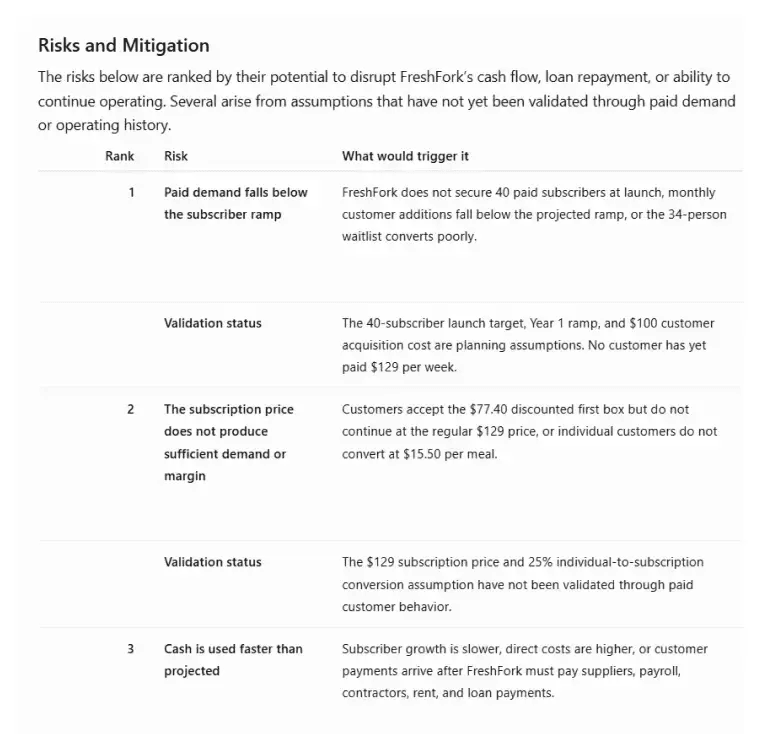
For example, FreshFork’s main risks came from untested customer demand, limited kitchen capacity, and cash flow during the early months. The responses focused on testing demand before expanding and preparing backup options rather than claiming the risks were solved.
Remember, every risk should connect to something real, and every response should be practical, affordable, and based on actions the business can realistically take.
Executive summary
Write the executive summary after completing the rest of the plan. Although it appears first in the final document, it should summarize the decisions, evidence, and numbers already covered elsewhere.
Keep it brief, usually around one page, and do not introduce new information just to make the summary sound stronger.
Write the executive summary for [a lender / an investor / internal planning]. Use only information already approved in the completed business plan sections. Do not introduce any new claim, figure, or market statistic.
Cover, in this order:
– What the business does and who it serves
– The problem and why this solution works
– How the business makes money
– What evidence supports the opportunity
– The business’s current stage
– The main goals or next milestones
– The team, briefly
If this is a lender plan, include the loan amount, use of funds, owner contribution, and how the projected cash flow supports repayment.
If this is an investor plan, include the amount being raised, how it will be used, and what milestones it will help the business reach.
If important information is missing, point it out before writing the summary.
The result is worth looking at before you read it, for what’s not in it.
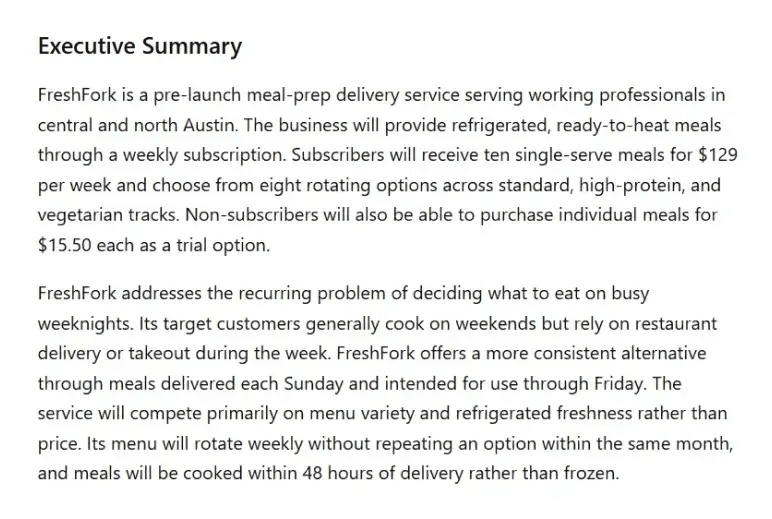
Make sure every claim and number appears elsewhere in the completed plan. Remove details that are useful but not important enough for the first page.
You now have a first draft of the main business plan sections, but it is not ready to use yet. Before sharing it, review the full plan for vague claims, missing evidence, repeated details, and numbers that do not match across sections.
The next step is to find weak points, missing information, and contradictions that may not be clear when you read each section separately.
Review and stress-test your ChatGPT business plan
Review the ChatGPT business plan as a complete document. Check that the claims are supported, the numbers match, and the plan still works if important assumptions do not go as expected.
Run the following checks before you call it done.
Find weak or unsupported writing
First, find details or sentences that sound polished but say very little or make claims without evidence.
Review my completed business plan for weak or unsupported writing.
Identify:
– Vague statements
– Generic advice that could apply to any business
– Promotional language
– Claims without evidence
– Details that appear to have been invented
– Sections that need more specific information
Do not rewrite them yet.
For each issue, show where it appears and tell me what fact, example, or evidence is needed to improve it.
Provide the missing information before asking ChatGPT to rewrite the weak parts. Do not let it replace one vague sentence with another.
Challenge your assumptions
Next, ask ChatGPT to review the plan from the intended reader’s point of view.
Read my business plan as a skeptical [lender/investor/internal decision-maker].
List the questions you’d ask before approving, the assumptions you’d challenge, the claims that need more evidence, the financial figures that look weak or unrealistic, and the reasons you might decline.
Be direct. I’d rather see the hard questions now than in the meeting.
Then test what happens if the plan does not go exactly as expected:
Test the plan under this downside case:
– Sales are 20% lower than forecast
– Costs are 10% higher
– The launch is delayed by two months
Explain which parts of the plan would be affected, including cash, staffing, capacity, funding, and milestones.
Do not change the original plan. I want to list out the assumptions and figures that would need to be updated.
Use percentages and delays that make sense for your business. The point is to see where the plan becomes difficult to carry out.
Check for contradictions and gaps
The second pass looks for numbers and claims that disagree across sections, or evidence a claim needs but it doesn’t have. A figure you update in the financials rarely gets updated everywhere else it appears, and that’s exactly what a careful reader catches.
Review my complete business plan for internal contradictions. Do not rewrite anything, just find the conflicts.
Check that the business details, customer, offer, pricing, marketing costs, sales forecast, capacity, hiring, funding, dates, and market claims match across all sections.
For each conflict, show where both versions appear and explain what source, record, or decision is needed to resolve it.
Correct the original sections rather than asking ChatGPT to hide the difference with broader wording.
Compare the plan against your source files
The last pass only applies if you built the plan from uploaded documents, a cost spreadsheet, competitor research, or an old draft. As you revise, the plan drifts from the files it came from, and the prompt asks ChatGPT to find every figure that no longer matches its source.
If you built the plan from uploaded documents, such as a cost spreadsheet, competitor research, or an old draft, check that the final plan still matches them.
Compare my completed business plan against the source files I uploaded.
Build a table showing any figure or claim in the plan that differs from the source file it came from: the plan’s version, the source’s version, and which appears more current.
Do not silently pick between conflicting numbers. Show me both.
Finish all these checks before sharing the plan. Any unsupported claim should be corrected, removed, or clearly marked as an assumption.
Verify the important facts and figures
Everything ChatGPT gives you is a first draft until you check it. It’s genuinely good at brainstorming ideas, searching information, reviewing files, and finding gaps. But its answer may still use the wrong source, misunderstand a figure, or rely on an untested assumption.
Before you use or share the plan, verify these details:
| ChatGPT can help you | You still need to verify |
| Find and summarize market research | The original source, date, location, and meaning of each figure |
| Compare competitors | Current prices, products, and features |
| Organize business information | Legal structure, ownership, contracts, quotes, and other official details |
| Review financial projections | Assumptions, formulas, cash balances, accounting treatment, and final results |
| Identify permits and funding requirements | Permits, licenses, regulations, loan terms, and eligibility |
| Describe target customers | Real demand, willingness to pay, and buying behavior |
The pattern is simple. ChatGPT handles the words and the structure, but you remain responsible for the information in it. Before moving ahead, make sure you can explain where the main figures came from and why your assumptions are reasonable.
Once these checks are complete, you can bring the approved sections, financial tables, sources, and supporting documents together into the final plan.
Turn your draft into a complete business plan
ChatGPT can help you research the market, test assumptions, and draft the main sections. But you still need to check that the claims are supported, the numbers match across the plan, and the projections reflect how the business will actually operate.
However, keeping everything consistent becomes harder as your assumptions change. When the writing, financial model, tables, and charts are stored separately, even a small update can leave parts of the plan out of date.
That is where a business planning tool like Upmetrics can help. It lets you bring the written plan and financial forecast into the same workspace.
You can organize the approved content into a structured plan, continue improving each section with AI assistance, and build realistic projections. This will make updates easier as your assumptions change.
In short, you can use ChatGPT to develop and test your ideas. Then use Upmetrics to organize, update, and prepare the finished document for review, update, or sharing.
Turn Your ChatGPT Draft Into a Complete Business Plan
Bring your plan, financials, and assumptions together in one place with Upmetrics.

Frequently Asked Questions
Is it safe to enter my business information into ChatGPT?
Do I need ChatGPT Plus, or is the free version enough?
Can I use a ChatGPT-assisted business plan to apply for a loan?
Should I use ChatGPT or business-planning software?
How long does it take to write a business plan with ChatGPT?

Vinay Kevadia
Vinay Kevadiya is the founder and CEO of Upmetrics, the #1 business planning software. His ultimate goal with Upmetrics is to revolutionize how entrepreneurs create, manage, and execute their business plans. He enjoys sharing his insights on business planning and other relevant topics through his articles and blog posts. Read more