


 Download Now: Mission and Vision Statement Templates
There’s a famous quote by Simon Sinek: “People don’t buy what you do, people buy why you do it.”
That “why” is really your mission, the reason you do the work today. Your vision is the next question: where is all of it headed? A vision statement for a business plan makes that future direction concrete. It’s a short statement, usually one or two sentences, that describes the future your company is trying to create and gives investors, lenders, and your own team a reason to believe in the direction you’re taking.
It doesn’t need to sound grand or copy Apple, Tesla, or Google. What it can’t be is so vague that any business could lift it word for word.
A useful vision statement is simple, specific, and tied to the company you’re actually building. It should make clear what success looks like for your business over the next several years.
What is a vision statement?
A vision statement is a short, future-focused statement that describes the long-term change a business wants to create.
In a business plan, it gives readers a clear sense of where the company is headed before they get into the other business plan components like strategy, operations, and financials. It helps answer a simple question: if this business works, what future are we building toward?
A strong vision statement is usually:
- Future-focused: It looks beyond what the business does today.
- Clear: A reader should understand it in one read.
- Specific: It should not sound like it could belong to any company.
- Memorable: Your team should be able to repeat the main idea without reading it twice.
Many founders confuse vision statements with mission statements. That confusion makes sense because both usually appear in the company overview section of a business plan. I’d separate them before writing either one, because each statement has a different job.
Vision statement vs mission statement
The simplest way to separate the two is this: your vision statement describes where the business is going, while your mission statement explains what the business does today to move in that direction.
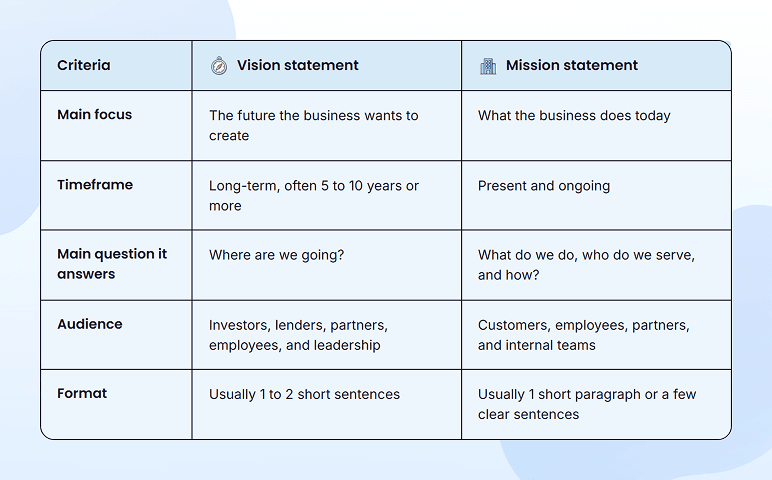
Here’s the difference in one business. Picture a neighborhood bakery:
- Mission (what it does today): “We provide fresh, handmade cakes and pastries for local families, offices, and events.”
- Vision (where it’s going): “To become the go-to local bakery for custom cakes and everyday baked goods in our community.”
It’s the same bakery in both lines. But the mission is about right now, the cakes, the pastries, the families and offices it serves every morning, and the vision skips ahead a few years to the spot the bakery is trying to claim: the first place people in town think of when they need something baked.
While writing your business plan, make sure you don’t have a single statement doing two jobs. Use the vision statement to provide direction over the long haul. Use the mission statement to describe the reason the business exists and the work they do.
Why is a vision statement important?
A vision statement is important because it communicates to the readers the direction in which the business is headed.
That seems like an easy thing to do, but it changes the way that the other parts of your business plan are read. Your goals, strategy, hiring plan, marketing approach, operations, and financial forecasts should all point in the same direction.
Now, here are the benefits of a clear vision for your plan:
1) Aligns every other section
Once a reader knows where you’re headed, your strategy, staffing, and numbers have a reference point. A restaurant aiming to become the most trusted family-dining brand in its city makes different choices than one chasing a fast-casual franchise model, on pricing, locations, staffing, and funding alike.
2) Gives investors and lenders context
Investors want to understand the kind of company you are building. Lenders want to see whether that direction is realistic enough to support repayment. The vision tells them which one that is before they reach your financials.
3) Guides day-to-day decisions
If your vision is to be the go-to bookkeeping partner for local restaurants, you probably shouldn’t chase every small-business client that comes your way. If it’s to build a premium home-care brand for aging adults, your pricing, training, and quality standards all have to support that promise.
Now comes the important part!
How to write a vision statement for your business plan?
The order matters here. Most people jump straight to wording the sentence, but the best vision statements come from getting the thinking right first, which is exactly where Step 1 starts.
1) Understand the purpose
A vision statement is only as clear as the purpose underneath it. So, before writing the statement, get clear on the future you are building toward: who you want to serve, what position you want to hold, and what should be different if the business succeeds.
I’d start with two questions:
- What problem are we solving?
- What should be different for customers if we solve it well over time?
That second question matters because a vision statement isn’t just about what the business does today. It’s about the future change the business is seeking.
A bakery may sell bread and pastries, but its larger purpose might be to become the neighborhood’s most trusted place for fresh, locally made food. A bookkeeping firm may handle monthly records, but its larger purpose might be to help small restaurant owners feel in control of their numbers.
If you’re a small team, bring in a few people who see the business from different angles: sales, operations, customer service, product delivery. You don’t need everyone involved, but you do need enough perspective to avoid a vision that makes sense to the founder and no one else.
After this step, you should be able to complete this statement:
“Our business exists because we want to help [specific audiences] move toward [better future].”
2) Start with the list of keywords
Once you’re clear on the purpose, start collecting the words that should shape your vision statement.
I’d group them into four buckets:
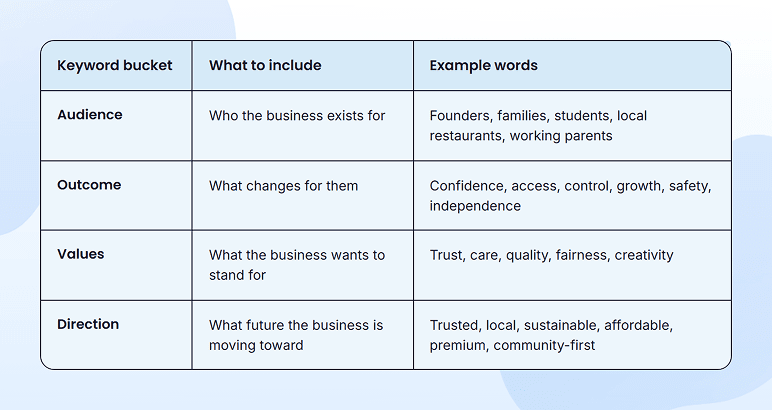
You don’t need a perfect sentence yet. At this stage, look for the words your final statement should be built around.
A simple way to do this is to write 10 to 15 words on a page, then narrow them down to the 3 to 5 that feel most central to the business. Ask:
- Which words describe the future we actually want to build?
- Which words would our customers recognize as true?
- Which words sound specific to us, not generic to our industry?
- Which words must appear in the final statement, even if the wording changes?
For example, a premium evening-wear brand might start with confidence, elegance, self-expression, celebration, and occasion. A rough vision could become: “To help women feel confident and expressive during life’s most meaningful celebrations.”
That sentence still needs editing, but it shows how keywords move from scattered ideas into a clear, future-focused direction.
3) Answer the basic business questions
After you have your purpose and keywords, try putting them to the test by using some of the basics when you ask some questions about your business.
The Heilmeier Catechism is a set of nine questions developed by George Heilmeier, a former DARPA director, to stress-test whether an idea is worth pursuing. You don’t need the full framework, but the core questions translate well to vision work—paraphrase them like this:
Ask:
- What are we trying to do? Describe the long-term outcome in plain language.
- How is it done today? Name the current problem, gap, or limitation in the market.
- What’s different about our approach? Explain what your business will do better or differently.
- Who cares? Be specific about the customers, communities, or stakeholders who benefit.
- What changes if we succeed? Describe the future impact, not just the product or service.
- How long will it take? Think in a realistic long-term window, usually 5 to 10 years.
Answer these in plain language first. If an answer sounds like something you’d slap on a billboard, simplify it. The goal isn’t to sound bigger than the business. It’s to make the direction clear.
4) Envision the future
Now step back from the business as it is today and look further out.
A question I’d sit with is: If this business succeeds over the next 5 to 10 years, what’s actually different for your customers, your team, your industry, or your neighborhood? This is where your vision becomes future-focused as you will be describing the future you’re working toward.
One trap I’d warn you about is not letting the vision turn into a goal. “Open 3 locations in 5 years” is a business goal. “Become the most trusted neighborhood café brand in the city” is a vision, because it describes the future position you want to hold, not a number you’re chasing.
Same thing at a smaller scale. “Hit $100K in revenue this year” is a goal. “Become the bookkeeping partner independent restaurants in town actually trust” is a vision. One is a target you’ll pass; the other is a position you keep working toward.
The same thinking works for any small business.
My tried and tested way to find this future is by writing the testimonial I’d want a customer to give 10 years from now. What would they say changed because your business existed? Nine times out of ten, that answer points you straight to the heart of your vision.
5) Write your vision first in long-form
Before you try to write the final sentence, write the messy version first.
Aim for 150 to 250 words if you can. I know that sounds long for a vision statement, but this is only a working draft. Even a shorter rough paragraph works, as long as it captures the main idea. The point is to get the important thoughts out before you start cutting.
In the long version, cover three things:
- The future you want to create
- The people who benefit from that future
- Why your business is positioned to help create it
For example, a rough draft for a bookkeeping firm might look like this:
“We want to help independent restaurant owners feel more confident about their finances. Many small restaurants struggle with cash flow, tax planning, and payroll because they don’t have a clear view of their numbers. Our goal is to become the bookkeeping partner that helps restaurant owners understand their financial position, make better decisions, and build businesses that can survive seasonal swings, rising costs, and local competition.”
That’s not the final vision statement. It’s far too long. But it gives you the raw material for the next step, where you’ll cut it into something clear and memorable.
6) Make it short & evaluate
After having the longer draft, start trimming it.
A good vision statement should be easy to remember, but not too short to become meaningless. I would try to make 1-2 sentences, about 15-30 words.
But how do you abbreviate it without losing the point?
Anything that describes the business’s day-to-day work should be the first thing to cut. Keep the parts about the future, the audience, and the bigger change you want to drive.
Just don’t cut so far that the statement could belong to any business. If the audience, outcome, or future direction disappears, you’ve gone too far.
Take the long-form bookkeeping draft from the previous step. Cut the how (cash flow, payroll, tax planning), keep the future and the audience, and it collapses into something like:
“To help independent restaurant owners run confident, lasting businesses.”
Then run it through four quick questions before you finalize:
- Is it clear after one read?
- Is it future-focused?
- Is it specific to this business?
- Could your team remember the main idea without reading it twice?
7) Review and revise
After getting a shorter version, test it out before you nail it down.
Begin with people who are knowledgeable about the business, like a co-founder, manager, advisor, or an early team member. After, have one or two individuals outside of the business read it, if possible. That outside reaction matters because your business plan may be read by people who do not have your full context.
Ask for specific feedback. “Does this sound good?” will not tell you much. Better questions are:
- Can you explain the main idea after one read?
- Does it feel future-focused, or does it sound like what we do today?
- Does it feel specific to this business?
- Does it stretch beyond what we do today, but still feel like something we could realistically own?
- Would this approach be desirable to an investor, lender, partner, or employee?
Refine the statement until it is understandable without further explanation. The final version should be clear, specific, and repeatable.
But a vision statement isn’t a one-time exercise. The business will change, and at some point, the statement has to keep up.
When to revisit your vision statement?
Once you’ve defined your vision, treat it as a living statement, not a permanent one. It should be stable enough to guide your bigger direction and strategic choices, but flexible enough to evolve as the business does.
Don’t rewrite it every couple of months. A constantly changing vision can no longer serve to give the company a clear direction, and your staff tunes it out.
What counts as significant? Revisit your vision statement when you:
- Rewrite or update the business plan
- Shift your business model
- Enter a new market or launch a new product line
- Raise funding
- Prepare for a merger or acquisition
- Build a new 3 to 5-year strategic plan
When you do review it, ask:
- Is this still the future we’re building toward?
- Does it match what the company actually does now?
- Is it still specific enough to be ours and no one else’s?
- Does it still help us make decisions?
And if you’re rewriting your business plan, review the vision first. Everything else in the plan should point toward that future.
What makes a good vision statement: 5 key elements
A good vision statement should do more than sound inspiring. It should help readers understand where the business is going and why that direction makes sense.
Before adding your vision statement to the business plan, check it against these five elements:
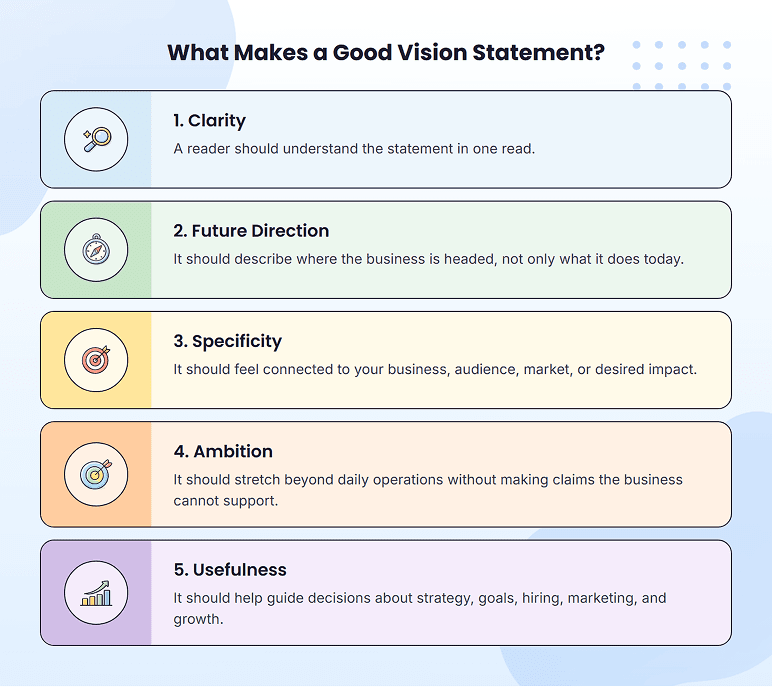
1) Clarity & future-focused
A clear vision says where the business is headed in plain language. I’d steer well clear of broad phrases like “changing the industry,” “building the future,” or “delivering best-in-class solutions.”
They sound polished, but they don’t tell anyone what you’re actually trying to become. Watch the difference. “To deliver best-in-class wellness experiences” could describe any gym in the country. “To help busy parents stay strong and active well into their 60s” tells you who it’s for and where it’s going.
2) Purposeful
A strong vision statement should give people a reason to care about the future you are building. Avoid sounding dramatic, as that usually makes the statement feel forced. Instead, connect the business to an outcome that matters to customers, employees, or the community it serves.
For example, “To provide bookkeeping services for restaurants” explains the work, but it does not give much reason to care. “To help independent restaurants build stronger, more financially stable businesses” feels more meaningful because it connects the service to a better future for the customer.
3) Ambitious but believable
A vision statement should stretch past what the business does today, but it still has to feel believable.
Watch out for claims that sound big only because they’re broad. A single-location coffee roaster doesn’t need to say it’ll become the biggest coffee company on the planet. It sounds ambitious, but it isn’t tied to the size, market, or plan behind the business.
Something like “To become the roaster that defines specialty coffee across the Pacific Northwest” works better. It still gives the business a bigger future to grow into, but it’s scaled to a real market that the plan can actually support.
4) Focused
This is where a lot of vision statements get crowded as founders try to cram the offer, the audience, the values, the goals, and the growth plan into one sentence. The result might be accurate, but it’s too heavy for anyone to remember, which defeats the point.
Your vision doesn’t need to list everything the business does. A legal services firm might offer estate planning, trusts, business formation, and asset protection. But the larger direction can be simpler: “To make long-term legal protection more accessible for families.
5) Specific to your business
A generic vision statement usually uses words any company could claim: better service, better future, trusted solutions, customer success, and industry leadership. None of those are wrong on their own, but they need context.
Instead, look for the details that make the direction yours. That could be your audience, location, category, standard of service, customer outcome, or the problem you are choosing to solve.
Compare these two versions:
- Too generic: “To help businesses succeed through better financial support.”
- More specific: “To help independent restaurants in Texas build stronger, more financially stable businesses.”
The second version works better because it names the audience, market, and outcome. It gives the reader a clearer reason to believe the statement belongs to that business.
Once your draft passes these checks, you can use AI to tighten it further.
Use this AI prompt to improve your vision statement
AI can help you tighten your vision statement, but I would not use it to create the first draft from nothing. If the prompt does not include your audience, purpose, future direction, and business context, the output will usually sound generic.
Use AI after you have a rough version. Paste your draft into the prompt below and ask it to improve clarity, specificity, and length without changing the meaning.
AI prompt:
“I am writing a vision statement for my business plan. Help me improve the statement so it is clear, future-focused, specific, and easy to remember.
Business context:
- Business type: [insert business type]
- Target audience: [insert audience]
- Main problem we solve: [insert problem]
- Future we want to create: [insert future direction]
- Location or market focus: [insert if relevant]
- Tone: clear, practical, and not overly corporate
My rough vision statement:
[Paste your draft here]
Please give me:
- Three improved versions of the vision statement
- A short explanation of what changed in each version
- One version that is best for a formal business plan
- A quick check on whether the statement sounds too vague, too broad, or too unrealistic.”
After you get the response, do not pick the version only because it sounds polished. Check whether it still feels true to the business you are actually building.
AI can help you clean up the wording, but examples help you judge the direction.
Vision statement examples of popular brands
I wouldn’t read the examples below as lines to copy, but as patterns. Don’t just ask whether a statement sounds good, ask what future it points to, what business choice it supports, and what it leaves out. The strong ones rarely list every product, service, or customer segment. They pick one clear direction and make it easy to understand.
We’ll start with well-known brands, then move to small-business examples that are usually easier to model when you’re writing your own plan.
One thing before the list: not every statement below is technically a vision. A few, like Nike’s and Shopify’s, are missions. I’ve kept them because the lesson, how a company compresses its long-term direction into a single sentence, holds true either way. Where a line is a mission, I’ll flag it.
1) IKEA
IKEA’s vision is “to create a better everyday life for the many people.”
I find this example to be nice because it doesn’t say anything about furniture. IKEA’s vision is targeted at the customer’s life, while they sell furniture, home goods, and design ideas. That gives the company a bigger direction without making the wording feel inflated.
2) Nike
Nike’s official mission is “to bring inspiration and innovation to every athlete in the world.” The company also likes to say, “If you have a body, you are an athlete.”
Even though Nike labels this as a mission, it carries a strong vision-style lesson. The important move is how Nike defines the audience. It doesn’t limit “athlete” to professionals or serious competitors. It expands the audience while staying close to the brand’s core.
3) Disney
Disney’s mission statement is “to be one of the world’s leading producers and providers of entertainment and information.”
The word to sit with here is focus. Films, theme parks, streaming, merchandise, media networks, Disney could have crammed all of it in. Instead, one idea, entertainment and information on a global scale, sits above the lot and pulls every business line in the same direction.
4) Amazon
Few are as blunt as Amazon. At the heart of its company direction sits one line: “to be Earth’s most customer-centric company.” (Amazon pairs it with two more, being Earth’s best employer and safest place to work, but the customer-centric piece is the one that shapes everything.)
This one is direct. It doesn’t sound poetic, but it tells you exactly what Amazon wants to be known for. I’d study this example for its focus. The statement gives Amazon a clear decision filter: if something improves the customer experience, it supports the direction.
5) Coca-Cola
Coca-Cola’s current vision reads: “to craft the brands and choice of drinks that people love, to refresh them in body and spirit.”
What makes it work is the pairing of category and feeling. It names the business (drinks) and the outcome people are meant to walk away with (refreshment). That’s a pattern a small business can borrow directly: say what you do, then say what changes for the customer.
6) TED
Then there’s TED, whose mission lives in two words: “Spread ideas.”
Short statements usually feel thin. This one holds because the entire organization leans on it, talks, conferences, podcasts, education programs, and community events, all of which trace back to spreading ideas. The takeaway isn’t “be short at any cost.” It’s those short works when the idea is strong enough to carry the whole business.
7) Southwest Airlines
Southwest wants to be “the world’s most loved, most efficient, and most profitable airline.”
Most companies pick one outcome. Southwest names three at once: customer love, operational efficiency, and financial strength, and balances them. For a business plan, that balance is the lesson: a vision can aim high, but it should still describe the kind of business you’re actually building.
8) Alzheimer’s Association
Nonprofits often write the cleanest visions of all. The Alzheimer’s Association is “a world without Alzheimer’s and all other dementias.”
There’s no slogan or hedging, just the future the organization exists to create. That’s a lesson for any business: when the future is clear enough, the statement doesn’t need length to land.
9) Habitat for Humanity
Habitat for Humanity puts it plainly: “a world where everyone has a decent place to live.”
It could have reached for “improve communities” or “create better lives”, but those belong to anyone. Habitat names the exact future instead: a decent place to live, for everyone. Study this one for how specific it stays while still sounding big.
10) Shopify
Shopify closes the list with “to make commerce better for everyone.”
For small-business readers, this is the most relevant of the bunch; the direction is built around sellers, entrepreneurs, and access to commerce. It’s broad without being random: online stores, payments, retail tools, logistics all fit under one idea. The move worth copying is that Shopify never calls itself a website builder. It defines the future it wants to shape.
Once you’re clear on the vision statement, the final question is where does it belong in the plan.
Where does a vision statement go in a business plan?
Typically, a vision statement is located in the company overview section of a business plan, near the mission statement, business purpose, values, and company goals.
You may also see it referenced in the strategic planning section of some business plans, or as a brief reference in the Executive Summary. However, the primary location for it is the Company Overview, where readers are looking to learn what the business is, why it exists, and where it’s heading.
I would not stick the whole vision statement in the Executive Summary. The part is typically tightly packed. Rather, add a brief note there if necessary, and then explain the vision in the Company Overview.
Conclusion
A vision statement isn’t a line you drop into the company overview and forget. It’s the direction everything else in the plan points toward.
So once you’ve written yours, use it as a test: do your goals, strategy, and numbers actually support that future? If they don’t, that’s useful; it tells you what to fix.
That’s really the whole job. Get the direction right, and the rest of the plan has something to line up behind.
Your next step is simple: open your plan and write the version you have today. You can tighten the words later. If a blank page is the problem, our free vision and mission templates give you a structure to fill in.
Give Your Vision a Clear Business Plan
Build a structured plan that keeps your goals, strategy, and financials aligned.

Frequently Asked Questions
Should a small business even have a vision statement?
Can a vision statement and a slogan be the same thing?
Do investors actually read the vision statement?
Does a vision statement need to be public?

William Ranieri
William Ranieri is an experienced business consultant specializing in entrepreneurship, executive training, and leadership development. He helps clients find better ways to improve communication, balance growth with budget demands, and build stronger teams. With 40 years of interviewing and coaching, he shares practical strategies that make business challenges easier to handle and support long-term success. Read more