


Most business plan guides tell you to write your executive summary last. So you skip it and move to the next section: Company Overview.
You read the instruction, then compare it with the executive summary. Soon, both sections start sounding almost the same. Both ask for a short introduction to your business, what you do, who runs it, and where it’s headed.
Then you search online and come across another term: company description. Some articles use it the same way as company overview. Others say it’s completely different.
That’s where many first-time founders get stuck. The section sounds simple, but the questions keep piling up. What’s the difference between a company overview and a company description? How long should it be? Can you write one before the business is officially registered?
I’ve seen founders spend hours overthinking a section that should take less than an hour to write.
This guide clears up the confusion.
I’ll walk you through a simple 9-part structure for writing a company overview, share examples for three different business types, and explain the difference between a company overview and a company description so you can stop second-guessing and start writing.
Key Takeaways
- A company overview explains what your business does, who runs it, and where it’s headed. It usually comes after the executive summary.
- It covers nine main areas: business details, legal structure, ownership, location, team, company background, target customers and services, mission and values, and future goals.
- Keep it between 300 and 500 words, or about one to two pages. Longer sections are often skimmed.
- Write a rough draft early to organize your ideas, then finalize it after the rest of your business plan is complete.
What is a company overview?
A company overview (also known as business overview) is the section of a business plan that explains the main details about your business, including:
- What your business does
- Who owns and runs it
- Where it’s located
- How it’s legally set up
- How the business started
- What goals the business has
This section usually comes right after the executive summary and is about 300 to 500 words long.
The executive summary introduces the idea. The company overview explains the actual business behind it and shows that it’s real, organized, and serious.
What is the difference between a company description and a company overview?
A company description is one small part of the company overview. It’s a short paragraph that explains:
- What the business does
- Who the customers are
- What problem the business solves
It’s usually around 100 to 150 words long. Some templates call it a business description, but both terms mean the same thing.
Here’s an example of a company description:
That’s around 100 words.
The full company overview would include this paragraph plus more details about the founders, legal setup, company background, mission, location, and future goals. You’ll see the full worked examples later in this guide.
So if a template asks for a company description, write the short “what we do” paragraph. If it asks for a company overview, write the full section.
The two sections overlap because, as said earlier, company description is part of the company overview. The main difference is the amount of detail.
Can I write a company overview before launching my business?
Yes. A company overview is not just a summary of a business that already exists. It’s also a structured introduction to the business you’re planning to build.
Many founders get confused because sections like business history, team, ownership, and legal structure sound like things you can only write after launching. But those are simply the categories the overview covers. What changes is the information you include based on your stage.
Here’s how pre-launch founders usually handle each section.
Legal structure and ownership
You do not need to register the business before writing the overview.
You can simply explain what you plan to register it as. For example:
This shows your planned structure without pretending the paperwork is already complete.
Team
List the founders you currently have and mention important roles you plan to hire for later.
If you’re a solo founder, say that clearly. For example:
Many solo founders try to make the team sound bigger than it really is. That usually hurts credibility more than it helps. A clear hiring plan looks more honest and professional than vague mentions of “advisors” or “consultants.”
Business history
If the business hasn’t launched yet, the history section becomes the origin story.
You can include things like:
- When the idea started
- Early research or validation work
- A prototype or beta version
- Pre-orders or early customer interest
- Pilot projects or signed letters of intent
- What the next steps are
A company overview written before launch and one written after launch usually follow the same structure.
The main difference is timing. One explains what already exists. The other explains what is currently being built.
What to include in an effective company overview
Before we go through the components, here’s an important thing to understand: each component exists for a reason.
Every lender, investor, or business partner reading your plan will have a few basic questions about your business. If you leave out key details, the reader is forced to guess, and that usually creates doubt.
When you include all nine components, the company overview answers those questions clearly without needing extra explanation.
Here’s what to include:
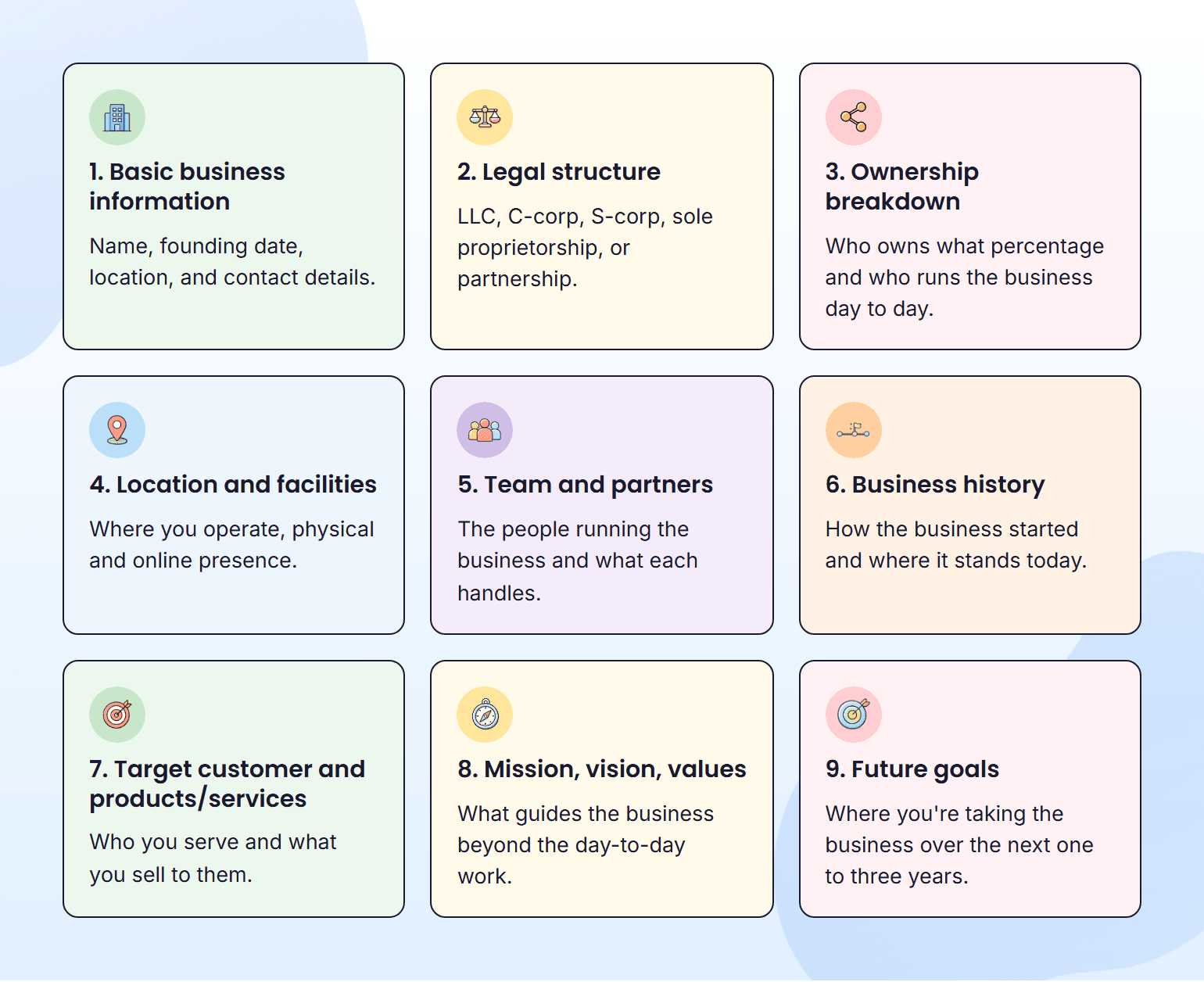
1. Basic business information
Start with the basic facts about your business. This is usually the easiest part to write, but many founders either rush through it or add too much detail.
Include the following:
- Business name: Use the registered legal name, not the brand name (unless they’re the same). If you operate under a doing business as (DBA), include both.
- Founding date: The date the business was officially formed, or the date operations started if the business isn’t registered yet.
- Location: Your city and state at a minimum. If you operate remotely or in multiple locations, mention that briefly here.
- Contact information: Main business email, phone number, and address if needed.
- Website and online presence: Your website and any main social media or platform links customers use to find you.
Usually, one line for each item is enough. The goal is simply to confirm the key business facts quickly.
For example:
That’s enough to give a lender or investor the key details they need from this section.
2. Legal structure
After covering the basic business details, the next step is to mention your legal structure.
This may look like a small detail, but it tells readers a lot about how the business works. Your legal structure affects:
- How the business is taxed
- Who is personally responsible if something goes wrong
- Who has the authority to sign contracts for the business
Lenders usually check this before approving a loan. Investors check it before making an investment. That’s why it’s important to state it clearly so readers don’t have to guess.
Here are the five most common legal structures used by small businesses in the United States:
- Sole proprietorship
- Partnership
- LLC
- C-corp
- S-corp
In your company overview, you usually only need one or two lines for this section. Mention your legal structure, the state where it’s registered, and who the members or owners are.
You don’t need to explain why you chose that structure. That discussion usually happens later in meetings or conversations.
For example:
If you’re unsure which structure is right for your business, the SBA provides side-by-side comparisons of different business entity types.
3. Ownership breakdown
After the legal structure, the next thing readers want to know is who owns the business.
This section explains who owns the company, how much of the business each person owns, and who is involved in running it day to day.
Some owners manage the business every day. Others may only invest money or assets and not be involved in daily operations. Both are normal, but readers should clearly understand who actually runs the company.
For each owner, include their name, ownership percentage, role, and whether they work in the business full-time, part-time, or not at all.
Example: Two active co-founders
Example: Active founder and passive investor
If you’re the only owner, one sentence is enough.
For example:
Keep this section short and clear. You do not need to explain future ownership changes, stock options, or investor plans here. Those details belong in the financial or funding sections of the business plan.
4. Location(s) and facilities
This section explains where your business operates, both physically and online.
Include details like:
- Your main business location
- Whether the space is owned, leased, home-based, or fully remote
- Any additional or future locations
- Your website or online selling platforms
- Remote team members working from other locations
In most cases, one short paragraph is enough.
You do not need to explain lease details, office layout, or square footage in depth. Those details belong in the operations section of the business plan.
For example:
If your business is fully remote, say that clearly. For example:
That’s all this section needs to do. The goal is simply to show readers where the business operates so they can picture how it works without making assumptions.
5. Team and partners
Now introduce the people running the business. This is the section lenders and investors read to figure out whether the team has the experience to run the company successfully.
For each person, include their name, title, past experience, what they handle in the business today, and their ownership share or role if it wasn’t already mentioned in the ownership section.
Keep the bios short. You do not need full resumes here. Full resumes can go in the appendix of the business plan.
For example:
That’s enough detail for readers to understand who Sarah is and what she does.
If you plan to hire important roles later, mention them briefly. For example:
This shows readers that you’ve thought about what the business will need as it grows.
You can also briefly mention outside professionals who support the business, such as accountants, lawyers, or advisors. For example:
You do not need a formal advisory board to include this.
If you are running the business alone, simply say so. For example:
That usually sounds more honest and professional than trying to make the team seem larger than it is.
6. Business history
If your business hasn’t launched yet, this section becomes the story behind the idea. The pre-launch section earlier in this guide explains what you can include here.
If the business is already running, this section should explain how it started and how it got to its current stage.
Try to cover three things:
- When and why the business started
- Important milestones over time
- Where the business stands today
Milestones can be simple things, like your first customer, your first employee, a bigger client, becoming profitable, moving into a larger space, or opening another location. These details help show how the business has changed over time.
Keep this section clear and factual. Avoid lines like “we became a trusted brand” or “we experienced rapid growth.” Real dates, events, and numbers make the story more believable and easier to follow.
For example:
“Maple & Oak Coffee Roasters started in 2021. At the time, the owners were selling roasted coffee at weekend markets in East Austin and preparing small batches in a shared kitchen.
Most early customers were people buying coffee for home use. After a steady increase in repeat customers, the business registered as a Texas LLC in 2023 and started supplying coffee to its first local café.
Later that year, two more cafés began placing wholesale orders. By the end of 2024, the business moved into its own roasting space in East Austin because the shared kitchen space was no longer enough for daily production.
As of 2026, Maple & Oak supplies coffee to 23 wholesale accounts across Central Texas.”
7. Target customer and products/services
In this section, cover two things: who your customers are and what you sell to them.
Keep both parts short. The goal is to give readers a quick understanding of the business, not a full product breakdown.
Target customer
Start by clearly describing your main customer. Be specific.
Instead of saying “small businesses,” say something like “independent cafés with 5 to 15 seats across Central Texas.”
Instead of saying “home cooks,” say “first-time bakers aged between 25 and 40 looking for sourdough kits and online baking classes.”
Then include one number that helps readers understand the size of the business. Depending on your stage, this could be:
- Current customer count (for existing businesses)
- Expected first-year customers (for pre-launch businesses)
- Number of pre-orders, pilot users, or signed letters of intent
Products or services
Briefly explain what you sell and what makes it different from other options in the market.
You do not need to list every product or explain pricing here. The full details belong in the products and services section later in the business plan.
Example:
That’s enough information for readers to understand who the business serves, what it sells, what makes it different, and the rough size of the business.
8. Mission, vision, and core values
Your mission, vision, and core values are three different things, and each one tells readers something different about the company.
- The mission explains what the business does today
- The vision explains where the business is headed in the future
- The values explain how the team works and makes decisions day to day
Write each one separately.
Mission statement
Your mission statement explains what your business does and who it serves. Keep it short and specific.
A good mission statement should sound unique to your business, not something that could apply to any company.
Example: Maple & Oak’s mission
Vision statement
Your vision statement explains where you want the business to go in the future. Keep it to one or two sentences.
It should feel ambitious but still realistic enough that readers can clearly picture it.
Example: Maple & Oak’s vision
Core values
Core values explain how your business operates day to day. These should feel real and specific, not like generic corporate phrases.
Avoid vague words like “integrity,” “innovation,” or “excellence” without explanation. Those words are so common that they stop meaning much on their own.
Example: Maple & Oak core values
- Pay producers fairly, every time.
- Roast small enough to know every batch.
- Show up for our cafés, even when it costs us.
- Be honest about what’s in the bag.
- Stay small enough to do this well.
For example, “To deliver excellent service with integrity” could describe almost any business. But “To supply independent cafés across Central Texas with small-batch coffee” only fits Maple & Oak. That’s what makes it stronger and more believable.
9. Future goals
Your vision explains where you want the business to go in the long run. Your future goals explain the practical steps you’ll take to get there.
By this point, readers know what your business does, who runs it, and how it operates. Now they want to see the goals you’re working toward.
Focus on two timeframes: one-year goals & three-year goals.
One-year goals
These should be specific and realistic goals you plan to achieve within the next 12 months.
This can include things like:
- Adding new customers
- Hiring employees
- Opening a new location
- Launching a new product or service
- Reaching a revenue target
Three-year goals
These are the bigger goals for where you want the business to be in the next 3 years.
They do not need to be extremely detailed, but they should still be clear enough for readers to picture the direction of the business.
Keep this section short. Usually, three to five goals total are enough. A very long list can make it look like you haven’t decided what matters most.
Example:
Maple & Oak’s future goals
One-year goals (2027)
- Grow from 23 to 40 wholesale café accounts across Central Texas
- Hire a second full-time roaster to support growth
- Reach consistent monthly profitability
Three-year goals (2029)
- Expand into the Dallas–Fort Worth market while keeping the small-batch model
- Hire part-time packaging and delivery staff to support higher order volume
- Launch a coffee subscription service for direct online customers
Tips to write an effective company overview
One of the biggest mistakes first-time founders make in this section is writing too much. When you’re worried the business may not sound impressive enough, it’s easy to keep adding more details. Before long, the company overview turns into several pages of background information most readers don’t need.
The following 4 tips will help you write a company overview that is clear, complete, and easy to read.
1. Adjust to your reader (investor vs. bank vs. internal)
Once you have the structure, adjust it based on who will read it. An investor, a bank loan officer, and your own team may read the same business plan, but each one focuses on different things.
Here’s how the same business, Maple & Oak Coffee Roasters, might introduce itself to different readers.
| Reader | What to focus on | Example opening line |
| Investor | Growth and future plans | “Maple & Oak supplies 23 wholesale café accounts across Central Texas and plans to grow to 40 next year.” |
| Bank / SBA loan officer | Stability and ability to repay | “Maple & Oak is a Texas LLC operating since 2023 and supplies 23 established wholesale accounts with steady monthly revenue.” |
| Internal team | Current goals and direction | “Maple & Oak roasts single-origin coffee for independent cafés and is focused this year on growing to 40 accounts while maintaining small-batch quality.” |
The facts stay the same. Only the focus changes.
If you are not sure who the main reader is, start with the investor version first. It usually pushes you to be more clear and specific about where the business is headed.
2. Tell a story (use narrative structure)
No matter who’s reading the overview, people usually remember stories better than lists of facts.
Someone reading multiple business plans in a day is more likely to remember the business that explained how it started and why it exists, not the one that only listed information.
A simple business story usually has three parts:
- The problem
- What the business does about it
- Where the business is today
You do not need dramatic storytelling or creative writing. You just need to connect the facts in a way that makes sense.
Here’s the difference.
Flat version:
Story version:
Both examples include the same facts. The difference is that the second version explains why the business exists, not just what it is.
One important thing to remember: this approach works best for investors and pitch-style business plans. If you’re writing for a bank or SBA loan, stay more focused on direct facts and stability. Loan officers usually care more about risk than storytelling.
3. Draft it early, finalize it last
The company overview summarizes the rest of your business plan. The problem is that you can’t fully summarize a plan you haven’t finished writing yet.
A simple way to handle this is to write it in two stages.
Start with a rough draft early. This helps you get clear on what the business is, who it serves, how it works, and where it’s going before you build the rest of the plan.
Then, after the full business plan is finished, come back and update the overview. By then, you’ll have more accurate numbers, clearer goals, and a better understanding of the business.
The early draft helps you organize your thinking. The final version makes sure everything matches the finished plan.
4. Proofread and get it tested
Before you finalize the overview, ask someone who doesn’t know your business to read it. A fresh reader notices things you stop seeing after writing and rewriting:
- Confusing terms. Words that make sense to you but not to an outsider.
- Bragging lines. Phrases like “industry-leading” or “best-in-class” that sound empty to most readers.
- Details that don’t match. A number or date here that doesn’t line up with the rest of the plan.
After that, check the basics yourself: spelling, grammar, punctuation, and flow.
If your business is already running, update this section whenever something changes, like a new owner, a new location, or a new direction. An overview that’s out of date can do more harm than good.
Not sure how to word your overview?
Let AI draft your company overview in minutes
Company overview examples
Below are three examples for different types of businesses: a consulting firm, a pre-launch food startup, and a renewable energy company. Each one follows the same nine-part structure from this guide, so you can see how the format works across different industries.
Note: These are sample businesses created for this guide. They are not real companies.
Service business example: Northstar Compliance Consulting
Company Snapshot
Northstar Compliance Consulting is a consulting company registered in Delaware. The business helps small software companies complete security audits like SOC 2. Many software companies need these audits before larger customers will agree to work with them.
Legal Structure and Ownership
Northstar Compliance Consulting is a Delaware LLC with 55% ownership by Priya Iyer and 45% by Marcus Webb. The owners are full-time employees of the business.
Location and Facilities
The business operates remotely. Priya works from Austin, Texas, and Marcus is based in Raleigh, North Carolina. The company also works with three part-time contractors located in different cities across the United States.
Client meetings are handled through video calls. The company website, northstarcompliance.com, is used to securely share files and project documents with clients during audits.
Team and Partners
Priya Iyer, CEO, spent eight years managing audits at a large accounting firm before starting Northstar. She handles client communication, project planning, and new business.
Marcus Webb, Head of Audit, previously worked at a software company where he managed the company’s first SOC 2 audit. At Northstar, he oversees audit work and helps train contractors working on projects.
The company plans to hire its first full-time employee once client work becomes more consistent.
Business History
Priya and Marcus first met in 2020 while working on the same audit project from opposite sides. Priya was leading the audit team, and Marcus was handling the process from the client side.
During that project, both noticed the same issue. Smaller software companies were often paying very high prices for audits because most consulting firms mainly focused on large enterprise clients.
They started Northstar Compliance Consulting in 2022 to work with smaller software businesses that needed a more practical and lower-cost option.
Their first client was a 22-person software company that needed to complete an audit within four months so customer contracts could move forward.
By the end of 2024, Northstar had completed 31 audits for software companies across the United States.
Target Customers and Services
Northstar mainly works with U.S.-based software companies that have between 10 and 100 employees and are preparing for their first compliance audit.
Most clients are being asked by larger customers or business partners to complete audits before contracts can move forward.
The company offers:
- SOC 2 readiness and audit support
- HIPAA compliance support
- ISO 27001 audit support
- Annual renewal support for existing clients
Mission, Vision, and Values
Mission
Help small software companies complete major audits without paying enterprise-level prices.
Vision
Become the audit firm that growing software companies recommend to other businesses.
Core Values
- Tell clients bad news early
- Charge for completed work instead of hourly billing
- Keep senior team members involved in every project
Future Goals
One-Year Goals
- Grow from 31 clients to around 50 clients
- Hire the first full-time employee
- Launch HIPAA support as a separate service
Three-Year Goals
- Build a small in-house consulting team
- Add support for companies managing multiple audits at the same time
- Build a steady referral base without depending heavily on paid advertising
Pre-launch example: Crafty Cones
Company Snapshot
Crafty Cones is an ice cream business based in Houston, Texas. It will sell handmade ice cream served in waffle cones made in-house. The business has not opened yet and plans to launch its first location.
Legal Structure and Ownership
Crafty Cones will register as a Texas LLC before opening. Maya Flores will own 60% and Sam Whitfield will own 40%. Maya will manage the business full-time. Sam owns a pizza restaurant in Houston and will act as an advisor rather than a full-time operator.
Location and Facilities
The first location will be a storefront in Houston. The shop will prepare ice cream and cones on-site. The business will also have a website (craftycones.com) and offer delivery through food delivery apps.
Team and Partners
Maya Flores, Owner. Pastry chef with six years of experience in Houston restaurants. Responsible for recipes, hiring, and daily operations.
Sam Whitfield, Co-owner and Advisor. Owner of Dough’s Pizzeria in Houston since 2017. Will advise on suppliers, licensing, and food-service setup.
Roles to be filled before opening: ice cream production lead, two counter staff, and a part-time social media manager.
Business Background
Maya started selling ice cream at Houston weekend markets in 2025. The product sold well and built a small group of repeat customers. She decided to open a permanent shop and brought in Sam, who has experience running a food business in the city. The menu and cone designs are still being finalized.
Target Customers and Products
Crafty Cones is aimed at everyday customers in Houston, including families, students, and downtown workers. The main product is handmade ice cream in custom waffle cones. The cones are the main point of difference from standard ice cream shops.
Mission, Vision, and Values
Mission
To make good-quality ice cream that is affordable for everyday customers.
Vision
To grow from one shop into several Houston locations over time.
Core values
- Make products in-house.
- Keep prices affordable.
- Focus on the quality of the cones.
Future Goals
One-Year Goals
- Open the first Houston location.
- Build a base of repeat customers.
- Finalize a core menu.
Three-Year Goals
- Open a second location.
- Become known locally for the cones.
- Supply cones or ice cream to a few local cafés.
Established business example: SolarSynergy
Company Snapshot
SolarSynergy is a solar energy company based in Austin, Texas. The company designs, installs and maintains solar panel systems for homes and businesses throughout the state. The company has been in business since 2019.
Legal Structure and Ownership
SolarSynergy is registered as a Delaware corporation. The company chose a corporate structure to make it easier to bring in investors and protect the owners from personal liability.
Laura Mitchell and Kevin Brown are the owners of the business, and a small group of early investors who have minority shares.
Location and Facilities
The company’s main office and equipment warehouse are located in Austin, Texas.
Installation crews work on customer properties throughout the state to finish projects. The business does not have an online store, but the website is used for quotes and customer support.
Team and Partners
Laura Mitchell, CEO, was previously an energy consultant for over a decade. She is responsible for partnerships, business strategy, and company growth.
Kevin Brown, CTO, is an electrical engineer responsible for system design, installation standards, and technical operations.
The company also employs a CFO, a sales team, and several full-time installation crews. During busy periods, SolarSynergy works with outside electricians for extra support.
Business History
SolarSynergy began in 2019 with funds raised from a crowdfunding campaign and a few angel investors.
The company started with residential solar installations and later branched out to commercial installations. In 2024, SolarSynergy had installed over 500 systems in Texas.
Target Customers and Services
SolarSynergy works with homeowners and businesses across Texas that want to lower energy costs or switch to renewable energy.
The company’s core business is solar system design, installation, and maintenance. It also provides energy-efficiency consulting services to customers who are planning larger projects.
Mission, vision, and values
Mission
To bring solar power to the homes and businesses of Texas at a more affordable and viable price.
Vision
To be one of the top solar installation companies in the southern United States.
Core Values:
- Use reliable equipment built to last
- Give customers honest pricing and savings estimates
- Stand behind every installation
Future Goals
One-Year Goals
- Expand into two additional Texas metro areas
- Add a second commercial installation crew
- Launch a maintenance plan for existing customers
Three-Year Goals
- Operate in at least three states
- Grow commercial projects to half of total company revenue
- Build a referral network with local builders and contractors
Prepare your company overview section
A good overview gives readers a clear picture of what your business does, who runs it, where it stands today, and where it’s headed.
You now have everything you need to write one.
Use the nine components from this guide, keep the section between 300 and 500 words, and use the examples above for reference.
Start with a rough draft early to organize your ideas, then update and finalize it after the rest of the business plan is complete.
If you need help getting started, Upmetrics can help. The AI business plan generator follows the same nine-part structure covered in this guide and can generate a first draft you can edit and improve. You can also explore 400+ sample business plans to see how other businesses wrote their company overview sections.
Start Building Your Business Plan Today
Create a clear company overview and complete business plan with Upmetrics.


Vinay Kevadia
Vinay Kevadiya is the founder and CEO of Upmetrics, the #1 business planning software. His ultimate goal with Upmetrics is to revolutionize how entrepreneurs create, manage, and execute their business plans. He enjoys sharing his insights on business planning and other relevant topics through his articles and blog posts. Read more