


You’ve got a business idea, and before you spend a dollar on it, how do you actually know anyone wants what you’re planning to sell?
That’s the question market research answers. And it’s the one most first-time founders either skip or overthink.
You don’t need costly reports, surveys, or focus groups. And you definitely don’t need a team of data analysts. What you do need is a clear sense of whether people will actually buy what you’re planning to sell, and why they’d choose you over the alternatives.
That’s what market research gives you. It’s how you get to know your customers, test your idea before you fund it, size up your competitors, and make smarter calls while the stakes are still low.
That’s the short answer to why market research is important. By the end of this guide, you’ll know exactly what to research, where to find the data for free, and how to turn what you learn into a business plan investors actually take seriously.
What is market research?
Market research is the process of gathering information about your target market: who your potential customers are, what they want, how big the opportunity is, and who you’re competing against.
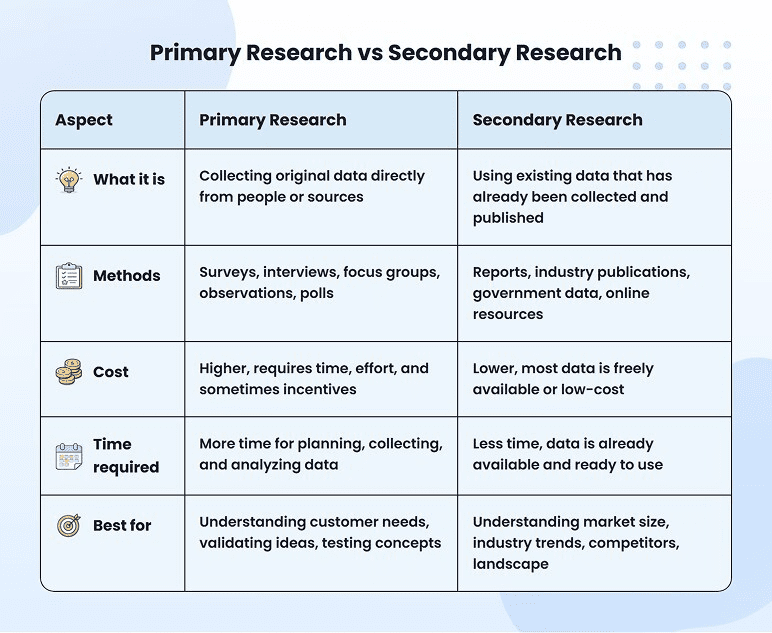
Most small businesses use two types of market research.
Primary research is any research that you do yourself, such as surveys, individual interviews, focus groups, or observing people in a store. It’s unique to your business, and no one else can have the data.
Secondary research is what already exists: census reports, industry studies, competitor websites, Reddit threads, Google Trends, and SBA.gov resources. It’s easy, inexpensive, and provides you with the broad context that a 10-person survey never can.
Say you’re opening a coffee shop in downtown Eugene, Oregon. Secondary research tells you how many people live within a mile, the median household income, and how many cafes already serve the area.
Primary research is you standing outside the planned location for three mornings, counting foot traffic, then walking into five neighborhood cafes to check what they charge for a 12-oz latte.
Why is market research important for your business?
The majority of business owners end up failing because they got the market wrong. They create products for which customers have no need, appeal to the wrong market, or enter an area of competition blindly.
Market research is what prevents that. In the sections below, I’ll break down the six specific ways market research pays off, from understanding your customers to building a business plan investors actually trust.
1) Helps you understand your target customers
Most founders can describe their ideal customer in one sentence, like:
- “Busy professionals.”
- “Small business owners.”
- “Health-conscious people.”
- “Students.”
But those labels don’t tell you enough to build a business around them.
Market research helps you move from a broad audience guess to a clear customer profile. It shows you who your customers are, what problems they’re trying to solve, how they currently solve them, what they’re willing to pay for, and what would make them choose you over another option.
| What to study | What it tells you | Business decision it affects |
| Demographics | Age, income, location, occupation, family status | Pricing, product range, location, packaging |
| Buying behavior | How often they buy, where they shop, what they compare, and how much they spend | Sales channels, offers, marketing messages |
| Needs and pain points | Problems, frustrations, goals, and reasons for switching | Product features, positioning, messaging |
| Buying triggers | What makes them act now, such as price, convenience, trust, or urgency | Promotions, CTAs, launch campaigns |
That single finding changes everything: your menu, your pricing, your delivery schedule, even the photos in your ads. And it’s a lot cheaper to learn it from ten conversations than from a freezer full of unsold high-protein meals.
Take a meal prep startup as an example. You assume your customer is the fitness crowd: macros, protein counts, the whole thing. So you start interviewing potential customers, and a different picture shows up. The people most eager to buy aren’t gym-goers at all. They’re working parents who don’t care about macros and just want one less thing to think about on a Tuesday night.
The one finding rewrites your menu (simpler meals, family portions), your pricing (per-family, not per-macro), and your delivery schedule (Sunday night drop-offs before the work week). It’s a lot cheaper to learn that from ten conversations than from a freezer full of unsold high-protein meals.
Once you get your customer’s attention correctly, you can make your offer according to what they actually need, not what you think they need.
Research on customers is also not a one-off job. Needs evolve, competition gets better, and customer preferences change. That’s the way the ones that continue to listen to customers fare; they are often better at adapting their products, pricing, and marketing before the market outgrows them.
2) Validates your idea before you spend money on it
There’s a reason so many businesses don’t make it past the first few years. According to the U.S. Bureau of Labor Statistics, only about half of new businesses survive to year five. And when you look at why the ones that fail actually failed, it’s that they committed money to an idea before confirming anyone wanted it.
Validating your business idea is how you avoid that. It means testing the assumptions your business depends on while they’re still cheap to be wrong about.
Every new business is built on a few beliefs the founder hasn’t actually checked yet. That the problem matters to enough people. That those people will pay to solve it. That they’ll pick your version over whatever they use now. Some of those beliefs hold up. Some don’t. The point of validation is to find out which is which before the money is spent, not after.
In practice, that means getting honest answers to a handful of questions before you commit:
- Is the problem actually painful, or just mildly annoying?
- Who feels it enough to pay for a fix?
- How are they solving it today, and what does that cost them?
- Would they genuinely switch to what you’re offering, or just say they would to be polite?
That last one matters more than it looks. People are generous with hypothetical enthusiasm and stingy with actual money. And validation won’t exactly give you a clean yes or no. More often, it redirects the idea.
Say you want to launch a paid budgeting app for freelancers. You talk to enough of them, and the pattern is clear: they like the concept, but they’re tired of monthly subscriptions. That’s not the idea failing. That’s the idea, telling you it wants to be a one-time purchase, or a free tier, or a tool sold to the accountants who serve those freelancers instead.
The founders who do this end up not having spent a year and their savings building something the market was never going to buy.
3) Identifies market opportunities and gaps
The best business ideas aren’t always brand-new ones. A lot of them come from someone noticing what customers already want but can’t easily find.
That’s really what market research is doing here. It helps you spot the gaps. It may be a group of customers that’s being overlooked, a need for a service that no business is offering, a price point that no business is going for, or a complaint that can’t seem to be solved.
I encourage founders to abandon the idea of asking “What should I start?” and rather ask “What is missing and who is still underserved?” It’s a much more helpful question!
Typically, market gaps usually show up in five ways:
- Underserved customer segments: The product is available, but not offered for a particular segment, such as freelancers, working parents, students, or local businesses.
- Unmet needs: Customers are purchasing from competitors but are still dissatisfied with price, quality, support, convenience, or feature availability.
- Geographic gaps: There is definitely a demand, but there are virtually no options to meet that demand in the immediate vicinity.
- Pricing gaps: It’s either too costly or too limited in features for those you’d be selling to.
- Trend gaps: Customers’ behavior is changing, but businesses are lagging.
Now, not every gap is worth chasing. A gap can exist because nobody actually wants it filled. Before you commit, look for three signals: repeated complaints, clear demand, and people already paying for imperfect alternatives. If folks are actively searching, comparing options, or grudgingly buying something that doesn’t quite fit, you’ve probably found something real.
4) Strengthens your competitive position
Your competitors are already talking to your future customers. They are creating price expectations, addressing objections, and influencing buyers’ expectations in any business in your field.
You either were part of that conversation or you weren’t.
Market research helps you understand the competitive environment before you walk into it. Through competitor analysis, you can study what other businesses offer, how they price, what customers actually love about them, and where they fall short. The point isn’t to copy what’s working but to find the gaps your competitors leave open and give customers a real reason to pick you instead.
A simple competitive review answers questions like:
- What are competitors charging?
- What features, services, or packages do they offer?
- What do customers praise in their reviews?
- What complaints show up over and over?
- Which customer segments are they ignoring?
- Where do you have a clearer, sharper, or better offer?
You don’t have to beat the bigger players on price or size. You can compete by being more specific, easier to buy from, faster to respond, or better suited to a narrow customer group. That’s how most small businesses actually win.
It’s helpful to use a SWOT analysis to help you structure what you’re finding. Take a small coffee shop opening downtown.
- The Strengths might be the founder’s barista experience and a prime corner location.
- Weaknesses could be a tight launch budget and no built-in customer base.
- The Opportunities are the lunch crowd from nearby offices and a gap in specialty drinks.
- The Threats are two established cafes within three blocks and rising lease costs in the area.
Once you map it out like this, you can see exactly where to compete, what to fix, and what to plan around.
You don’t need expensive software to get started. Google your main keywords, read competitor reviews, study their websites, and scroll through their social media comments. For most small businesses, a quarterly competitive review is plenty. In fast-moving markets, do it monthly.
5) Supports data-driven business decisions
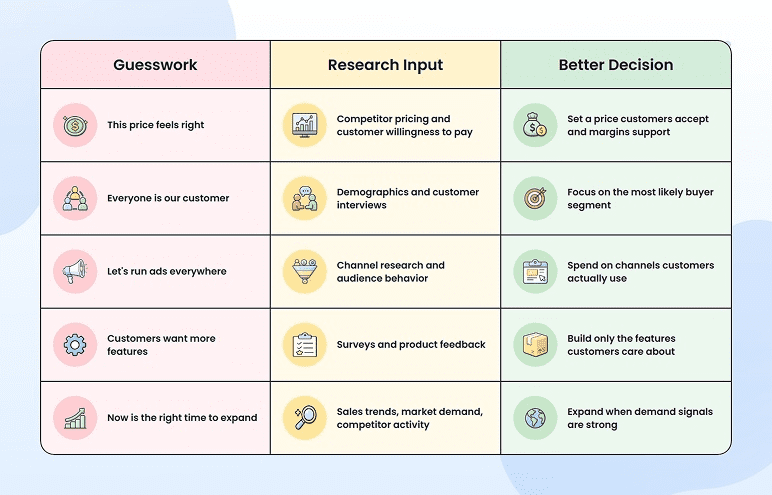
When real money is on the line, instinct isn’t enough. Market research provides you with the information that will help you make those decisions. Rather than making educated guesses about what customers want, the price they’ll pay, or which marketing channel to invest in, you can base these decisions on real evidence.
It can help you decide:
- What price range are customers willing to pay
- Which product features matter most
- Which customer segments to target first
- Which marketing channels are worth testing
- When to expand, pause, or rework your offer
One of my favorite examples is LEGO. According to MIT Sloan, the Danish toymaker nearly went bankrupt in 2003 after spending years chasing growth in directions that pulled it away from its core brick-based play experience.
The recovery came from a much sharper, research-backed view of what customers actually valued, which led to smarter calls on which products, partnerships, and product extensions to invest in, and which to drop. That shift is what brought the company back to profitability.
It enables you to avoid spending on products, campaigns, and features that customers are not interested in. Then, as your business gets going, it’s the same instinct that guides you in your surveys of customers, sales reports, reviews, website analytics, and competitor analysis. Everything provides you with feedback on what is or is not working and where to make changes.
6) Builds a stronger business plan
Investors and lenders do not fund ideas alone. They want evidence that the business has a real market, a clear customer base, and a practical plan for making money.
The research material you collect does not just help you make better decisions. It becomes the foundation of your business plan. When you base your market size, target audience, competitive analysis, pricing strategy, marketing plan, and financial projections on actual research, they are all stronger.
A lender would ask, for instance, why you think you’ll have 200 people at your restaurant every day. Market research provides you with data to back up your statement with the local population, nearby foot traffic, competitor pricing, customer surveys, and spending patterns.
It is the same for an online business, a SaaS product, a service company, or a retail store. Numbers that are backed by research can be easily understood and substantiated. Market research also enhances the parts of the report that investors are going to give most attention, including:
- Who is your customer, how big is your market, and what are the market trends that drive the demand
- Understanding your consumers and why they might choose you over the competition.
- What channels, messages, and offers will be most effective?
- Assumptions about revenues derived from pricing, customer demand, market size, and sales capacity
This is where Upmetrics comes in handy. Your market analysis, competitor research, and financial assumptions can all be included in your business plan, eliminating the need to keep them in notes, spreadsheets, and reports.
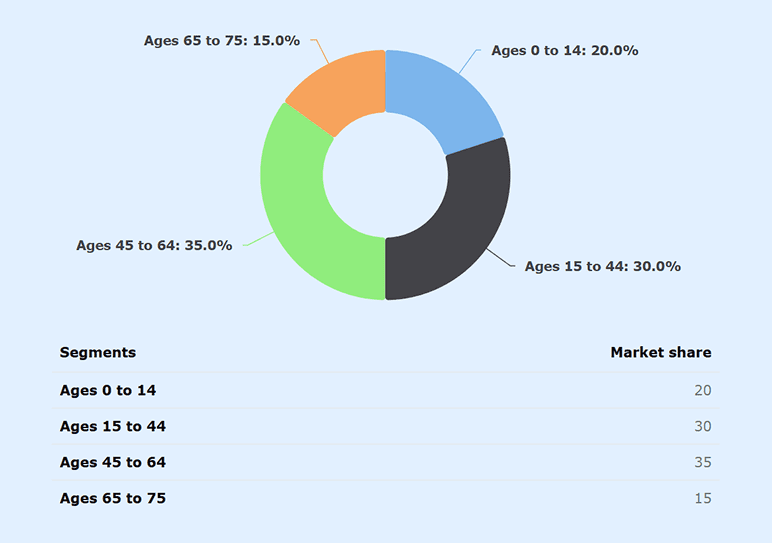
A business plan should demonstrate an understanding of the market, market segmentation, identification of the target market, and evidence of the strategy.
This is what market analysis of an investment company’s business plan looks like:
All your research, ready for investors
Turn customer interviews & market data into a fundable business plan
How do you conduct your market research (Practical steps)
You don’t need a $50,000 research budget or a team of analysts to understand your market. For most small businesses, focused questions, free data, and a handful of customer conversations will get you most of the way there.
Here’s a simple process to follow:
- Define the exact questions you need answered. Who are your customers? Will they pay for this? Which competitors do they already use? What price feels reasonable?
- Start with secondary research. Pull free data from SBA.gov, the Census Business Builder, Google Trends, BLS industry stats, and SCORE for market size, trends, and customer demographics.
- Study your competitors. Look at their pricing, reviews, websites, and customer complaints. A few hours are usually enough.
- Then move to primary research. Talk to five to ten target customers, or send a short survey. This is where the most valuable insights come from.
- Organize what you find. Group it into patterns, objections, pricing signals, and demand indicators.
- Apply it. Use what you learned to shape your product, pricing, marketing, and business plan.
You are not seeking 100% certainty, but the consistent patterns. Once you have seen the same answer two or three times, you’ve got enough answers to make the next decision.
Secondary research, for instance, could reveal the level of household income, population, and competitor density in your area if you are establishing a home cleaning service. Primary research can reveal customer dissatisfaction with existing service providers, how much they are willing to pay, and if they require weekly cleaning, move-out cleaning, or same-day bookings.
The bottom line
Here’s what I want you to take away: market research isn’t a one-time project you finish before launch. It’s the habit of staying close to your customers, your competitors, and the market you’re operating in.
You won’t get every call right. Nobody does. But the founders I see succeed are the ones who make decisions based on what they actually learned, not what they assumed at the start. A few hours of research now will save you months of building the wrong thing.
When the secondary research feels like a slog, it’s time for a tool such as Upmetrics’ AI industry research to do the work for you and bring in market size, trends, and the competitive picture to incorporate right into your plan.
So if you’re sitting on an idea right now, don’t wait. Go talk to ten people this week. The answers will tell you what to do next.
The Quickest Way to turn a Business Idea into a Business Plan
Fill-in-the-blanks and automatic financials make it easy.

Frequently Asked Questions
What’s the difference between market research and market analysis?
How much does market research cost?
What is the difference between market research and marketing research?
How often should a business conduct market research?
Can small businesses do market research on a budget?

Upmetrics
Upmetrics is the #1 business planning software that helps entrepreneurs and business owners create investment-ready business plans using AI. We regularly share business planning insights on our blog. Check out the Upmetrics blog for such interesting reads. Read more