


 Download Now: Free Business Idea Checklist
If you’re here, I don’t think you need more opinions about your business idea. You need a clear answer to one question: will someone pay for this?
Most founders don’t skip validation. They mistake the wrong signals for it. A friend who lights up when you explain the idea, a LinkedIn post that gets 50 likes, three people at a networking event who call it exciting. It all feels like proof. It isn’t.
CB Insights analyzed 431 failed startups and found that 43% collapsed due to poor product-market fit. Most of those founders believed their idea had real demand. They just never tested it properly.
If you want to learn how to validate a business idea without much fuss, let me walk you through seven methods to test real demand before you build anything.
What does it “actually” mean to validate a business idea?
Validation, or market validation as it’s sometimes called, is evidence that real demand exists before you build anything. Opinions, interests, and polite enthusiasm are not evidence. Actual behavior that shows commitment is.
Someone saying they’d use your product is a reaction. Someone paying a deposit to get early access is a decision. One costs them nothing. The other does.
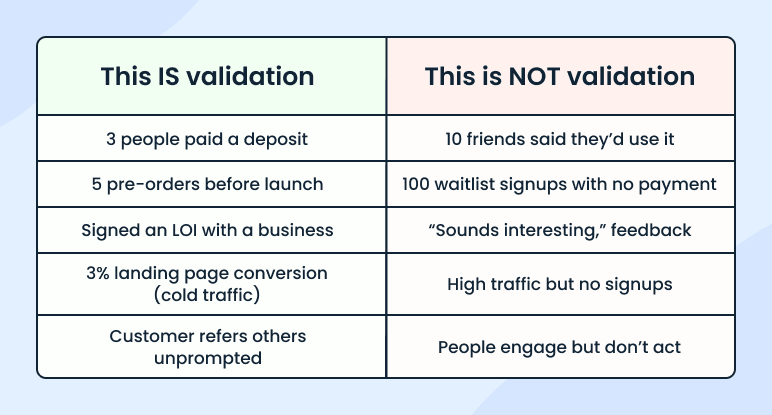
What I count as validation is anything that shows real intent:
- Someone takes an action that costs them something, time, money, or a formal commitment
- A customer pre-orders or joins a paid waitlist
- A business signs a letter of intent
- Your landing page converts consistently from cold traffic
- People refer others without you asking
Polite curiosity doesn’t make the list. Neither does “I’d try it when it’s ready” or a hundred waitlist signups with no payment behind them.
Validation doesn’t mean your idea is perfect. It means you’ve reduced the biggest risk: building something nobody actually wants.
The reasons why your validation attempt might fail (4 traps)
From what I’ve seen, most founders trying to figure out how to validate a startup idea run into the same problem: the process feels like it’s working when it isn’t. These four traps are why that happens.
1) Listening for agreement, not truth
This happens when you subconsciously steer conversations toward positive reactions. You explain your idea clearly, maybe even pitch it well, and people respond with “that makes sense” or “that sounds useful.”
The problem is, agreement is frictionless. It costs the other person nothing. So you walk away with a false positive signal. That makes you think demand exists, but you’ve only tested how well you can explain the idea, not whether anyone needs it.
2) Talking to the wrong people
If most of your conversations are with people who know you, your data is biased from the start. They’re more likely to be supportive, more patient, and less critical. This creates a distorted picture of demand, as you’re not testing the market; you’re testing your network.
When you go beyond that circle, interest drops sharply because the signal was never real to begin with.
3) Asking questions that can’t fail
Hypothetical questions almost always get a yes because there’s no cost, commitment, or consequence attached to answering them.
So even if 10 out of 10 people say yes, you’ve learned nothing about actual demand. The result is you overestimating interest and moving forward based on answers that were never tied to real behavior.
4) Mistaking interest for intent
You might get signups, positive reactions, maybe even repeat conversations, so it’s natural to assume that you’re validated. So, you build based on “interest,” only to realize later that interest doesn’t convert into customers.
There was no real commitment there. Until someone puts something real on the line, the assumption remains untested.
7 Ways to validate a business idea (The most practical ones)
Business idea validation comes down to a handful of methods done properly. With those traps in mind, here’s what actually works.
If you’re wondering how to test your business idea without burning through time or money, you don’t need all seven of these. In most cases, two or three done properly will give you clearer answers than trying to cover everything. The goal is to get to a point where you’re confident in your signal.
1. Talk to real potential customers
You need conversations with people who don’t care about your idea and match your target market. Start where they already are: LinkedIn (by role or industry), Reddit communities, Slack groups, niche forums, and even local meetups. If you can clearly define who you’re targeting, you can find them.
Then comes volume. One or two conversations won’t tell you much. Aim for 20-30 conversations. Patterns start showing up around 10-15, but you need more to trust what you’re hearing. In B2B, fewer but sharper conversations work better. Ten decision-makers who actually face the problem are more useful than 30 random people.
Avoid anything hypothetical, like Would you use this? Or does this sound useful? These questions don’t test anything. Rob Fitzpatrick’s The Mom Test is built entirely around this idea: people don’t tell you the truth about your idea, but their past behavior does. Instead of asking what someone would do, ask what they’ve already done. That’s where the real signal is.
Focus on behavior:
- “How are you solving this today?”
- “Have you paid for something like this before?”
- “Walk me through the last time this happened.”
Listen for customer pain points: frustration, workarounds, and money already being spent on imperfect solutions.
You’ll know you’ve done enough interviews when you start hearing the same problems, the same patterns, and the same objections without new information showing up.
2. Check if you’re solving a tier-1 problem
A big part of knowing how to evaluate a business idea is asking one question before anything else: Is this a problem people deal with immediately, or something they get to when they have time?
A Tier-1 problem is one that people deal with immediately when it shows up. It disrupts their day, costs them time or money, and is in their top 2-3 ongoing frustrations. If it’s the kind of thing they’d fix “when they have time,” it’s not Tier-1, so building a solution for it is a hard sell.
During interviews, don’t lead with your idea. I’d suggest asking:
- “What are the biggest problems you deal with in [area]?”
- “What’s been frustrating you lately about this?”
If your problem doesn’t come up without prompting, it means you’re introducing the problem, not solving one that already exists for them.
I think of it as the painkiller vs. nice-to-have test. Painkillers solve something urgent. People buy them fast. Nice-to-haves make things slightly better. People say they want them, then never pay. You want to be the painkiller.
This might surprise you, but competition is actually a good sign. If others are already solving this problem and making money, the problem is real. No competition often means no demand. The question worth asking isn’t whether competitors exist. It’s how they’re solving the problem and where they fall short.
3. Analyze your competition
Competition is proof that demand exists. But that isn’t a relevant question. It’s how they’re solving the problem and where they fall short.
I’m not suggesting you map the entire market here. What I’d do is use competitor reviews to validate whether the specific problem you’re solving is something real customers are actively frustrated about.
Start with G2, Capterra, Product Hunt, or app store reviews for competing products. Head straight to the 3-star reviews. That’s where people describe exactly what’s missing, what’s broken, and what they wish existed. If the frustration you’re building a solution for keeps showing up unprompted across multiple reviews, that’s strong validation. If it doesn’t appear at all, that’s worth pausing on.
A few things I’d look for specifically:
- How are they pricing their product or service?
- What complaints show up repeatedly?
- Which type of customer seems underserved or ignored?
You can also use Google Trends to check whether interest in this problem is growing or declining. That gives you one more data point before committing further.
From there, use a simple rule: match what already works, then improve what’s important. If competitors cover 80% of the basics, your job is to be clearly better in the 20% that customers care about most.
If you want to go deeper, that’s where proper market research and industry analysis start becoming useful.
4. Build a simple landing page
A landing page is one of the cheapest ways to test your business idea before writing a single line of code. Focus on giving a clear explanation of what you’re offering, who it’s for, and why it matters. Then a single action: join a waitlist, book a demo, or pre-order.
The key is focus. Don’t list features or over-explain. Just answer one question: why should someone care?
You can build this in a few hours using tools like Carrd, Webflow, or even a basic Google Form. Once it’s live, the real question becomes: do people act?
Most founders look at traffic or impressions. I’d ignore that and focus on conversion rate. Here’s a simple way to read what you’re seeing:
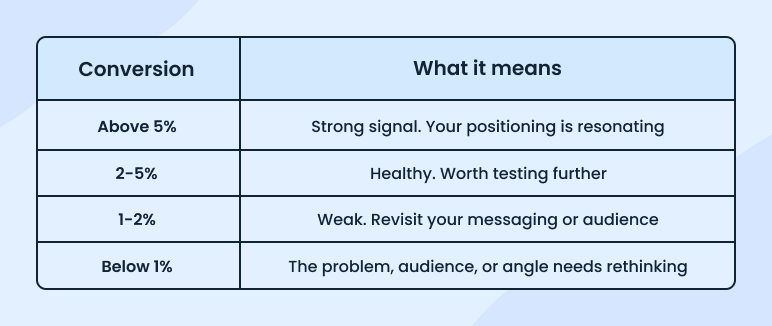
To get traffic, you don’t need a big budget. Useful signals can come from $50-$100 in targeted ads. Posting in relevant Reddit threads, LinkedIn groups, or Slack communities costs nothing as long as the audience matches.
This method tests one thing: does your idea make sense to someone who doesn’t know you, and do they care enough to act? If they do, the next question is whether they’ll actually commit to it. That’s where Method 5 comes in.
5. Verify willingness to pay (Not just interest)
A strong conversion rate tells you people are interested. But interest is still a low-cost action. The question at this stage isn’t whether people like the idea; rather, if they’ll pay for it. The easiest way to test that is to ask for something real.
For a product, that could be a pre-order or a small deposit. It doesn’t have to be the full price. Even $5-$10 is enough to separate curiosity from intent.
Say you’re building a meal planning app. You pitch it to 20 people, and most react positively. But when you ask for a $10 deposit, only two follow through. That gap is your real answer.
For B2B ideas, I look for a different signal. A letter of intent works better than a deposit. It’s not a contract, but it forces the buyer to take a real position on whether they’d move forward if the product existed. That’s a fundamentally different level of commitment than signing up for updates.
You can also test this in conversations by naming a price early. A specific number cuts through politeness fast. People who were casually interested suddenly get very clear about whether they actually want it.
Validation done? Don’t lose momentum.
Turn early signals into a plan investors will read
6. Build an MVP (Minimal viable product) or prototype
An MVP is just the cheapest way to test if someone will commit to your solution and keep coming back to it. I’d recommend starting with the simplest possible version. There are three ways to do that:
- Concierge MVP: Do it manually first. If you’re building a meal planning app, don’t build the app yet. Create the plans yourself and send them to a few users. Charge them for it. If they pay and come back, you have your answer. It can only cost you your time.
- Wizard of Oz: If doing it manually doesn’t feel realistic, build a front-end that looks and feels like a real product to the user, but there’s no automation behind it. When someone submits a request, you fulfill it yourself. It sounds like additional work, and it is, but it lets you test real usage before you spend months building.
- Prototype or demo: When you only need to demonstrate to someone how to work, a Figma prototype or a basic clickable demo is all you need. The only thing I’d say here is don’t just ask for feedback. Ask for a deposit or a signed agreement. The moment someone puts a commitment on the table, you know the demo actually meant something
I’d suggest narrowing your scope. Test one problem, one solution, one assumption at a time. If you test too many things at once, you’ll finish the exercise without knowing what actually moved the needle.
7. Run a small-scale pilot
The world is online, but trust me when I say that a lot of ideas still need to be tested in a small, controlled, real-world setting.
For physical products, I think selling at a local market, pop-up, or event is about as direct as it gets. People either stop, pick it up, and buy, or they don’t. And if they come back the following week or send someone else your way, that’s a strong sign your product works.
For digital products, I’d always go with a paid beta over a free one. Keep it small, around 10-20 users, and charge them even at a reduced rate. Users who have skin in the game engage differently. They actually use the product, and when something doesn’t work, they tell you why.
In the case of service businesses, make it even simpler. You need to get your first 3-5 clients by direct outreach or referrals before you build anything else. If you need help organizing that outreach, SCORE.org provides free mentorship for small business owners.
| Business type | How to pilot | What to watch for |
| Physical product | Local market, pop-up, or event | Repeat purchases, referrals |
| Digital product | Paid beta, 10-20 users | Retention, active usage, and feedback quality |
| Service business | 3-5 paying clients via outreach | Repeat work, referrals, willingness to pay full price |
Across all three, what I recommend you should be really watching for is the same thing: do they come back, keep paying, and tell others? If your first group of users doesn’t stick, that’s your signal. It’s far cheaper to figure that out now than after you’ve scaled.
How to know when you’ve validated enough
From what I’ve seen, most founders either stay in validation too long or move forward too quickly. There’s no exact finish line, but there are clear signals that tell you when to stop testing and start building, or when not to.
The determining factor isn’t a single response. It’s whether you’re seeing consistent, repeatable signals across different methods. One person reacting positively is interesting. Three people independently showing the same behavior is a signal. Five is a pattern.
The most reliable way to validate a startup idea is rarely through one method alone. If your customer interviews, landing page, and willingness-to-pay test are all pointing in the same direction, that consistency is your green light toward product-market fit.
If one method is positive and the others are flat, keep testing. Two or three strong signals across different methods are usually enough to move forward with confidence.
| Green Lights (Proceed) | Red Lights (Pause or Pivot) |
| 20–30 interviews with the same problem coming up without prompting | You have to explain the problem before people relate to it |
| 3–5 people have paid (or placed deposits/pre-orders) | Fewer than 3 people are willing to pay anything |
| Landing page converts above ~2% from targeted traffic | Conversion stays below ~0.5% after testing different angles |
| People refer others without being asked | Interest only comes from people who know you |
| Someone asks for access or wants it immediately | Feedback is positive but non-committal |
If the signals are consistently red, don’t keep pushing the same idea in the same direction. Consider whether the problem needs reframing, the solution needs changing, or you’re targeting the wrong customer entirely.
Sometimes a small shift in any one of those three things is enough to change the signal completely. And occasionally, the honest answer is to walk away and start with a different idea. That’s the process working exactly as it should.
What comes after validating your business idea? The Plan.
In my experience, this is where most people lose momentum. Though they have proof of demand, there’s no clarity on how to turn it into something repeatable. Who exactly are you selling to? At what price? Through which channel? What does it cost to deliver?
If it were me, I’d start by tightening what I already know. The validation data should be enough to give direction. Which type of customer showed the strongest intent? What use case came up repeatedly? That becomes the focus and the foundation of your business concept. Everything else gets deprioritized.
Then, I’d (and you should too) map the basics:
- How will you make money (pricing and model)?
- What does it cost to deliver your product or service?
- How will you get your first 10-50 customers consistently?
Following a structured approach helps. Turning this into a clear plan covering your target market, offer, costs, and go-to-market is how you actually start a business rather than just plan one. I’d recommend using Upmetrics to put this into one place without starting from scratch.
Finally, set short-term targets like the next 90 days. What needs to be true for this to work? More paying customers? Better retention? A repeatable acquisition channel? Validation reduces risk. Planning turns that into something you can actually run.
Conclusion
Validating a business idea doesn’t have to take months or cost a lot. What it does require is honest testing: real conversations with strangers, a landing page that either converts or doesn’t, and at some point, asking someone to actually pay.
I’ve seen founders spend a year building something their friends told them was great. I’ve also seen founders get a clear answer in two weeks by talking to the right people and asking the right questions. The difference is whether you’re willing to hear an honest answer early.
Pick one method from this guide and run it properly. Once the signal is clear, the next step is turning what you’ve learned into a business plan. The signal you get, good or bad, is worth more than anything you’ll figure out sitting at your desk.
The Quickest Way to turn a Business Idea into a Business Plan
Fill-in-the-blanks and automatic financials make it easy.

Frequently Asked Questions
Can you validate a business idea for free?
What is the 50/100/500 rule for business validation?
How is idea validation different from market research?
How many customer interviews do I need to validate a business idea?
Do I need to build an MVP to validate a business idea?
What if validation shows my idea won't work?

Vinay Kevadia
Vinay Kevadiya is the founder and CEO of Upmetrics, the #1 business planning software. His ultimate goal with Upmetrics is to revolutionize how entrepreneurs create, manage, and execute their business plans. He enjoys sharing his insights on business planning and other relevant topics through his articles and blog posts. Read more