


What is the current ratio?
The current ratio shows whether a business has enough short-term assets to pay its short-term dues. Lenders and investors check this number early. It is one of the simplest ways to read financial health.
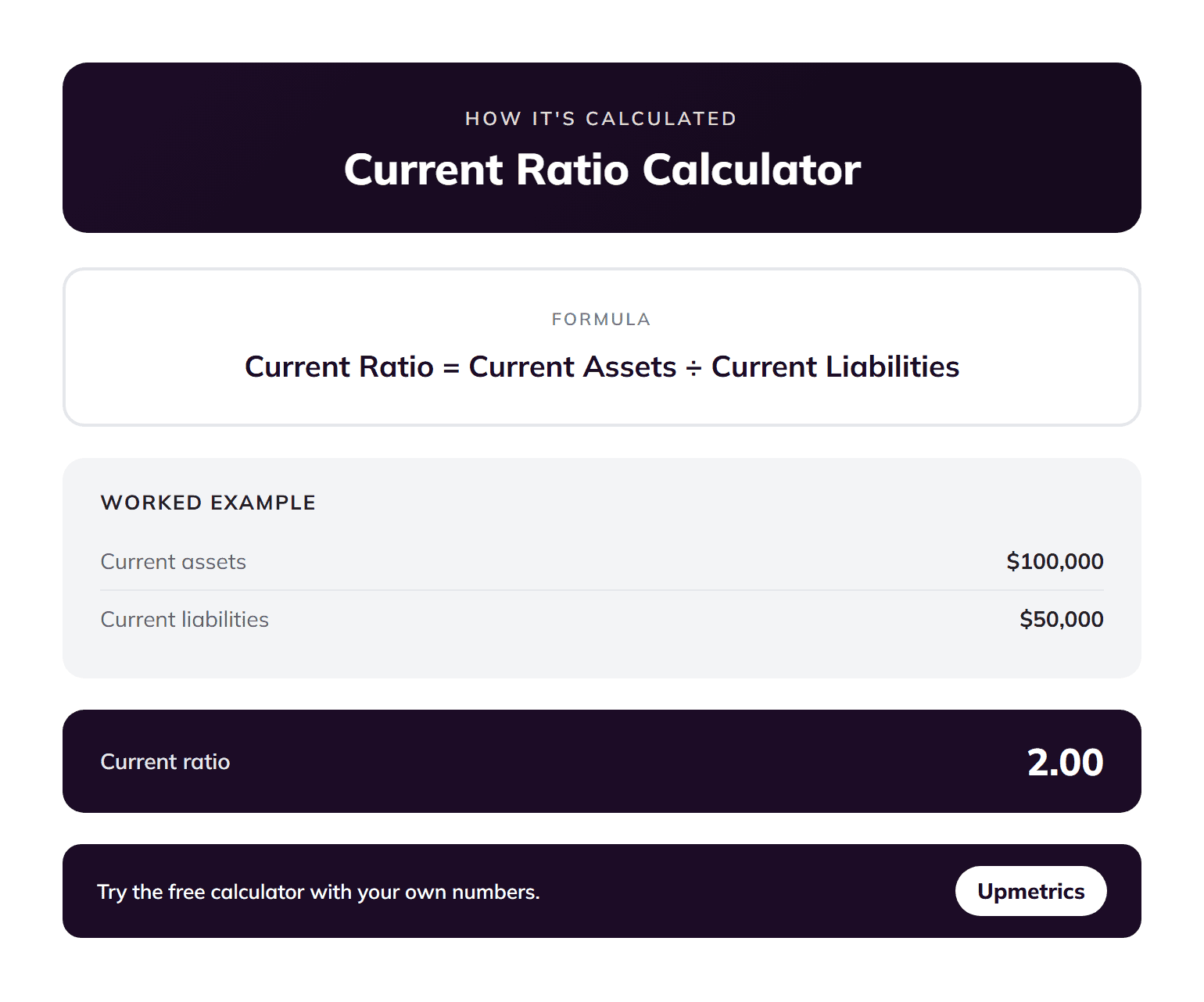
Current assets divided by current liabilities gives you the ratio. A retail shop with $85,000 in current assets and $50,000 in current liabilities has a ratio of 1.7. For every $1.00 it owes, it has $1.70 available.
Above 1.0 means the business can cover what it owes. Below 1.0 means it cannot, not from current assets alone. That is not always a crisis. But it does mean something needs attention.
How to use this calculator (and what counts as current)?
To calculate the current ratio, you only need two numbers: total current assets and total current liabilities. Both come from your balance sheet.
- Current assets are what converts to cash within 12 months. Cash, bank balances, accounts receivable, inventory, and prepaid expenses all count. Leaving out accounts receivable is a common mistake. Do not include long-term assets. They do not count as current assets.
- Current liabilities are what the business owes within 12 months. Accounts payable, short-term loans, unpaid wages, taxes, and upcoming bills all go here.
If a line of credit has been used, it counts as a current liability. If it has not been used, it does not count.
Also, make sure all numbers are taken from the same date on the balance sheet.
Why lenders and investors look at your current ratio?
The current ratio is one of the quickest ways an outsider can judge if a business is financially stable. Before lending money or investing, they want to know one thing: can this business handle its short-term obligations on its own?
For lenders, the number sets the baseline. Most traditional lenders want 1.2 or above. SBA lenders often look for 1.5 or higher. A ratio below 1.0 means the business holds more liabilities than it currently has. That raises concerns and usually requires explanation or extra collateral.
For investors, it is less about the number and more about the direction. A ratio that keeps falling each quarter, even if it stays above 1.0, shows the business is slowly getting tighter. That pattern matters more than a single snapshot.
Going into a funding conversation without knowing your current ratio puts you in a weak position. A low ratio is not always a dealbreaker. Not knowing it is. Using tools like Upmetrics include liquidity ratios in financial projections, so you are not working this out manually every time.