


What a marketing plan actually needs to answer
A marketing plan isn’t a list of channels you intend to try. It’s an answer to three specific questions: who are you trying to reach, what will make them choose you, and how will you actually reach them with the budget and time you have. A plan that skips straight to “we’ll do social media and email” without answering the first two questions usually underperforms.
The businesses that get the most from a marketing plan are the ones that pick 2-3 channels and commit, rather than spreading thin across everything at once. A focused plan with consistent effort on fewer channels almost always outperforms a scattered one.
How to use this generator
Describe your business, your target customer, and your goal, more sales, more awareness, more signups, for example. “A local bakery trying to drive more weekday foot traffic” gives the generator a specific enough target to build a real plan around.
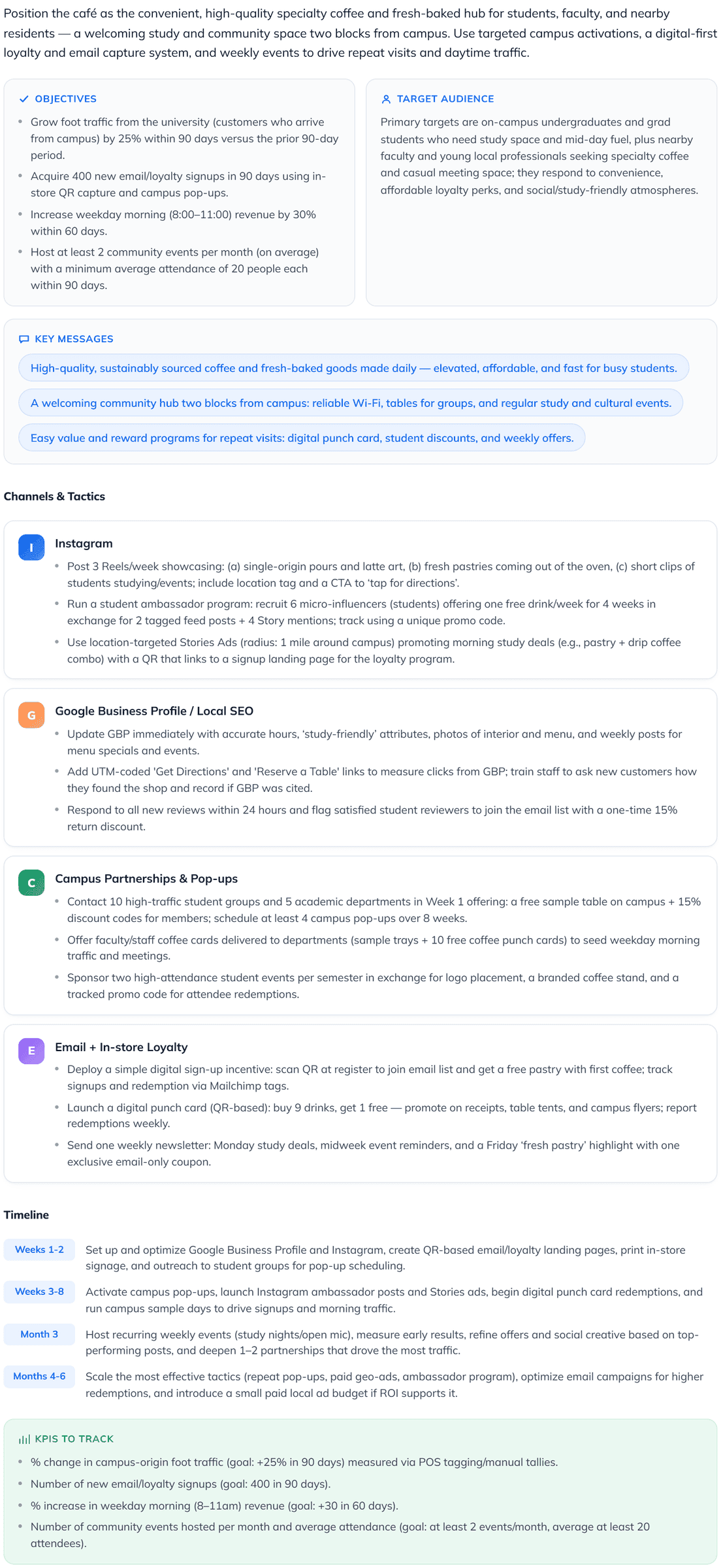
The output is a draft plan covering target audience, positioning, and suggested channels. Treat it as a starting framework; fill in your actual budget, timeline, and the specifics only you know about your market.
What belongs in your marketing plan
Target audience
Be as specific as your buyer persona allows. “Everyone in my city” isn’t a target audience; it’s the absence of one.
Positioning
What makes you the right choice for that specific audience. This should connect directly to your value proposition, not restate your product features.
Channels and tactics
Where you’ll actually reach your audience, and what you’ll do there. Pick channels based on where your specific customer already spends time, not based on what’s trendy.
Budget and timeline
What you’re spending, over what period, and how you’ll know if it’s working. A plan without a budget is a wish list, not a plan.
How you’ll measure it
The specific number you’re watching, new customers, revenue, signups, and how often you’ll check it. Without this, you won’t know whether to keep going or change course.
Common marketing plan mistakes
Trying every channel at once
A new business testing five channels simultaneously usually learns less than one testing two channels properly, since it’s hard to tell what’s actually working when everything is running at once.
Skipping the audience step
Jumping straight to tactics without a clear audience means every channel decision is a guess. Nail down who you’re targeting first; the channel choices get much easier after that.
No way to measure success
If you can’t say what number you’re trying to move, you won’t know when the plan is working or when it’s time to change it.