


What is markup?
Markup is the amount added to the cost of a product to arrive at the selling price. Margin is the portion of the selling price that is profit. Both deal with cost and price, but they are calculated differently and give different percentages.
How is it different from margin?
Markup is based on cost. If a product costs $40 and sells for $60, the extra $20 is the markup. That is 50% of the cost. Margin is based on the selling price. The same $20 profit divided by the $60 selling price gives a 33% margin.
So the numbers are the same, but the percentages are different. If a business targets a 50% margin but calculates it as markup, prices will be set too low. The expected profit will not be achieved.
Markup starts from the cost. Margin starts from the price. This difference affects how products are priced.
How to use this calculator?
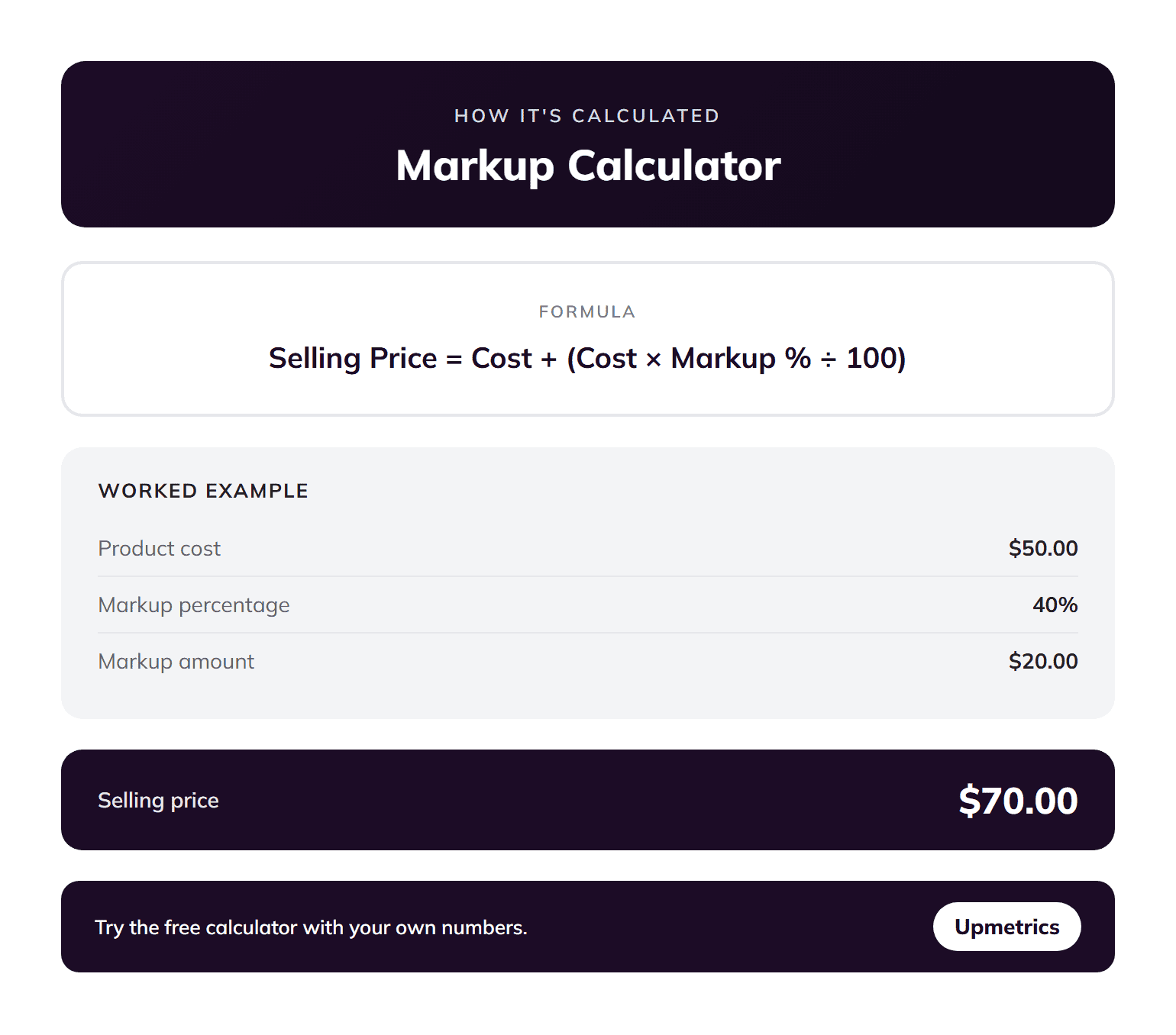
Use this calculator to calculate markup, selling price, or check the markup behind a price.
1. Product cost and markup
Enter the product cost and markup percentage. The calculator shows the markup amount and selling price.
2. Selling price
Enter the selling price. The calculator shows the markup amount and percentage behind that price.
3. Full product cost
Include all costs such as shipping, packaging, payment fees, and import duties. Missing these will give incorrect results.
How to choose the right markup for your business?
The right markup is not the same for every business. It can also vary between products in the same business.
Cost structure
If a business has high rent, more staff, or expensive equipment, it needs a higher markup on each sale to cover costs. A business with lower fixed costs can work with a lower markup.
Competition
Customers expect prices within a certain range. Markup should keep the final price within that range. Charging more only works if there is a clear reason for it.
Volume
Products that sell in large numbers can have a lower markup because costs are spread across many sales. Products that sell less need a higher markup to cover the same costs.
Industry norms
In retail, a common starting point is keystone pricing, which means doubling the cost (100% markup). In restaurants, food is often marked up 200% to 300%. These are starting points. The actual markup should cover all costs and leave a profit.