


 Download Now: Free Customer Analysis Template
Quick question: Do you know how many of last month’s customers came back this month? Most owners I talk to don’t, and that is the problem.
We obsess over the new customer: the ad, the launch, the funnel. Meanwhile, the people who already paid us once slip out the back, and we never notice.
After a second purchase, that rises to 49%, and after a third, it climbs to roughly 62%. The much-cited Bain research agrees: a 5% lift in retention can raise profits 25% to 95%, per the Harvard Business Review.
But the answer is not to immediately buy a loyalty platform or throw discounts at every customer. What trips people up is order. Discount? Referrals? Win-back email? If you pick wrong, you risk burning money without changing behavior. That mistake hurts more when your customer base is 50 people, not 50,000. So let us go in the order that works.
What customer loyalty really means (and why it matters more for small businesses)
Customer loyalty means customers keep choosing your business after the first purchase because the experience, value, service, and relationship give them a reason to come back.
Sometimes that loyalty is transactional: points, discounts, punch cards, referral credits, or member-only offers. Sometimes it is emotional: trust, familiarity, convenience, shared values, or the feeling that your business “gets” the customer. The strongest loyalty usually has both. A discount may bring someone back once, but trust is what makes them stop comparing every alternative.
This matters more for small businesses because you usually cannot outspend larger competitors on acquisition. There are 36.2 million small businesses in the U.S., according to the SBA Office of Advocacy’s 2025 profiles, which means customers have plenty of choices in almost every category. If every sale depends on a new ad click, a new promotion, or a new lead, growth becomes expensive fast.
Retention changes that math. Returning customers are cheaper to reach, easier to sell to, and more likely to refer others, because you already paid to earn their attention once.
| Scenario | Cost | What it means |
| New customer from ads | $30 | You spend $30 to win one first-time buyer. |
| Returning customer email or offer | $5 | You spend $5 to bring back someone who already knows you. |
| Average order value | $50 | Both customers placed the same-sized order. |
| Cost difference | $25 saved | The repeat order gives you more room to protect profit. |
Spending $30 to acquire a customer who places one $50 order leaves you only $20 to cover product and profit. Spending $5 to bring that same customer back for another $50 order leaves you $45. For a small business with a smaller customer base, every lost repeat customer has a bigger impact.
How to measure customer loyalty
Sales numbers will not tell you if customers are loyal. There could be a number of reasons why a customer purchases once, such as because of a discount, location, urgency, or convenience.
Loyalty shows up in behavior—repeat purchases, higher spend over time, referrals, and customers who complain instead of quietly leaving. The biggest signal is whether they choose you when there’s a real alternative.
Before you can figure out how to increase customer loyalty, you need a baseline. Start with 2 or 3 metrics, not all five. For most small businesses, the best starting point is the repeat purchase rate, because it uses data you already have. If customers buy again, your service, offer, pricing, and follow-up are doing something right. If they do not, no loyalty program will fix the problem until you understand where the drop-off happens.
The five most useful customer loyalty metrics are repeat purchase rate, customer retention rate, Net Promoter Score, customer lifetime value, and churn rate. They map loosely to the 3 R’s of customer loyalty:
- Retention is measured by customer retention rate and churn rate (the same picture from two angles).
- Repeat purchase is measured by repeat purchase rate and customer lifetime value (one shows the behavior, the other shows the dollar value over time).
- Referrals can be estimated through NPS, but actual referral tracking is stronger because it shows who really brought in a new customer.
| Metric | What it tells you | Simple formula | Small-business read |
| Repeat purchase rate | How many customers buy more than once | Repeat customers ÷ total customers × 100 | For many retail and service businesses, 20 to 40% can be a useful starter range, but your own trend over time matters more than a general benchmark. Low-frequency businesses may need a longer time period. |
| Customer retention rate | How many customers do you keep over a period | ((End customers − new customers) ÷ start customers) × 100 | Compare against your own past months first. Industry averages vary widely by category. |
| Net Promoter Score | How likely customers are to recommend you | % promoters − % detractors | Above 0 means more promoters than detractors. 50+ is generally strong, but compared to the industry. Bain’s NPS method uses the 0 to 10 recommendation question. Use it alongside other forms of market research when you want a fuller picture of what customers think. |
| Customer lifetime value | How much is one customer worth over time | Average order value × purchase frequency × customer lifespan | Helps decide how much you can safely spend on rewards, referrals, and win-back offers. |
| Customer churn rate | How many customers have you lost | Lost customers ÷ starting customers × 100 | Track monthly or quarterly. A rising churn rate is an early warning sign. |
Which metric should you start with?
Pick based on how your business actually sells:
- Retail, coffee shop, restaurant, e-commerce: Start with the repeat purchase rate. Transaction frequency is high, and the data is already sitting in your POS.
- Service business (salon, cleaning, repair): Begin with customer retention rate, measured over a 3-6 month period, looking for returning customers.
- Consultant, agency, wedding vendor, home services: The lowest hanging fruit is to begin with NPS, along with referral tracking. Long buying cycles need a satisfaction signal, not just purchase data.
- SaaS, subscription, or membership business: Begin with churn rate and CLV (Customer Lifetime Value).
- High-margin or B2B business: Start with CLV plus NPS. Long buying cycles need a satisfaction signal, not just purchase data.
If customers aren’t purchasing frequently, use a longer measurement window. A coffee shop can monitor repeat customers on a monthly basis, while a home repair shop, consultant, or wedding party might have to wait 6 to 12 months to see repeat customers. In those businesses, referrals, reviews, repeat projects, and reactivation responses may tell you more than monthly purchase frequency.
A large dashboard isn’t necessary to keep track of this. Once a month, export sales data from your POS, ecommerce store, booking system, or payment processor and maintain a basic spreadsheet. For example, in Square, businesses can view, customize, and export reports on sales and transaction analysis.
CLV also helps with planning. For example, spending $20 on a referral reward, thank-you gift, or win-back offer may make sense for a customer worth $600 over two years. It may not make sense for a customer worth only $60.
If you had 500 customers this month, and 125 of them returned for a second purchase, your repeat purchase rate for this month is 25%. You’re on the right track with your loyalty program if that increases to 32% with follow-up emails, better packaging, and a small reward.
9 strategies to build customer loyalty
You now know what to measure. These nine customer loyalty strategies are what move those numbers, and the order matters as much as the tactic. Run them in the wrong order, and you waste money asking for referrals from people who have not yet had a second good experience with you.
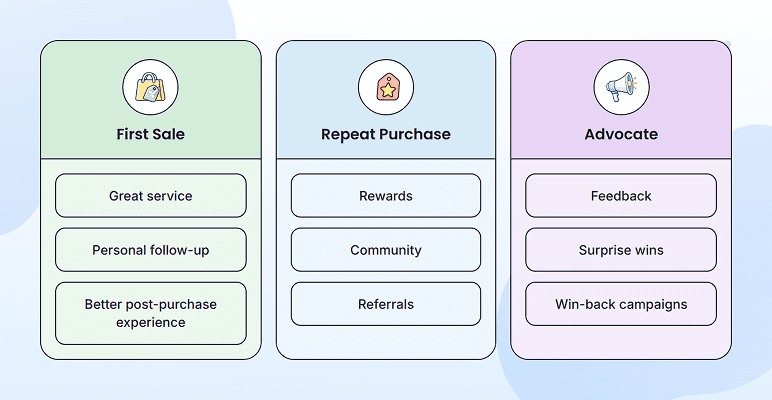
The order I recommend:
- First sale: earn the second purchase through service, personalization, and a strong post-purchase moment.
- Repeat purchase: reward the behavior with rewards, community, and referrals.
- Advocate: turn loyal customers into referrers, reviewers, and repeat advocates.
If the repeat purchase rate is low, I would start with service, personalization, and post-purchase experience. If repeat purchases are steady but referrals are weak, move to feedback, surprise rewards, and referral offers.
1) Deliver consistently great customer service
Customer service is the base layer of loyalty. If the first experience is slow, confusing, or cold, a reward program will not fix it.
For a small business, good service usually means fast replies, clear answers, and ownership when something goes wrong. Set a response standard your team can actually meet:
- Reply to emails within 4 business hours.
- Answer live chat within 1 minute when available.
- Follow up on complaints within 24 hours.
A bakery, salon, repair shop, or local retailer does not need a complex support system to start. A shared inbox, a Tidio free plan, a Help Scout starter plan, or a tracked Gmail label can work. The real goal is consistency. Customers return when they know what experience they will get every time.
2) Personalize every interaction
Personalization does not mean expensive software. For most small businesses, it means remembering names, past orders, preferences, dates, and small details that make the customer feel recognized.
Let me explain with an example. After a customer buys a skincare product, send a short follow-up a week later saying, “Hope the moisturizer is working well for your dry skin. Reply if you want help choosing the night cream that pairs with it.” That message feels more personal than a generic “Thanks for shopping with us” email.
You can track this manually for a long time. If you have fewer than 500 active customers, a Google Sheet with customer name, last purchase, preference, last contact date, and next follow-up is enough. The value is not in the tool. It is in using the information to make the next interaction more relevant.
3) Make the post-purchase experience memorable
First-time buyers form their opinion of your business in the days after they pay. That is where loyalty either starts or stalls. Use the post-purchase window to send one small thing that signals you care:
- A handwritten thank-you card.
- A setup or “how to use” guide.
- Better-than-expected packaging.
- A care card.
- A small bonus item or sample.
- A check-in message asking if they need help.
The point is to reduce buyer’s remorse and make the customer feel they made the right choice.
Keep the cost controlled. A thank-you postcard may cost around $0.50 per order. If 1,000 first-time orders cost $500 in cards and even a small share of those customers come back, the return can justify the spend. Track it by comparing the repeat purchase rate before and after adding the post-purchase touch.
4) Reward repeat purchases
Rewards work best when they protect profit and encourage behavior you actually want. Do not start with a complicated points program if a simple reward will do.
For many small businesses, a punch card, store credit, free add-on, birthday reward, or “buy 5, get 1” offer is enough. A coffee shop can offer the 10th coffee free. A pet groomer can offer $10 off every fifth visit. A boutique can offer early access to returning customers before a sale goes public.
Before you give a discount, be sure to read the margin. For a $50 purchase, it costs $5 for a 10% loyalty discount. If your gross margin is $15, this discount takes away ⅓ of your gross profit. Don’t make discounts permanent without calculating the impact on your margins. A markup calculator does this in seconds. Rewards should be designed to make it easier to repeat purchases, but not to encourage customers to wait for a lower price.
5) Build a community around your brand
Community is a large term, but if you’re a small business, it can also be simple. It might be a small customer workshop, a monthly event in-store, a private Facebook group, a close friends list on Instagram, or a WhatsApp broadcast list.
These touchpoints give returning customers a reason to stay engaged between purchases. A fitness studio can run a monthly member challenge. A bookstore can host a local reading club. A meal prep business can share weekly customer recipes or post photos of what its customers have cooked. These touchpoints build habit and identity around the business.
This can be free, if you’re already using an existing Facebook group or Instagram list, or can cost anywhere from $50 to $150 a month, depending on the number of people who join and whether you have a small in-store event with refreshments, samples, or a demo.
6) Ask for and act on feedback
Feedback is one of the cheapest loyalty tools you have, and I think most small businesses underuse it. It shows customers their opinion matters and catches problems before they turn into silent churn.
Ask short questions after key moments:
- After every third purchase, send a 2-question survey.
- Following a service appointment, ask, “What did we do well? What could we do better?”
- To get NPS (Net Promoter Score), pose a question to customers of your business, asking them to rate your company on a scale from 0-10 for how likely they are to recommend your business to others.
Then contact unhappy customers within the next 24 hours. This can be $0 by using Google Forms and following up manually with a sheet. The actual time commitment is 15 to 30 minutes per week.
If you receive a complaint and respond to it, the customer may be more loyal than if they had never complained but simply walked away. When 10 people say “slow reply”, it’s not a reward problem; it’s a response time problem.
7) Run a referral program
In my view, referral programs work best after customers have already had a good experience. That is why they belong after repeat purchase.
So keep the structure simple. It could be giving something to the existing customer and something to the new one. “Give $10, get $10” works because both sides benefit. A local service business could offer a $25 account credit after the referred customer completes their first paid booking.
If you spend $30 to acquire a new customer through ads, a $20 referral reward is still cheaper. For in-store businesses, the offline tactics that work are:
- Referral cards handed out at checkout.
- A short referral message printed on receipts.
- A QR code on packaging or a counter card.
- Partnerships with non-competing local businesses (a yoga studio + a juice bar, for example).
For more local promotion options, see our list of offline marketing ideas.
8) Surprise customers with unexpected wins
Expected rewards are useful. The more unexpected the reward, the better.
It may be a complimentary upgrade, a small birthday gift, early access to a product, a handwritten note to regular customers, or a minor added service as a free bonus following a service problem. This doesn’t have to be expensive. A $5 upgrade might be valuable if it comes at the right time and fulfills the desires of the customer.
Use surprises carefully. Once all the surprises are announced, it’s a promotion. If it is random, it feels thoughtful and relates to the customer relationship; it can strengthen loyalty.
For instance, a salon adds a complimentary scalp massage at the end of a long appointment when the stylist notices the client looks stressed. The customer is reminded of the gesture as it feels earned and not pushed.
9) Reconnect with lapsed customers
A lapsed customer bought before but has not returned within the expected buying window. For some businesses, that is 60 days. For others, 6 to 12 months.
I would not treat lapsed customers as lost forever. They already know your business, so they may be cheaper to bring back than a brand-new buyer. Some of the win-back options that work include:
- “We noticed it has been a while. Here is 15% off your next visit this month.”
- “It may be time for your next tune-up, cleaning, refill, or review.” (good for service businesses where a discount is not the right hook)
- “We added something new since you last visited.” (works when you launched a product or service they might not know about)
Measure the response rate and compare it with paid acquisition. If a $7 email offer brings back a customer who places a $75 order, that beats another ad campaign. If no one responds, the issue may be timing, offer strength, or the original customer experience.
How to spend on customer loyalty without hurting profit
Loyalty has a cost. Every thank-you note, referral payout, win-back email, and minute of staff training shows up somewhere on the books. The job is to make sure that money does work, not just leaves the account.
That is why I treat it as part of the marketing strategy section of your business plan, not as a vague idea you remember after sales slow down.
I start by putting a real retention line in the marketing budget, however small. Fifty dollars a month is enough to run a single experiment, and that is the point: every loyalty dollar should be tied to a behavior you can measure. If a spend cannot point to repeat purchase rate, referrals, retention, or CLV at the end of the month, it is not earning its place.
My rule of thumb:
- 80% acquisition / 20% retention when you are early-stage and still building awareness.
- 70% acquisition / 30% retention, once you have a steady customer base and a measurable repeat-purchase rate.
Watch the margin while you do this. Recurring discounts are the most common way small businesses bleed retention spend, because every discount on a $50 order costs the same whether the customer was about to buy anyway or not.
If margins are tight, swap discounts for rewards that do not touch price: early access, service upgrades, faster support, a member-only perk. And keep an eye on cash flow before any discount becomes a permanent fixture.
Sample loyalty budget (for a $3,000 monthly marketing budget, 70/30 split)
| Line item | Description | Monthly cost | % of marketing budget |
| Referral incentives | Give-and-get rewards for customer referrals | $300 | 10% |
| Loyalty rewards or discounts | Punch card rewards, birthday offers, repeat-purchase credits | $225 | 7.5% |
| Retention email or basic CRM | Email follow-ups, customer notes, win-back messages | $150 | 5% |
| Customer experience training | Staff training, scripts, service recovery process | $225 | 7.5% |
| Total retention budget | $900 | 30% |
Look at the numbers once a month. A referral offer that brings someone back for less than the cost of an ad click is worth doubling down on. A win-back email that nobody opens needs a different subject line, a different offer, or a faster send window before you decide it does not work.
This is also the part of your plan that a lender or investor will read closely. When they review what they look for in a business plan, they want evidence that you understand the cost of keeping a customer, not just the cost of finding one. A budget line tied to a metric is that evidence.
If you are starting from scratch, the Upmetrics AI business plan generator can build the marketing strategy section for you in minutes, with the retention budget included.
Conclusion
Customer loyalty is not a campaign that you run one time. Rather, it’s a system you develop over time: earn the second purchase, reward the repeat, and give your best customers a reason to refer, review, or return.
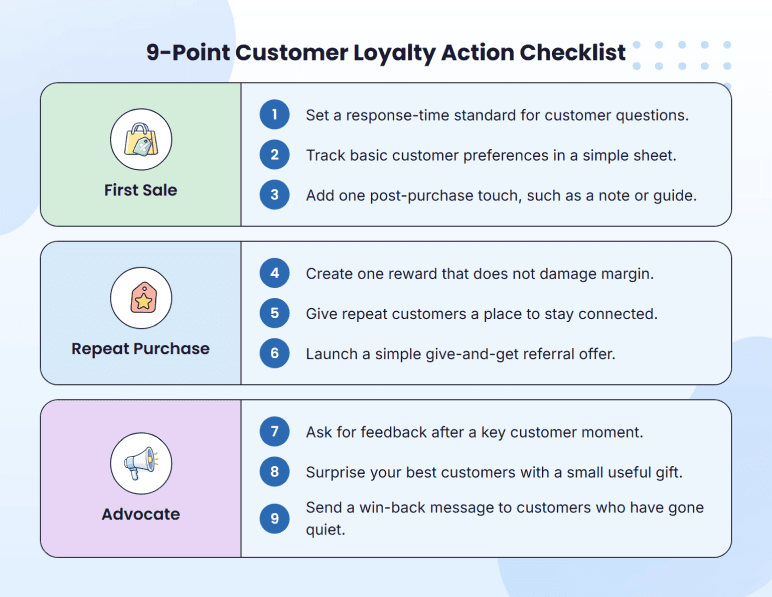
You already have the framework, the strategies, and a budget plan. Here is the 30-day rollout I would actually use:
- Week 1: Choose 2 metrics to measure (I would do repeat purchase rate and churn) and have something to measure from.
- Week 2: Give one first-sale improvement, such as a quicker response standard or a post-purchase note, which is designed to bring more first-time buyers back.
- Week 3: Add one margin-safe repeat-purchase tactic (a punch card, store credit, or a member-only event) to give existing customers a reason to come back without eroding margin.
- Week 4: Test one advocate-stage action, like asking for feedback or sending a win-back message, so satisfied customers do not stay silent.
Then give it time. Revisit the same numbers in 90 days and keep whichever loyalty actions actually moved repeat purchases, referrals, or retention.
If you want loyalty built into your business plan from day one, the Upmetrics business plan software gives you a marketing strategy section, a budget builder, and forecasting tools so retention is part of the plan, not an afterthought.
The Quickest Way to turn a Business Idea into a Business Plan
Fill-in-the-blanks and automatic financials make it easy.

Frequently Asked Questions
How much should a small business spend on a loyalty program?
Can I build customer loyalty without software?
How long does it take to build customer loyalty?
Should I offer discounts or rewards — which works better for a small business?
What's the difference between customer loyalty and brand loyalty?

Cortney Becker
Cortney Becker is a Marketing Consultant with 10 years of experience in product development and growth marketing. She specializes in creating high-impact content and market positioning strategies that boost revenue growth and sales performance. Her background spans SaaS, technology, energy, subscription services, and consulting, with a strong focus on product adoption and sustainable growth. Read more