If you’re starting a new business, launching a new product, or entering a new market, you’ll want to be sure there’s a viable market, to understand who’s interested in your product, and the price they’re willing to pay.
But how do you get these answers? Do you need to interview prospective customers, complete surveys, monitor competitors, or analyze current market data?
Well, every research method is used for a different purpose, and you might not need to use all of them. That’s because knowing what you want to learn can help you choose the right one without wasting time or money.
In this guide, I’ll discuss the different types of market research, when to use each, and how to pick the best for your business.
What are the different types of market research?
Primary, secondary, qualitative, and quantitative research are the four most commonly discussed types of market research. However, market research can also be categorized based on its objective and the specific business area you’re studying.
Here’s a quick comparison to help you understand the differences:
| Classification | Types of market research | Question it answers |
|---|---|---|
| Data source | Primary and secondary research | Where did you get your data from? (That is, did you conduct your own study, or did you obtain it from another source?) |
| Data type | Qualitative and quantitative research | What kind of data is needed (open-ended context or numbers that can be measured)? |
| Research objective | Exploratory, descriptive, and causal research | What do you want to find out? (Do you want to uncover a problem, profile a market, or test cause and effect?) |
| Business needs | Customer, competitor, market size, product, pricing, and brand research | What research area are you interested in based on your business? |
Many of these classifications often overlap.
For instance, if you are interviewing prospective customers to understand their frustrations about existing products, you are conducting primary, qualitative, exploratory, and customer research all in a single activity. So, it’s not necessary to perform each type as a separate research project.
Now, let’s explore each classification group in more detail.
Types of market research based on data sources
As you research your market, you can gather new information or utilize information that is already available. This is the difference between primary and secondary research.
Primary Market Research
Primary market research involves gathering new information to address your specific research questions.
The most basic research techniques used include:
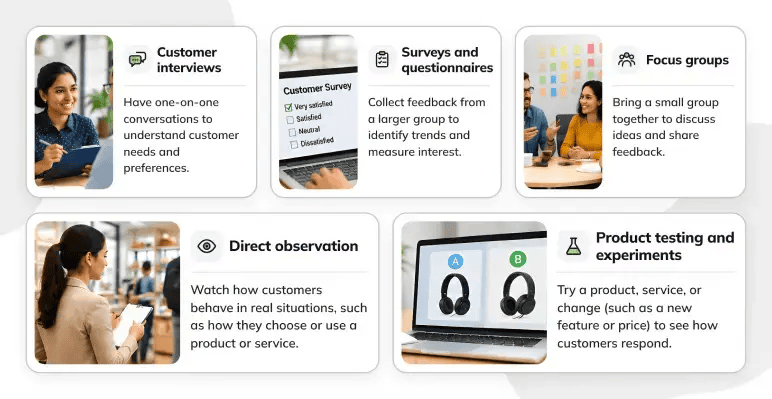
Now, let’s imagine you are going to start a bakery store in your area. While some reports exist in the industry, they say nothing about what baked goods local residents want to be sold in their neighborhood.
You can obtain information specific to your business by talking to prospective customers or testing a few products at a Saturday morning market.
When do you use primary research?
Use it when you’re validating a business idea, exploring customer needs, testing a new offering, or investigating a problem specific to your business.
There is no need to have any previous customers or a lot of money to do in-depth research. You can target those who are already purchasing products and services comparable to what you’re trying to sell.
Primary research can be done in your own way and will provide you with more control over the information you gather, but it will require time and effort. The answers you get will also be dependent on whom you reach out to and what questions you ask.
Secondary market research
Secondary market research is a procedure that entails utilizing information already gathered by your business or other companies.
Secondary research can be obtained from:
- Government statistics and demographic data
- Industry reports and trade publications
- Competitor websites and pricing information
- Current web-based customer reviews
- Previously gathered sales and customer data
For instance, if you want to launch a residential cleaning company, you may look at the statistics of houses in your area, look at the services your competitors offer, and see what kinds of feedback customers are giving regarding the services they receive.
This allows you to have a preliminary idea of the market you are dealing with, before you begin calling clients.
When is it appropriate to use secondary research?
It can be used to determine market size, learn about market trends, find out about customer segments, or get familiar with the competition.
The U.S. Census Bureau, Bureau of Labor Statistics, and Google Trends are some great resources that can help US businesses without any research budget.
The information gathered from secondary sources is sometimes easier, faster, and less costly than collecting new information. But the data can be out-of-date, too general, or even gathered for another intent. So, make sure that it is current, covers a specific area, and is applicable to your needs.
Types of market research based on data type
If you know where to find information, think about what kind of information you need. Do you want to know people’s experiences and why they make their decisions, or do you need numbers to measure something?
That’s the difference between qualitative and quantitative research.
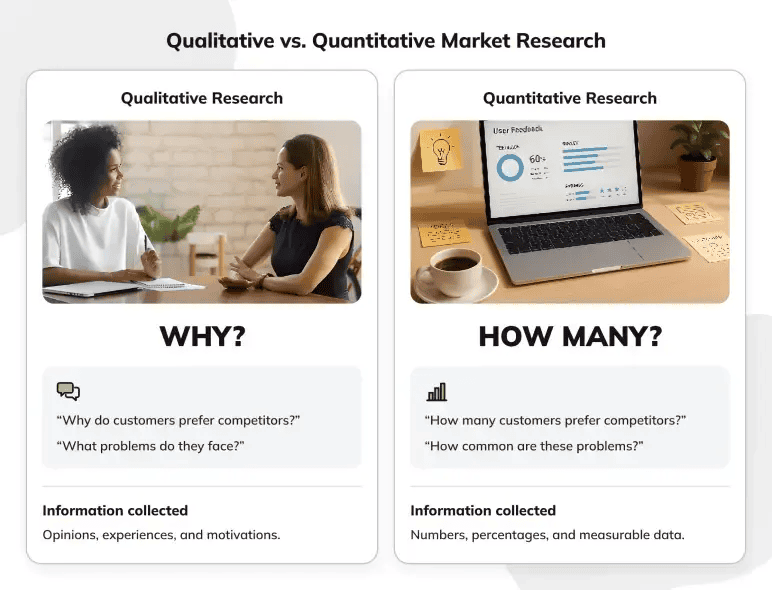
Qualitative market research
Qualitative market research gives you insights into how people think, how they feel, why they do things, and what they think.
For example, if you run a fitness center and you’re seeing that a lot of people are not renewing their memberships, then this is the kind of information you’ll need.
Your membership data will reveal your customer attrition rate, but not the reason you are losing customers.
For that, you need to talk to former members, and you might find that their lack of friendliness, inflexibility of classes, or personal attention has been leading them to choose to attend elsewhere. These insights give you something specific to investigate or improve.
Some of the qualitative research techniques include in-depth interviewing, focus groups, open-ended survey questions, and observation. You can also review and analyze feedback and reviews from existing customers.
When should you use qualitative research?
This is particularly helpful when you have a definite idea of a product or service that you wish to create, but you do not have a clear idea as to why, or when you are still figuring out what customers really want.
But if you find a problem using qualitative research, it’s not enough to know that the problem exists; you have to know how prevalent the problem is in your target market. A numerical answer might be required to make a big business judgment.
Quantitative market research
Quantitative market research is a method that collects and analyzes numerical data to quantify the characteristics of a market, customer behavior and preferences, or market performance.
It is helpful to answer questions like “how many”, “how much,” and “how often”.
Suppose you think you have an idea for a new meal subscription service. You’d like to know how many times potential customers buy ready-to-eat meals and how much they spend on them.
A well-designed questionnaire might be useful to collect quantitative data about how often people buy it, what type of subscription they prefer, and how much they spend on it.
Another way would be to review real orders from a small pilot program to gain insight into purchasing behavior.
Common quantitative research methods and sources include structured surveys, sales records, web analytics, experiments, and statistical databases.
When to employ quantitative research?
Use it when you need numbers to help you make a decision, for example, estimating likely sales of a product, deciding which two products to offer, or investigating how common a customer problem is.
Remember that it does not necessarily mean reliable research just because there are many responses. If your participants are not your target audience, you could draw incorrect conclusions about your findings.
Types of market research based on research objectives
Your research approach also depends on what you’re trying to achieve. It could be a chance to find out if there is an opportunity, assess an existing situation, or determine whether a specific change has an impact.
These three objectives are referred to as exploratory, descriptive, and causal research.
Exploratory market research
When there is not enough understanding about a problem or opportunity, exploratory research is used to deepen the understanding.
For instance, if you’re thinking about opening your own pet care company, you may wonder what type of services pet owners require the most in your area.
So, you could talk to pet owners and listen to the grievances against current services, which might lead you to realize that there is a need for evening pet care or flexible weekend care.
At this stage, you’re not trying to measure demand. You’re narrowing down your list of potential opportunities that are worth investigating further.
Descriptive market research
Descriptive research is used to gain insight into the nature of a market demand, the customers, or the business situation.
In the pet care case, after determining that there may be a need for evening care, you might conduct a survey of pet owners in your community to determine:
- How often they require evening care
- Which days they prefer it
- How much they are spending on evening pet care currently
The results provide a more detailed understanding of the opportunity, but don’t necessarily provide insights into why certain customer behaviours exist.
Causal market research
Causal research is used for the purpose of finding out whether a change in one factor results in a change in another factor.
It is frequently helpful in analyzing pricing, marketing messages/communications, product characteristics, and service enhancements.
For instance, if you have an eCommerce business and wish to know if you could boost conversions by providing free shipping.
You could randomly present two sets of website visitors with different offers: free shipping and a shipping charge. When you adjust for all other factors, you can determine whether anyone is buying more or less because of free shipping.
The key is not to change several things at once. Otherwise, you will not know which change resulted in the outcome.
Types of market research based on business needs
While the previous classifications describe how you approach research, businesses also divide up market research by what they are researching.
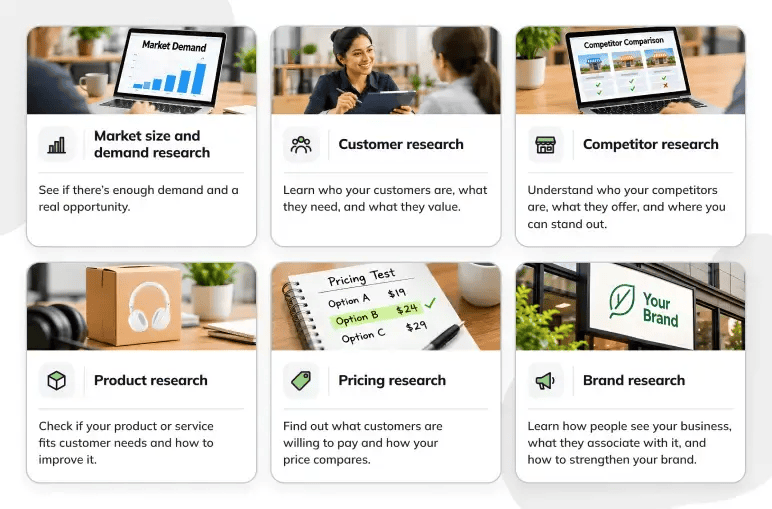
Here are six common market research areas that can assist you in making various business decisions.
Market size and demand research
Market size & demand research allows you to gain insight into the size of a potential market, existing demand, trends, and opportunities for growth.
This is especially useful when determining the options of entering a market, growing your business, or expanding into a new geographical region.
For instance, if you want to start a day care business, you might try to find out how many child care centers are currently available, how many nearby families have young children that you are targeting, and what kind of population trends are in the area.
One could also inquire if local day care centres have waiting lists to get a better sense of whether there is an unmet need for child care.
But having a big or expanding market doesn’t always mean that your business will necessarily have a great demand.
Customer research
Customer research involves knowing your customers, their needs, the decision-making process, and what affects their decision.
It lets you narrow down your target market, create buyer personas, and make decisions related to attracting and serving customers.
For instance, a home cleaning company may find that parents appreciate flexible scheduling, whereas older customers may prioritize consistency and reliability.
From these results, the business could schedule weekend hours for working parents and assign a regular cleaning person for those who value consistency.
For established companies, the data from customer research can also be used to find out why customers are not satisfied, why they do not buy from the company again, or why customers are migrating to another competitor.
Competitor research
Competitor research is a process of analyzing businesses/firms that cater to the same or similar customer requirements.
It helps you comprehend their offerings, pricing, positioning, strengths, weaknesses, and potential for differentiation.
Suppose you are starting a car rental service. Researching the current rental firms may show that the majority of them serve people who are traveling in and out of the airport, but provide restricted delivery choices for customers whose cars need repairs.
That could be a potential opportunity to serve another customer segment.
However, it’s not enough to find a gap in the market. You also need to decide whether your customers appreciate the service and whether you can provide it profitably.
Product research
Product research helps you determine whether the product or service will meet customer needs before investing resources in its development or production.
For example, if you have a small furniture company looking to create a new range of compact home-office desks, you might test with different designs and solicit feedback from your prospective customers and then take a few preorders in order to give yourself a buffer against the risk of a mass failure.
It’s also useful for understanding which features clients value and what they’d like to see improved in an existing product.
Pricing research
Price research helps businesses comprehend the willingness of customers to pay, price sensitivity, and the impact of pricing on purchasing decisions.
It could also be used in setting initial prices, introducing new packages, or considering a price increase.
For example, a mobile car detailing service might consider finding out what customers currently pay for similar services and whether they’re willing to pay more for the convenience of having their cars cleaned at home.
But willingness to pay is just one aspect of pricing. Your prices also need to reflect your costs and support your margins.
Brand research
Brand research is the study of customer perception of your brand, what they associate with it, and how it is compared to other brands.
It can be useful when developing your brand positioning, assessing your brand marketing messages, or repositioning an existing business.
For instance, an independent coffee shop might try to position itself as a premium specialty coffee destination, but find that the customers perceive it as offering the best value for money and availability.
Then the shop owner can choose to either reinforce the existing value of the coffee to the customer or make changes in the value to appeal to a customer seeking a higher-quality coffee experience.
How to pick the right type of market research for your business?
Never begin your research with the question, “Should I do a survey or an interview?” Start with the decision in front of you and work backward.
I would recommend using the following steps before spending time or money on research.
Step 1: Identify the business decision you need to make
Define the exact decision you want to make, and the biggest uncertainty that prevents you from doing so. “I want to do market research” is too general, “Should I launch a ₹1499 starter kit or stick to a ₹799 refill pack for the first time buyers” directly cuts to the chase.
Step 2: Determine what information is available
Before collecting new data, review the available data: past orders, support tickets, website analytics, competitor data lists, public reports. If there is existing information that could provide 80% of the answer, a quick check may be appropriate, rather than skipping the study altogether.
Step 3: Find out what additional evidence you need
Match the other remaining gap with the right lens:
- Use qualitative research to analyze why customers hesitate, what words they use, or what is broken in their experience.
- Apply quantitative research when measuring the number of people concerned, estimating demand, or comparing options numerically.
- Use causal testing when a specific change (which involves pricing, positioning, or a feature) represents significant stakes, and you want behavioural proof first before rolling it out broadly.
Step 4: Select a method that fits your resources and decision
Compare the amount of research you can afford, time, customer access, and how reversible the decision is. It’s easy to change website headlines, and it’s reversible—a lightweight test is usually enough.
Signing a three-year lease and managing 5,000 units of inventory is costly and difficult to undo. So it justifies performing primary and secondary validation more carefully.
Step 5: Combine research types where necessary
One approach works well for small, routine changes like verifying analytics before making any tweaks to a product description. Combine two or more types when introducing a new offer, entering a new market, or changing prices.
Use secondary and qualitative work to shape your choices, and then test qualitative or causal to see if they’re worth investing in before putting money.
The following table can help you turn common business goals into practical research activities:
| Your Business Goals | Research approach | Where to start | If you need more evidence |
|---|---|---|---|
| Estimate market size | Secondary, quantitative | Government and industry data | Local demand surveys and market testing |
| Validate a business idea | Primary, qualitative and quantitative | Customer interviews and early feedback on your idea | Paid preorders or product trials |
| Understand customer pain points | Qualitative, exploratory | Customer reviews and targeted interviews | Survey a wider group of potential customers |
| Study competitors | Secondary (with primary checks where feasible) | Competitor offerings, pricing, and reviews | Try competing products or interview their customers |
| Test the impact of a price change | Primary, causal | Review current prices, margins, and sales data | Controlled pricing experiments |
| Measure customer preferences | Qualitative and quantitative | Existing customer feedback | Targeted interviews and surveys |
| Explore a new market opportunity | Exploratory and descriptive | Industry trends and conversations with potential customers | Targeted surveys or small-scale market testing |
Treat these as starting points rather than fixed rules. Your approach may change depending on what you want.
Conclusion
In short, good market research does not mean you have to tick off all the types of market research or conduct complex ones that you can’t do anything with!
It’s the idea of collecting enough reliable data at an acceptable cost and speed that fits your business to make a more informed choice than a guess.
Choose one specific business question today, review what you already know, and do the smallest possible thing to test your assumptions.
With clear findings on your market, demand, and customer needs, you can now directly incorporate them into your market analysis and financial assumptions in your business plan. For that, you can use a tool like Upmetrics to organize your strategy and projections in one place.
The Quickest Way to turn a Business Idea into a Business Plan
Fill-in-the-blanks and automatic financials make it easy.

Frequently Asked Questions
What's the difference between market research types and methods?
Which type of market research is best for startups?
Is it possible to do market research without paying any money?
How do I know if I've conducted enough market research?
What type of market research should I include in my business plan?

Cortney Becker
Cortney Becker is a Marketing Consultant with 10 years of experience in product development and growth marketing. She specializes in creating high-impact content and market positioning strategies that boost revenue growth and sales performance. Her background spans SaaS, technology, energy, subscription services, and consulting, with a strong focus on product adoption and sustainable growth. Read more