


You know you need investors for your startup. Depending on your stage, that could be friends and family, angel investors, VC firms, accelerators, or crowdfunding.
The harder part is knowing where to find them.
Which websites should you use? Where can you find angel groups or VC firms? Can AI help you find investors that actually fit your startup?
That’s what this guide is for.
I’ll explain which types of investors fit your startup stage, how to find investors for a startup, which places are worth checking, and how to find them using AI and Google.
Which type of investor fits your startup stage?
Before you start looking, it helps to know which funding sources actually fit where your startup is today.
A startup with only an idea will usually have different options than one with a working product, customers, or revenue.
Here’s a simple way to look at it:
| Where your startup stands | Funding sources to consider first |
| Idea or early validation | Your own funds, friends and family, grants, startup competitions, some accelerators, and individual angel investors |
| Prototype or MVP (minimum viable product) | Friends and family, angel investors, accelerators, relevant grants, and crowdfunding |
| Early traction or pre-seed | Angel investors, angel groups, accelerators, pre-seed funds, and micro-VCs |
| Seed or early revenue | Angel groups, seed funds, VC firms, and corporate investors |
I’d use this as a starting point, not a strict rule. Your industry, location, funding amount, and the progress you’ve made can also affect which option makes sense.
For example, if you only have a business idea, your own funds or friends and family may be the most realistic place to start. Once you have a working product and some early customers, angel investors or pre-seed funds may become more relevant.
I’d also avoid jumping straight to VC firms just because you need outside funding. Start with the sources that fit where your startup stands today.
Knowing the type of investor you need is one thing. Finding the right place to look is another.
Where to find investors for your startup?
Here are the main places you can use to find investors for your startup, depending on who you’re looking for.
Friends and family
Friends and family are usually the easiest investors to identify, so the main thing here is choosing carefully.
I’d suggest approaching only people who understand the risk, can afford to lose the money, and will not need it back within a fixed timeframe.
Keep the investment and its terms clearly documented, even when the investor is someone close to you.
Angel investors
For angel investors, I’d suggest starting with OpenVC, which has both free and paid features. You can search its investor database and narrow the results by stage, industry, location, and round size. Some filters, like check size, may require the paid plan.
You can also check Signal by NFX, which is free. Its Angel, Scout, and Solo-Capitalists lists can help you find individual investors and narrow your search by stage, industry, or location.
For angel groups and networks, you can use the Angel Capital Association directory to find groups across the US.
Another useful way is to find 5-10 startups similar to yours and check who invested in their earliest rounds. This can help you find angels who already invest in businesses like yours.
You can also find individual angels through LinkedIn. Try searches like “angel investor + [your industry]” or “angel investor + [your city]”.
If you use LinkedIn Sales Navigator, you can narrow the search further by location, industry, seniority, and current company.
Before adding anyone to your list, I’d recommend checking their recent investments to make sure they still invest at your stage, in your industry, and at a check size that fits your round.
Venture capital firms
One practical way to find VC firms is to look at startups similar to yours and see who funded them.
Start with 5-10 comparable companies and use Crunchbase to check their funding rounds and participating investors. If the same VC firms appear across several companies in your space, they’re worth researching further.
OpenVC is worth using here again, but this time to look specifically for VC firms rather than individual angels.
Dealroom is another useful option. It offers free access for approved founders, so you’ll need to apply first. You can use it to research investors by location, stage, type, and portfolio focus.
If you already have access to PitchBook, use it for deeper research on funds, deals, and portfolio companies. Since it’s a paid research platform, you probably don’t need it for your first investor search.
Once you have a few firms, compare their current portfolio, stage focus, and typical round size before shortlisting them.
Corporate venture capital
Some large companies invest in startups through their own venture arms. These can be worth looking at if your startup works in an industry or area that matters to the company.
Here are a few examples:
| Corporate venture arm | Backed by | Typical stage | What it invests in |
| Salesforce Ventures | Salesforce | Seed to growth | Enterprise software, including SaaS, security, data, AI, fintech, and health tech |
| M12 | Microsoft | Seed to Series B | Seed to Series B startups in AI, cloud, security, and deep tech |
| Alexa Fund | Amazon | Early stage and later rounds | AI, hardware, generative media, smart agents, and other emerging technologies |
To find more, check large companies in your industry and look for pages called Ventures, Investments, or Innovation. You can also use Crunchbase or Dealroom to see which corporate investors have funded startups similar to yours.
The main thing to confirm is whether the venture arm is still investing in companies like yours.
Accelerators and incubators
Accelerators and incubators work a little differently from other investor types because not all of them invest directly. Some provide funding, while others mainly offer mentorship, resources, and access to investors.
There are three practical ways to find accelerator and incubator programs:
1. Start with major programs
Check well-known accelerators such as Y Combinator, Techstars, and 500 Global and apply directly through their websites.
2. Use a discovery platform
Use F6S to find smaller accelerators, incubators, and startup programs by industry and location.
3. Search for local or industry-specific programs
Look for programs run by universities, local startup organizations, state economic development agencies, and industry groups. Google can help here, especially when you search by city, state, or industry. I’ll cover the exact search queries later in this guide.
Before applying, check whether the program provides funding, how much equity it takes, and whether it gives you access to investors through introductions or demo days.
Equity crowdfunding
Equity crowdfunding also works differently from angel or VC fundraising. Instead of finding investors one by one, you raise through a platform where many individual investors can invest in your startup.
The main platforms worth checking are:
All three support regulated startup fundraising in the US, but they differ in fees, campaign requirements, investor audience, and the types of companies they tend to feature.
I’d consider this route more seriously if you already have customers, users, or a community that may want to invest. Wefunder, for example, explicitly positions its offering around community-led raises.
The important thing to remember is that listing your startup on a platform does not automatically bring investors. You will usually need to bring attention to the campaign yourself, so compare the platform’s fees, audience, and campaign requirements before choosing one.
This is how you can find investors for your startup through the main investor types and platforms. But there are also other practical ways to uncover relevant investors. Let’s look at those next.
Other ways to find investors for your startup
AI has made investor research much easier. You can now build a first investor list much faster instead of searching through dozens of websites one by one.
Find investors using AI
For this, I’d start with tools like ChatGPT, Claude, or Perplexity.
Instead of asking: Find investors for my startup.
Use a more specific prompt:
For example, I tested it with a sample startup scenario:
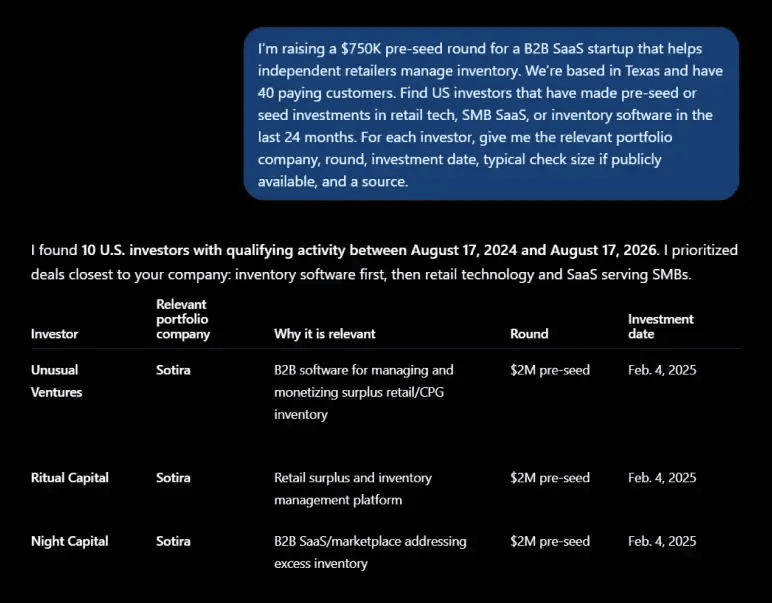
The first response gave me a broad list of 10 investors. That’s useful for discovery, but some names may still be too broad or not a close enough fit.
So the next step is to narrow it down. Use a follow-up prompt like:
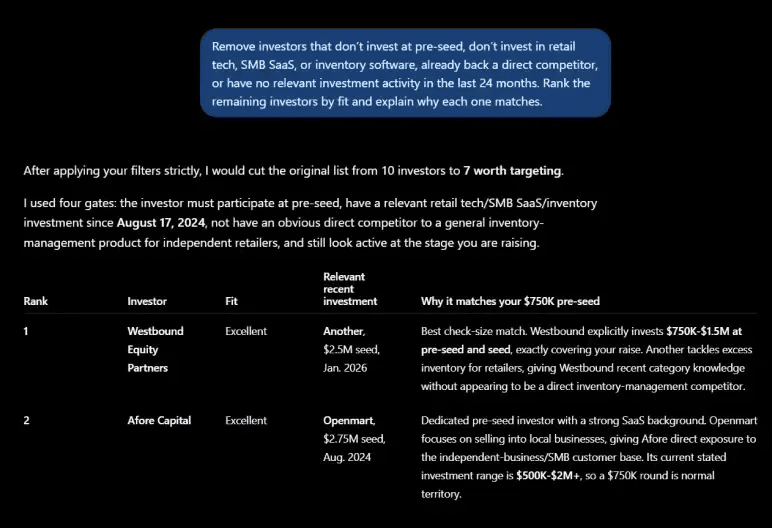
Out of the 10 investors from the first search, the second prompt narrowed the list down to 7 better matches. It also explained why each one fit based on stage, industry, and recent activity.
This is the better way to use AI for investor research: build a broad list first, then narrow it using your actual criteria.
Just make sure to check each investor’s website, portfolio, and recent deals before adding them to your final list.
Use Google for targeted investor searches
Google works best when your search is specific. Add your industry, stage, city, state, or recent funding activity to the query instead of searching broadly for “startup investors.”
Try searches like:
“[your industry] pre-seed investors”
“[your city] angel network”
“[your state] venture capital firms”
“[your industry] seed VC [your state]“
You can also search recent funding rounds:
“[your industry] startup” “pre-seed round”
“[similar startup name]” investors
For a broader search, Google AI Mode can also help. For example:
I tested it with the same startup scenario:
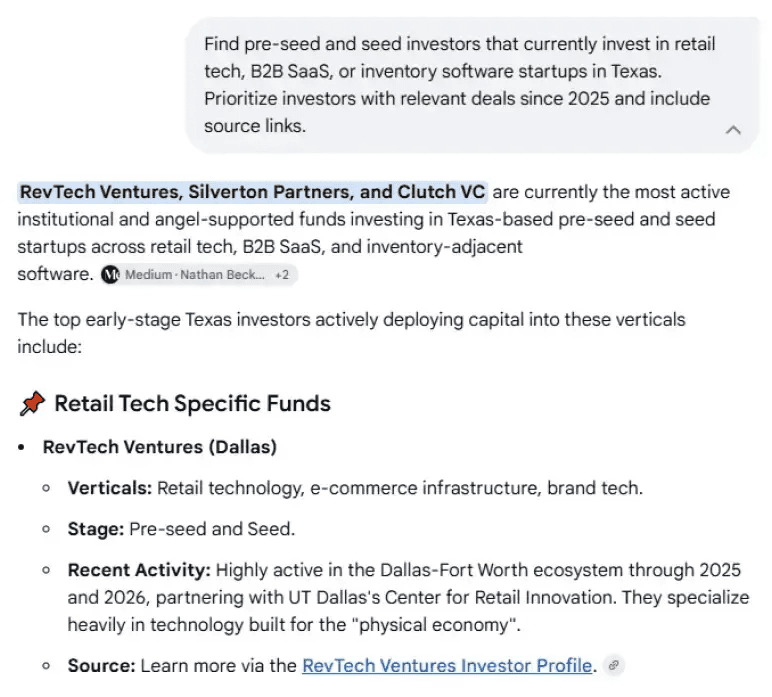
It gave me 3 relevant investors, along with their investment stage, recent activity, and source links. This makes it easier to check whether each investor is still active and worth researching further.
For local searches, add your city, state, or region to the query to surface regional angel groups, local VC firms, and university-linked investors.
Conclusion
Finding investors is not really about collecting as many names as possible. It’s about knowing where to look, then narrowing the list to people who actually invest in startups like yours.
Once you find the right investors, the next step is making sure you’re ready for the conversation. They may want to understand your market, business model, financial forecasts, and how you plan to use the money.
That’s where Upmetrics can help. You can use it to build your business plan, research your market, and create financial forecasts so the key details are ready when investors ask for them.
Ready to Approach Investors?
Build a clear business plan and financial forecasts before you approach investors.

Frequently Asked Questions
What should I do after finding potential investors?
Do I need to pay for investor databases?
How recent should an investor’s activity be?
How many investors should I put on my list?
Can I find startup investors offline?

Anthony Ray
Anthony Ray is an SBA Commercial Loan Officer specializing in commercial lending, financial analysis, and risk management. Over the years, he has helped business owners secure the financing they need to grow and succeed. Besides that, he shares practical insights on banking, loans, and financial strategies based on his industry experience. Read more