


 Download Now: Startup Fundraising Checklist
Getting funding for a business often gets difficult after the first few searches. Loans, grants, SBA programs, investors, crowdfunding, credit lines, and credit cards seem to be useful. But it is still hard to know which option actually fits your business.
A founder with only an idea has different options than a business with steady revenue, unpaid invoices, or equipment needs.
You have to consider your credit, cash flow, timeline, how you plan to use the money, and your ability to repay it in order to see what works for you.
So before you apply everywhere, I’d suggest narrowing the field. Know your funding need, current stage, and the proof you can show. Then focus on the funding routes that fit your business.
Quick answer: Which funding option fits your situation?
Just not sure where to begin? I’ve prepared the table below to help you match your current situation with funding options that may better fit your stage:
| Your situation | Start with these funding options |
| You only have an idea | Bootstrapping, pre-sales, personal network funding |
| You are pre-revenue but preparing to launch | Microloans, CDFIs/community lenders, equipment leasing, local/state grants, business credit cards |
| You already have revenue and need working capital | SBA 7(a), bank or credit union loans, business line of credit, online lenders, payment processor financing |
| You need equipment, vehicles, or machinery | Equipment leasing/financing, vendor or dealer financing, SBA 7(a) & 504 |
| Customers owe you money, but payments are slow | Invoice financing, invoice factoring, business line of credit |
| You want funding that you don’t have to repay | Small business grants (if eligible), pitch competitions, reward or donation crowdfunding |
| You are planning for a high-growth startup | Angel investors, accelerators or incubators, equity crowdfunding, venture capital |
I have already covered each option in detail, including when it makes sense, what it’s usually used for, and what to watch before you apply, in a later section.
How much funding do you actually need?
First, get clear on how much funding you will need and what the funding will be used for before you even apply for funding.
Many business owners start with a round number like $25,000, $50,000, or $100,000. If the funder asks, “What is the money being used for?” you should be able to tell them the answer.
So list out the main costs the money will cover:
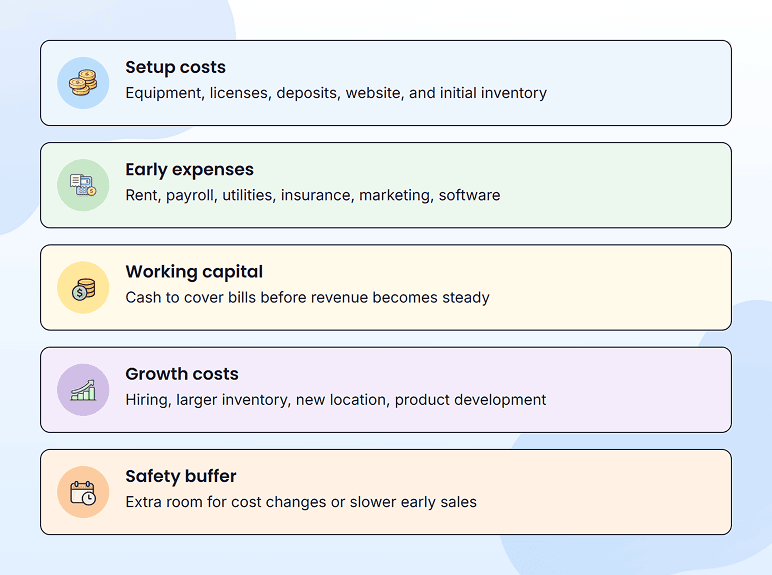
Add up the estimated costs for each area. Then subtract the money you already have available, such as savings, owner investment, business income, or early sales.
It’s as easy as:
Funding needed = costs required to cover – money currently available
For example, your business needs $82,000 for equipment, inventory, early expenses, and working capital. You can cover $32,000 from available funds. That means you need $50,000 in outside funding.
So instead of saying, “I need around $50,000,” say:
“I need $50,000 to cover the gap between my total costs and the money I already have.”
This makes the number easier to trust because it shows how you calculated it and what the money will cover. It also helps you avoid asking for too little or taking on more funding than the business actually needs.
What to check before choosing a funding option?
Once you know how much funding you need, don’t pick an option just because it sounds available. First, check whether it actually fits your situation: what the money will cover, how quickly you need it, and what your business can realistically qualify for.
Also, remember that different funders look for different things. Lenders want to know if you can repay. Grant programs check whether you meet their rules. Investors look for growth, traction, and the potential for strong returns.
Use these checks to narrow your list:
| What to check | Why it matters |
| Purpose of the money | Different needs point to different options. Equipment, invoices, and working capital are not funded the same way. |
| Timeline | Faster funding may help urgently, but it often costs more. Slower routes may not work if you need cash soon. |
| Eligibility | Revenue, credit, time in business, industry, location, and documents can rule out options early. |
| Proof available | Funders may ask for sales, invoices, bank activity, contracts, projections, or customer interest. |
| Repayment ability | Loan payments should not strain payroll, rent, inventory, taxes, or owner pay. |
| Ownership/control | Equity funding avoids loan payments but usually means sharing ownership. |
| Total cost | Fees, interest, repayment pressure, restrictions, or shared ownership can make one option more expensive than it first looks. |
If an option does not match your timeline, repayment ability, or ownership goals, move it lower on your list.
Business funding options by stage and need
Once you know how much funding you need and where it will go, it’s easier to shortlist the funding routes that make sense for where your business is today.
You do not need to compare every option here. Start with the one closest to your situation, then choose two or three realistic options to research further.
If you are still in the idea stage
If your business is still an idea, funding should help you test whether the idea is worth pursuing, not lock you into big repayments too early.
At this stage, most formal funding options will be difficult because you do not yet have revenue, invoices, or a steady cash flow. So start small and spend only on what helps validate the business.
Bootstrapping or self-funding
Bootstrapping is usually the most realistic place to start if you have some savings or income you can safely put into the idea. It means using your own money instead of taking a loan or giving up ownership too early.
It works best for small early costs like registering the business, building a simple website, testing ads, buying samples, purchasing software, or ordering a small amount of inventory.
The key is to set a limit. Do not use money needed for rent, bills, emergency savings, or personal expenses.
Pre-sales or customer deposits
Pre-sales can work when customers are willing to pay before the product or service is fully delivered. This helps in two ways: You bring in early cash and prove that people are interested enough to buy.
This works best when the offer is clear and easy to deliver, such as a limited product, paid class, event booking, service package, or membership launch. Be clear about pricing, delivery dates, and refund terms.
Personal network funding
This funding can come from friends, family, or a business partner. This may be easier than getting approved by a lender, but unclear expectations can damage relationships.
Write down whether the money is a loan, gift, or investment. Do not leave the terms vague. Also agree on repayment, ownership, and what happens if the business takes longer to make money.
If you are pre-revenue but preparing to launch
If you are close to launch but do not have steady sales yet, focus on smaller funding options tied to a clear startup cost. This could be inventory, permits, supplies, equipment, or early working capital.
Funders will take the request more seriously when they can see exactly what the money helps you prepare for.
Microloans and nonprofit lenders
These are frequently an excellent source of funding when you need a smaller amount of capital. This includes SBA microlenders, Community Development Financial Institutions (CDFIs), nonprofit lenders, community lenders, local programs, and platforms such as Kiva.
These lenders are available to assist with startup expenses, inventory, supplies, small equipment, permits, or working capital.
SBA microloans can reach a total of $50,000, and the average SBA microloan is approximately $13,000. They are issued through SBA-approved intermediary lenders, and not directly to the borrower by the SBA.
Before applying, prepare:
- A simple business plan
- Startup cost estimate
- Funding allocation
- Owner information
- Basic financial projections
These lenders may be more flexible than banks, but they still need to see how the business will make money and repay the loan.
Business credit cards
Get business credit cards from your bank or a card issuer, with limits usually running $1,000 to $50,000 based mostly on your personal credit.
They can help with small startup expenses like software, supplies, ads, fuel, tools, or travel. They can also help keep business and personal spending separate.
Do not treat them like long-term startup funding. They’re not a good fit for rent, payroll, or long-term funding because the interest compounds faster than a new business can absorb it.
If you already have revenue and need cash for daily operations
If your business is making sales but cash still gets tight, funding options that rely on actual sales, bank activity, and cash flow may start to make sense.
They work best for temporary cash gaps, such as buying inventory before revenue comes in, covering payroll during a slow month, paying suppliers on time, or waiting for customers to pay.
SBA loans, mainly SBA 7(a)
It might be a good choice when you’re looking for a fixed financing plan for working capital, growth, equipment, refinancing, or acquisition.
The maximum amount of an SBA 7(a) loan is $5 million, and some of the key SBA 7(a) eligibility requirements are the type of business, credit history, and geographic location.
The process of applying for SBA loans is done through the SBA lenders, banks, credit unions, or SBA Lender Match, not through the SBA as the lender. Be prepared with tax returns, bank statements, projections, business plan, collateral information, and a breakdown of funds.
A personal guarantee is often required for SBA loans and could result in having to pay back personally if the business fails.
Traditional bank or credit union term loans
A bank or credit union term loan can work when you need a lump sum for a clear business purpose and can handle fixed monthly payments. It tends to be more suitable for businesses that have consistent income, have their records up to date, and have a solid repayment history.
The maximum loan amount depends on the lender. Some bank term loans begin at $10,000 and may reach hundreds of thousands of dollars, depending on revenue, credit, collateral, and loan type.
For instance, Bank of America offers unsecured business term loans of up to $10,000. Chase offers small business loans of up to $500,000.
Before you apply, ask the bank about the typical requirements, such as annual revenue, length of time in business, credit score, collateral, tax returns, financial statements, and personal guarantees.
Business line of credit
A business line of credit works best when your business is stable overall, but cash comes in unevenly. You get approved for a limit, draw only what you need, repay it, and use it again when needed.
It fits seasonal inventory, payroll timing, supplier payments, delayed customer payments, or a short cash crunch. Start with your own bank or credit union if you already have a relationship, then compare other lenders if the offer is too small, too expensive, or too slow.
Used well, it is a flexible cushion. Used poorly, it can quietly cover ongoing losses until the limit is maxed out.
Online business lenders
Online lenders can be considered if you are unable to get a bank loan, if a loan is too slow or has too much paperwork, or if you are out of reach right now.
The approval process is typically faster than a conventional bank application, and they will typically consider your business revenue, bank activity, credit, and length of time in business.
Loan amounts vary by provider. OnDeck states that its term loans can be as large as $400,000. And Fundbox claims it will offer loans up to $250,000.
However, the online financing could cost more and have shorter terms, additional charges, or daily/weekly payments.
Before signing, check the complete payback, fees, repayment plan, and whether payments leave enough cash for payroll, rent, inventory, tax, and owner pay.
If you need equipment, vehicles, or machinery
If the funds are primarily for a specific asset, you should consider this asset-based financing first before a general-purpose loan.
This applies to businesses buying vehicles, kitchen equipment, medical equipment, manufacturing machinery, POS systems, tools, fixtures, or other large assets.
The right option depends on one simple question: Do you want to own the equipment, use it for a while, or take the easiest financing offer at purchase?
| Option | Choose it when | Check before signing |
| Equipment financing | You want to own the equipment | Monthly payment, down payment, total cost, asset value |
| Equipment leasing | The equipment may need upgrades or replacement | Lease term, upgrade options, maintenance, end-of-lease terms |
| Vendor/dealer financing | You want convenience at purchase | Compare with a bank, credit union, or outside equipment lender |
For larger equipment or fixed-asset needs, SBA 7(a) or SBA 504 loans may also fit. SBA 504 is designed for major fixed assets, and SBA says 504 loans are available through Certified Development Companies with a maximum loan amount of $5.5 million.
But do not finance equipment just because approval is available. The equipment should clearly improve revenue, capacity, efficiency, delivery, or cost savings. Otherwise, you may add payments without improving the business enough to cover them.
If customers owe you money, but payments are slow
Invoice financing or factoring only makes sense if you have already delivered the work, sent the invoice, and are waiting for the customer to pay. It is not startup funding, and it will not help if you do not already have unpaid invoices.
This is common in B2B businesses where customers don’t pay immediately.
For example, a trucking company, staffing firm, wholesaler, manufacturer, or service provider could complete the work today and not be paid for it for 30, 60, or 90 days.
Invoice financing or factoring can help turn unpaid invoices into cash sooner. But they work in slightly different ways:
- Invoice financing lets you borrow against unpaid invoices. You usually keep control of the customer relationship, but you pay a fee to get cash sooner.
- Invoice factoring means selling unpaid invoices to a factoring company. You receive cash back quicker, while the factoring business might gather the money from your customer.
Before choosing either option, ask: Who contacts the customer? What fees apply? What happens if the customer pays late? Will the customer know a third party is involved?
If slow payments happen often but are manageable, a business line of credit may be cleaner than funding one invoice at a time.
Invoice funding can help with timing gaps. It will not fix a business that still loses money after customers pay.
If you want funding that you do not have to repay
Grants, prize money, and some crowdfunding routes are attractive because they do not work like traditional debt. But they are also competitive, restricted, and usually slower than they sound.
This category is worth exploring, but it should not be a part of your funding plan, not the whole plan.
Small business grants
They can be useful, but only when you search in the right place. Start with the type of grant that matches your business situation. The table below shows where to look first.
| Grant type | Best for | Where to check |
| State and local grants | Local hiring, redevelopment, tourism, agriculture, disaster recovery, or community impact | State, city, and county websites; local chamber; SBDC (Small Business Development Center) |
| Federal grants | Public programs, research, education, community development, or government priorities | Grants.gov |
| SBIR/STTR grants | Research, technology, or innovation-based businesses | SBIR.gov |
| Private or founder-specific grants | Businesses matching a founder group, industry, location, or program goal | Grant discovery platforms, nonprofits, private business programs |
The Minority Business Development Agency (MBDA) Business Centers provide capital access, contracts, technical assistance, and referrals for eligible minority-owned businesses. Use MBDA as a support resource, rather than as a source of direct grants.
Pitch competitions
Pitch competitions can be worth applying to if the prize, audience, judges, or networking opportunities are valuable to your business. But don’t treat them as your main funding plan. They are competitive, time-consuming, and not guaranteed.
They work best when you can explain your business clearly in a few minutes, and the competition matches your stage, industry, location, or founder profile.
Before applying, research what the prize amount is, who’s eligible, how much time is involved, what expenses are involved, how it is judged, and if the exposure is actually good for your business.
If the competition takes weeks to prepare but the prize or audience does not help your business, it may not be worth it.
If you are building a high-growth startup
If you’re building a startup that needs to grow fast, loans may not always be the right fit. You might need money before the business can fully support itself. Maybe to build the product, hire people, acquire customers, or move faster in a large market.
Startup equity funding can help with that, but it comes with a tradeoff. You may give up ownership and take on expectations around growth, updates, and future fundraising.
Angel investors
Angel investors can invest in startups that are not ready for VC investment, but have enough validation to be interesting. It might be a strong founder, initial traction, customer insight, a working product, or a good growth story.
When it is time to pitch to angels, they typically want to know what problem you are solving, who will purchase your product or service, how your business can expand, and how their money will be used.
Put together a pitch deck, basic projections, traction proof, and funding ask before reaching out. Identify angels via warm introductions, angel groups, founder networks, startup events, angel accelerators, and investor platforms.
Venture capital
It’s only realistic for startups that can grow quickly in a big market, and that can potentially give very large returns. VC investors typically focus on a large market, rapid growth, a scalable business model, and a large exit opportunity.
Don’t chase VCs simply for the purpose of funding. A local business that has good profitability can still be a poor fit for venture capital if it can not scale fast or have that kind of return.
In order to approach VC firms, you need a solid pitch deck, traction, a market size story, a financial model, and a detailed understanding of how the funding can help accelerate growth.
Accelerators and incubators
They can assist when funding alone is not enough. They can provide mentorship, investor introductions, workspace, technical support, and sometimes a small amount of capital.
They can be helpful in the early days of developing the business model, raising or seeking acceptance into a better startup network.
There are popular programs like Y Combinator and Techstars that attract notice, but those at the regional, university, or industry level might be a better fit for many founders. Read the terms carefully because some programs will accept equity, while others will provide funding, and some will provide support.
Equity crowdfunding
This lets many people invest smaller amounts in your business in exchange for ownership. Platforms such as StartEngine, Wefunder, Republic, and DealMaker are common examples.
This can work if your startup has a strong story, public appeal, existing audience, or a product people can understand quickly. But it is still real fundraising. You may need legal preparation, disclosures, campaign promotion, investor updates, and a plan for managing many small investors.
Investors fund clarity, not guesswork
Build an investor-ready business plan this weekend
How to improve your chances of getting funded?
Here’s something worth knowing before you apply for funding: it’s rarely the idea that gets rejected. It’s the application.
Many funding requests don’t fall apart because the business concept is weak. They fall apart because the request is vague, the numbers don’t hold together, or there isn’t enough evidence to support where the business actually stands.
Fortunately, most of these problems can be prevented. Before you apply, I’d suggest you focus on these five points.
1. Be clear about what you’re asking for
As I stated earlier, you should already know exactly how much money you require and what you’ll be spending it on. Now, make sure you communicate that clearly in your application.
Don’t just ask for a round number. Describe how you have determined the amount and what it is being used for.
For instance, stating that you need $40,000 for kitchen equipment, opening inventory, permits, and 3 months of working capital is much more effective than just stating that you need approximately $40,000.
A clear funding request makes it easier for funders to understand why you need the money and shows that you’ve considered how it will be used.
2. Use the right proof for your stage
This is where I see a lot of founders get stuck. They think they need perfect traction before applying for funding. That’s not always true.
What you really need is evidence that fits where your business is today.
If you are still at the idea or pre-launch stage, use the proof you have: customer interviews, waitlist signups, pre-orders, supplier quotes, market research, or a business plan.
If you are already operating, use stronger proof: sales, bank statements, invoices, purchase orders, repeat customers, or financial statements.
The point is not to prove everything perfectly. It is to show honest evidence that reflects your current stage.
3. Make sure your numbers make sense
Funders don’t expect flawless projections. What they’re really checking is whether everything lines up.
Your funding request should match your cost breakdown. Your financial projections should support your business goals. And if you’re applying for a loan, your repayment plan should show that the business can realistically afford the repayments.
A financial story that’s consistent (even if modest) builds more trust than one that’s ambitious but full of gaps.
4. Prepare for the funding source you’re applying to
Different funding sources look for different things. So I would say don’t use exactly the same application everywhere.
A lender is usually interested in repayment ability. An investor is more likely to focus on growth potential and market opportunity. A grant provider may care more about eligibility and the impact of your business.
The closer your application matches what the funder wants to see, the easier it is for them to evaluate your business and say yes.
5. Review your application before submitting
Before you submit your application, take a few minutes to review everything.
Check that you’ve answered all the funder’s questions, included the required documents, and made sure your financial information is accurate and consistent.
Also, confirm that you meet the eligibility requirements, so you don’t spend time applying for funding you can’t qualify for.
A final review can help you catch small mistakes before the funder does.
The bottom line
Getting funding becomes much easier when you stop treating every option as equally relevant.
Some funding paths will fit your business right now. Others may make sense later, once your revenue, credit, documents, or business plan are stronger. That is normal.
What matters is knowing where you stand before you apply. Be clear about how much money you need, why you need it, and what your numbers say about the business. Funders are not only looking at the idea. They want to see whether the business is ready to use the money well.
That clarity will not guarantee funding, but it will help you approach the right options with a stronger case and avoid spending time on paths that are not realistic yet.
Ready to Explore Your Funding Options?
Plan your funding needs and create financial projections with AI-powered business planning tools.

Frequently Asked Questions
What are the basic steps to get funding for a business?
Do I need a business plan to get funding?
How long does it take to get business funding?
What's the biggest mistake to avoid when applying for funding?

Anthony Ray
Anthony Ray is an SBA Commercial Loan Officer specializing in commercial lending, financial analysis, and risk management. Over the years, he has helped business owners secure the financing they need to grow and succeed. Besides that, he shares practical insights on banking, loans, and financial strategies based on his industry experience. Read more