


 Download Now: Free Business Plan Template
Setting a price for your product is easy because almost every founder follows the same simple technique. You add up your costs, see what competitors are charging, run a quick calculation, and pick something that feels right.
It works on paper, which is why most people do it. But it doesn’t hold up to scrutiny, whether the person scrutinising is a customer deciding if you’re worth their money, an investor reading your business plan, or just you, a year in trying to understand why the business isn’t growing the way you thought it would.
Not to mention the consequences that follow this kind of pricing approach: sales lag, margins shrink, discounts pile up.
That’s the gap I want to close. Because the price itself, really, is not what gets judged. The reasoning behind it is. And that reasoning, that’s your pricing strategy.
What is the pricing strategy?
I’ll keep my answer simple here. A pricing strategy is the reasoning you use to decide what to charge for your business offerings.
The number is just the output. The strategy is everything you use to get there, usually a mix of:
- What does it cost you to make and deliver the product
- What customers are actually willing to pay
- What competitors charge for something similar
- The margin you need to keep the business healthy
- The position you want to occupy in the market
Let’s say you have a candle brand selling on Shopify that charges $32 a candle. The reasoning that gets you to $32 might go something like this: your materials, packaging, and Shopify fees come to around $14 per candle, a comparable brand on Amazon charges $18 but uses paraffin, yours is soy with a designer scent, and you need a 55% margin to fund growth without raising money.
Is pricing strategy the same as a pricing model?
Quick clarification, because these get mixed up all the time.
Strategy is the reasoning that tells you whether to price above competitors, below them, or somewhere in between. The model is the structure (one-time payment, subscription, tiered plans, pay-per-use) you actually use to charge. You can run the same strategy through different models, or different strategies through the same model.
I’ll use “pricing strategy” as the umbrella term through most of this, but when we hit SaaS pricing, the distinction will be important.
The 9 pricing strategies, in depth
Before going deep on each one, here’s all 9 pricing strategies with examples in one place: who they fit, how they work, a real-world example, and the trade-off to watch for.
| Strategy | Best for | How it works | Limitation |
| Cost-plus | Manufacturers, commodity products | Price = production cost + fixed markup | Ignores what the customer would actually pay |
| Competitive | Crowded markets, similar offerings | Price set near the competitor’s average | Race to the bottom on margin |
| Value-based | Differentiated brands, strong perceived value | Price reflects the value the customer sees | Requires real customer research, not guesswork |
| Penetration | New entrants trying to win share fast | Launch below competitors, raise later | You train customers to expect low prices |
| Price skimming | Tech launches with no direct competition | Launch high, lower in stages over time | Margin shrinks fast once competitors arrive |
| Premium | Luxury or status goods | Price well above market to signal quality | Shrinks the addressable market |
| Economy | High-volume, low-margin businesses | Price below the market average | Brand perception risk if you ever want to move upmarket |
| Psychological | B2C retail, impulse purchases | Charm pricing ($9.99) or anchor pricing | Loses effect at higher price points |
| Dynamic | Time or inventory-sensitive markets | Price flexes with real-time demand | Customer backlash if used too aggressively |
Cost-plus pricing
This is the most basic pricing strategy and probably the most used. You tally up what it costs to make, slap a markup on top, and what you get is your selling price.
Production cost + markup = selling price
With this pricing strategy, you’ll never accidentally sell at a loss, and it’s the easiest pricing logic in the world to explain. However, it doesn’t account for your customer’s willingness to pay. So cost-plus is useful for setting your floor, but you’ll usually want to layer something else on top of it before you settle on the actual price.
Competitive pricing
With this strategy, you look at what others are charging for something similar and price yours around that. It’s the default in crowded markets where everyone is selling more or less the same thing.
Typically, you get three options with this strategy:
- Price below the average to pull in traffic and read as the value option in the category
- Price at the average, and let your product or brand do the convincing instead of your sticker
- Price above the average, which only works if you can clearly point to why
But once one player drops their price, the rest usually follow. What it leads to is that nobody makes decent money on their offering anymore.
Value-based pricing
Forget your costs for a second and what competitors charge too. Value-based pricing is when you set your price based on what the thing is actually worth to the person buying it.
A new iPhone Pro costs around $999 while a Samsung Galaxy (with basically the same specs) costs about $799. The phones themselves don’t cost Apple $200 more to make. People just pay more for an iPhone because, to them, it’s worth more. The brand, the ecosystem, the resale value, all of it adds up to something they’ll pay extra for.
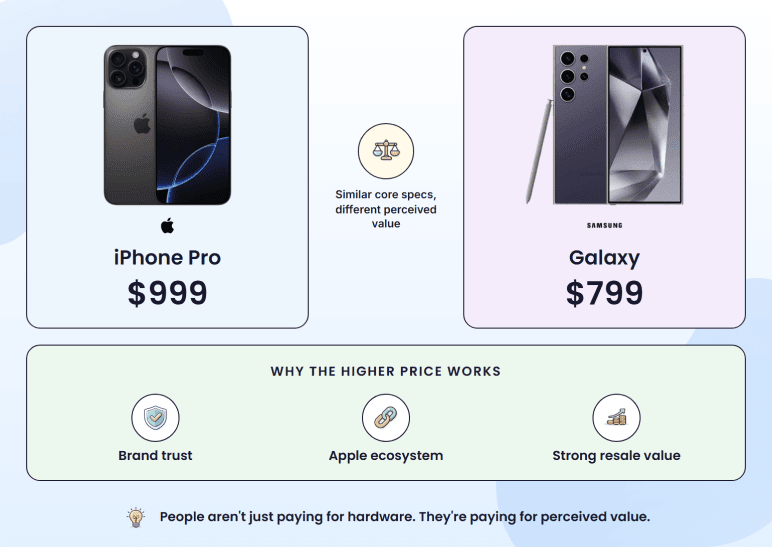
That’s value-based pricing. You charge what people think it’s worth, not what it costs you to make.
Penetration pricing
With penetration pricing, you come into the market with a price way below what everyone else is charging, eat the bad margins for a while, and use the low price to pull customers in fast. Once enough people are using you, you slowly raise prices back up to something that actually makes sense.
When T-Mobile rolled out its “Uncarrier” plans in 2013, it undercut AT&T and Verizon by significant margins, and over a few years, as it pulled in millions of customers, its pricing crept back closer to industry norms.
This sort of pricing strategy makes sense for a while, but raising the price later kind of feels like a bait to the customer in most cases.
Price skimming
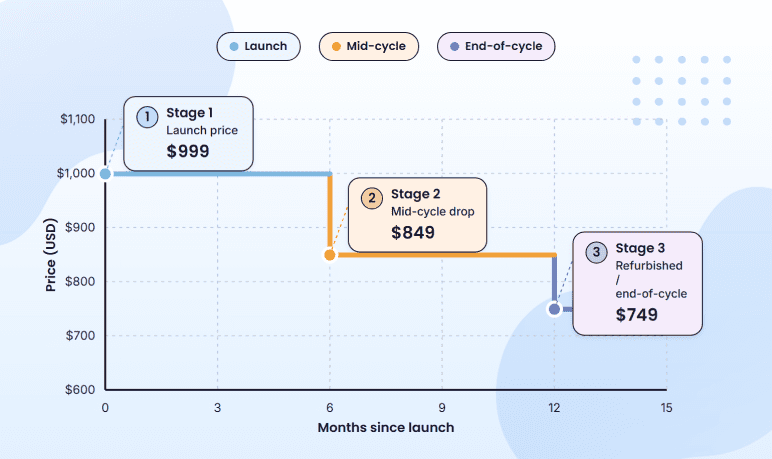
Let me explain it like this. Price skimming is basically the opposite of penetration. You launch high, sell to the people willing to pay top dollar first, then drop the price in stages to pull in everyone else over time.
Apple does this with every new iPhone launch. Each year’s new Pro model holds the premium price, the previous year’s model gets discounted to fill the lower tier, and within two or three years, it’s usually retired from the official lineup entirely. So the high price only holds while it’s the newest thing in the box. Once your competitors catch up or your own next product lands, the margin shrinks fast.
Premium pricing
Premium pricing is pretty much self-explanatory. You price your product noticeably above the market, and the high price itself becomes part of what makes the product desirable.
I know it sounds a lot like value-based, but with value-based, the price reflects the value the product delivers. With a premium, the high price itself is part of the value.
Let me explain it like this. A Rolex tells you it’s 3 pm just as well as a $40 watch does. People pay $10,000 for the Rolex because the price is the point.
However, this sort of pricing only works for products where status, craftsmanship, or scarcity actually matter to the buyer.
Economy pricing
Economy pricing is the one where customers come to you because you’re the cheapest. That’s the whole pitch.
In order to become profitable with this sort of pricing, you may need to have one of these:
- A leaner operation that lets you survive on smaller margins
- High enough volume that thin margins still add up
- A second revenue line, like Costco’s $65 annual membership
- A stripped-down customer experience, like IKEA’s flat-pack model
But once you’re known as the cheap option, climbing back up the price ladder is genuinely hard.
Psychological pricing
Psychological pricing is when you set your price in a way that nudges how the customer feels about it, not just what they pay. The whole strategy is built on small mental shortcuts.
If I have to use psychological pricing for a cafe, I’d set the price of a latte at $4.99, rather than writing straight-up $5.00. The $4.99 reads as “four-something”, and $5.00 reads as “five.”
A few of the pricing techniques are:
- Charm pricing, where the number itself is engineered to land in a lower mental bracket
- Anchor pricing, where you frame the price next to something more expensive
- Decoy pricing, where you add a third option to make the one you actually want sold look like the smart choice
- Bundle pricing, where you package products together so the per-item cost feels lower
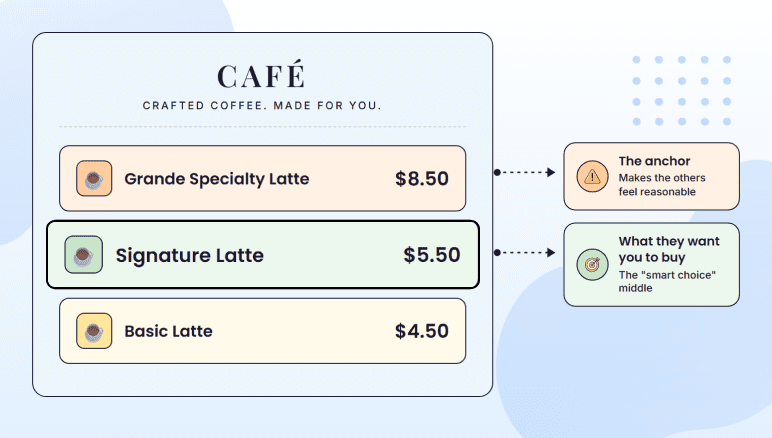
Mind you, these tricks work best in lower-priced, fast-decision categories like grocery stores, apparel, or fast food.
Dynamic pricing
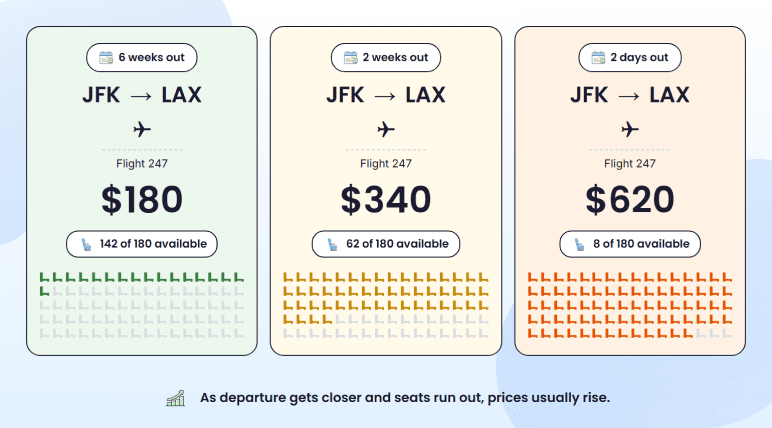
Dynamic pricing is basically when the price isn’t fixed. It moves up and down depending on what’s going on in the market at that exact moment. If more people want it right now, the price goes up, and once the demand cools off, the price comes back down.
You might have seen this a hundred times with flights. The same seat on the same plane might cost you $180 if you book six weeks early, and $620 if you wait until two days before. Though nothing about the flight changes, it’s just the timing of when you tried to buy it.
Everything we’ve covered so far applies pretty cleanly if you’re selling a physical product or a service. But if you’re running a SaaS business, the rules change. Subscription revenue, free tiers, paying by the seat, all of that changes how you think about pricing. I think it’s worth explaining in detail.
SaaS pricing models work differently: tiered, freemium, and usage-based
If you’re selling a physical product or service, the 9 strategies above will carry you most of the way. Still worth a skim, though, because tiered plans, subscriptions, and freemium-style hooks are showing up everywhere now.
But if you’re building a SaaS, a SaaS investor or advisor isn’t going to stop at pricing. They’ll want to know:
- How customers move between plans
- How free users actually become paid users
- How customer usage changes your revenue
- Whether the model supports predictable recurring income
I’m not going to add strategies anymore; they’re pricing models. You still pick a strategy from the 9 above. The model is the structure you wrap around it.
Tiered pricing
In tiered pricing, you offer the same product at multiple price points, each with a different mix of features or limits. All the popular SaaS products like Slack, HubSpot, and Notion work on tiered pricing.
The risk is tiers that blur into each other. Usually, three or max four (Free or Basic, then Pro, then Business or Enterprise) is the sweet spot.
For a business plan, the way to justify tiering is to show the customer split you expect across plans. That mix is what drives your average revenue per user, and it’s the first thing an investor will ask about.
Freemium pricing
Freemium is when there’s a free version that’s actually usable, and you make money from the customers who upgrade. Spotify, Canva, Zoom, they all run on this.
Freemium works when two things line up: serving free users costs you almost nothing, and there’s a clear reason to upgrade. The risk is free users that drain your infrastructure, or a free version so generous that nobody ever pays.
For a business plan, the number that matters is your free-to-play conversion rate. Industry runs around 2 to 5%, and you’ll need to defend whatever you put in your model against that benchmark.
Usage-based pricing
Usage-based pricing charges the customer for what they actually use. It could be API calls, storage, compute, seats, or whatever the unit of consumption is. AWS, Snowflake, and AI APIs like OpenAI and Anthropic all run on this pricing.
What I like about this model is that it’s the fairest one on paper. The customer pays in proportion to the value they’re pulling out, but the catch is bill shock. A customer who used $200 worth one month and $4,000 the next won’t be happy when that invoice lands.
For a business plan, this is the hardest model to forecast. Investors will want to see your assumptions on average usage and how you’ve handled the variance.
Alright, I’ve thrown a lot at you so far; it’s about time I put them into action.
Forecasting usage-based revenue is messy
Model every pricing scenario with AI-built projections
How I’d actually build a pricing model: a 6-step process
I’m going to use some of the strategies and SaaS models we just covered, so you can see how this actually plays out. Most founders sitting down to write the pricing section of their business plan run into the same handful of questions:
- Which strategy actually fits my business?
- How do I justify my price to a lender or investor?
- What if my market doesn’t have clear competitors?
- How do I know if my pricing will hold up six months from now?
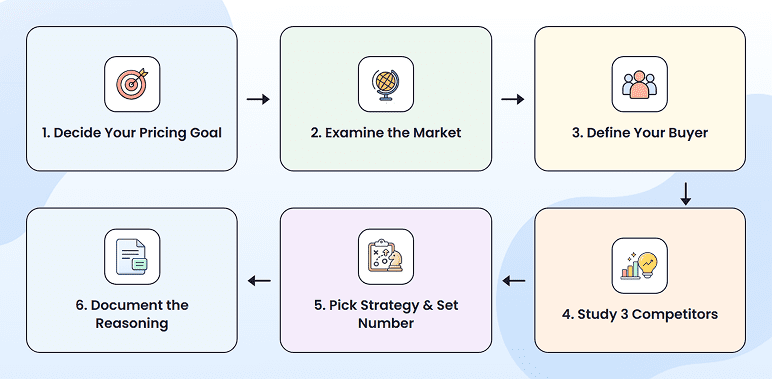
Wherever you’re starting from, this framework below will land you on an optimal pricing strategy for your business.
#1. Decide what you want your pricing to do
This sounds obvious, but it’s the step most founders tend to ignore. Pricing can chase different goals.
- Are you going for the highest possible margin?
- Fastest share of the market?
- Steady cash flow?
- Long-term customer value?
You can’t go after all four at once. So pick one and stick with it, because everything below this step depends on what you picked here.
#2. Examine the market
The spreadsheet you’re putting all the information on won’t give you an answer to what the market will actually pay. So spend 30 minutes browsing your category on a marketplace or aggregator. Amazon, Etsy, G2, or wherever your customers are. That’ll give you a price range for customers in the whole category.
A crowded market with lots of similar options pushes you toward competitive pricing. A new or sparse market gives you room for value-based or premium.
#3. Get specific about who you’re selling to.
A good price assumes a specific buyer in mind. Sit down and answer three things about them:
- Who they actually are (income, business size, role)
- How sensitive they are to price (looking for the cheapest option or willing to pay for quality)
- What job are they hiring your product to do?
The clearer your buyer profile, the easier the pricing decision becomes.
If you need help building a clear target market profile, we’ve got a full guide on it.
#4. Pick three competitors and study them properly
You don’t need to look at twenty of them. I’d say three direct competitors are enough. Then, see what their pricing looks like, where they’re bundling stuff together, where they’re running discounts.
And don’t forget about substitutes, because sometimes your real competition isn’t another business at all. It’s the customer choosing to do nothing or just figuring it out themselves.
#5. Pick your strategy and put a real number on it
Take what you built in the first four steps. Then pick one of the 9 strategies (or a SaaS model if SaaS is your business), do the math, and write the reasoning into your plan. Make sure the price lines up with your financial projections, because those numbers get stress-tested first.
And if a lender or investor pushes back on the price later, your best answer is the customer data you pulled in Step 3.
#6. Document the reasoning
Write a short paragraph that names your strategy, walks through how you got to the number, and references your customer data and competitor research.
I say, two paragraphs are usually enough. The reader (lender, investor, advisor) judges whether you’ve thought it through, and this is the part that proves you have.
Now, you will get a final number that can be your final “price.” Don’t treat that as the final one, though. That number almost never sticks, and that’s okay.
To pressure test it, raise prices by 10 to 15% for the next 20 new customers only, leave your existing customers alone, and see what happens to conversion. If it holds, you were underpriced. If it tanks, you’ve found your ceiling.
Either way, revisit pricing every six to twelve months, or sooner if a competitor moves or your costs shift.
Final thought
If your pricing section in the business plan reads like a number with a sentence next to it, you’ll get questions you can’t answer. If it reads like a decision with the reasoning underneath, you won’t.
That’s really the only test that matters. Open your plan, write your strategy, walk through how you got to the number, reference the customer data, and the competitor read that got you there.
If you’d rather not start from scratch, Upmetrics has business plan templates with the pricing section already structured, plus 400+ sample business plans for reference.
Build a Pricing Strategy That Makes Sense
Set the right price using your costs, customers, competitors, and business goals.

Frequently Asked Questions
Can you use more than one pricing strategy at a time?
Should startups price low to attract early customers?
What's the difference between B2B and B2C pricing strategies?

Vinay Kevadia
Vinay Kevadiya is the founder and CEO of Upmetrics, the #1 business planning software. His ultimate goal with Upmetrics is to revolutionize how entrepreneurs create, manage, and execute their business plans. He enjoys sharing his insights on business planning and other relevant topics through his articles and blog posts. Read more