


I’ve asked many business owners over the years who their target market is. This includes founders writing their first business plan, owners who’ve been running their business for years, and first-time founders about to step into the market.
Surprisingly, many of them said the same thing: “all who need my product or service.”
And honestly, it sounds like a smart and genuine answer from their side. But it’s not a target market. It’s a hope.
When you try to sell to everyone, your message becomes too broad, your marketing feels generic, your pricing becomes unclear, money gets wasted, and the right customers can easily pass you by. And when you submit a business plan that says “everyone is our primary customer,” the lender doesn’t push back. They just stop reading.
That’s why this guide exists. I’ll show you how to identify a target market, make sure you’ve chosen the right one, and describe it clearly in your business plan.
What is a target market?
A target market is the specific group of people or businesses you choose to focus on because they’re the most likely to need your product or service, pay for it, and be reached through your sales and marketing channels.
Your target market is not everyone who could buy from you. It is the group you choose to serve first.
I’ve noticed many people confuse target market with target audience. They sound similar, but they are not the same.
Target market vs. target audience
Your target market is the main customer group your business is built to serve.
Your target audience is a smaller group within that market that you’re trying to reach with a specific marketing message or campaign.
For example, a gym’s target market could be:
- Target market: Adults in the local area who want a structured fitness routine.
Inside that market, the gym could focus on different target audiences at different times:
- Target audience: Overweight adults weighing 200 pounds or more who want to lose 30-50 pounds in the next six months.
- Another target audience: Young adults aged 20-30 who want to gain 10-15 pounds of lean muscle.
Both groups belong to the same target market, but they need different messages, offers, and marketing campaigns.
You can have one target market and many target audiences inside it.
How to identify your target market in 5 steps
When founders ask me how to identify their target market, I walk them through the same five steps every time. None of it is complicated, but the order matters.
Most people get the first step wrong, and that mistake tends to throw off everything that comes after it.
Let’s start there.
1) Start with the problem you actually solve, not the product you built
Before you can find your customer, you need to understand what problem you’re solving for them.
Look at what your business offers and list the specific problems it solves. Next to each problem, write down the value your solution provides. Then write down the types of people who benefit from that value.
Think of it as three columns: the problem, the value, and the people who care about both.
Let’s say I’m building a clean protein brand. Here’s what those three columns might look like:
| Problem | Value | Who Benefits |
| Bloating, breakouts, and digestive issues from daily protein use | Gut-friendly protein that’s easy on the stomach | People with sensitive stomachs and regular gym-goers who train often |
| Not knowing exactly what’s in the product | Clean ingredients with transparent sourcing | Health-conscious customers who read every label |
| The same few flavors across most brands | 15+ seasonal and year-round flavor options | Long-time users tired of vanilla and chocolate |
| Standard formulas that feel too heavy or too large | Lighter blends and smaller serving sizes | Women looking for daily protein and parents buying for active kids |
Notice that I’m not choosing a target market yet. I’m simply listing the groups of people who might have these problems.
When you do this for your own business, your goal is to make a broad list, not pick a winner.
2) List every customer group that feels this problem
The people column from Step 1 is spread across different rows. Step 2 is where you bring those groups together into one list so you can compare them side by side.
Pull each customer group out of the table and write it as a separate item. Then look at the list and ask yourself: who else has this problem that didn’t show up in the exercise? Add them in.
The goal isn’t to create a shortlist yet. It’s to create a complete list of possible customer groups.
Going back to my clean protein brand, here’s what my list might look like:
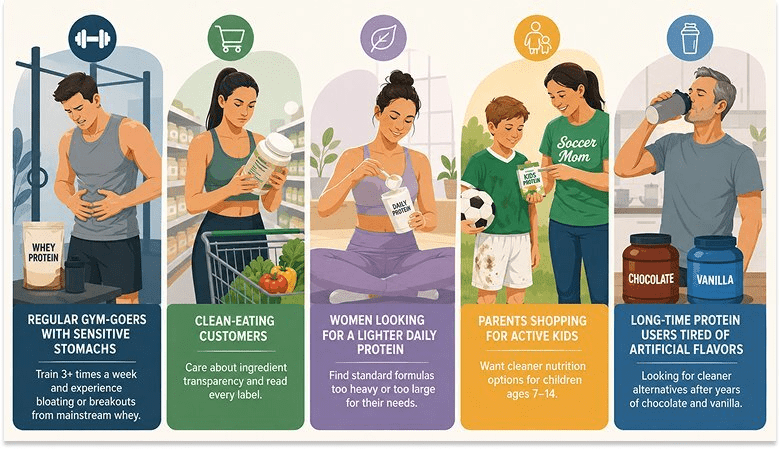
That’s how I’d build my list. Five possible customer groups, any of which could become the primary target market for the business.
Step 3 is where you choose the most promising group and build a detailed profile of them.
3) Sketch your most promising segment in detail
Most founders never get past this step. They keep their target market “flexible” because they don’t want to rule anyone out. The problem is that if you don’t choose a customer, you don’t really have a target market.
This is where you pick one group and describe them in detail.
Choose one customer group from your Step 2 list. Not all five. Just one. The goal is to make that customer specific enough that you could recognize them in real life.
How you choose depends on where your business is today.
- If you already have customers: Look at the people who buy from you most often and see which group from Step 2 they look most like. Start there. You already know they’re willing to pay.
- If you’re pre-launch: Choose the group whose problem shows up most often in competitor reviews, online communities, or conversations you’ve had with potential customers.
Once you’ve picked a group, answer these six questions:
- How old are they?
- What’s their income or budget?
- Where do they live?
- How much do they usually spend in your category?
- What frustrates them about the current options?
- What are they hoping to achieve by buying a product or service like yours?
Don’t worry about getting every detail right. Use your best assumptions and the market knowledge you already have. Step 4 is where you’ll test those assumptions against real-world signals.
For my clean protein brand, I’d choose regular gym-goers with sensitive stomachs. They stood out during the earlier steps, and they buy protein regularly rather than once in a while.
Here’s what that customer might look like:
That’s enough to start making real decisions.
4) Pressure-test what you wrote against real data
The profile you created in Step 3 is still a hypothesis. It might sound right, but you haven’t proven it yet. Step 4 is where you test it against real data.
How you do this depends on whether you already have customers.
If you already have customers:
Start with your own data. Sales records, email engagement, reviews, and support tickets can tell you who’s actually buying from you.
Start with sales records. Look at the customers who buy most often and spend the most. In many cases, they’re your real target market, or close to it. Compare their age, location, and buying habits to the profile you created in Step 3.
Next, check your email and CRM data. Which groups open your emails, click your links, and make purchases? If one group consistently engages more than the others, pay attention to it.
Then read recent reviews and support tickets. Look at how customers describe their problems. If they’re using a different language than you used in your profile, your marketing message may need work.
You’re looking for two things: where the data matches your profile and where it doesn’t.
The second one is usually more useful. It shows you what needs to change.
If you’re pre-launch:
If you don’t have customers yet, use outside market research sources instead:
- The U.S. Census Bureau gives you age, income, household composition, and education by ZIP code or metro area.
- The BLS Consumer Expenditure data shows you what people in different income brackets actually spend on different categories. Both are free.
Read the last 50 reviews of two or three direct competitors on Google, Amazon, or Yelp. Search Reddit for threads about the problem you solve. Look at Google Trends for the search terms your customers would use. This is where you find out what real people complain about, ask for, and rave about.
Talk to 5 to 10 people who fit your profile. Ask questions and listen carefully. You can also create a simple landing page or waitlist to see if people show interest.
The goal of Step 4 isn’t to prove your profile is right. It’s to learn where it’s wrong and improve it using real information.
Step 5 is where you’ll take what you’ve learned and look for opportunities your competitors may be missing.
5) Find the customer your competitors are overlooking
One of the biggest mistakes founders make is choosing the same target market their competitors are already chasing. If everyone is trying to reach the same customer, it’s much harder to stand out.
You can avoid that by answering three simple questions.
Q1: Who are my competitors talking to?
Pick three or four direct competitors. Look at their homepage, customer testimonials, influencers they work with, and pricing.
You’ll usually notice a pattern. Most competitors in a category tend to focus on the same type of customer. That’s useful because it shows you where the market is already crowded.
Q2: Who are they not talking to?
This is often the more important question.
Look for customer groups that have the problem your product solves but don’t show up in your competitors’ marketing. It could be a different age group, a different need, or a different budget.
Whatever it is, that group may not be getting much attention from the businesses already in the market.
Q3: Where does my target market fit?
Now compare your Step 3 profile to what you found.
If your target customer is in the crowded group, you’ll need a good way to stand out.
If they’re in a group that competitors are mostly ignoring, you may have found a good opportunity.
If they’re somewhere in the middle, you have options. You can move your messaging closer to the underserved group without completely leaving the larger market.
Either way, it’s important to know where your customer fits before you commit.
For my clean protein brand, most competitors seem to target serious male gym-goers. Their packaging, messaging, and influencer partnerships all point to that audience.
Sarah from my Step 3 profile fits that group, which means I’d be competing with a lot of other brands for her attention.
That makes me stop and think.
If I shift my focus to women looking for a lighter daily protein, the picture changes. There’s still demand, but far fewer brands are speaking directly to them. That’s the group I’d be more interested in building the brand around.
That’s the five-step process. By the end, you should have a clear description of one customer group, tested against real signals, and positioned in a part of the market where you can realistically compete.
The next question is what to do if more than one customer group looks promising.
What if you have more than one target market?
This is one of the most common questions I get, and the answer is yes, you can have more than one target market.
The mistake is treating all of them the same.
Pick one primary target market and make the others secondary.
Your primary market is the group your pricing strategy, messaging, and marketing are built around. Your secondary target markets still matter. You’ll sell to them and serve them well. They just aren’t your main focus.
If you’re choosing between multiple groups, ask:
- Which group needs my solution the most?
- Which group is most likely to pay for it?
- Which group is easiest to reach?
- Which group gets the most value from what I’m offering?
For my clean protein brand, women looking for a lighter daily protein would be my primary market.
That doesn’t mean I’d ignore everyone else. People with sensitive stomachs, clean-eating customers, and parents shopping for active kids could still be secondary markets I’d serve with the same products. But my packaging, marketing, and partnerships would be built for women first.
A simple rule: if you can’t say which market comes first, you probably haven’t chosen a primary market yet.
Got your target market? Now write the plan.
Turn your customer research into a full business plan
Writing the target market section of your business plan
By the end of the five steps, you should have a clear picture of your target market.
Now it’s time to put that information into your business plan.
This section usually goes in the market analysis section, where a lender, investor, or potential partner may spend less than a minute reading it. The section is short, but it can have a big impact on how they view the rest of your plan.
A strong target market section should answer five questions:
- Who is your target market?
- Where are they located?
- What problem do they have?
- Why will they choose your business?
- How will you reach them?
If you’ve completed the five steps in this guide, you already have most of this information. Your job now is to pull the key details together into a short, clear paragraph.
Use this template:
Our target market is [specific customer group] in [location or service area] who need [problem or need]. They are likely to buy from us because [buying reason]. We will reach them through [marketing or sales channels].
For the clean protein brand I’ve been building throughout this article, the target market statement might look like this:
Now compare that to a weaker version:
The weak version is too broad. The stronger version clearly explains who the customer is, where they are, and why they’ll buy.
What lenders look for
From what I’ve seen, lenders usually look for three things:
- Is the market large enough to support the business?
- Does the founder clearly understand the customer?
- Is there evidence behind the claims?
A vague target market section can make the rest of the business plan feel less convincing, even if the numbers are solid.
Add a buyer persona
Some founders also include a buyer persona in the appendix or market analysis section. This isn’t required, but it can help bring the customer to life for the reader.
Here’s what one might look like, using the clean protein customer we sketched earlier:
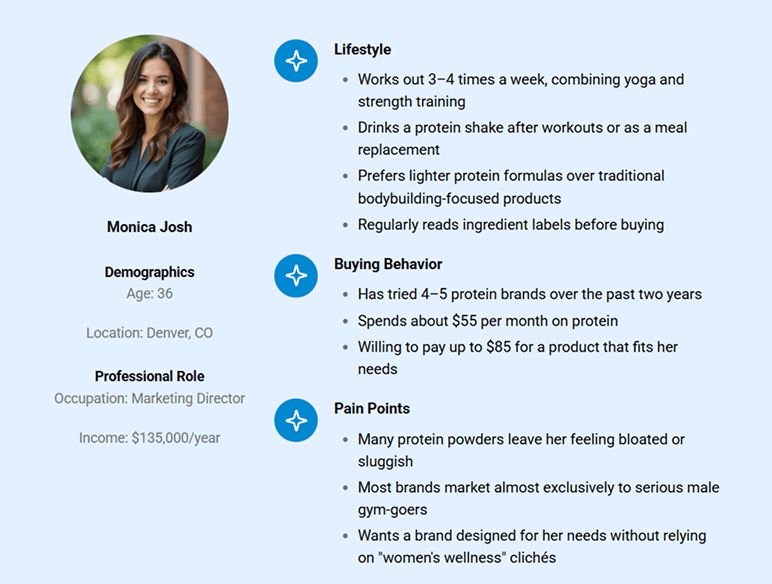
With a clear target market section, the rest of your business plan becomes easier to support. Your pricing, marketing, sales strategy, and financial projections all have a clear customer behind them.
Conclusion
The founders I mentioned at the start of this article treated their target market like a guess. By now, yours shouldn’t be.
You’ve defined the problem you solve, listed the customer groups who have it, chosen the most promising one, tested your assumptions, and looked for opportunities your competitors may be missing.
That’s a target market. Not a guess.
From here, the job is simple: turn what you’ve learned into a clear target market statement for your business plan, marketing strategy, or sales efforts.
If you need help putting it all together, Upmetrics offers an AI business plan generator, guided planning tools, and 400+ business plan templates to help you build your plan faster.
Either way, you have the process. Now it’s time to put it to work.
Give Your Business a Clear Customer Focus
Define who you serve, what they need, and how your business will reach them.

Frequently Asked Questions
What are the main types of market segmentation?
Can my target market be "everyone who needs my product"?
How do I know when my target market is changing?

Vinay Kevadia
Vinay Kevadiya is the founder and CEO of Upmetrics, the #1 business planning software. His ultimate goal with Upmetrics is to revolutionize how entrepreneurs create, manage, and execute their business plans. He enjoys sharing his insights on business planning and other relevant topics through his articles and blog posts. Read more