


Getting more sales does not always mean finding more leads.
A small business can have plenty of enquiries and still struggle because the wrong people are coming in, prospects do not see enough value in the offer, follow-ups are inconsistent, or existing customers rarely buy again.
That is why adding another tactic, such as cold calling, discounts, social selling, or networking, may not fix the real problem.
A better approach is to identify where sales are getting stuck and improve that part of the process.
Below, I’ll walk through 7 practical sales strategies small businesses can use to attract better prospects, convert more opportunities, and generate more revenue. I’ll also show you how to choose the right strategy and measure whether it is working. But first…
What is a sales strategy?
A sales strategy is the overall approach you use to win customers and grow sales. It helps define who you want to sell to, where sales opportunities will come from, how you will turn prospects into buyers, and how you will generate more revenue from existing customers.
It is different from a sales tactic. A strategy sets the direction, while tactics are the specific actions you use to carry it out, such as outreach, referrals, networking, or follow-up.
I’d say this distinction matters for a small business because you usually do not have the time or budget to try every possible sales tactic. You need to focus on the activities that address the specific part of sales you need to improve.
7 practical sales strategies for small businesses
Now that you know what a sales strategy does, the next step is deciding where to focus your effort.
The strategies below cover the main areas small businesses can improve, from finding better prospects to converting more customers and generating more revenue from existing ones.
1. Focus your sales effort on customers most likely to buy
When sales are slow, I think one of the easiest mistakes is assuming you simply need more leads. But if many of those leads are poor fits, increasing volume only gives you more people to chase.
Start by narrowing your target market to the types of customers who are most likely to need what you sell, get real value from it, and realistically buy from you.
If you already have customers, look at the ones that tend to be the best fit. Ask yourself:
- Which customers buy most consistently?
- Which are easiest to serve profitably?
- Which customers get the most value from the offer?
- Which types tend to stay longer or buy again?
- Which enquiries usually become paying customers?
These patterns can help you narrow your focus.
For example, a bookkeeping firm may initially target “small businesses.” But its best customers might turn out to be service businesses with 5–20 employees that have outgrown DIY bookkeeping but are not ready to hire an in-house finance person.
Once you know who you want to pursue, qualify individual prospects before investing too much time in them.
Depending on the type of sale, that may mean checking whether they have a genuine need, whether your offer is a good fit, whether the timing is realistic, and whether they have the ability to buy.
2. Strengthen the value behind your offer
Even when you are reaching the right people, sales can still stall if prospects do not see enough value or difference in what you offer.
A clear value proposition helps customers understand why your offer is worth choosing. Make sure they can quickly see:
- What problem you solve
- Who the offer is best suited for
- What outcome they can expect
- Why your approach is a better fit than other options
Generic statements such as “high quality,” “great service,” or “competitive pricing” rarely help a buyer make a buying decision because competitors can say exactly the same thing.
Suppose two accountants describe their service this way:
“Monthly bookkeeping services for small businesses.”
That tells the customer what is being sold, but not why they should care.
A more specific offer might be:
“Monthly bookkeeping and financial reporting for growing service businesses that have outgrown spreadsheets but do not need a full-time finance team.”
The second version gives the customer more context about who the service is designed for and why it may fit their situation.
That value can come from several places, such as specialization, faster turnaround, greater convenience, stronger expertise, better support, lower risk, or a different pricing or service model.
Make sure the offer itself is just as easy to understand. Clear packages, pricing, and inclusions make it easier for prospects to compare their options and see what they are paying for
3. Build reliable ways to generate qualified prospects
Once you know who you want to sell to, the next question is straightforward:
Where will those people consistently come from?
Many small businesses never really answer this. They rely on whatever happens to bring in leads, such as referrals, occasional networking, or one-off outreach. That can generate sales, but it is hard to build consistency around it.
Instead, look at the ways customers already discover or buy from businesses like yours and identify the channels you can realistically maintain.
Depending on your business, useful prospect sources might include:
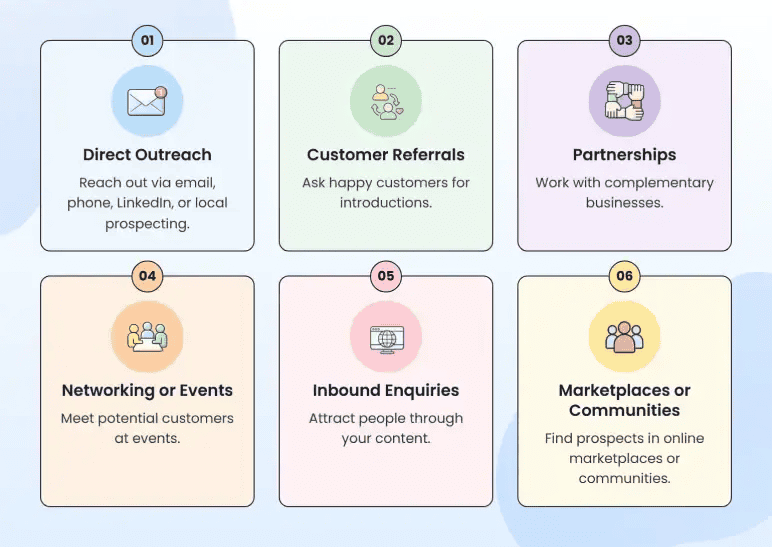
One thing I’d like to add: start with one or two sources you can realistically work consistently rather than trying all of them at once.
For example, a commercial cleaning company may get stronger opportunities from direct outreach to office managers and referrals from property managers than from broad social media activity.
Whichever channels you choose, track which ones actually lead to qualified prospects and paying customers, not simply which ones generate the most enquiries.
In short, build a dependable flow of good-fit opportunities instead of constantly searching for the next source of leads.
4. Improve how you turn prospects into customers
If plenty of suitable prospects are reaching you but few actually buy, generating more leads will not fix the problem.
You need to look at what happens after someone shows interest. That means how you handle the sales conversation.
For that, I’d recommend you understand the customer’s specific situation. Find out what they are trying to solve, what matters most in their decision, and what may be holding them back.
Once you understand the need, guide the prospect toward the most suitable option instead of presenting everything you sell. Too many choices can make the decision harder.
Where appropriate, support your recommendation with proof such as:
- Relevant customer examples or case studies
- Reviews and testimonials
- Demonstrations or samples
If a prospect still hesitates, find out why before trying to close the sale. The concern could be price, timing, risk, trust, or another priority. I would say you should avoid offering a discount before understanding the real reason for their hesitation.
Also, check whether your buying process makes it easy to move forward. Slow quotes, complicated proposals, unclear next steps, or difficult payment can lose customers who were otherwise ready to buy.
Therefore, make the path from interest to purchase as clear and easy as possible.
5. Follow up and nurture prospects consistently
Not every good prospect will be ready to buy after the first conversation. Some need more time, more information, or approval from someone else.
That is why follow-up matters. It often gets pushed aside when day-to-day work gets busy. A quote is sent, the prospect says they will think about it, and nobody checks back at the right time.
Instead, decide the next step before the conversation goes cold. Note what the prospect is considering, what they still need, and when you should reconnect.
When you follow up, give them a clear reason to respond. That could mean answering a question, sharing a relevant example, clarifying an option, or checking back around the timeframe they mentioned.
Avoid sending repeated “just checking in” messages. Keep the follow-up useful and tied to what the prospect actually needs.
And do not chase every opportunity forever. If someone is no longer responsive or the need is no longer active, move on and focus your time on stronger prospects.
Keep open opportunities, next actions, and follow-up dates in one place so promising leads do not get lost.
6. Generate more sales from existing and past customers
You do not always need more new leads to increase sales. Sometimes improving customer loyalty and finding more ways to serve people who have already bought from you can also create new sales opportunities.
There are two practical ways to look for those opportunities:
Get customers to buy more often
Think about when customers may naturally need to buy again.
Depending on the business, that could mean renewals, recurring services, maintenance, seasonal work, rebooking, or replenishment.
For example, a cleaning company that mainly sells one-time deep cleans could offer an ongoing biweekly or monthly cleaning plan.
That changes the revenue relationship without acquiring another customer.
Increase what you can help each customer with
You can also help existing customers with additional needs. That might involve:
- Upselling to a more suitable package
- Cross-selling complementary services
- Adding premium options
- Bundling related products
- Expanding the scope of work
A landscaping company, for example, may already provide lawn maintenance but later help the same customer with irrigation, seasonal cleanup, or tree care.
I’d suggest keeping these recommendations relevant to the customer’s needs. The aim is not simply to sell more, but to find the next useful way your business can serve someone who already trusts you.
7. Make your sales process consistent and repeatable
Many small businesses do not have a formal sales process.
That is not automatically a problem. But as sales activity grows, it becomes harder to manage everything from memory. Leads get missed, follow-ups slip, and different prospects may be handled in completely different ways.
You do not need a complicated sales system to fix this. Begin by defining the basic stages a prospect usually moves through, for example:
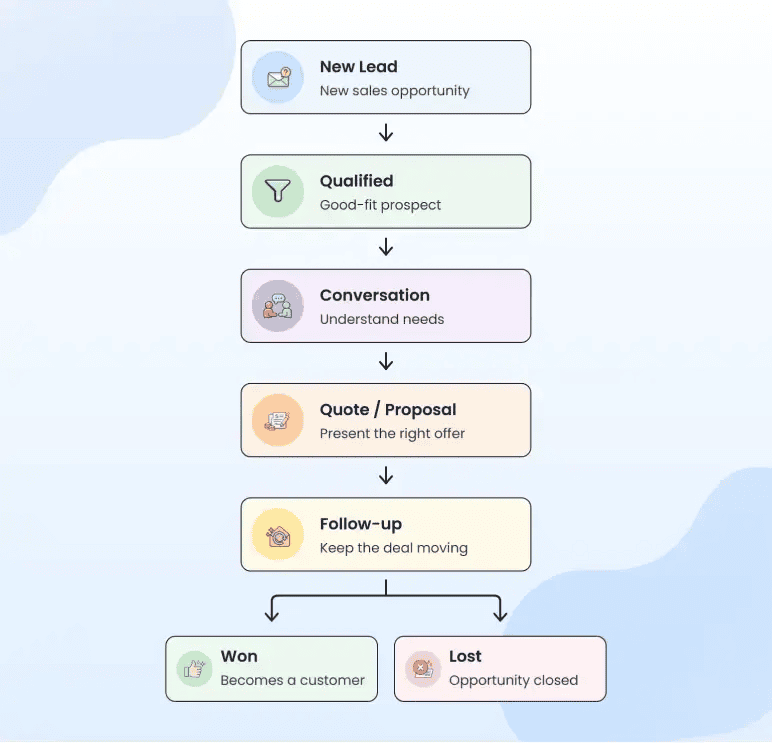
Then keep each active opportunity in one place with a few simple details:
- Current stage
- Next action
- Follow-up date
- Expected value, if useful
- Person responsible, if more than one person handles sales
Your stages should match how your business actually sells. A retailer may move from enquiry to purchase quickly. A consultancy may need several conversations before sending a proposal.
The point is to create enough structure that you always know where an opportunity stands and what needs to happen next.
Overall, these are the different ways to improve sales. But you do not need to use all seven strategies at once.
Now, let’s look at how to identify where that problem is and which strategy deserves your attention first.
Which sales strategies should you focus on?
Different sales problems need different fixes. A business struggling to attract enough suitable prospects should not focus on the same things as one getting plenty of interest but losing buyers later in the process.
Use the table below to match what you are seeing in your sales with the area that is most worth improving first:
| If this is happening… | It likely means… | Focus on… |
| You get plenty of leads, but few are a good fit | You are targeting the wrong people | Better-fit customers |
| Prospects do not see enough reason to choose you | Your offer or value is not clear enough | Strengthening your offer |
| You do not have enough suitable prospects | Your lead sources are too limited or inconsistent | Generating qualified prospects |
| Good prospects show interest but rarely buy | Something is stopping them from moving forward | Improving conversion |
| Prospects go quiet after calls, quotes, or demos | Follow-up is weak or inconsistent | Follow-up and nurturing |
| Customers buy once but rarely return or buy more | You are missing repeat-sales opportunities | Existing and past customers |
| Leads, follow-ups, or next steps regularly get lost | Your sales process is too informal | A more consistent sales process |
If several areas are weak, start with the one hurting sales the most.
For example, if you already get plenty of good prospects but few buy, work on conversion before trying to generate more leads. More leads simply magnify whatever is already broken later in the process.
What if you do not know where sales are getting stuck?
Review a few recent opportunities and look at:
- Where did prospects come from?
- Were they actually a good fit?
- Where did they stop moving forward?
- Why did they buy or say no?
You may notice a pattern quickly. That makes the problem clearer. If poor-fit leads mostly come from one source, lead quality may be the issue. If good prospects often stop after a quote, conversion or follow-up may need attention.
Then track the results to see whether the change is actually helping.
How to measure whether your sales strategy is working?
You do not need to track every sales metric. Focus on the few signals that show whether the part of sales you are trying to improve is actually getting better.
What you track should depend on the strategy you are working on. Use the table below as a simple guide:
| If you are improving… | What to track |
| Customer targeting | Lead quality, customer fit, qualified leads |
| Your offer and value | Proposal acceptance, price objections, reasons for saying no |
| Prospect generation | Qualified leads and customers by source |
| Sales conversion | Prospects becoming customers, where prospects drop off |
| Follow-up | Responses and opportunities moving to the next step |
| Existing-customer sales | Repeat purchases, renewals, upsells, revenue per customer |
| Sales process | Missed follow-ups, stalled opportunities, time to close |
Review the results over time and look for problems that keep repeating.
For example, if prospects often stop after receiving a quote, work on your conversion or follow-up. If one lead source keeps bringing poor-fit prospects, improve or replace that source.
Final thoughts
Wrapping up! You do not need more sales tactics simply because sales are slower than you want.
First, find the constraint: where sales are getting stuck. Choose the strategy that addresses that problem, and then track whether it improves the result.
Once you know what is working, turn it into a clear sales goal and make sure it connects with your broader business plan. That is where a business planning software like Upmetrics can help.
You can use it to build your business plan, work through your financial forecasts, and keep your sales and growth assumptions connected as the business changes.
The goal is not just to make more sales today, but to build a sales approach that supports where you want the business to go next.
Plan Your Sales for Better Growth
Set realistic goals and create a clear plan to reach more customers.

Frequently Asked Questions
What is the best sales strategy for a small business?
What is the difference between a sales strategy and a marketing strategy?
How much should a small business spend on sales?
How often should you review your sales strategy?

Cortney Becker
Cortney Becker is a Marketing Consultant with 10 years of experience in product development and growth marketing. She specializes in creating high-impact content and market positioning strategies that boost revenue growth and sales performance. Her background spans SaaS, technology, energy, subscription services, and consulting, with a strong focus on product adoption and sustainable growth. Read more