


When you start building a business plan, some numbers are already known, such as rent, pricing, equipment costs, or employee wages. But others, like customer demand, sales, growth, and future costs, still need to be estimated.
That becomes especially difficult when you’re starting a new business with little or no historical data. You still need reasonable numbers to plan how the business will operate and build your financial projections, but those numbers shouldn’t be arbitrary guesses.
That is where business plan assumptions come in.
In this guide, I’ll walk you through what business plan assumptions are, which ones matter, how to choose realistic values, and how to document them clearly in your plan.
What are business plan assumptions?
Business plan assumptions are the estimates or expectations you make about important parts of your business that you cannot know for certain yet. They give you a clear starting point for planning customer demand, sales, costs, staffing, and other future needs until actual data becomes available.
For example, say you’re opening a salon. You expect to serve 15 customers a day at an average spend of $60. Those numbers aren’t confirmed yet, but you need them to estimate sales, staffing, supplies, and expenses.
Since these estimates influence other parts of your plan, they shouldn’t be random. Important ones should be based on the best information available, such as market research, past results, supplier quotes, or comparable businesses.
The goal is to make the reasoning behind your plan clear and easier to understand for you and anyone reviewing the plan.
What assumptions should you include in a business plan?
There isn’t a standard list of assumptions every business must use.
A software company, restaurant, construction firm, and consulting business will all rely on different variables.
So don’t try to document every estimate in your plan. I’d suggest focusing on the assumptions that can meaningfully affect your revenue, expenses, cash flow, operations, or funding requirements.
For each one, think about two things:
What do you need to estimate? What information can give you a reasonable starting point?
Here are the main areas to consider:
Market assumptions
Market assumptions describe what you expect to be true about the customers and environment you’re entering. You don’t need to forecast everything happening in your industry. Focus on the market conditions your business actually depends on.
You might need to estimate:
- Customer demand
- The size of your reachable market
- Customer preferences or buying behavior
- Market growth
- Adoption of a new product or service
To make these estimates, start with the market you can realistically reach. Look at local customer or population data (from the Census Bureau, IBISWorld, Bureau of Labor Statistics), nearby competitors, customer interviews or surveys, and any early interest you’ve already seen.
These signals can help you judge whether enough demand exists for the business you’re planning.
For a salon, that could mean assuming there is enough demand in the local area for haircuts, color services, and styling, based on the number of nearby residents, customer preferences, and the salons already serving that market.
For most small businesses, this is more useful than simply assuming they will capture a small percentage of a huge industry market.
You also don’t need to predict exactly how every competitor will respond. Include competitive conditions only when they materially affect your business demand, pricing strategy, or ability to win customers.
Sales and revenue assumptions
Sales and revenue assumptions are the numbers you use to estimate how much income your business is likely to generate from sales.
Depending on the business model, this may include customer volume, units sold, average transaction value, pricing, purchase frequency, conversion rates, seasonality, or expected growth.
Rather than choosing a revenue figure first, build it from smaller numbers you can estimate more realistically.
For example, a salon might assume:
| Sales assumption | Estimate |
| Customers per day | 18 |
| Average spend | $65 |
| Operating days per month | 26 |
Each estimate should have a reasonable basis. The customer estimate could be based on expected demand and service capacity, while average spend can come from planned pricing and the services customers are likely to buy.
Using those assumptions, estimated monthly revenue would be:
18 × $65 × 26 = $30,420
So the $30,420 isn’t a number the owner simply chose. It comes from smaller assumptions that are easier to research and explain.
Cost and expense assumptions
Cost and expense assumptions cover major amounts you expect to spend but cannot confirm yet.
These may include inventory or materials, cost of goods sold (COGS), payroll, utilities, marketing, insurance, shipping or delivery, maintenance, and other significant operating expenses.
Use actual figures whenever they’re already known. For example, if the salon has signed a lease for $4,000 a month, rent is no longer an assumption.
For costs that are still uncertain, use the best information available.
Payroll can be estimated from planned staffing, working hours, and local wage rates. Product costs can come from supplier prices and expected product usage. Insurance or utility estimates may come from preliminary quotes or costs from similar businesses.
Spend more time on costs that can have the biggest effect on profitability or cash needs. For a salon, payroll and product costs will usually matter more than small administrative expenses.
Operational assumptions
Operational assumptions highlight what the business expects to need or be able to handle to deliver its products or services. They may cover:
- Number of employees
- Operating hours
- Production or service capacity
- Customers served per day
- Equipment capacity
- Supplier availability and lead times
- Opening or launch timing
Base these assumptions on what the business can realistically handle, such as available staff, working hours, space, equipment, and supplier capacity.
For the salon, the sales forecast assumes 18 customers a day. That number only works if the salon has enough stylists, appointment slots, and working hours to serve those customers.
If one stylist can handle around six appointments a day, the salon would need about three stylists to support that forecast. If it opens with only two, the sales forecast may need to start lower and increase once another stylist is hired.
This is why operational assumptions matter: a sales forecast can look perfectly reasonable on paper, but the business still needs the people, time, space, and resources to deliver it in practice.
Funding and cash flow assumptions
If your business will rely on a loan, outside funding, or customer payments that arrive later, you may need to make assumptions about financing and cash flow.
For a loan, you may need to estimate the amount borrowed, interest rate, repayment period, and when the money will be available. If you’re raising investment, you may instead need to estimate how much funding you expect and when you expect to receive it.
Use current information from lenders or financing options that are actually available to you rather than choosing the terms yourself. Once the final terms are confirmed, replace the estimates with the actual figures.
Cash flow assumptions focus on when money is expected to come in and when it needs to go out. This matters because revenue and cash are not always received at the same time.
You can use expected customer payment terms, supplier payment terms, deposits, loan repayments, and other payment schedules to estimate that timing.
Here, I’d say: pay particular attention to timing gaps. If major expenses, such as payroll, rent, or supplier bills, are due before customer payments or funding arrive, the business may need extra cash to cover the gap.
Economic and regulatory assumptions
Some businesses may also need to make assumptions about outside changes that could affect their costs, pricing, or operations.
These may include:
- Future wage increases
- Inflation in major costs
- Changes in taxes or fees
- Licensing or permit requirements
- New industry regulations
- Exchange rates for imported products or materials
You don’t need to account for every possible change. Focus only on the ones that could have a noticeable effect on your business.
Use confirmed information whenever it is available. For conditions that are still uncertain, rely on recent government, industry, or market information that is relevant to your business rather than making a broad guess about what might happen.
I’d suggest you focus on changes your business has a reasonable chance of facing, rather than trying to predict everything that might happen.
Now that you know which assumptions matter and what they are based on, the next step is to show them clearly in your business plan.
How to document assumptions in your business plan?
There isn’t one required format for documenting assumptions. In most cases, explain important assumptions close to the part of the plan they support rather than collecting everything in a separate section. For instance:
- Market or customer-demand assumptions can appear in the market analysis.
- Staffing or capacity assumptions can sit in the operations section.
- Sales, cost, funding, and cash flow assumptions usually make the most sense in your financial plan section.
When several assumptions directly affect your forecasts, it can also help to include a short key assumptions summary in the financial section. This gives readers a quick view of the main numbers behind your forecast, such as customer volume, average spending, cost percentages, or staffing levels.
For important assumptions, don’t just state the number. Add enough context to show what it represents and what you based it on.
Here’s how the assumptions summary could look inside your plan:
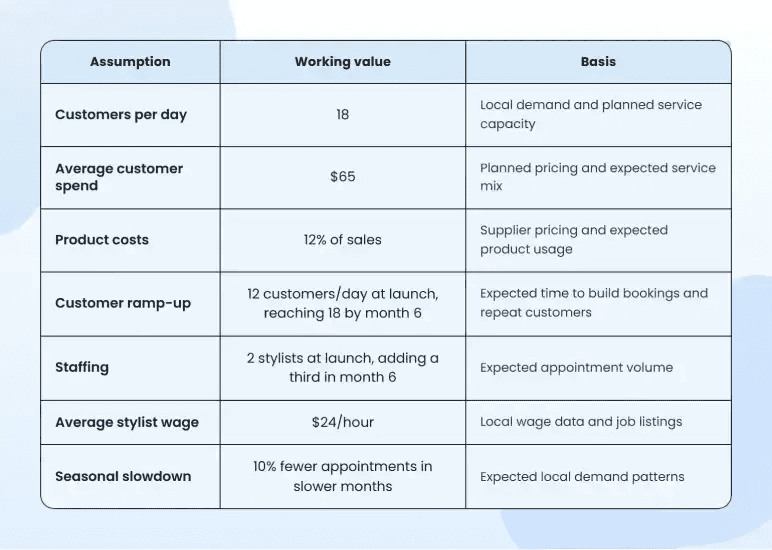
Keep the assumptions consistent throughout the plan. If you change an important assumption later, update any forecasts or sections that rely on it.
You also don’t need to document every small estimate. Focus on the assumptions that have the biggest effect on your sales, costs, operations, cash flow, or funding needs. And these are the numbers lenders or investors are most likely to look at, and the ones you’ll need to revisit as your business starts generating real results.
Conclusion
Business plan assumptions give you a reasonable starting point for the parts of your business you can’t know for sure yet.
The goal isn’t to get every number exactly right. It’s to make sure your important estimates have a sensible basis and can be updated as you learn more.
Once those assumptions are in place, use them to build your business plan and financial projections. This helps you see how your expected sales, costs, staffing, funding, and cash needs fit together and whether the business looks workable.
If you need help putting those pieces together, Upmetrics lets you build your business plan and financial forecasts in one place. You can work through the numbers behind your forecast and keep them connected to the rest of your plan. That way, you can easily update them as your assumptions change.
Build Better Plans With Realistic Assumptions
Use realistic assumptions to build a clear plan and prepare for future growth.

Frequently Asked Questions
Are business plan assumptions the same as financial projections?
What happens if an important assumption is wrong?
Can I use a range instead of one number for an assumption?
Should business plan assumptions be conservative or optimistic?
What if different sources give me different numbers?
Do lenders and investors look at business plan assumptions?

Vinay Kevadia
Vinay Kevadiya is the founder and CEO of Upmetrics, the #1 business planning software. His ultimate goal with Upmetrics is to revolutionize how entrepreneurs create, manage, and execute their business plans. He enjoys sharing his insights on business planning and other relevant topics through his articles and blog posts. Read more