


 Download Now: Free Business Plan Template
If you’re reading this, your credit score is probably not where you want it to be. Maybe it’s below 620. Maybe someone told you SBA lenders only accept borrowers with a 650+ score.
So now you’re wondering if applying is even worth it.
See, bad credit can make SBA loans harder to get, but it does not always mean you have no options. The real answer depends on the loan program, the lender, and how strong the rest of your application looks.
In this guide, I’ll explain which SBA loan options may work with bad credit, what credit score lenders usually expect, how to apply, how to improve your chances, and what other funding options to consider if an SBA loan does not work out.
Can you really get an SBA loan with bad credit?
Yes, you can apply for an SBA loan with bad credit. But getting approved is harder.
The SBA does not set a minimum personal credit score that applies to every loan program. Approval depends on the lender and a few other factors, such as:
- What type of business you run
- Who owns the business
- Where the business operates
- How you plan to use the loan
- Whether the business can repay it
- Whether you meet SBA eligibility requirements
That said, bad credit can change your options. Some lenders may reject low-credit applications quickly, while others may look at the full picture before deciding.
So the real question is not just whether you can apply. It is which SBA loan program fits your situation, which lender you choose, and whether your application gives them enough confidence to approve the loan.
What credit score do you need for an SBA loan?
As I said above, the SBA does not set a minimum personal credit score across all programs, so the requirement can vary by loan type and lender.
Most lenders still use personal credit as an early filter. Here’s a rough idea of what many SBA lenders may expect:
| SBA loan program | Program type | Typical personal credit score (FICO) |
| SBA 504 loan (CDC/504 loan) | Separate SBA loan program | 680+ |
| Standard SBA 7(a) loan | 7(a) subtype | 650-680+ |
| SBA Express loan | 7(a) subtype | 650-680+ |
| Export Express loan | 7(a) subtype | 650-680+ |
| CAPLines | 7(a) subtype | 650-680+ |
| International Trade loan | 7(a) subtype | 650-680+ |
| Export Working Capital Program | 7(a) subtype | 650-680+ |
| SBA 7(a) Small Loan | 7(a) subtype | Often around 650+ |
| SBA Microloan | Separate SBA loan program | Around 620+, sometimes lower depending on the lender |
| SBA Disaster loans | Disaster assistance program | No fixed score; credit history and ability to repay matter most |
These ranges refer to your personal credit score.
Why does bad credit hurt SBA approval?
I wouldn’t look at bad credit as just a low score. For an SBA lender, the bigger concern is what that score says about your ability to repay.
For example, a few old late payments may not hurt as much if you have paid on time since then. But recent missed payments, unpaid collections, high credit card balances, or a past loan default can make lenders more cautious.
That is because the lender is trying to answer one simple question: if you had trouble paying before, what proves you can handle this loan now?
So, the score matters. But the timing and status of the credit issue matter too. Older, resolved problems are easier to explain. Recent or unresolved problems make approval much harder.
Best SBA loan programs for bad credit
Here are 3 SBA loan options that make the most sense to check first if your credit score is low:
1. SBA microloans
| Factor | Details |
| Bad-credit fit | Usually the most flexible SBA-backed option |
| Typical credit expectation | Around 620+, but some microlenders may be more flexible |
| Loan amount | Up to $50,000 |
| Interest rate | Generally around 8% to 13% |
| Repayment term | Up to 7 years |
| Lenders | Nonprofit, community-based intermediary lenders |
| Best for | Startups, very small businesses, and borrowers who need a smaller loan |
| Can be used for | Working capital, inventory, supplies, furniture, fixtures, machinery, or equipment |
SBA Microloans are usually the first option I’d check if your credit score is low.
These loans are offered by nonprofit, community-based lenders, who may be more willing to look at your overall application instead of focusing only on your credit score. That can work in your favor if you have a solid business plan, a clear reason for the loan, and a realistic plan to repay it.
But don’t mistake flexibility for guaranteed approval. If your credit is weak, be ready to explain what caused it, what has changed since then, and why your business is in a good position to repay the loan today.
2. SBA 7(a) Small Loan
| Factor | Details |
| Bad-credit fit | Possible, but harder than Microloans |
| Typical credit expectation | Often around 650+ |
| Loan amount | Up to $350,000 |
| Interest rate | Negotiated with the lender, but cannot exceed SBA maximums |
| Repayment term | Usually up to 10 years for working capital or equipment; up to 25 years for real estate |
| Lenders | SBA-approved 7(a) lenders |
| Best for | Businesses that need more than a Microloan but still want a smaller SBA loan |
| Can be used for | Working capital, equipment, inventory, supplies, business expansion, debt refinancing, or ownership changes |
SBA 7(a) Small Loans may be worth checking if you need more than a Microloan can offer, but you are not ready for a larger standard 7(a) loan.
If you have bad credit, I’d look at this as the next step after a Microloan. A smaller loan request may improve your chances, but lenders will still look for a clear use of funds, enough cash flow to repay the loan, and no major unresolved credit problems.
Collateral may also come into play. For loans of $50,000 or less, the SBA doesn’t require collateral. For larger loans ($50,001 to $500,000), each lender follows its own collateral policy. However, a loan shouldn’t be denied just because you don’t have enough collateral.
Also, pay attention to the type of lender you approach. CA SBLCs are not a separate SBA loan program; they are mission-based SBA 7(a) lenders that focus on underserved small businesses. If your credit is weak and a traditional bank feels like a poor fit, these lenders may be worth checking when you explore 7(a) options.
3. SBA disaster loans
| Factor | Details |
| Bad-credit fit | Case-specific; only available after a declared disaster |
| Typical credit expectation | No fixed score; credit history and ability to repay matter most |
| Loan amount | Up to $2 million for eligible business physical damage or economic injury |
| Interest rate | Set by SBA for each disaster; lower rates may apply if you cannot get credit elsewhere |
| Repayment term | Up to 30 years |
| Lenders | SBA directly |
| Best for | Businesses affected by a declared disaster |
| Can be used for | Repairing or replacing damaged business property, equipment, inventory, and covering operating expenses after a disaster |
SBA disaster loans are different from regular SBA business loans. I would only look at this option if your business is in a declared disaster area and the funding need is directly tied to that disaster.
A low credit score doesn’t automatically disqualify you. The SBA will still review your credit history and your ability to repay the loan. They also want to see that the disaster caused the damage or financial loss and that your business can recover with the loan.
So, don’t think of an SBA Disaster Loan as a general option for bad credit. It’s only available if your business meets the SBA’s disaster eligibility requirements.
SBA loans may be harder with bad credit
Some SBA loans are still possible with weak credit, but they are usually not the best place to start.
These loans are either larger, faster to process, or tied to major purchases like real estate and equipment. That gives lenders less room to overlook recent credit problems.
Standard SBA 7(a) loans
- Typical credit expectation: Around 650 to 680+
Standard SBA 7(a) loans can go much higher than 7(a) Small Loans, so lenders usually expect a stronger borrower profile.
If your score is below 620, this is usually difficult unless the business already looks strong on paper. A Microloan or 7(a) Small Loan is usually a more realistic first step.
SBA Express loans
- Typical credit expectation: Around 650+
SBA Express loans move faster than regular 7(a) loans, but faster does not mean easier.
The lender has more control over the decision, so its own credit standards matter a lot. Do not treat SBA Express as a shortcut around bad credit. It may be faster for qualified borrowers, but it is not usually more forgiving.
SBA 504 loans
- Typical credit expectation: Around 680+
SBA 504 loans are mainly used for major fixed assets, such as real estate, buildings, land, improvements, or large equipment.
Because the project is bigger, the lender and CDC will look closely at whether the deal makes sense. If your credit is low, a 504 loan usually makes sense only when the business is already stable and the project clearly supports growth.
Now that you know which SBA loans may work with bad credit, let’s look at what can improve your chances of getting approved.
What can help you qualify despite bad credit?
When your credit score is low, lenders look for other signs that your business can still repay the loan. These are often called “compensating factors”.
The lower your credit score, the more the rest of your application needs to show that you’re a reliable borrower.
Here are some of the factors that can strengthen your application:
| What can help | Why it matters to the lender |
| Strong cash flow or debt service coverage | Shows the business may have enough money coming in to cover expenses and loan payments |
| Cleaner recent payment history | Shows the credit issue may be old, not an ongoing pattern |
| Smaller, specific loan request | A smaller request can feel less risky than a large, vague loan amount |
| Clear use of funds | Shows exactly what the loan will pay for and how it helps the business |
| Owner investment or down payment | Shows you have money at risk too, not just the lender |
| Collateral, if available | May reduce lender risk, but it does not cancel out bad credit |
| Industry experience or time in business | Shows you understand the business and are not starting from zero |
| Clear credit explanation | Helps the lender understand what happened, what changed, and why it is less likely to happen again |
| Repayment-focused business plan | Connects the loan amount, use of funds, revenue, cash flow, and repayment plan |
You don’t need to be strong in every area. But if your credit is weak, your cash flow, loan purpose, credit explanation, and repayment plan become much more important.
In some cases, a co-owner or guarantor with stronger credit, signed customer contracts, or unpaid invoices can also strengthen your application. Think of these as extra support, not a replacement for showing that your business can repay the loan.
How to apply for an SBA loan with bad credit
Applying with bad credit is not just about filling out forms. You need to choose the right loan, approach the right lender, and explain why your business can repay the money.
Step 1: Check your personal and business credit reports
Start by checking what the lender will see. You can get free weekly credit reports from Equifax, Experian, and TransUnion through AnnualCreditReport.com.
Look for recent missed payments, collections, charge-offs, high credit card balances, tax liens, judgments, or reporting errors. If something is incorrect, dispute it before applying. If it is accurate, be ready to explain what happened and what has changed.
If your business has its own credit history, check that too. A thin business credit file is common for newer businesses, but unpaid accounts or incorrect business details can create unnecessary problems.
Step 2: Match your loan need with the right SBA program and lender
Since we already covered the main SBA loan options above, use this step to match your situation with the right program and lender type.
Do not choose a loan only by the amount you want to borrow. Choose it by what the money will pay for and where you are most likely to get a fair review.
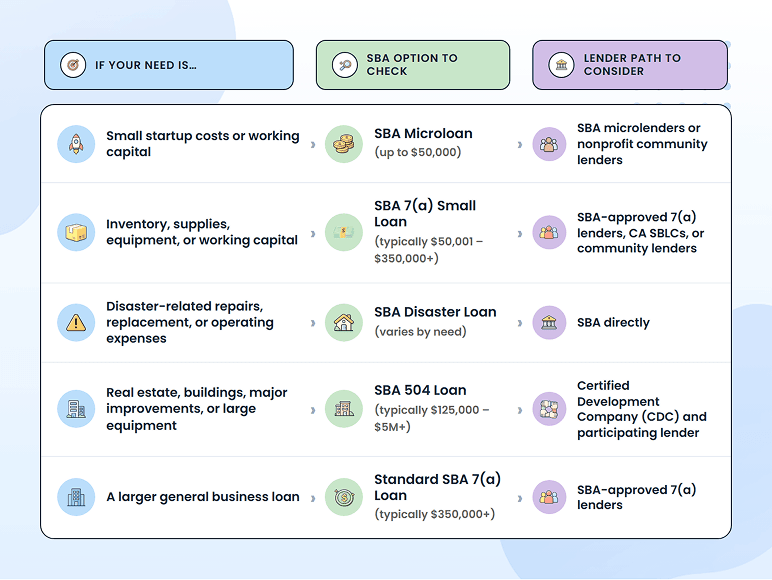
This matters more when your credit is weak. A specific loan purpose and the right lender path are easier to explain than a broad “I need funding” request sent to the wrong place.
Step 3: Prepare a short credit explanation
A low score is not the only problem. The bigger issue is leaving the lender to guess what caused it.
Write a short explanation before you apply. Focus on the credit issues that are most likely to raise questions, such as recent late payments, collections, charge-offs, high credit card balances, or a past default.
Your explanation should cover three things:
- What caused the issue
- Whether it has been paid, settled, corrected, or improved
- What has changed so the same problem is less likely to happen again
For example, “My score dropped after a medical bill went to collections in 2023. The account has since been paid, and all business and personal payments have been on time for the past 12 months.”
Keep it factual. A lender does not need a long story. They need to see that the issue is not still growing, still unpaid, or likely to affect your ability to repay the SBA loan.
Step 4: Build a repayment-focused business plan and forecast
With bad credit, your business plan has to do more than describe the business. It has to answer the lender’s biggest concern: “Can this business still repay the loan?”
Keep the plan focused on the loan decision. Show how much you are borrowing, where the money will go, and how that spending helps the business earn more, reduce costs, or stabilize cash flow.
Your forecast should prove the same point with numbers. Include expected sales, major expenses, existing debt payments, and the estimated SBA loan payment. The lender should be able to see whether there is enough cash left each month to cover the loan.
I would rather submit a simple, realistic plan than a long plan with perfect-looking numbers. If sales are seasonal, costs are rising, or the first few months will be tight, show that clearly. For a bad-credit application, believable numbers are more useful than optimistic ones.
Step 5: Gather your loan documents
Once your credit explanation, loan purpose, business plan, and forecast are ready, gather the documents that support your application.
The exact list depends on the SBA program and lender, but you may need:
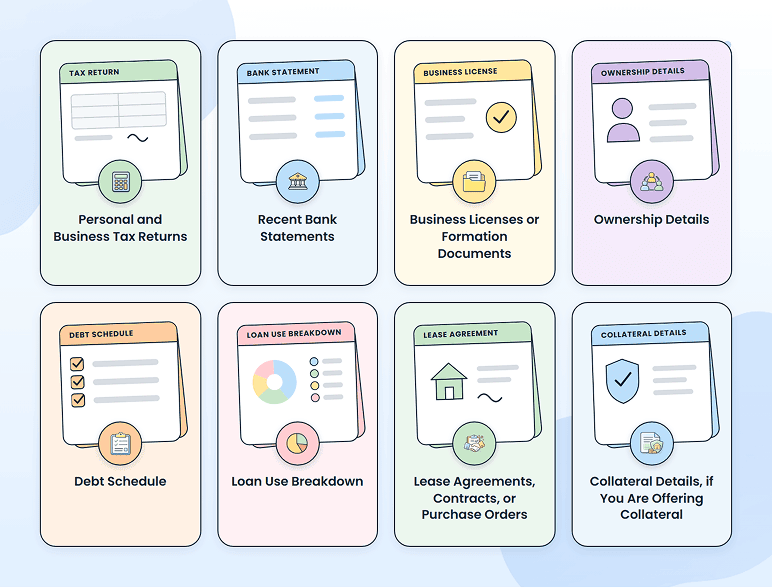
Do not treat documents as a last-minute task. Missing or messy records can slow down the review, and with bad credit, delays give the lender more reasons to question the file.
Step 6: Apply with the strongest-fit lender first
As explained in Step 2, choose the lender path that fits your loan type, credit situation, and funding need. Then apply with that lender first instead of sending the same application everywhere.
Once you choose the lender, follow their process. Some start with a short pre-screening form or phone call. Others may send you to an online application or document upload portal.
If the lender says your application is not a fit, ask for the reason before moving on. That feedback can help you fix the next application instead of repeating the same mistake.
If your SBA loan application gets rejected, do not treat it as the end. You still have other funding options while you improve your credit and strengthen the business.
Alternatives to SBA loans for bad credit
I’d compare alternatives by two things: whether they fit your funding needs and whether they are realistic with your credit.
| Alternative | Best for | Easier with bad credit? | Good idea when |
| CDFI or community lender loan | Local businesses, underserved founders, startups, and small operators | Yes | You want a more flexible lender than a bank |
| Non-SBA microloan | Small funding needs and early-stage businesses | Yes | You need a smaller loan amount |
| Equipment financing | Machinery, vehicles, kitchen equipment, tools, or other business assets | Sometimes | You are buying equipment the lender can finance |
| Invoice factoring | B2B businesses with unpaid customer invoices | Yes | Customers owe you money and you need cash sooner |
| Online business line of credit | Short-term cash flow gaps | Sometimes | You have steady revenue and can manage repayments |
| Business credit card or secured business card | Small purchases or rebuilding credit | Sometimes | You only need a small amount and can repay quickly |
| Crowdfunding or pre-sales | Product launches, local brands, creators, or consumer businesses | Yes | You can sell before borrowing |
| Merchant cash advance | Last-resort fast cash | Yes | You have strong card sales and no safer option |
Grants, local programs, and friends or family funding may also help in some cases. But I would not treat them as direct replacements for an SBA loan. Grants can be slow and competitive, and informal funding can create problems if repayment terms are not written down clearly.
Conclusion
Getting an SBA loan with bad credit is harder, but it’s not impossible.
A low credit score means the rest of your application needs to be stronger. Your business plan, cash flow, loan purpose, and explanation of your credit history all help show the lender that your business can repay the loan.
Start with the SBA loan program that best fits your situation, and make sure your application is complete and realistic. If you don’t qualify right now, you can improve your credit, strengthen your business, and apply again later.
If the process feels overwhelming, SBA loan assistance can help you prepare your documents, build a lender-ready business plan, and understand the questions lenders are likely to ask before you apply.
The goal isn’t just to apply. It’s to give the lender a strong reason to approve your loan.
Make Your Business Loan-Ready
Create accurate financial projections and a business plan for your next funding opportunity.

Frequently Asked Questions
Can I get an SBA loan with a 500 credit score?
What is the easiest SBA loan to get with bad credit?
How can I improve my bad credit before applying for an SBA loan?
Can I get an SBA loan after bankruptcy?
How does a low credit score affect interest rates and loan terms?
When should I apply, and when should I wait?
Will a business partner’s good credit help?
How long does each SBA loan program take?

Anthony Ray
Anthony Ray is an SBA Commercial Loan Officer specializing in commercial lending, financial analysis, and risk management. Over the years, he has helped business owners secure the financing they need to grow and succeed. Besides that, he shares practical insights on banking, loans, and financial strategies based on his industry experience. Read more