


Today, booking an Airbnb takes about a minute. Pick a city, compare a few places, message a host, done.
In 2008, the same idea sounded strange: pay to stay in a stranger’s home instead of a hotel.
Convincing investors of something that unfamiliar is hard, and this 14-slide deck is what the founders used to do it. It’s the real deck, not a polished recreation.
And it isn’t perfect. The problem slide is thin, the market math is weak, and there are almost no traction numbers. Yet the company eventually got funded with this basic story intact.
That’s what makes it worth studying. I want to look at what the deck gets right, what it gets wrong, and what founders can learn from both.
Want to see the original first? You can view or download the original Airbnb pitch deck PDF here before reading the breakdown.
About Airbnb (then vs. now)
When this deck was created, AirBed&Breakfast was barely a company.
It had a working product and a few listings, but almost no revenue. The team was still trying to prove that people would actually pay to stay in strangers’ homes.
Getting funding was difficult.
In June 2008, an introduction from Michael Seibel helped Brian Chesky, Joe Gebbia, and Nathan Blecharczyk meet seven investors. They were trying to raise $150,000 at a $1.5 million valuation. Five said no. Two never replied. (Source)
To keep the company alive, they famously repackaged cereal as “Obama O’s” and “Cap’n McCain’s” and sold it around the 2008 election. (Source)
Things finally started to turn around in early 2009.
The founders got into Y Combinator for $20,000 in early 2009. By that April, a seed round led by Sequoia had raised around $600,000, the round this deck is best known for.
The contrast with today is hard to picture. In early 2009, Airbnb was making roughly $200 a week. By 2025, it reported $12.2 billion in annual revenue, with more than 8 million active listings and over 5 million hosts across 220-plus countries.
And the growth continued into 2026, with Airbnb reporting $2.68 billion in revenue in the first quarter alone, up 18% year over year.
Airbnb pitch deck: slide-by-slide analysis
Let’s go through all 14 slides and look at what each one was trying to communicate.
1) Slide 1: Welcome
The cover does more than show the company name.
It opens with: “Book rooms with locals, rather than hotels.”
I like this because it immediately gives investors something familiar to compare the business with.
Before the founders explain anything else, you already understand the basic idea and what they’re trying to replace.
Takeaway: Use your opening slide to make the business easy to understand, not just to show your logo.
2) Slide 2: Problem
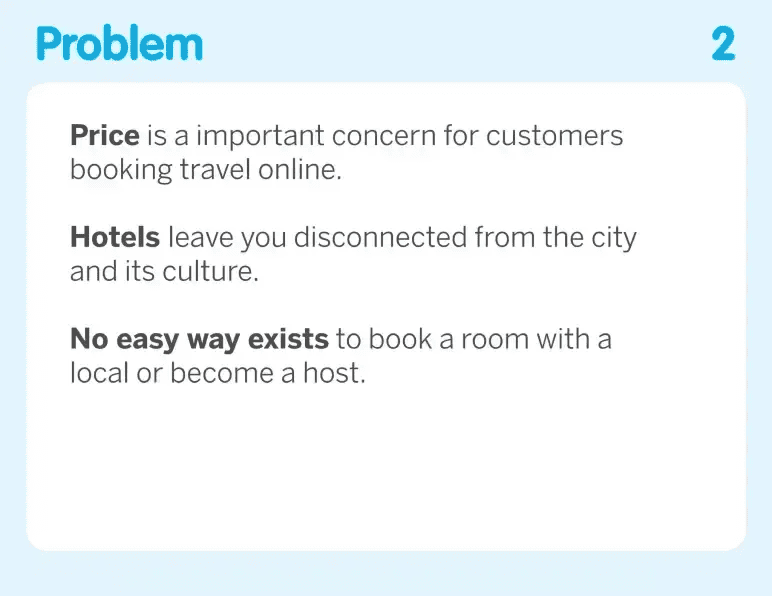
The problem slide makes three points. There are no statistics, surveys, or cost comparisons.
By today’s standards, I’d call this a fairly weak problem slide.
It works better because the founders soon show that they’ve already built the product. For a founder with only an idea and no proof, this slide would be much harder to defend.
Takeaway: If your problem slide is light on evidence, you need stronger proof somewhere else in the deck.
3) Slide 3: Solution
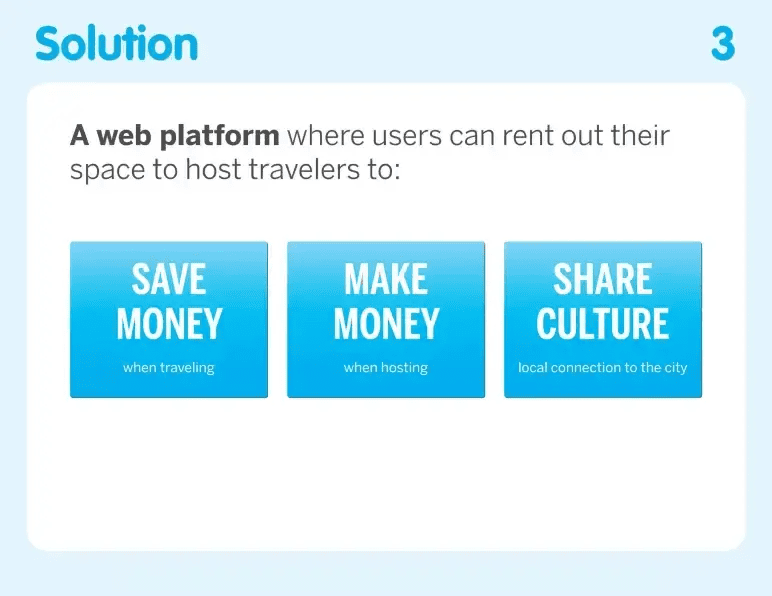
The solution is explained through three simple ideas:
- Save Money
- Make Money
- Share Culture
This works especially well because AirBed&Breakfast is a two-sided marketplace. Travelers need a reason to book. Hosts need a reason to list.
Instead of explaining those two sides separately, the founders show the value to both on one slide. I still see marketplace startups overcomplicate this today.
Takeaway: If your business serves two sides of a marketplace, show the value to both clearly and together.
4) Slide 4: Market Validation
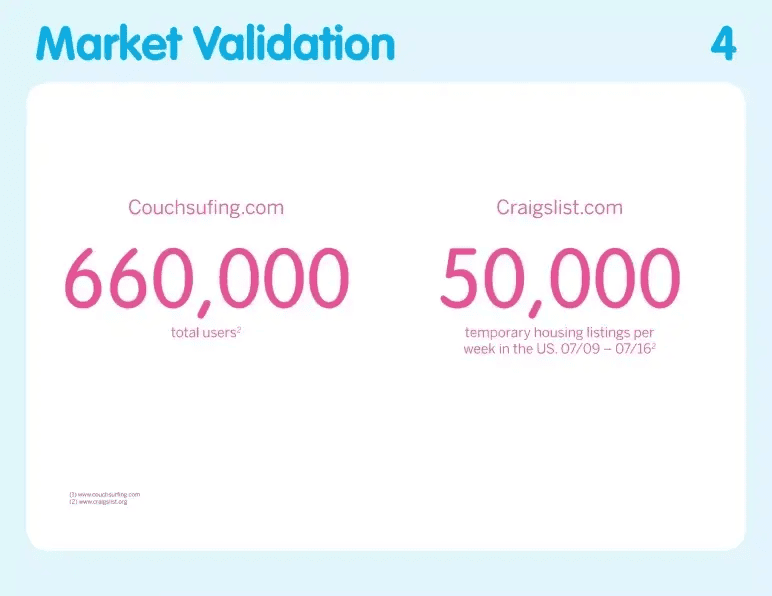
AirBed&Breakfast didn’t have much traction of its own yet, so the founders used evidence from similar behavior.
They pointed to:
- 660,000 Couchsurfing users
- Around 50,000 temporary-housing listings on Craigslist each week
These numbers don’t prove that people would pay for AirBed&Breakfast.
But they do show that people were already comfortable finding places to stay through strangers online. That makes the idea feel less risky.
Takeaway: If you don’t have traction yet, show that customers already have the problem or behavior your idea is built around.
Ditch your old-school pitch deck creation methods
Make compelling pitch decks in minutes with AI
Plans starting from $14/month

5) Slide 5: Market Size
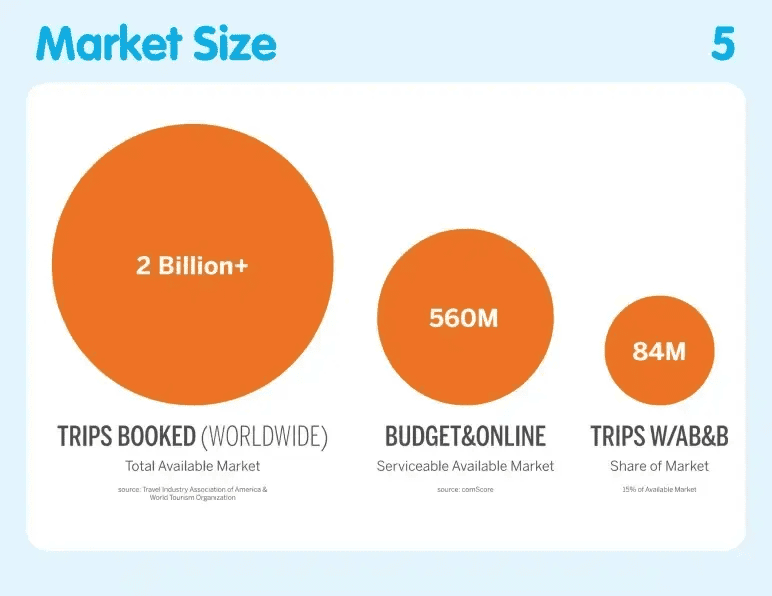
This is where I’d push back.
The slide starts with a market of 2 billion trips, narrows it to 560 million “budget and online” trips, then says AirBed&Breakfast could capture 84 million trips.
That works out to 15% of the market. The problem is that the deck never explains why 15% is realistic.
To me, that’s not really market sizing. It’s a future market-share assumption. And that assumption matters because it also feeds into the revenue projection later in the deck.
Takeaway: Use your market-size slide to show the opportunity, not market share you haven’t earned yet.
6) Slide 6: Product
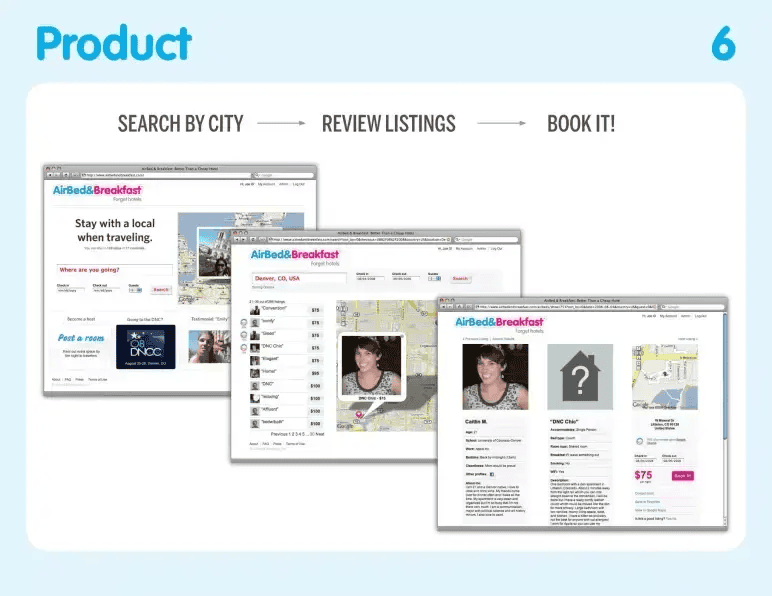
For me, this is the strongest slide in the deck.
Instead of describing the product, the founders show three real screenshots:
- Search by city
- Review listings
- Book a place
One screenshot is dated August 2008 and promotes accommodation around the Democratic National Convention in Denver. That one detail says a lot.
The product is real. It’s live. And the founders are already testing a specific way to attract customers. That is far more convincing than simply saying the product is ready.
Takeaway: Showing a working product is usually stronger than describing what it does.
7) Slide 7: Business Model
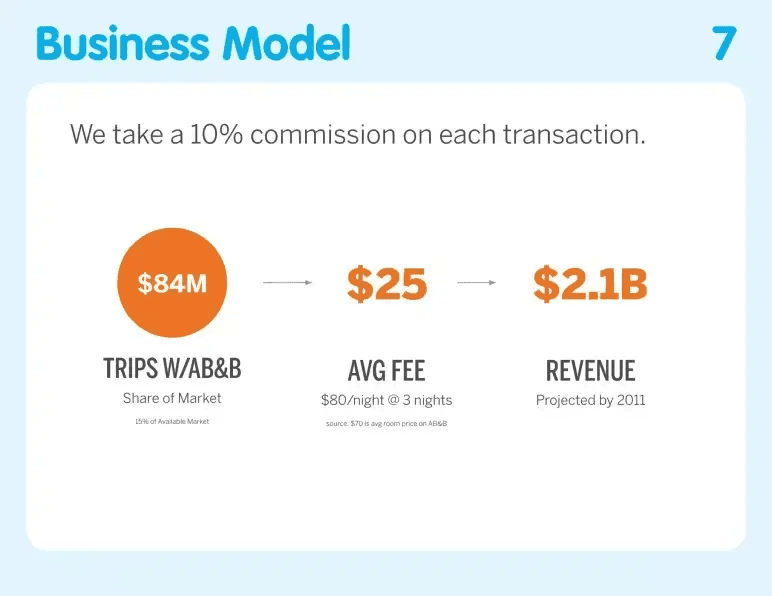
The business model is simple: AirBed&Breakfast takes a 10% commission on each booking. The problem comes with the revenue projection.
The founders take the 84 million trips from the market-size slide and multiply them by an average $25 fee.
That gives them a projection of $2.1 billion in revenue by 2011. The math works.
The assumption behind it is the issue. Airbnb eventually crossed $2.1 billion in annual revenue, but not until 2017.
Takeaway: A formula can be correct, and the forecast can still be weak if the assumptions behind it aren’t realistic.
8) Slide 8: Adoption Strategy
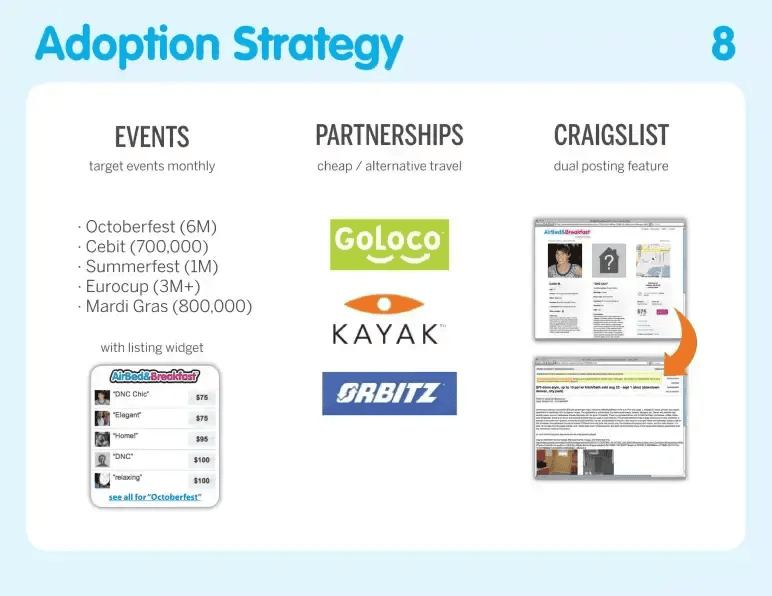
This slide becomes much more specific.
The founders name events such as Oktoberfest, CeBIT, and Mardi Gras. They also mention possible partners such as Kayak, Orbitz, and GoLoco. Another idea was “dual posting,” which would let hosts cross-list their properties on Craigslist.
A version of that later became part of Airbnb’s well-known Craigslist growth strategy.
What I like here is the level of detail. The slide doesn’t just say “partnerships” or “social media.” It shows where customers might actually come from.
Takeaway: Your go-to-market slide should show real customer-acquisition opportunities, not broad marketing terms.
(It’s worth noting what happened with that “dual posting” idea. It later became part of Airbnb’s well-known Craigslist strategy, where hosts could cross-post listings to Craigslist and bring users back to Airbnb, until Craigslist eventually shut it down. The broader lesson is still useful: find where your target users already spend time and make it easier for them to discover your product there.)
9) Slide 9: Competition
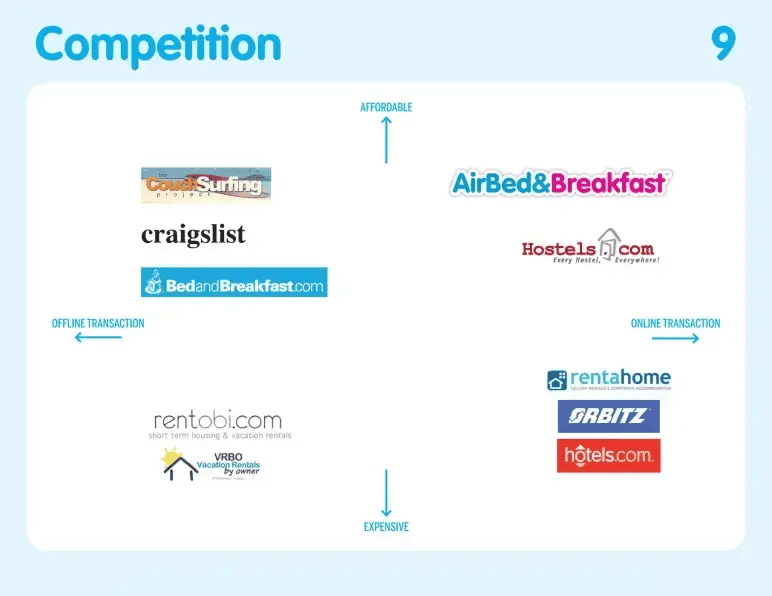
The competition slide uses a simple 2×2 grid.
The two factors are:
- Affordable vs. expensive
- Offline vs. online
AirBed&Breakfast appears alongside Hostels.com, while Craigslist, Couchsurfing, Orbitz, and Hotels.com appear in the other parts of the grid.
It’s simple, but I like that the founders don’t pretend there’s no competition. That’s more believable than saying your business has no real alternatives.
Takeaway: Naming your competitors usually builds more trust than pretending you don’t have any.
10) Slide 10: Competitive Advantages
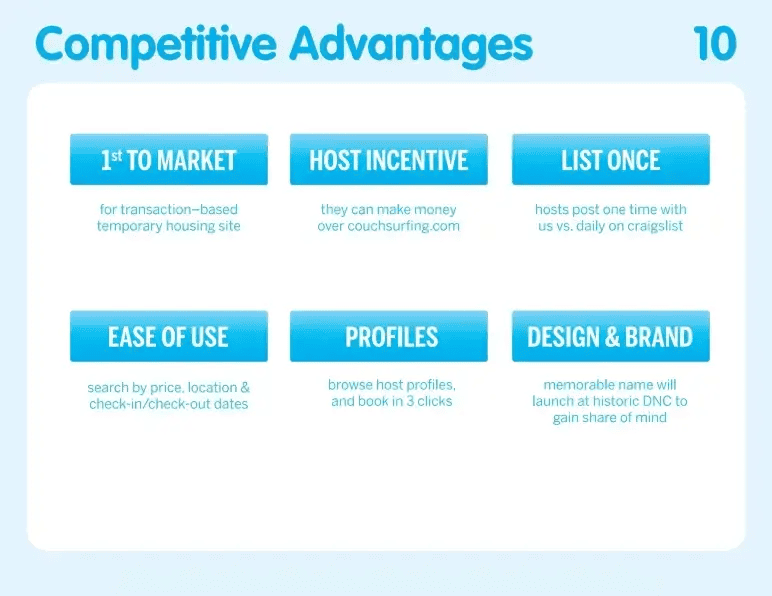
The slide lists six advantages, but “List once” stands out most to me.
At the time, someone using Craigslist might need to keep reposting a listing. AirBed&Breakfast gave hosts a simpler option: list once and keep the property available.
That’s a clear improvement users can understand immediately. It’s much stronger than vague claims such as “better experience” or “easier platform.”
Takeaway: Strong competitive advantages should solve specific customer problems.
11) Slide 11: Team
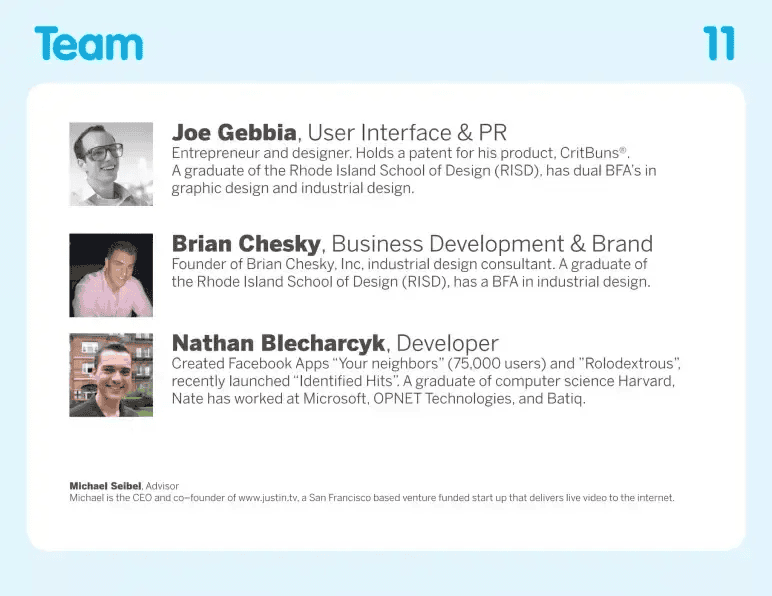
The founding team was unusual.
Brian Chesky and Joe Gebbia were industrial designers from RISD. Nathan Blecharczyk was a Harvard-trained engineer who had been building software businesses since his high school years.
There was no dedicated salesperson and no MBA on the founding team. But between the three founders, they covered design, product, engineering, branding, and business development.
At this stage, that matters more than perfect job titles.
The slide also includes Michael Seibel of Justin.tv, the same person whose introductions helped the founders reach investors that summer.
Takeaway: For an early-stage startup, show that the team has the right skills to build and grow the business.
12) Slide 12: Press
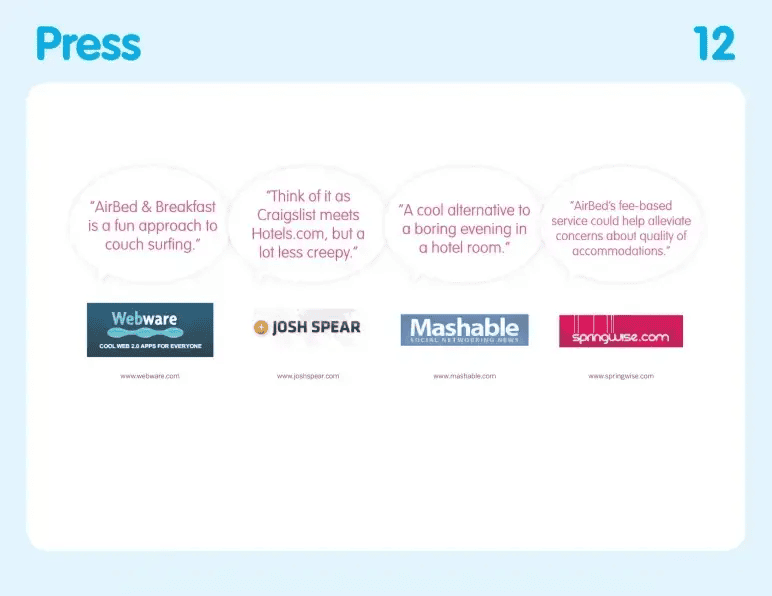
The slide includes quotes from Webware, Josh Spear, Mashable, and Springwise.
Most describe the business in a similar way, including the memorable line: “Craigslist meets Hotels.com, but a lot less creepy.”
I don’t think that repetition is accidental. The same basic positioning shows up across several slides.
So even if an investor skims the deck quickly, they’re still likely to remember what the business does.
Takeaway: Keep your positioning consistent across the deck so the main idea sticks.
13) Slide 13: User Testimonials
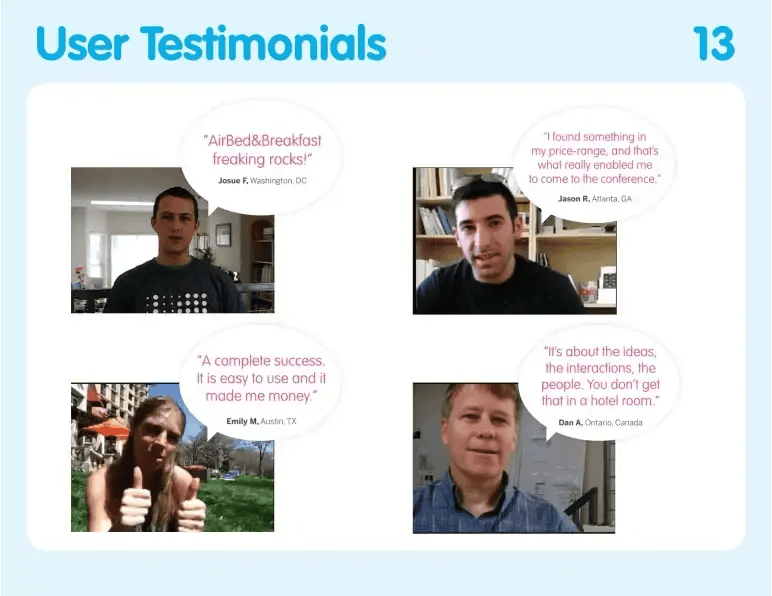
The founders include four real users with names, cities, photos, and short comments about their experience. These aren’t strong traction metrics.
But at this stage, real people saying they used the product and got value from it still matters. It gives investors at least some evidence that the idea works in practice.
Takeaway: If you don’t have strong traction numbers yet, real customer testimonials can still provide useful proof.
14) Slide 14: Financial
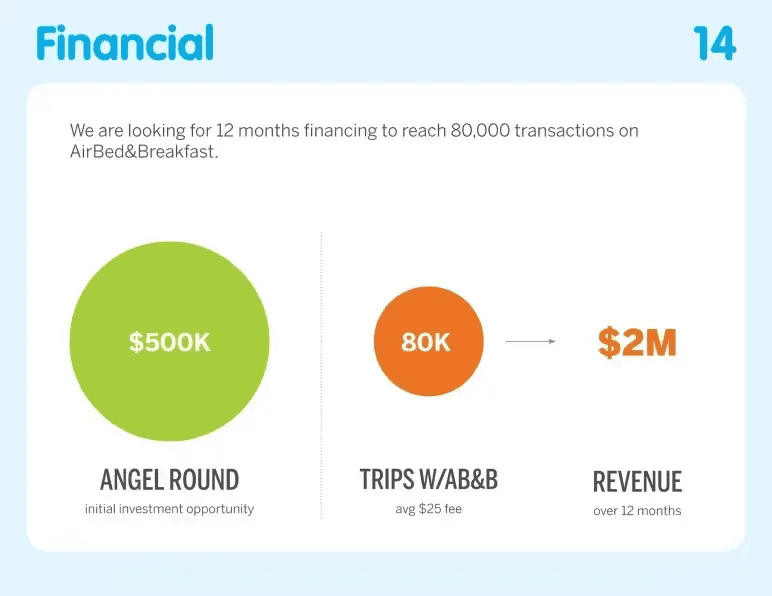
The final slide asks for $500,000, although Airbnb’s seed round ultimately closed higher, at around $600,000.
The founders say that funding could help them reach 80,000 transactions within 12 months.
Using the same $25 average fee:
80,000 transactions × $25 = $2 million in revenue
I find this much more believable than the $2.1 billion projection from slide 7.
The fee assumption is the same. The difference is the scale. This target is tied to a specific amount of funding and a 12-month goal.
Takeaway: Connect your funding ask to realistic milestones investors can understand.
Looking across all 14 slides, the deck’s strength isn’t any one page. It’s that the same simple idea, an affordable and local alternative to hotels, gets reinforced from every angle, even as individual slides lean on thin evidence to do it. That combination, a clear story riding on shaky proof, is worth unpacking before you borrow anything from it.
What I like most about this pitch deck
Read as a whole, a few things stand out that explain why this deck worked despite its gaps.
- It reduces risk instead of selling upside. The market-validation slide, the live product screenshot, and the user testimonials are all doing the same quiet job: showing that people already behave this way, so the founders aren’t asking investors to bet on a behavior that doesn’t exist yet. When you have no revenue, lowering perceived risk does more than promising a big number.
- Every claim is anchored to something concrete. “List once” beats “easier to use” because a host feels the difference immediately. A dated DNC screenshot beats “our product is live” because you can see it. Specifics are harder to argue with than adjectives.
- The ask is disciplined. The $500,000 request is tied to 80,000 transactions in 12 months, so an investor can judge whether the money buys a real milestone. That restraint reads as more credible than the $2.1 billion dream two slides earlier.
If you take one thing into your own deck, make it this: prove the behavior your business depends on already exists, then attach every claim and every number to something a reader can check.
Conclusion
Airbnb’s original deck is worth studying because it shows both sides of what a pitch has to do. Walking through the fourteen slides, you can see how clearly the founders explained an idea most people found strange, and also where the deck reached past what it could prove, especially on market size and revenue.
That’s the balance every founder has to strike. A clear story gets an investor to understand you, but the evidence underneath is what gets you the check. This deck nailed the first and gambled on the second, and it’s a useful reminder to do both.
If you’re building your own deck, Upmetrics’ AI pitch deck generator can help you create an investor-ready pitch deck in minutes, with the right structure in place and the flexibility to edit every slide as you go.
Turn Your Story Into a Powerful Pitch
Create an investor-ready pitch deck that brings your business vision to life.

Frequently Asked Questions
Can I use the Airbnb pitch deck template for my own startup?
What can founders learn from a pitch deck that investors mostly rejected?
Is the Airbnb pitch deck good by today's standards?
More pitch decks, broken down
See all 26



Vinay Kevadia
Vinay Kevadiya is the founder and CEO of Upmetrics, the #1 business planning software. His ultimate goal with Upmetrics is to revolutionize how entrepreneurs create, manage, and execute their business plans. He enjoys sharing his insights on business planning and other relevant topics through his articles and blog posts. Read more