


 Download Now: Free Investor Pitch Templates
You might have a product, early customers, some revenue, or even a pitch deck ready. But when it’s time to approach investors, the questions start piling up:
Is the business ready for funding? Is there enough demand for this business? Can the business grow beyond its current stage? And what will investors want to see before they take it seriously?
I’ve seen many first-time business owners get stuck at this stage. Not because the idea is weak. But because they don’t really know how investors evaluate opportunities, or what separates a good idea from a fundable one.
In this guide, I’ll show you what investors look for, what earns their confidence, and how to improve your chances of getting funded.
What to know before pitching investors?
Many people spend weeks on their pitch deck before answering this simple question: Am I even pitching the right type of investor?
It matters because different funding sources look for completely different things:
- Angel investors (often called angels) may be willing to take a chance on an early-stage business owner with a strong vision and a few signs that customers are interested.
- A venture capitalist is usually looking for a business that can grow much bigger and much faster to justify their fund math.
- Banks and lenders (not investors in the traditional sense) care less about growth. But they want confidence that the loan can be repaid.
That means the same business can get different responses depending on who’s reviewing it.
A VC might pass because the market opportunity isn’t large enough. An angel may see strong potential in the same conversation. A bank might reject a startup with no revenue but approve an established company with steady cash flow.
That’s why a rejection doesn’t always mean your business isn’t worth funding. Sometimes it simply means you’re talking to the wrong audience.
Before you spend more time tweaking your pitch deck, take a step back and think about who you’re trying to raise money from. The better the match between your business and the funding source, the easier it becomes to get meaningful conversations.
Once you’re clear on who you’re pitching, the next challenge is to prove why your business is worth their time, attention, and capital.
10 Steps to convince investors to invest in your business idea
Here are the 10 steps that will help you make a stronger investment case for your business. Not all of them will apply to you at the same time. So use the ones that match where you are right now.
1. Find investors who match your business
If you’ve already identified the right type of investor, it’s easier to narrow your list to the ones that fit your business.
Most investors won’t be a right fit for your business, and that’s normal. They specialize. Some only fund specific industries. Some only back certain business models. Some only invest in particular geographies or stages.
So doing proper research before you reach out is what separates a focused process from a frustrating one.
Start with their track record. Have they backed businesses that look like yours? Do they fund companies at your stage? Are they writing checks in the size you’re looking to raise?
Take one example. Say you’re raising your first round for a software startup. A VC firm that mainly backs growth-stage healthcare companies isn’t the right fit. No matter how good your pitch is. But if you run a local service business, angel investors or small-business lenders are usually a better fit than a VC firm.
So the goal isn’t to pitch as many investors as you can. It’s to focus on the ones who already have some reason to care about what you’re building.
The more closely an investor’s interests align with your business, the better your chances of getting a serious conversation.
2. Build an investor-ready pitch deck
Once you’ve identified the right investors, the next step is giving them a quick way to understand your business.
In many cases, your pitch deck is the first thing investors will see. Before they schedule a meeting or ask deeper questions, they’ll skim it to decide whether the opportunity is worth exploring further.
A strong pitch deck covers the basics in 10 to 15 slides:
- The problem
- Your solution
- Target market
- Business model
- Traction
- Team
- Financial outlook
- Funding ask
The mistake a lot of business owners make is trying to fit everything into the deck. Investors don’t need every detail upfront. They need to quickly understand what your business does, who it’s for, and why it has a chance to succeed.
Your pitch deck gets you the meeting. Your business plan wins what comes after. Once an investor is interested, they’ll ask for the full plan, the financial model, the market research, and your assumptions. Have all of that ready before you start pitching, not after.
If you need help building a pitch deck and business plan that tells one consistent story, use tools like Upmetrics. It lets you keep your plan, financial projections, and pitch in one place. So you can walk into investor conversations confidently.

3. Tell a simple story
Investors hear hundreds of pitches every year. But most of them start to sound the same. That includes features, products, revenue, and market size without ever explaining why the business exists in the first place.
A small coffee roaster owner I worked with had this exact problem. The original version of their pitch was: “We sell specialty coffee online and through local cafés.” True, but that’s easy to forget. And they didn’t get the meeting.
But here’s how they rewrote it for the next conversation:
“Every café in our city was buying coffee through the same two importers. We flew to Guatemala two years ago and started sourcing direct from one farm. Café owners noticed the difference and asked us to wholesale to them. We’re in 14 shops now, with 12 more waiting.”
Same coffee. Same revenue. Same market. The second one got a yes. The point is to give investors a clear thread to follow from the problem to the outcome.
The first version is just about facts. The second one walks them through a problem, an unexpected move, a response from real customers, and where things stand now.
That’s what investors remember after the meeting.
4. Be the founder that investors want to back
A strong business idea helps, but investors will also pay attention to who’s leading it.
You don’t need a perfect resume or a track record of building successful businesses. What counts is having a clear reason you understand this problem better than others.
Maybe you’ve worked in the industry for years. Maybe you’ve experienced the problem firsthand, or spent enough time talking with customers to understand what they actually struggle with.
Investors hear that depth in the first few minutes of the conversation. So how you handle hard questions makes a difference. Nobody expects you to know everything. But honest answers, clear thinking, and a realistic understanding of your business all build confidence.
And most importantly, adaptability matters. That’s because businesses rarely go exactly to plan.
Customers behave differently from what was assumed. Marketing channels stop working. Competitors respond. Markets shift. How you handle those situations often helps build trust with investors.
5. Show what gives you an edge
Most businesses don’t succeed simply because they had the idea first. They succeed because they have something that makes it harder for competitors to catch up.
If the opportunity looks attractive, competition is inevitable. The real challenge is having a reason customers choose you over the alternatives.
Your edge is whatever makes that advantage difficult to copy. It could be:
- Years of industry experience
- Strong customer relationships
- An exclusive partnership or supplier deal
- A unique product or process
- Access to a specific audience/distribution channel
- Proprietary data or technology
- Being early to a growing trend
For example, take two companies selling similar products. One has direct supply partnerships with three major distributors that took years to build. The other doesn’t. Both products may be good, but only one of them has something a well-funded competitor would struggle to copy overnight. That’s an edge.
Where small business owners stumble is in reaching for generic answers. “Better service.” “Higher quality.” “We care more.” Every competitor in the room says the same thing.
Focus on the specific reasons customers would choose you, and keep choosing you, as the business grows. The goal isn’t to prove you have no competition. It’s to show why your business has a stronger chance of winning in that market.
6. Demonstrate how your business can scale
A business can be good and still not be investable if it has nowhere obvious to grow.
Investors are looking for a clear path that shows where the business is now and where it could go next. That might include reaching a new customer segment, opening another location, expanding into a new market, adding a higher-margin service, or improving profit margins as sales increase.
The point is not to claim the business will become huge. It’s to show that there is a realistic way to grow beyond the current stage.
A stronger way to explain scale is to focus on the next move. For example:
If demand is already coming from one customer segment, can you reach a second segment? If one sales channel is working, can you repeat it in another market? If operations are manual today, what changes as the business grows?
The more clearly you can explain the next stage of growth, the easier it becomes for investors to see a larger opportunity behind the business.
7. Prove there’s real demand
Investors don’t want demand to exist only in your assumptions. They want evidence that customers are interested, engaged, or willing to pay. This is often referred to as traction.
You don’t need thousands of customers or years of sales history to show traction. Depending on your stage, it can be waitlists, demo requests, pre-orders, pilot users, signed letters of intent, first sales, repeat purchases, referrals, or renewals. Each one gives investors more confidence that demand is real.
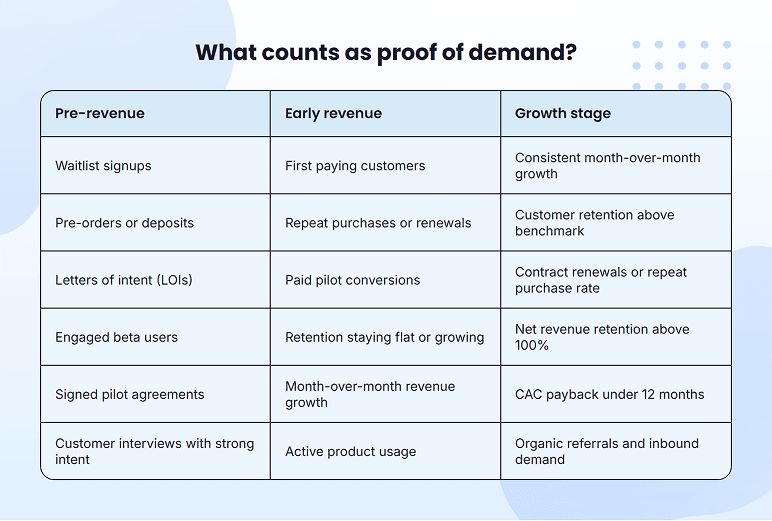
What matters is behavior, not opinions. A customer saying “I like this idea” is useful. A customer joining a waitlist, paying a deposit, signing a pilot, or coming back for a second purchase is much stronger.
You don’t need massive traction to start investor conversations. But you do need something more convincing than “people told me they like the idea.” The focus is usually on people taking real action around what you’re building.
8. Be honest about risks and challenges
Every business has risks. Investors know that before they ever take the meeting.
What makes them uncomfortable isn’t the risk itself. It’s when the person running the business avoids talking about it, or worse, pretends it doesn’t exist.
In fact, a real concern is whether you’ve thought through the biggest challenges and prepared a realistic plan for handling them.
Here’s the smarter move: know your weak spots before they ask. Maybe customer acquisition is unpredictable right now. Maybe the team has a real gap. Maybe one supplier holds too much control. You probably already know which of these applies to you, even if you haven’t said it out loud.
When the question comes, just say it. Investors don’t need perfect answers, and they don’t expect you to have solved every problem. They want to know you’ve really looked at them.
If you pretend nothing can go wrong, you’ll probably walk out empty-handed. An honest answer builds more confidence than an optimistic one.
9. Present realistic financial projections
Investors don’t expect your financial projections to be perfectly accurate. But they do expect them to be realistic, logical, and tied to clear assumptions.
Many business owners get this wrong in one of two directions. Some present aggressive forecasts that are hard to believe. Others underestimate what the business can realistically achieve.
What investors are really checking is whether the assumptions behind your numbers hold up under questioning.
If you’re forecasting strong growth, can you explain where those customers will come from? If you’re planning to hire, does the timing match where the business will be? If expenses increase, can you clearly explain why?
The strongest projections connect back to the rest of your pitch. Your pricing, customer growth, hiring plans, and operating costs should all line up with the numbers you’re presenting. If anything contradicts what you said earlier, that’s what investors will catch.
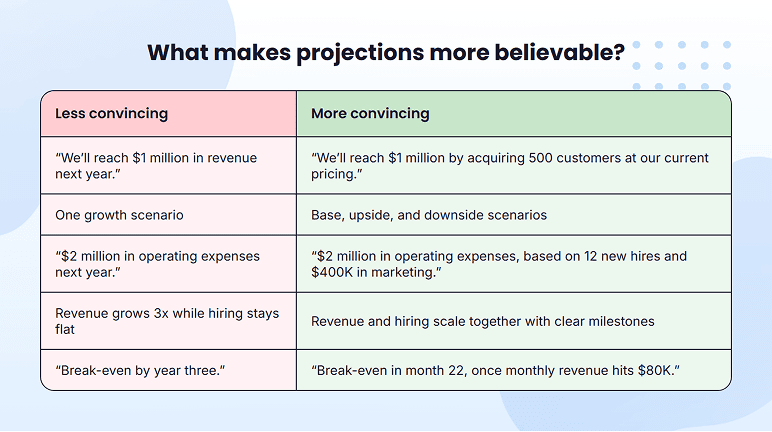
From my experience, investors aren’t looking for the biggest numbers. They’re looking for numbers that are grounded in reality and that you can confidently explain when the questions start coming.
10. Have a clear funding ask
The most important number in your pitch is the one you’re asking for. A vague ask usually gets a vague response.
One mistake many business owners make is choosing a funding amount without clearly explaining how they arrived at it. Investors want to know why that number makes sense and what it will help the business accomplish.
The amount you’re raising should be tied to a clear plan. How much do you need? How long will it last? And what will it help you achieve?
Investors aren’t investing in the number itself. They’re investing in what that money allows the business to do.
A stronger ask sounds like:
“We’re raising $500,000 to cover 18 months of inventory, hiring, and marketing as we open our second location. By the end of that period, the goal is to have both locations operating profitably.”
That’s much more convincing than simply saying:
“We’re raising $500,000.”
Avoid broad funding ranges whenever possible. A request for “$1 million to $3 million” often creates more questions than answers. A specific ask usually shows more preparation and confidence.
Conclusion
Convincing investors gets easier when your pitch is clear. They should quickly understand what you’re building, who needs it, how it can grow, and what their money will help you achieve.
Not every investor will say yes. Sometimes the investor is not the right fit. Sometimes your numbers need work. Sometimes the pitch needs stronger proof. But a “no” is not always a dead end. It can also be free feedback for your next pitch.
Use those conversations to improve. Tighten the parts that felt unclear, strengthen your assumptions, and keep building proof around the business. The more prepared you become, the easier it is for the right investor to take the opportunity seriously.
Before you start those conversations, keep your pitch deck, business plan, and financial forecast consistent. A planning tool can help keep your slides and numbers organized.
Build Your Business Plan for Investors
Build your plan and present your business with confidence.

Frequently Asked Questions
How long does it take to convince an investor to invest?
Can I get investors without a business plan?
Why do investors reject good business ideas?
What are the common mistakes that turn investors away?

Vinay Kevadia
Vinay Kevadiya is the founder and CEO of Upmetrics, the #1 business planning software. His ultimate goal with Upmetrics is to revolutionize how entrepreneurs create, manage, and execute their business plans. He enjoys sharing his insights on business planning and other relevant topics through his articles and blog posts. Read more