


You may see cash going up in one section and down in another, but still not know whether that is normal, whether the business is doing well, or whether something needs attention.
The good news is that you do not need to understand accounting in depth to read it properly. You just need to know what each part is showing and how the numbers connect.
In this guide, I’ll show you how to read a cash flow statement step by step, using a simple example to make each part easier to understand.
What is a cash flow statement?
A cash flow statement shows where cash came from and where it went during a specific period, such as a month, quarter, or year.
It is usually split into three parts:
| Section | What it shows |
| Operating activities | Cash connected to the day-to-day business, such as money collected from customers and cash paid for regular business expenses. |
| Investing activities | Cash used to buy or received from selling long-term assets, such as equipment, vehicles, or property. |
| Financing activities | Cash related to loans and owner funding, such as taking out a loan, repaying one, or putting more money into the business. |
Together, these three sections explain why your cash balance went up or down during the period.
If these three sections still sound confusing, don’t worry. In the next section, I’ll use a simple small-business cash flow statement and show you how to read each part, one step at a time.
How to read a cash flow statement step by step
A cash flow statement becomes much easier to read once you stop treating it like a list of unrelated numbers.
The real job is to answer one question: why did the cash balance change?
Let’s work through a simple example.
Assume Northstar Cleaning Co. had a profitable year. During the year, it bought new equipment, took out a small business loan, and ended with some customer invoices still unpaid.
Its cash flow statement looks like this:
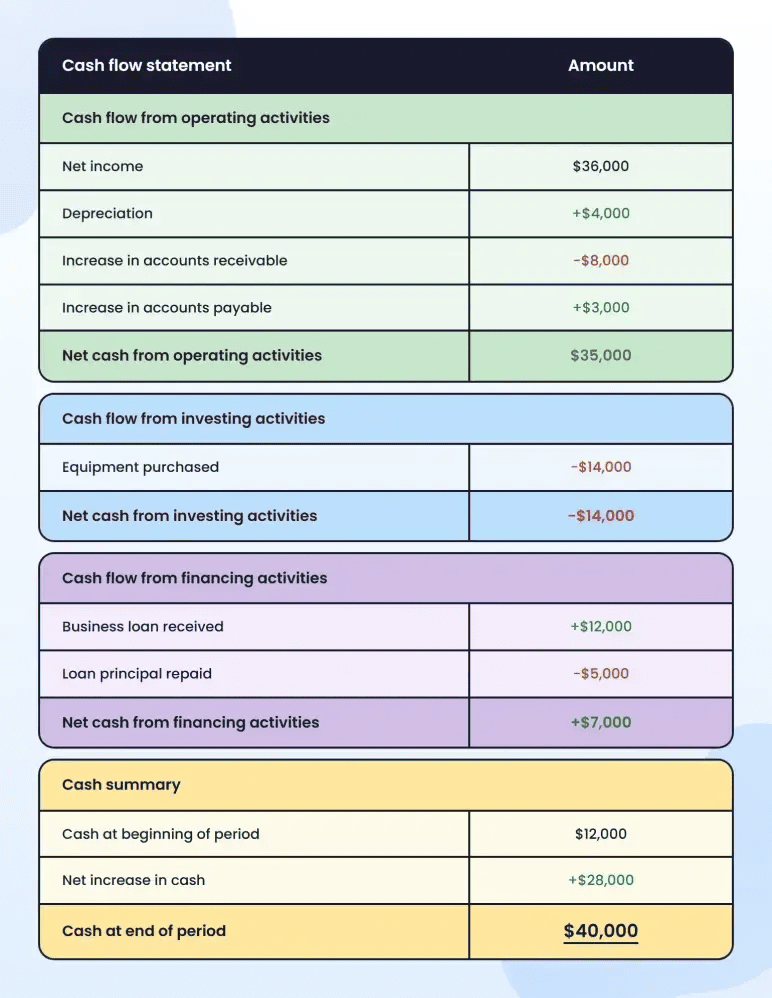
If your statement looks more complicated, that is normal. Yours may have more lines, different labels, or several years shown side by side. Start with one period first. Once you understand that column, you can compare it with the others.
I’ll repeat the part we are reading in each step, so you do not need to keep scrolling back to this table.
Now let’s read Northstar’s statement in the same order I would read yours.
1. Start at the bottom: Did cash go up or down?
Before looking at operating, investing, or financing activities, find the beginning and ending cash balances.
For Northstar:
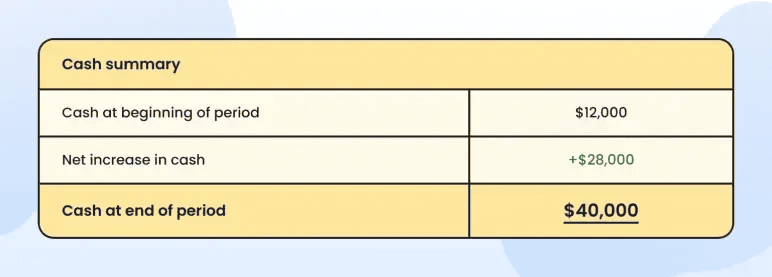
Northstar started with $12,000 and ended with $40,000.
So cash increased by $28,000.
That gives us the first piece of the story, but not the whole story.
We still do not know where that extra $28,000 came from.
Did customers generate it? Did Northstar borrow it? Did it sell something? Or did several things happen at once?
That is what the three sections above are going to tell us.
On your own statement, do the same thing first:
Find beginning cash → find ending cash → work out whether cash increased or decreased.
Then move up to the operating section.
2. Check how much cash the actual business generated
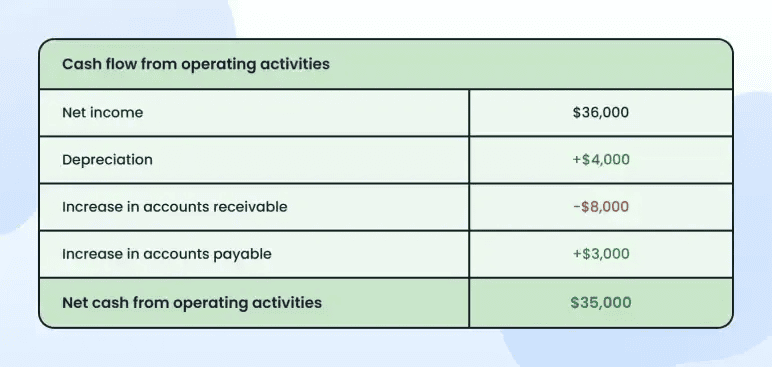
Here is Northstar’s operating section:
Start with the bottom line:
Net cash from operating activities: +$35,000
This means Northstar’s normal business activities generated $35,000 in cash during the year.
For a small business owner, this is one of the most useful numbers on the statement because it helps answer: is the business itself bringing in cash from normal operations?
Now look at the number above it.
Northstar reported $36,000 in net income, but only generated $35,000 in operating cash.
Why are they different?
Because profit and cash do not always move at the same time.
The three lines in between explain what happened.
Depreciation added $4,000 back
Northstar shows:
Depreciation: +$4,000
Depreciation reduced the profit shown on the P&L, but Northstar did not actually pay $4,000 in cash for depreciation during this year.
That is why it gets added back.
You do not need to know the accounting behind depreciation to read the statement. Just remember:
This is an adjustment to profit, not another $4,000 coming into the bank account.
Accounts receivable reduced cash by $8,000
Northstar also shows:
Increase in accounts receivable: -$8,000
Accounts receivable is money customers owe you but have not paid yet.
So Northstar had $8,000 more sitting in unpaid invoices.
The sales may already be included in its profit, but the cash had not arrived yet.
This is an important line to check if you ever find yourself thinking:
“The P&L says we made money, so why does cash still feel tight?”
If accounts receivable is reducing cash on your statement, ask what caused it.
- Are sales growing, so naturally more invoices are outstanding?
- Or are customers simply taking longer to pay?
That difference matters.
Accounts payable added $3,000
Northstar shows:
Increase in accounts payable: +$3,000
Accounts payable is money the business owes suppliers or vendors but has not paid yet.
Northstar had $3,000 more in unpaid bills, so that cash was still sitting in the business at the end of the period.
That is why the adjustment is positive.
But do not read this as $3,000 of extra profit.
The bills still need to be paid.
If payables keep increasing, I would check whether that is simply normal payment timing or whether the business is starting to delay supplier payments.
Once you understand these adjustments, the operating section becomes much clearer:
That is the key takeaway from this section.
On your statement: Start with the operating cash flow total. If it looks very different from net income, then look at the few lines in between that explain why.
If you run a product business, you may also see inventory here. An increase in inventory usually means cash was used to buy stock that has not yet been sold.
Now we know Northstar generated $35,000 from running the business.
The next question is: what did it do with some of that cash?
3. See where the business invested cash
Northstar’s investing section is simple:
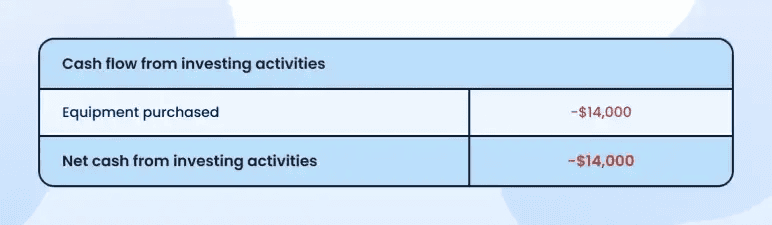
Northstar spent $14,000 on equipment.
That explains the negative number.
This is why I would not judge investing cash flow by whether it is positive or negative.
A negative number may simply mean the business bought something it needs for the future.
When you read this section on your statement, look at the lines underneath and ask: what did the business buy or sell?
You may see:
- Equipment
- Vehicles
- Machinery
- Property
- Other long-term assets
Northstar’s case is straightforward.
The business generated $35,000 from operations and then used $14,000 of cash to buy equipment.
Now the cash flow story is starting to come together.
But there is still one more section to check.
4. See how loans or owner funding changed cash
Here is Northstar’s financing section:
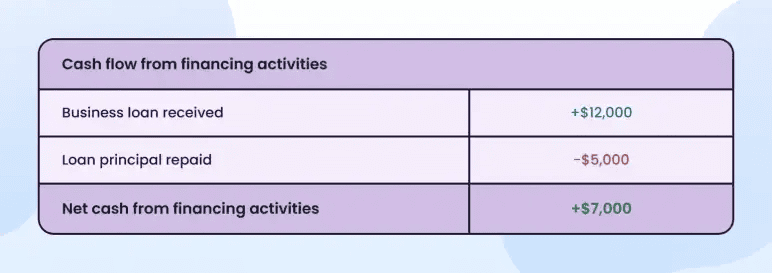
Northstar borrowed $12,000 and repaid $5,000 of loan principal.
So financing added $7,000 to cash.
The important point is simple:
This $7,000 increased the bank balance, but the cleaning business did not earn it from customers.
Your financing section may show:
- New loans
- Lines of credit
- Loan repayments
- Money put in by the owner
- Outside investment
- Money paid out to owners
When you read this section, separate that money from cash generated through normal operations.
For example, imagine your cash balance increased by $30,000, but you also took out a $40,000 loan.
You would not want to conclude that the business itself generated $30,000.
The loan may be the reason cash increased.
A useful question here is: What would our cash position have looked like without the new loan or owner contribution?
For Northstar, we already know the answer.
Even before financing, its normal operations generated $35,000 in cash.
We now have everything we need to explain why its cash balance increased.
5. Put the three sections together
Go back to the totals:
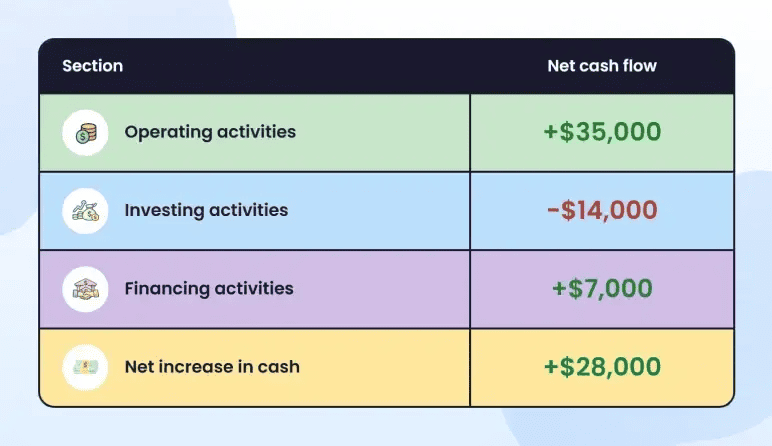
Now the statement becomes much easier to read:
- Northstar generated $35,000 from running the business.
- It spent $14,000 on equipment.
- Financing added another $7,000.
- So cash increased by $28,000 overall.
Add that to its starting cash:
$12,000 + $28,000 = $40,000 ending cash
This is the point of reading a cash flow statement.
You should be able to look past the individual rows and explain what happened to the business’s cash in plain English.
For Northstar:
Now try the same thing with yours:
If you can fill that in correctly, you have understood the main story behind your cash flow statement.
6. Once you understand one period, compare it with another
Do not start comparing years or months until you understand one period first.
Once you do, the comparison becomes much simpler.
Look at the same few numbers in the next period:
| Compare | Ask |
| Operating cash flow | Did the business generate more or less cash? |
| Accounts receivable | Is more cash sitting in unpaid invoices? |
| Inventory | Is more cash tied up in stock? |
| Accounts payable | Are unpaid supplier bills increasing? |
| Investing activities | Did the business buy or sell any major assets? |
| Financing activities | Did borrowing or repayments change? |
| Ending cash | Did the cash balance grow or shrink? |
Suppose Northstar generated $35,000 from operations this year but only $18,000 next year.
That change should make you look deeper.
Maybe customers are paying more slowly. Maybe expenses increased. Maybe inventory is taking up more cash.
You do not need to assume something is wrong immediately. The purpose of comparing periods is to spot what changed and then find out why.
If your statement already shows several years side by side, follow the exact same process.
Read the first year completely.
Then move across to the next year and compare the same totals and major lines.
That is much easier than trying to read all three years at once.
By the end of this process, you should be able to answer four questions about any cash flow statement:
- Did cash increase or decrease?
- How much cash came from normal operations?
- What cash was spent on or received from investments?
- How much did loans or owner funding affect the result?
If you can answer those four questions, you can read the statement.
From there, keep comparing the same numbers over time.
If you start seeing repeated cash shortages, weaker operating cash flow, or a growing need to borrow just to cover normal expenses, our guide to 12 cash flow problems every business faces and how to fix each one can help you identify what may be causing the issue and what to do next.
Conclusion
Once you know where cash came from, where it went, and what caused the balance to change, a cash flow statement becomes much easier to understand.
Keep comparing the same numbers over time, especially operating cash flow and the major changes behind it.
If you also want to plan ahead, Upmetrics’ financial forecasting software can help you build cash flow forecasts and complete financial projections as part of your business plan.
Plan Your Cash Flow Before It Becomes a Problem
Create cash flow forecasts and plan your income and expenses.

Frequently Asked Questions
What is the most important part of a cash flow statement?
Is negative cash flow always bad?
Why is my business profitable but still short on cash?
How often should I review my cash flow statement?

Vinay Kevadia
Vinay Kevadiya is the founder and CEO of Upmetrics, the #1 business planning software. His ultimate goal with Upmetrics is to revolutionize how entrepreneurs create, manage, and execute their business plans. He enjoys sharing his insights on business planning and other relevant topics through his articles and blog posts. Read more