Maybe you’ve helped set up a few parties or noticed how often people rent tents, tables, and chairs for family events. It seems like a business you could start with some equipment and a truck.
But running it regularly takes more planning. You need to decide where to store equipment, when to rent extra from another company, and how to price each job so delivery, setup, and pickup don’t eat into your earnings.
That’s why I have prepared this sample plan for Canopywell Party Rentals, a fictional company in Northeast Philadelphia seeking a $160,000 bank loan.
Use this example as a reference to plan your equipment purchases, daily operations, and financial projections.
Executive Summary
Canopywell Party Rentals is a new party equipment rental company in Northeast Philadelphia, opening on Monday, March 1, 2027. We rent frame tents, tables, chairs, linens, and heaters, and our crew delivers, sets up, and picks up every order.
We will operate from a 2,200 sq ft warehouse at Ashwick Flex Center, 2950 Comly Road, Unit 6, Philadelphia, PA 19154, near Northeast Philadelphia Airport. From there, our truck serves Northeast Philadelphia, Lower Bucks County, and eastern Montgomery County.
Event rental is a growing business. U.S. event rental revenue is expected to grow 9.5% in 2026, to $6.2 billion. For a local company like ours, this points to steady demand for tents, tables, and chairs close to home.
Our customers are families hosting graduations, birthdays, and First Communion parties at home; block parties, churches, and community groups; and caterers and planners who need a reliable rental partner.
Canopywell will stand out with on-time delivery, clean equipment, and tents installed by a trained crew. Every quote also shows delivery and setup as separate lines. This makes it easy for customers to see the full price before they book, with no surprises on party day.
Leadership & Vision
Marcus Ellery spent seven years at a suburban Philadelphia tent and event rental company, rising from crew member to operations coordinator. He has experience scheduling deliveries, managing crews, and preparing equipment for events.
His vision is to make Canopywell a dependable rental company for family celebrations and community events across Northeast Philadelphia.
Brindlewood Bank Term Loan
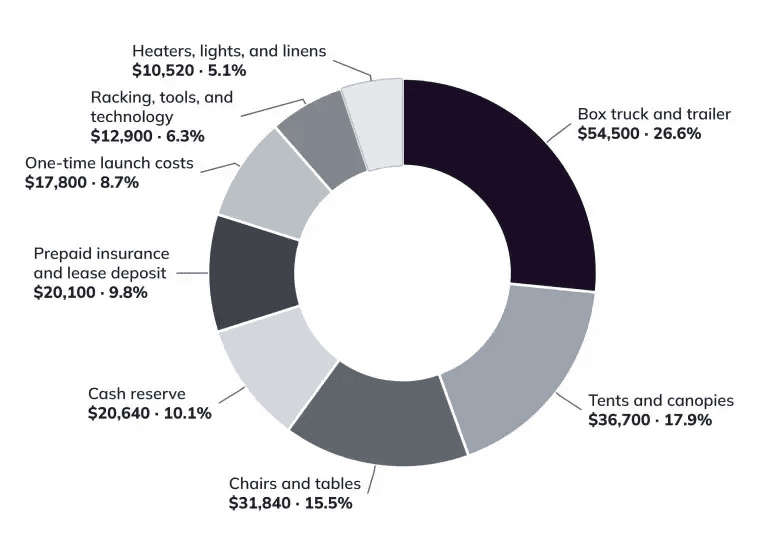
We are applying for a $160,000, 7-year term loan from Brindlewood Bank at 8.75% interest. Marcus is adding $45,000 of his own savings, for $205,000 in all. The money will pay for:
- $79,060 of rental inventory (tents, tables, chairs, linens, and heaters)
- $54,500 for a used box truck and an enclosed trailer
- A $20,640 cash reserve for the first spring and winter
- $20,100 for the first year’s insurance and the lease deposit
- $17,800 of launch costs and $12,900 for racking, tools, and technology
Financial Outlook
Canopywell expects revenue to grow over its first three years as it builds a regular customer base and takes on more bookings.
The chart below shows how each type of rental contributes to sales.
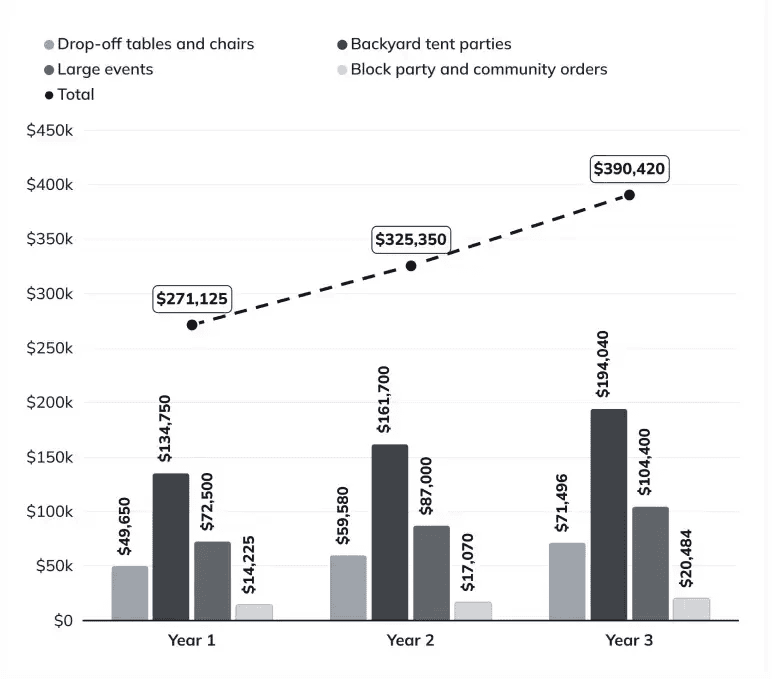
We expect 325 orders in Year 1. The average order comes to $834 because many customers book a full tent package, not just a few chairs.
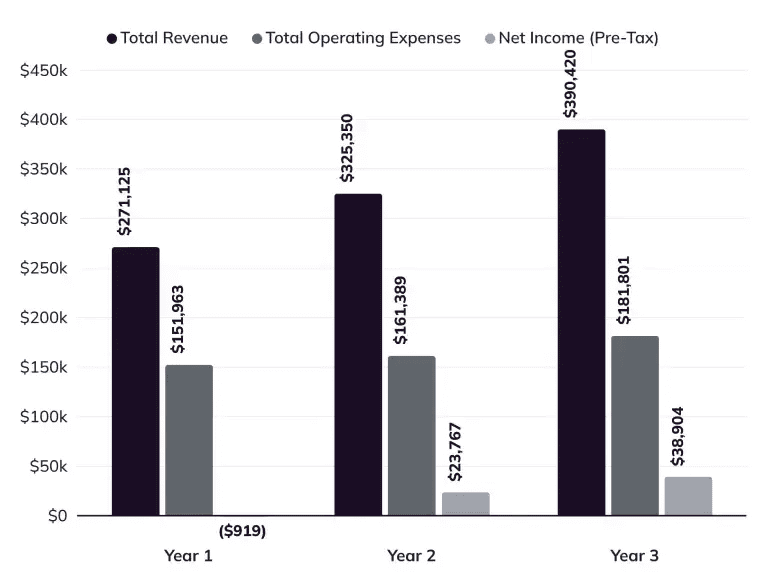
Revenue grows from $271,125 in Year 1 to $390,420 in Year 3.
Year 1 ends with a small loss of $919. This comes from $17,800 of one-time launch costs, such as the website and the opening marketing.
The business then turns a profit of $23,767 in Year 2. Profit grows to $38,904 in Year 3.
Month-end cash never falls below $24,346, its low point in the first month of business. By Year 2, earnings cover the loan payments 2.13 times, which gives the bank a comfortable margin.

Company Overview
Marcus Ellery has spent seven years getting the right equipment to parties on time and setting it up safely. Canopywell Party Rentals is the company he is building to do that same work for families and groups in his own part of the city.
Our mission is to make hosting at home easy and stress-free, with clean equipment, a friendly, trained crew, and a full price customers can see before they book.
Business Structure
Canopywell is Marcus’s first business.
In November 2026, he formed Canopywell Party Rentals LLC, a single-member Pennsylvania limited liability company (LLC). The LLC signs the lease, the loan, and every rental contract.
This keeps business debts and customer claims separate from Marcus’s personal assets. The company’s insurance adds a second layer of protection.
Marcus Ellery’s Experience
Marcus grew up in Mayfair and now lives in Fox Chase, both in Northeast Philadelphia.
At his last job, a big rental company outside the city, Marcus worked his way up:
- Two seasons on the crew, loading trucks and setting up tables, chairs, and tents
- Three seasons as a crew lead, installing frame and pole tents
- Two years as operations coordinator, building the weekend load sheets and scheduling crews and trucks
- Calling other rental companies to borrow equipment whenever the warehouse ran short
This background means Canopywell opens with an owner who has already run busy June weekends, both from the truck and from the office.
Canopywell will focus on tents, tables, chairs, linens, heaters, and lighting. It won’t offer bounce houses, catering, or event planning, because each of these needs different insurance, staff, or skills. Marcus would rather do one job very well first.
Comly Road Warehouse
Canopywell’s warehouse is a 2,200 sq ft flex unit in a light-industrial area near Northeast Philadelphia Airport. Its 12-ft roll-up door and loading area make it quick to load the truck and trailer.
Inside, pallet racking holds the tents and chair stacks. Linens and small items stay organized in bins on shelving, next to a small office.
Roosevelt Boulevard (U.S. 1) and I-95 are a few minutes away. This lets the truck reach most of Northeast Philadelphia and Lower Bucks County in under 25 minutes.
We group our deliveries into three zones:
Zone 1
It covers Northeast Philadelphia neighborhoods such as Fox Chase, Bustleton, Somerton, Mayfair, Holmesburg, and Rhawnhurst, plus nearby Bensalem and Huntingdon Valley.
Zone 2
This covers the rest of Philadelphia north of Center City, Lower Bucks County, and eastern Montgomery County towns such as Abington, Cheltenham, and Jenkintown.
Zone 3
It covers Center City, South Philadelphia, and the rest of Bucks and Montgomery counties, by request.
The warehouse lease runs five years, with an option to renew for five more. All-in rent is $35,200 in Year 1. Canopywell paid a deposit of two months’ rent.
Goals for the First Three Seasons
Canopywell will grow only as fast as customers book its equipment.
Marcus will add chairs, tables, tents, and a second truck when bookings show the need, not on a fixed date. This keeps the company from spending money on equipment that would sit unused in the warehouse.
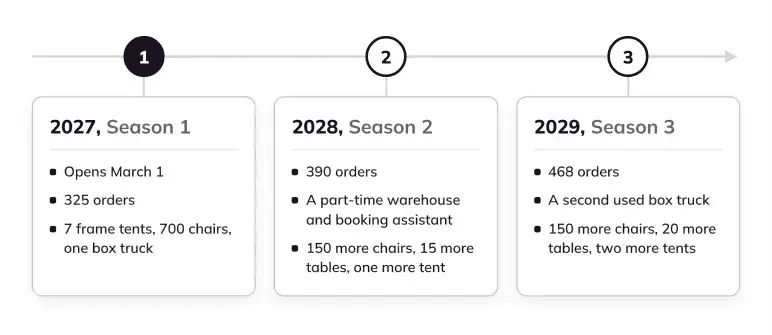
Here is what each of the first three seasons looks like:
Market Analysis
U.S. event rental revenue is expected to keep growing after 2026, by 8.3% in 2027 and 6.4% in 2028. This means Canopywell opens in a category where demand is still rising. Our own sales targets, though, start from local orders and prices.
Philadelphia alone has 702,646 households, based on Census data. In Northeast Philadelphia, many of these homes are rowhouses and twins with small yards, driveways, or a street that closes for a party.
This gives Canopywell a large base of hosts within a short drive. It also explains why many tent orders stand on pavement, held down with water-barrel weights instead of stakes.
Block parties are a Philadelphia custom, and each one starts with a Streets Department permit. In 2026, the city’s Philadelphia250 program supported 250 block parties citywide between May 23 and October 3.
This gives Canopywell a steady group of summer customers. We created our Block Party Bundle with them in mind.
When Demand Peaks
Party rentals in Philadelphia follow the school and church calendar, along with the weather.
- April and May bring First Communions, baptisms, and showers. Late May and June are graduation season, the busiest weeks of the year.
- Summer brings block parties, birthdays, and family reunions. In September and October, fall festivals and outdoor parties keep the heaters busy.
- In November and December, holiday parties rent tables, chairs, and linens, but few tents. January and February are quiet.
Canopywell expects May and June to bring 35% of its Year 1 revenue. November through February should bring just 10%.
This is why the company buys enough equipment for a normal June weekend and rents extra from other companies for the busiest ones. It also plans its cash around a slow winter. This helps it keep up with its bills during the quiet months.
Target Customers
Canopywell will serve four groups. Each one rents for a different reason and needs something different from a rental company.
1. Families hosting at home
Parents and grandparents throw graduation parties, birthdays, First Communion parties, and showers in their yards and driveways. They book two to six weeks ahead and compare prices online.
What they want most is one friendly company that brings the tent, tables, and chairs and takes everything away on Monday.
Most backyard tent parties and drop-off orders come from this group, and a family with a good first party often calls again for the next graduation.
2. Block parties and neighborhood groups
Block captains and civic associations close a street for a day each summer. They need 40 to 80 chairs, a few tables, and canopies at a low price. Most book in spring and come back every year.
3. Churches, schools, and community groups
Parishes, school parent groups, youth leagues, and nonprofits run picnics, festivals, and fundraisers, often on the same weekend every year.
They need clear invoices, a certificate of insurance, and someone they trust to handle the tent permit.
4. Caterers, planners, and small venues
These event professionals need a reliable partner for tents, tables, and linens, sometimes on short notice. They place fewer orders than families, but larger ones, and they book months ahead.
Canopywell needs about 325 orders in Year 1. This works out to roughly one order for every 2,160 Philadelphia households, before counting the suburbs, churches, schools, and trade accounts.
Competition
Canopywell’s direct competitors fall into two groups.
The first is the large full-service tent and event rental companies in the suburbs. They have big warehouses, pole tents for weddings, and well-known names.
For a small backyard party, though, they often charge high minimum orders and delivery fees. Their busy weekends also fill months ahead.
The second group is small owner-run operators who rent chairs, tables, and pop-up canopies from a garage. Their prices are low. Most don’t install frame tents, carry commercial insurance, or deliver within a set time window.
Canopywell’s indirect competitors are the other ways people solve the problem:
- Buying folding tables and a pop-up canopy at a big-box store
- Booking an indoor hall with tables and chairs included
- Borrowing tables and chairs from a church or a neighbor
Canopywell’s positioning is between the two kinds of direct competitors. It installs frame tents with a trained, insured crew, like the large companies. It also takes small orders with a low minimum and published zone fees, like the garage operators.
The large companies will keep the big weddings, and the smallest operators will stay cheaper on plain chairs. Canopywell is for the families and groups in between, who want a real tent set up safely without paying wedding prices.
Rentals & Packages
Canopywell rents everything a host needs to seat guests and keep them comfortable outdoors. Four simple packages cover most orders, and customers can also rent any item on its own.
Party Packages
Each package fits a common kind of party:
| Package | Best For | What’s Included | Typical Price |
|---|---|---|---|
| Drop-Off Basics | Birthdays, showers, and small family parties | 5 tables, 40 chairs, and 3 tablecloths, delivered and picked up | $331 |
| Backyard Tent Party | Graduations, communions, and milestone birthdays for 40–60 guests | One 20×20 or 20×30 frame tent installed, 7 tables, 50 chairs, and linens | $1,078 |
| Full Event Setup | Large family events, company picnics, and small weddings for 100–150 guests | Two frame tents, including a 20×40, plus 15 tables, 120 chairs, linens, string lights, and heaters as needed | $2,900 |
| Block Party Bundle | Block parties, church picnics, and community days | 10 tables, 60 chairs, and 2 pop-up canopies, delivered and picked up | $569 |
Typical prices include delivery to the nearest zone, setup, and the 10% damage waiver, but not sales tax. The quote shows each of these as its own line. This way, customers always know what they’re paying for.
Rental Catalog
Customers who want something different can build their own order from the catalog. It includes:
- Frame tents in three sizes, with optional sidewalls
- 10×10 pop-up canopies
- White folding chairs, plus banquet, round, and cocktail tables
- Tablecloths and runners in white, ivory, black, and six colors
- Propane patio heaters, string lights, and a quiet generator
Some customers ask for items Canopywell doesn’t own, such as dance floors, Chiavari chairs, china and glassware, or tents larger than 20×40. Canopywell supplies these through partner rental companies at its own prices.
This means a host can get everything for the party with one call and one bill.
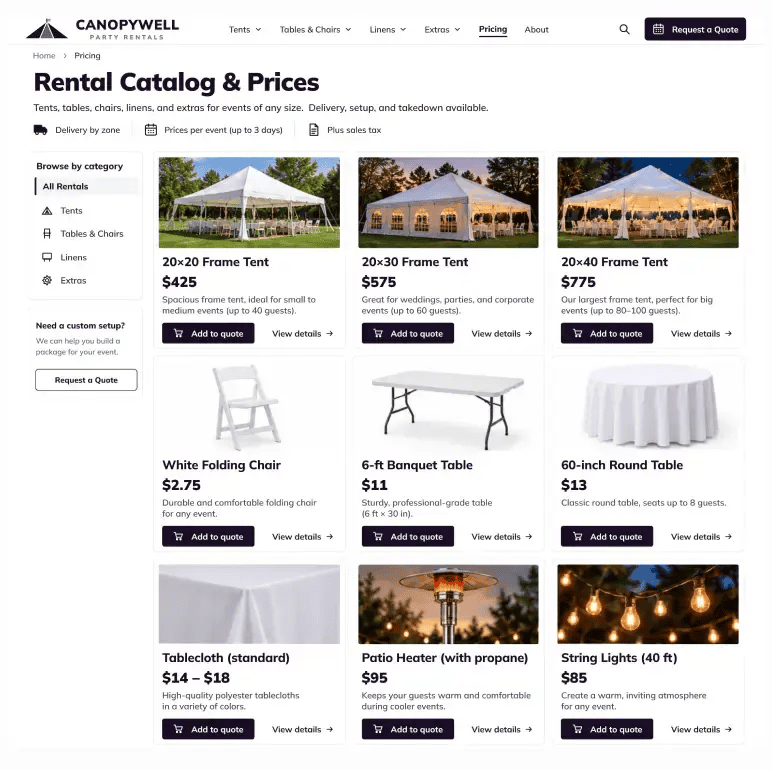
Here is the price sheet customers see online:
Delivery, Setup & Pickup
Canopywell charges for delivery by zone, and the fee covers the round trip:
- Zone 1: $85
- Zone 2: $110
- Zone 3: $145
A weekend rental covers up to three days, from delivery to pickup. This gives hosts time to decorate the day before and relax after the party.
Canopywell charges for tent installation per tent, from $95 for a 20×20 to $190 for a 20×40. Installation includes staking or water-barrel weights, any sidewalls ordered, and takedown after the party.
The crew drops tables and chairs at the curb or garage. For $0.75 per chair, it will also set them up.
Every order has a $150 minimum before delivery.
When a tent needs a city or township permit, Canopywell files the application for the customer and charges the permit fee at cost. This saves busy hosts time and paperwork.
Marketing & Sales Strategy
Most people who rent a tent start looking two to six weeks before their party. Our marketing focuses on being easy to find and easy to book in those weeks. After the party, we work to bring the same customers back the next year.
Before the First Season
Online booking opens on February 1, 2027, a month before the first delivery. Customers can see the packages, the price sheet, and the zone fees, then book and pay their deposit on the website.
Marcus will also set up a Google Business Profile with photos of the equipment and the warehouse, plus Facebook, Instagram, and Nextdoor pages.
In February, he will visit about 40 local caterers, small venues, parish offices, and school parent groups. Each visit leaves a one-page price sheet and an offer to open a trade account.
The $6,000 launch budget covers:
- Postcards to about 8,000 homes in Zone 1 in late February, as families start planning graduation parties
- Early search ads before the first deliveries
- Yard signs for the first tent jobs
- Printed price sheets for the February visits
The first 30 Google reviews will matter more than any ad. To earn them, the crew will ask every customer for a review at pickup, while the party is still fresh in their minds.
Where Orders Come From
Search brings in most first-time customers. Our Google ads appear when people within the three zones search for tent, table, and chair rentals or graduation party rentals.
A clear Google Business Profile with steady reviews brings in the same customers for free.
Social media works best close to home. We will post photos of real setups on Facebook and Instagram. We will also run small ads on Nextdoor, where neighbors ask each other who to call.
Referrals bring in the larger orders. Planners, caterers, and parish offices earn a 10% credit when they send a customer who books.
Yard signs, a few mailings, and small community sponsorships keep our name in front of each neighborhood.
The Year 1 marketing budget of $10,000 is split this way:
| Channel | Year 1 Budget | Share |
|---|---|---|
| Google search ads | $4,500 | 45% |
| Facebook, Instagram, and Nextdoor | $2,000 | 20% |
| Referral credits for planners, caterers, and churches | $1,500 | 15% |
| Google Business Profile, website, and reviews | $1,000 | 10% |
| Yard signs, mailers, and sponsorships | $1,000 | 10% |
| Total | $10,000 | 100% |
Trade Accounts & Repeat Customers
Caterers, planners, and small venues can open a trade account. Trade customers get:
- 10% off Canopywell’s prices
- First claim on equipment for busy weekends
- Monthly invoicing once they have booked three events
These terms make it easy for busy planners to send repeat work our way.
Churches, schools, and block captains often hold their events on the same weekend each year. Eight weeks before last year’s date, we send them a friendly text with last year’s order ready to repeat. This saves them time and helps us plan the season early.
Every family gets a thank-you text after pickup, with a review link and a $25 credit toward their next order.
Marcus tracks where each order came from in the booking software. He then moves more of the budget toward the channels that bring the most orders.
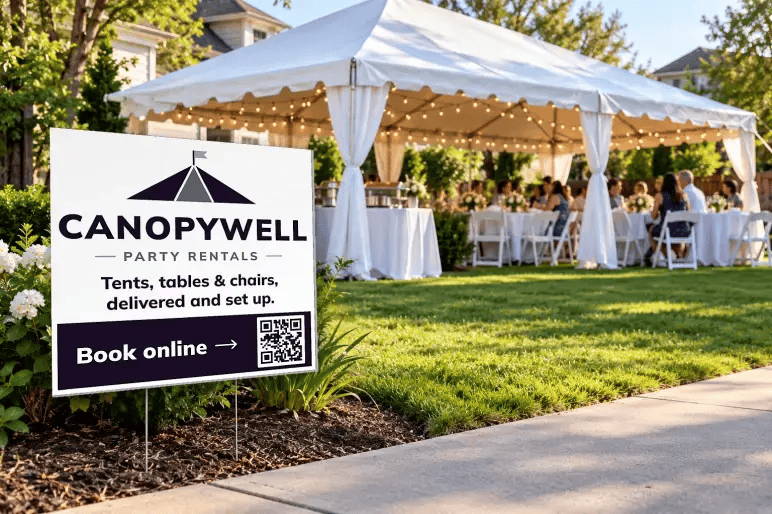
Neighbors often notice a tent going up on the next block.
To make the most of this, every tent Canopywell installs carries a sign like this one:
Operations Plan
Canopywell’s daily work focuses on two things: getting every order out on time, and bringing every item back clean and ready for the next party.
Hours, Booking & Deposits
Customers can reach the office by phone during these hours:
- March to October: Monday to Friday, 9:00 AM – 5:00 PM, and Saturday, 8:00 AM – noon
- November to February: Monday to Friday, 10:00 AM – 4:00 PM
Customers can also book online at any time. The booking software shows live stock for every date. This makes sure we never promise the same item to two parties.
Tent and large-event orders pay a 30% deposit at booking. Customers pay the full balance three days before delivery.
Plans change, so customers who cancel more than 14 days ahead keep their deposit as credit for another date.
Bad weather follows a different rule. If the forecast calls for winds above the tent maker’s limit, Marcus won’t install the tent. The customer can then move the date or get a refund for the tent.
This rule keeps guests safe, and customers know about it when they book.
Weekly Schedule
From March to October, the work follows the same weekly routine. This helps a small crew keep up with a busy season.
On Monday and Tuesday, the crew cleans returned chairs and tables, and dries, checks, and repairs the tents. Linens go to a commercial laundry.
On Wednesday, Marcus prints a load sheet for every order. The crew then pulls each order and stages it by route.
Thursday and Friday bring drop-off orders and tent installs, with two to four stops a day. The crew sets up each tent the day before the party.
Saturday morning covers the last deliveries, and Marcus stays on call for any problems. Pickups and tent takedowns run on Sunday evening and Monday.
The crew groups orders by zone, so the truck doesn’t cross the city twice in one morning. With its truck, trailer, and two crews, Canopywell can handle about 12 orders on a busy June weekend.
Crew & Staffing
A small team runs the work, and most of it is seasonal:
- Marcus Ellery, owner (full-time, all year): Handles sales, quotes, scheduling, and load sheets. He also drives the truck and leads tent installations on most weekends.
- Part-time crew (two in Year 1, three to four by Year 3): Load, deliver, set up, pick up, and clean, mostly from March to October. Each works about 15 to 25 hours a week in season, at $19.00 per hour in Year 1.
- Warehouse and booking assistant (from Year 2): Works about 20 hours a week from March to October. This person answers calls, confirms orders, checks returns, and runs cleaning days, which frees Marcus to spend more time with trade accounts.
Crew hours add up to 2,400 in Year 1.
Before the first job, Marcus trains every crew member in tent installation, safe lifting, and truck loading. This helps the crew work safely and set up every party with the same care.
He also checks that anyone driving the truck has the license required for that vehicle. Most of the time, the box truck weighs under 26,001 pounds, so drivers don’t need a commercial license.
Cleaning, Repairs & Inventory Tracking
Every item comes back to the warehouse before it goes out again. The crew checks each one for cracks, stains, and tears. This makes sure the next customer gets clean, safe equipment.
The crew also dries every tent top fully before folding it, because a tent folded wet will mildew within days. This keeps the most expensive equipment in good shape for years.
Damaged items get a tag in the booking software, and the crew pulls them until they are fixed or replaced.
The software also keeps a rental count for every item. This helps Marcus see which tents, tables, and linens earn their space on the racks.
The 10% damage waiver covers accidental damage, such as a torn tablecloth or a cracked chair. Customers pay the replacement cost only for lost items or misuse.
This gives hosts peace of mind, since a small accident won’t lead to a surprise bill.
When Renting Equipment Makes More Sense
Rental companies often rent equipment from each other. When a customer wants something Canopywell doesn’t own, Marcus rents it from another Philadelphia-area company.
He usually pays about 25% below that company’s price, then bills the customer at Canopywell’s normal rate.
This lets a small company say yes to large orders. A Full Event Setup with a dance floor brings in about $2,900, and the dance floor is only a small part of it. Turning down the dance floor often means losing the whole order.
Sub-renting also keeps cash in the business. A 30×60 tent costs about $16,500 to buy, money Canopywell needs for its first winter.
The trade-off is a smaller profit on each borrowed item. Marcus books sub-rentals as soon as a customer confirms, since other companies’ equipment sells out on busy weekends.
Here is how the numbers compare for three items Canopywell expects to sub-rent:
| Item | Price to Customer | Kept per Event if Sub-Rented | Kept per Event if Owned | Cost to Buy | Yearly Cost to Own | Bookings a Year for Owning to Pay |
|---|---|---|---|---|---|---|
| 12×15 portable dance floor | $420 | $60 | $380 | $2,900 | $957 | 3.0 |
| 100 Chiavari chairs with cushions | $650 | $118 | $590 | $6,800 | $1,619 | 3.4 |
| 30×60 frame tent | $2,200 | $460 | $2,050 | $16,500 | $3,679 | 2.3 |
Owning these items pays only once customers book each one two to four times a year, every year. One busy season doesn’t prove the next will look the same.
This is why Canopywell follows a simple buy rule:
- It buys a specialty item only after sub-renting it on six or more weekends in a season.
- It adds core items, such as chairs, tables, and 20×20 and 20×30 tents, when the next season’s busiest weekend would use more than 90% of what it owns.
On a peak June weekend in Year 1, the business expects to use about 90% of its chairs and 94% of its tents. With 20% more orders expected in Year 2, that weekend would need more than Canopywell owns.
This is why the company will add 150 chairs, 15 tables, and one more tent in March 2028.
Winter Months Management
From November to February, Canopywell earns about 10% of its yearly revenue. Rent, insurance, the loan payment, and Marcus’s salary still come due. The business plans for these months in four ways:
- Holiday parties, church dinners, and office events rent tables, chairs, linens, and heaters, with no tents.
- The crew works only the hours that holiday orders need.
- Tent repairs, deep cleaning, and the yearly inventory count happen in January.
- Graduation bookings start arriving in January, and each tent order pays its 30% deposit at booking.
Even so, the business uses about $25,100 of cash from November through February in Year 1. The cash reserve and the summer’s earnings cover this gap. This keeps Canopywell on track through its first winter.
Permits, Licenses & Insurance
Canopywell holds a Philadelphia Commercial Activity License, a Business Income & Receipts Tax account, and a Pennsylvania sales tax license. It collects 8% sales tax on rentals in Philadelphia and 6% in the suburbs.
The city’s Department of Licenses and Inspections requires a $126 permit for any tent over 400 sq ft.
Installers must hold $1 million of liability coverage, and tent fabric must meet the NFPA 701 flame standard. Canopywell files at least two weeks ahead and checks suburban township rules when it quotes.
Insurance covers general liability, the rental equipment, the truck and trailer, and workers’ compensation. This protects customers, guests, and the business if something goes wrong.
Financial Plan
Canopywell Party Rentals needs $205,000 to open: a $160,000 term loan from Brindlewood Bank and $45,000 of Marcus’s savings. Revenue grows from $271,125 to $390,420 over three years, and the business turns a profit in Year 2.
Startup Costs
| Category | Amount |
|---|---|
| Rental Inventory | |
| Frame tents, canopies, weights, and stakes | $36,700 |
| 700 chairs, 98 tables, and carts | $31,840 |
| Heaters, string lights, and generators | $6,520 |
| 250 tablecloths and runners | $4,000 |
| Vehicles & Warehouse Equipment | |
| Used 16-ft box truck with liftgate | $46,000 |
| Racking, shelving, pallet jack, and tools | $9,900 |
| 16-ft enclosed trailer | $8,500 |
| Laptop, tablets, card reader, and label printer | $3,000 |
| Prepaid Costs & Deposits | |
| First-year insurance premium | $14,200 |
| Warehouse lease deposit | $5,900 |
| One-Time Launch Costs | |
| Brand, website with online booking, and photos | $6,000 |
| Launch marketing | $6,000 |
| LLC formation, lease review, and rental contracts | $3,500 |
| Crew hiring, training, and uniforms | $1,500 |
| Permits, licenses, and registrations | $800 |
| Working Capital | |
| Cash reserve | $20,640 |
| Total Startup Costs | $205,000 |
Financial Assumptions
| Assumption | Year 1 | Year 2 | Year 3 |
|---|---|---|---|
| Drop-off orders ($331 each) | 150 | 180 | 216 |
| Backyard tent parties ($1,078 each) | 125 | 150 | 180 |
| Large events ($2,900 each) | 25 | 30 | 36 |
| Block party and community orders ($569 each) | 25 | 30 | 36 |
| Total orders | 325 | 390 | 468 |
| Average order | $834.23 | $834.23 | $834.23 |
| Damage waiver (% of equipment charges) | 10% | 10% | 10% |
| Sub-rented items, cost to Canopywell (% of billed price) | 75% | 75% | 75% |
| Paid crew hours | 2,400 | 2,880 | 3,456 |
| Crew pay per hour | $19.00 | $19.75 | $20.50 |
| Payroll tax (% of wages) | 10.5% | 10.5% | 10.5% |
| Owner salary | $40,000 | $46,000 | $52,000 |
| Warehouse rent, all-in | $35,200 | $36,256 | $37,344 |
| Card processing (% of revenue) | 2.9% | 2.9% | 2.9% |
| Equipment purchases | $0 | $9,200 | $53,200 |
| Monthly loan payment | $2,554.00 | $2,554.00 | $2,554.00 |
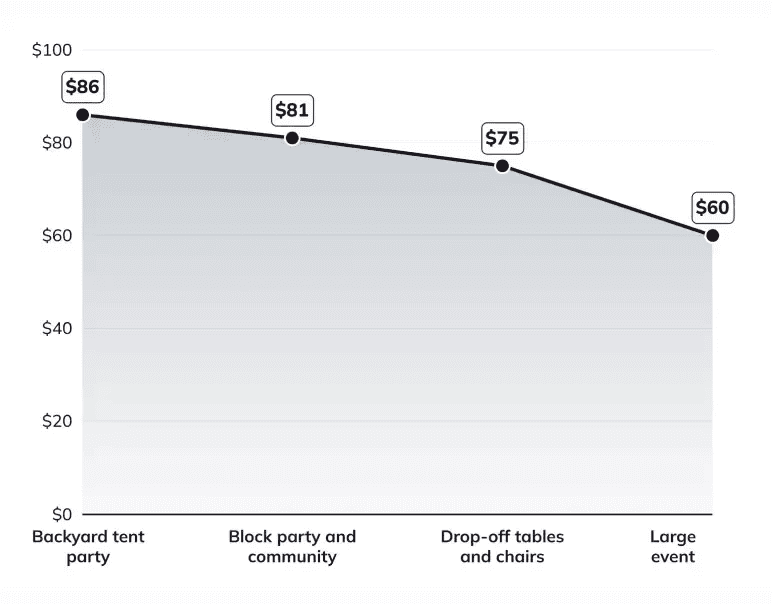
What Each Order Earns (Year 2)
| Order Type | Average Price | Direct Costs | Left Before Fixed Costs | Share Kept | Crew Hours | Kept per Crew Hour |
|---|---|---|---|---|---|---|
| Drop-off tables and chairs | $331 | $106 | $225 | 68% | 3 | $75 |
| Backyard tent party | $1,078 | $307 | $771 | 72% | 9 | $86 |
| Large event | $2,900 | $1,214 | $1,686 | 58% | 28 | $60 |
| Block party and community | $569 | $164 | $405 | 71% | 5 | $81 |
Projected Profit & Loss Statement
| Category | Year 1 | Year 2 | Year 3 |
|---|---|---|---|
| Revenue | |||
| Equipment rental | $180,000 | $216,000 | $259,200 |
| Sub-rented items | $13,750 | $16,500 | $19,800 |
| Delivery, setup, and pickup fees | $58,000 | $69,600 | $83,520 |
| Damage waivers | $19,375 | $23,250 | $27,900 |
| Total Revenue | $271,125 | $325,350 | $390,420 |
| Cost of Rentals | |||
| Sub-rented items from other companies | $10,312 | $12,375 | $14,850 |
| Cleaning and laundering | $9,300 | $11,160 | $13,392 |
| Delivery fuel | $6,225 | $7,470 | $8,964 |
| Lost and broken items | $2,700 | $3,240 | $3,888 |
| Peak-weekend truck rental | $0 | $1,680 | $0 |
| Crew wages | $45,600 | $56,880 | $70,848 |
| Payroll tax on crew wages | $4,788 | $5,972 | $7,439 |
| Total Cost of Rentals | $78,925 | $98,777 | $119,381 |
| Gross Profit | $192,200 | $226,573 | $271,039 |
| Gross Margin | 70.9% | 69.6% | 69.4% |
| Operating Expenses | |||
| Owner salary | $40,000 | $46,000 | $52,000 |
| Warehouse and booking assistant | $0 | $13,500 | $15,000 |
| Payroll tax on salaries | $4,200 | $6,248 | $7,035 |
| Warehouse rent | $35,200 | $36,256 | $37,344 |
| Insurance | $14,200 | $14,900 | $18,800 |
| Truck upkeep | $4,800 | $5,200 | $8,400 |
| Marketing | $10,000 | $10,500 | $11,000 |
| Booking and accounting software, website | $4,200 | $4,300 | $4,400 |
| Utilities | $3,000 | $3,100 | $3,200 |
| Phone and internet | $1,500 | $1,550 | $1,600 |
| Accounting, payroll service, and legal | $3,600 | $3,700 | $3,800 |
| Repairs and maintenance | $2,500 | $3,200 | $4,000 |
| Supplies | $2,400 | $2,700 | $3,000 |
| Licenses, permits, and city business taxes | $700 | $800 | $900 |
| Card processing | $7,863 | $9,435 | $11,322 |
| One-time launch costs | $17,800 | $0 | $0 |
| Total Operating Expenses | $151,963 | $161,389 | $181,801 |
| EBITDA | $40,237 | $65,184 | $89,238 |
| Depreciation | $27,840 | $29,680 | $40,320 |
| Interest expense | $13,316 | $11,737 | $10,014 |
| Net Income (Pre-Tax) | ($919) | $23,767 | $38,904 |
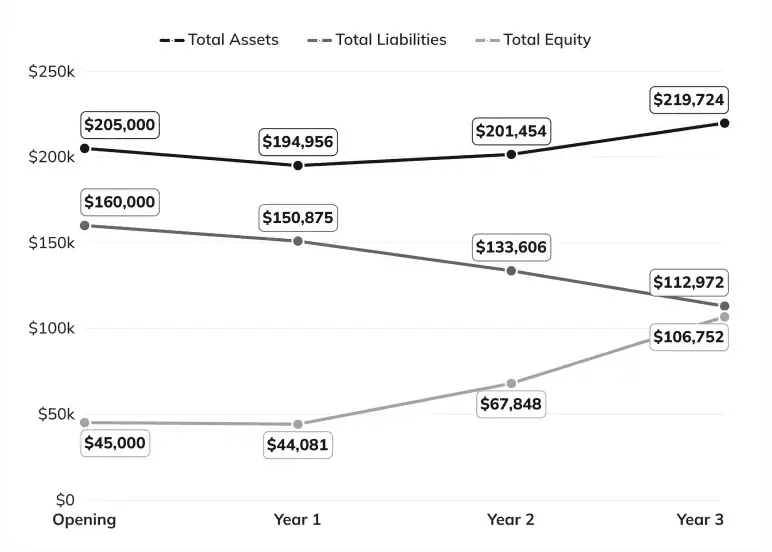
Projected Balance Sheet
| Category | Opening | Year 1 | Year 2 | Year 3 |
|---|---|---|---|---|
| Assets | ||||
| Cash | $38,440 | $70,436 | $97,414 | $102,804 |
| Prepaid insurance | $14,200 | $0 | $0 | $0 |
| Lease deposit | $5,900 | $5,900 | $5,900 | $5,900 |
| Equipment and vehicles, net | $146,460 | $118,620 | $98,140 | $111,020 |
| Total Assets | $205,000 | $194,956 | $201,454 | $219,724 |
| Liabilities | ||||
| Customer deposits for future events | $0 | $8,207 | $9,849 | $9,849 |
| Term loan | $160,000 | $142,668 | $123,757 | $103,123 |
| Total Liabilities | $160,000 | $150,875 | $133,606 | $112,972 |
| Equity | ||||
| Owner’s capital | $45,000 | $45,000 | $45,000 | $45,000 |
| Retained earnings | $0 | ($919) | $22,848 | $61,752 |
| Total Equity | $45,000 | $44,081 | $67,848 | $106,752 |
| Total Liabilities & Equity | $205,000 | $194,956 | $201,454 | $219,724 |
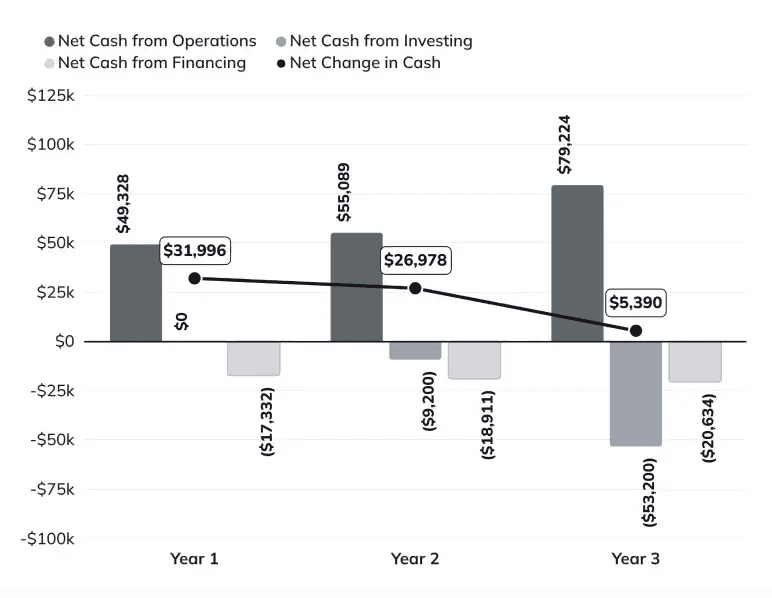
Projected Cash Flow
| Category | Year 1 | Year 2 | Year 3 |
|---|---|---|---|
| Beginning Cash | $38,440 | $70,436 | $97,414 |
| Operating Activities | |||
| Net income (pre-tax) | ($919) | $23,767 | $38,904 |
| Depreciation | $27,840 | $29,680 | $40,320 |
| Prepaid insurance used | $14,200 | $0 | $0 |
| Increase in customer deposits | $8,207 | $1,642 | $0 |
| Net Cash from Operations | $49,328 | $55,089 | $79,224 |
| Investing Activities | |||
| Equipment and second truck | $0 | ($9,200) | ($53,200) |
| Net Cash from Investing | $0 | ($9,200) | ($53,200) |
| Financing Activities | |||
| Loan principal repaid | ($17,332) | ($18,911) | ($20,634) |
| Net Cash from Financing | ($17,332) | ($18,911) | ($20,634) |
| Net Change in Cash | $31,996 | $26,978 | $5,390 |
| Ending Cash | $70,436 | $97,414 | $102,804 |
Break-Even Analysis
| Metric | Value |
|---|---|
| Yearly fixed costs, before depreciation and interest (Year 2) | $151,954 |
| Average order (Year 2) | $834.23 |
| Variable cost per order | $277.47 |
| Contribution per order | $556.76 |
| Contribution margin | 66.7% |
| Break-even orders per year | 273 |
| Break-even revenue | $227,681 |
| Orders needed to also cover loan payments | 328 |
| Forecast orders (Year 2) | 390 |
Loan Repayment & Debt Coverage
| Category | Year 1 | Year 2 | Year 3 |
|---|---|---|---|
| Interest | $13,316 | $11,737 | $10,014 |
| Principal | $17,332 | $18,911 | $20,634 |
| Ending loan balance | $142,668 | $123,757 | $103,123 |
| EBITDA | $40,237 | $65,184 | $89,238 |
| Debt coverage | 1.31x | 2.13x | 2.91x |
| Debt coverage before one-time launch costs | 1.89x | 2.13x | 2.91x |
Risks & Mitigation
Like any business that works outdoors, Canopywell faces a few risks from the weather, its equipment, and a short busy season. Marcus has tested how much room the numbers leave if the spring is rainy and orders fall short.
The table below shows Year 2 results under weaker sales:
| Scenario | Year 2 Revenue | EBITDA | Debt Coverage |
|---|---|---|---|
| Plan | $325,350 | $65,184 | 2.13x |
| Revenue 10% lower | $292,815 | $43,470 | 1.42x |
| Revenue 20% lower | $260,280 | $21,756 | 0.71x |
| Revenue 30% lower | $227,745 | $43 | 0.00x |
| Revenue 20% lower, with a quarter of Marcus’s salary deferred and marketing cut 30% | $260,280 | $37,614 | 1.23x |
Year 2 coverage stays at 1.25 times or better unless revenue falls more than 12.4%.
A weaker year would also push back the Year 3 equipment and truck purchases, since the buy rule waits for bookings.
Marcus watches four risks most closely:
- A rainy spring or a weak graduation season: Crew hours, sub-rentals, cleaning, and fuel all fall when orders fall. The cash reserve, spring deposits, and purchases that wait for bookings protect cash.
- A tent failure in high wind: A trained crew stakes or weights every tent to the maker’s instructions, and Marcus won’t install above the wind limit. General liability insurance covers what remains.
- Damaged or lost equipment: The damage waiver, replacement charges, and a check of every item on return keep losses small. The cost of rentals already includes a budget for breakage.
- Sold-out weekends: Sub-rental partners, a rented second truck on peak weekends, and the buy rule let Canopywell say yes as demand grows.
With these steps in place, Canopywell can keep serving customers and paying its loan, even in a tougher year.
The Quickest Way to turn a Business Idea into a Business Plan
Fill-in-the-blanks and automatic financials make it easy.


Upmetrics
Upmetrics is the #1 business planning software that helps entrepreneurs and business owners create investment-ready business plans using AI. We regularly share business planning insights on our blog. Check out the Upmetrics blog for such interesting reads. Read more