


Simple business plan template without the filler
Six chapters change a decision. The other four usually do not. This page says which is which, so you can cut the full template down instead of filling in all of it. No email required.
- Which six chapters to keep, and the four you can delete
- A worked example of all six, written out
- Word, Google Docs or PDF, set up to print cleanly
 Word
 Google Docs
Seven pages: the six chapters worth keeping, plus a twelve-month cash forecast. This is the version for a landlord, a supplier, or for thinking the idea through — not the thirty-one-page one.

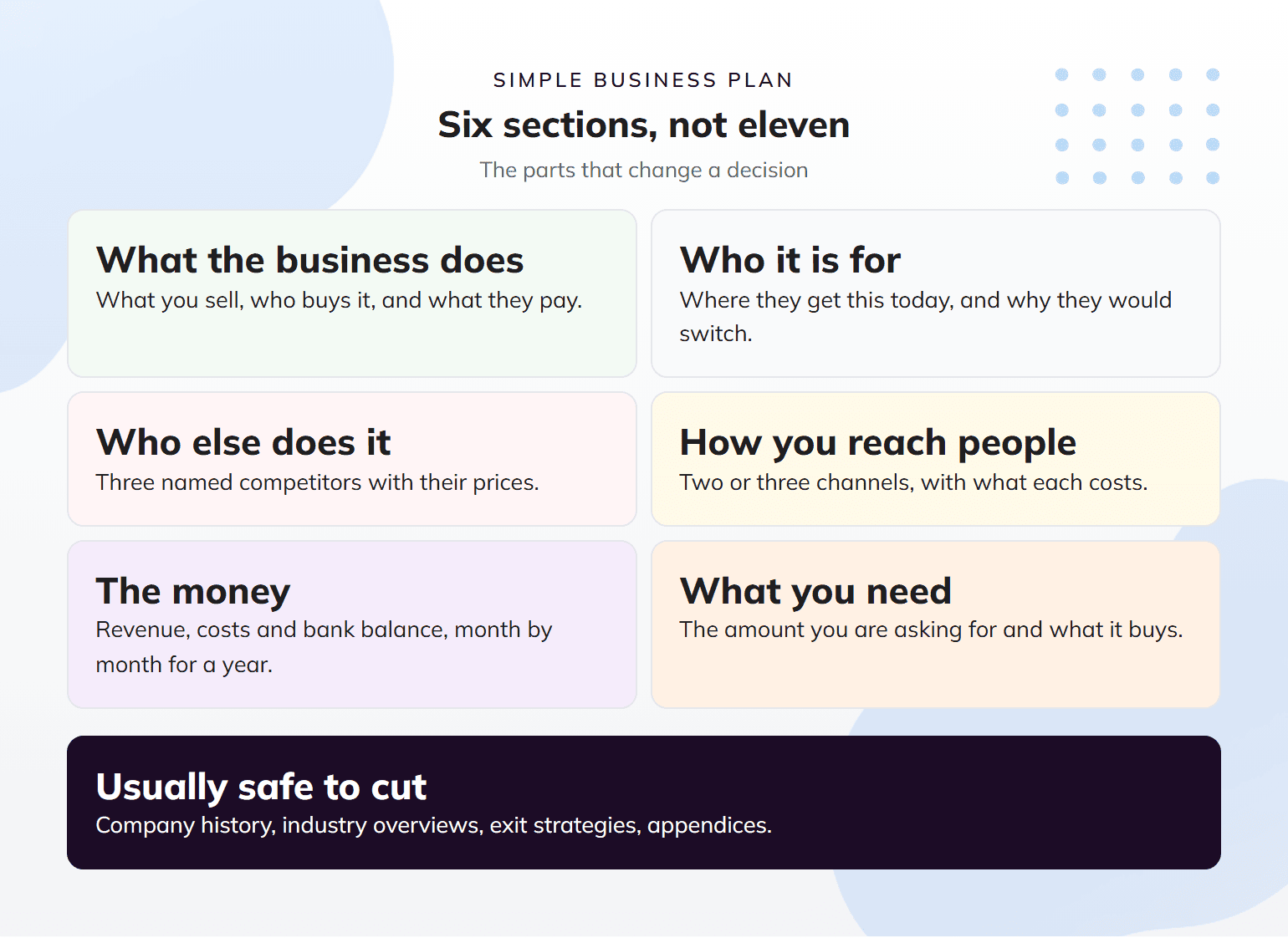


Six chapters, and four you can drop
A simple plan is not a worse plan. It is the same thinking with the padding removed. These are the parts that still have to be there, and the ones that usually do not.
Keep these six
What the business does
One paragraph. What you sell, who buys it, and what they pay. If this takes a page you have not decided yet, and no amount of further writing will fix that.
Who it is for
A real description of the customer, not a demographic range. Where they currently get this, what annoys them about it, and why they would switch.
Who else is already doing it
Three named competitors with their prices. This is the section people skip, and it is the one a lender reads to see whether you have looked outside your own head.
How you reach people
The two or three channels you will actually use, and what you expect each to cost. A list of nine marketing ideas reads as a plan to do none of them.
The money
Revenue, costs, and what you have in the bank, month by month for a year. Even the shortest plan needs this, and it is the part that cannot be waved through.
What you need and what it buys
If you are asking anyone for money, the amount and what it is spent on. If you are not, what you are funding it from instead.
These can usually go
The long company history
Relevant if there is a track record worth citing. Otherwise it is a paragraph about registering an LLC.
Industry overviews
Market size figures copied from a report say nothing about whether your business works. Keep it only if your plan turns on a trend you can evidence.
Exit strategies
Serious for an investor-facing plan. For a short plan written to get a decision made, it is filler.
Appendices
Attach documents if they are asked for. A simple plan does not need a numbered appendix referencing them.
The order to fill it in
Not top to bottom. Each step here produces something the next one needs, which is why the financial section comes near the end rather than being the thing you stare at first.
Write the money section's inputs first, on paper
15 minutesYour price, what each sale costs you to deliver, and how many you expect in a normal week. Three numbers. Everything downstream depends on them, and guessing them at the end is how plans end up internally inconsistent.
Go and read three competitors properly
30 minutesTheir pricing pages and their recent reviews. Write down what customers praise and what they complain about. This single half hour produces the competitor section, most of the customer section, and usually a change to your own pricing.
Fill in the two sections you already know
20 minutesWhat the business does, and who it is for. You have been explaining these out loud for weeks. Write them the way you say them, then stop. Resist smartening up the language.
Pick two channels and cost them
20 minutesNot a list of everything possible. Two, with a number next to each. If you cannot put a cost against a channel you have not thought it through enough to include it.
Now build the twelve months
60 minutesRevenue from your three inputs, costs from real quotes, and a running cash balance underneath. The cash line is the one that matters: a business can be profitable on paper in month three and still run out of money in month two.
Read it as the person receiving it
15 minutesLandlord, lender, partner, whoever asked. Every paragraph that would not change their answer comes out. This usually removes a fifth of what you just wrote, and it is the step that makes it a simple plan rather than a short one.
What those six chapters look like written out
A made-up mobile bike repair round, because the numbers stay small enough to check. Notice how short each answer is, and that every claim about competitors came from half an hour of reading reviews.
That is roughly 380 words and it answers every question a landlord, a supplier or a cautious relative would ask. A bank would want more, which is the whole point of choosing the length on purpose.
Is a simple plan the right one here
Length should be set by whoever is going to read it. Writing forty pages for a decision that needed six wastes a week, and handing six pages to a bank that wanted forty wastes the application.
A short plan is enough if
You are deciding whether to start at all, and need to see the numbers in one place
A landlord or supplier asked for something in writing before signing
You are applying for a small grant or a local programme with its own short form
You run the business already and want a plan you will actually re-read each quarter
You are briefing a co-founder, a first hire or an accountant
Go longer if
An SBA loan or any bank application
Raising from investors
You will be asked for a longer horizon than a simple plan covers
An immigration case, such as an E2 visa
You want it shorter still, on a single sheet
Wondering whether a lean plan is the same thing? Our guide to lean business planning covers where the two overlap and where they do not.
Want it short and still accurate? Upmetrics does the numbers.
Simple, lean, basic, standard
These get used as synonyms and two of them are not. Worth thirty seconds before you download the wrong one.
- Simple or basic
Not a defined format. People mean the standard plan with the ceremony taken out: fewer sections, plain language, no appendix. That is what this page gives you.
- Lean
A real named thing, from lean startup practice. It is a one-sheet canvas of problem, solution, channels and costs, meant to be revised constantly rather than finished. Useful for testing an idea, not for handing to a lender. Closest to our one page template.
- Standard
Confusingly, this usually means the long one. If a lender or a programme asks for a standard business plan, they want the full set of sections, not a short version. That is the full template.
- Printable
Just a format question. Every version here is set up for letter and A4 with sensible margins, so printing it does not split tables across pages.
- Outline
The headings without the guidance. If that is all you want, delete the help text from any of these files and you have one.
Not quite the right one?
Same template underneath. What changes is the guidance around it, and which sections do the work.
- Startup business plan templatePre-revenue, forecasting from assumptions with no trading history behind you.
- Small business plan templateAlready trading, writing from your own accounts rather than guesses.
- One page business plan templateThe whole business on a single sheet, with a worked example.
- 5 year business plan templateYear one monthly, years two to five annual, for a longer horizon.
- Nonprofit business plan templatePrograms, funding mix, governance and the impact section funders score.
Or go back to the full business plan template.

A short plan still needs the financials to add up
Answer the prompts and the projections, cash flow and balance sheet build themselves, however long the rest of it runs.
- No risk
- Cancel at any time
- 15 Day money back guarantee