Executive Summary
A lot of freelancers and small teams require a space between working at home and signing a long-term office lease. CommonDesk Coworking is a quiet and flexible space located in the centre of Austin, targeted to freelancers, remote workers, and small teams.
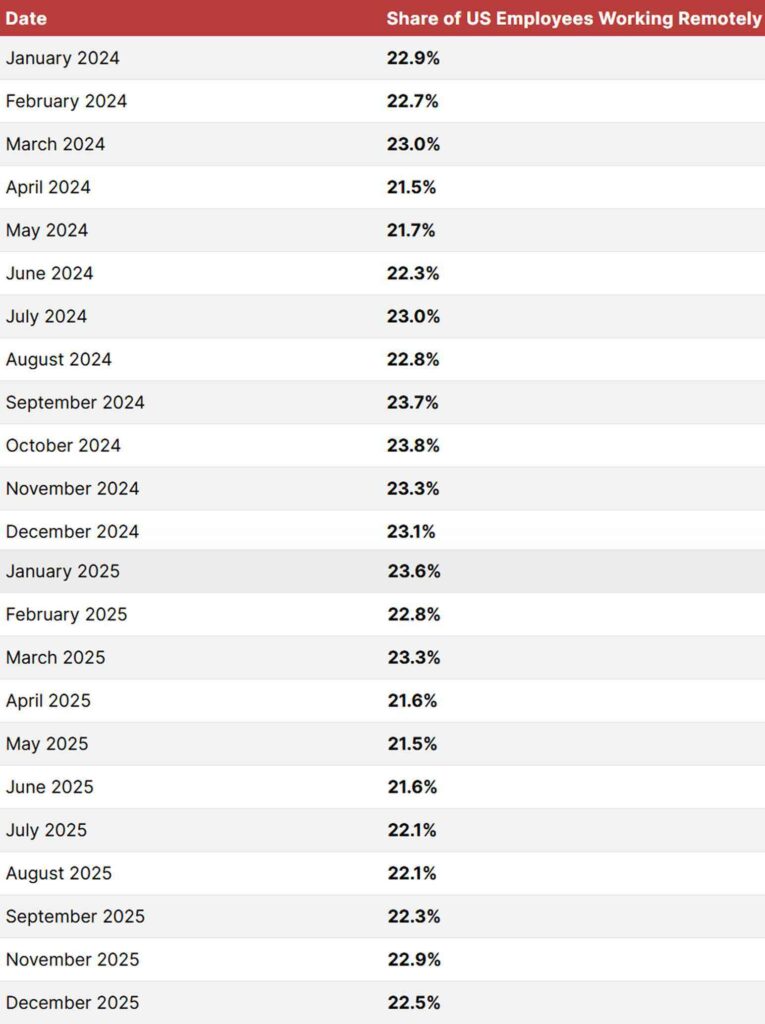
Importantly, the demand shows a greater shift in the way individuals work professionally. The United States Bureau of Labor Statistics reported in December 2025 that 22.5% of employees in the US were working from home. In cities such as Austin, where the number of freelancers and small businesses is increasing, individuals are becoming more interested in short-term, membership workspaces, rather than long-term office rent.
CommonDesk is located at 312 E 6 th Street, Suite 200, Austin. It is a small coworking space that is 3,000 square feet, rented to freelancers, remote workers, those who start their own businesses, and small teams.
It offers open desk membership, fixed desk membership, a limited number of private office memberships, and a shared meeting room. Every decision is made to remain basic and reasonable, allowing members to select only what they require without a long-term contract. Austin’s local market supports this positioning.
The downtown and surrounding neighborhoods are packed with freelancers, consultants, and small teams with unusual working hours. They prefer to be near the business center. So, those local concentrations allow a small, membership-based workspace to perform effectively without numerous and/or large contracts.
Jamie Collins is the owner and operates the business on a daily basis. He manages operations, recruits new members, receives payments, conducts business with vendors, takes care of the facility, and establishes community rules. As there are no W-2 workers at launch, the owner manages daily operations directly and relies only on limited contracted services for janitorial support and IT maintenance. Hence, the fixed costs are low, and decisions are simple to make.
To establish and support this operating model, the business requires a total startup capital of $210,000.
| Funding Category | Amount (in $) |
|---|---|
| Bank Term Loan (Bank of America, N.A.) | 120,000 |
| Owner Contribution | 90,000 |
| Total Startup Funding | 210,000 |
Startup funds are used for leasehold improvements, furniture and equipment, deposits and prepaid expenses, launch marketing, as well as early operating support.
Financial performance is modeled on gradual space utilization rather than rapid membership growth. In the first year, the business anticipates occupancy of approximately 45% of the space. The usage will increase in year two due to the increase in memberships every month and then stabilize. By following this trend, the business will be even in its second year since the membership revenues will increase as the expenses remain minimal.
CommonDesk is a realistic, owner-managed enterprise that operates cautiously, makes reasonable assumptions, and is established to operate steadily rather than grow rapidly.

Business Overview
Legal Structure
CommonDesk Coworking is a single-member limited liability company. This allows the owner to retain all decision-making and maintain a separation between personal and business liability.
Location and Facility
CommonDesk is ideally located at 312 East 6th Street, Suite 200, Austin, TX, in a central area that is easily accessible for local professionals. The space is situated near downtown business districts and residential zones, making it highly convenient for freelancers, remote workers, and small teams. That local density maintains a stable demand of flexible working environment and removes lengthy commutes.
One of the key advantages of this location is the ample parking available nearby. With several parking spots in close proximity, CommonDesk provides members with a hassle-free, accessible work environment, making it a preferred choice for those who commute by car. This accessibility adds significant value, especially in urban areas where parking can be a challenge.
The business measures approximately 3,000 square feet and requires minor interior modification in the walls, lights, signs, and wires. It does not require any large-scale construction, thus it can be opened fast and with minimal risk of construction.
Ownership and Management
CommonDesk is a sole proprietorship of Jamie Collins, who runs it and is the general manager. He has operated shared workspaces and small service businesses previously and managed the facility, customer service, and day-to-day work. That provides him with actual insight into member requirements, vendors, and workspace operation.
Owner responsibilities include:
- Day-to-day operations and facility oversight
- Member onboarding and billing
- Vendor and service coordination
- Marketing oversight and community standards enforcement
By combining ownership and management into a single role, the business maintains clear accountability and cost control while ensuring consistent service delivery without requiring full-time staff at launch.
Mission and Vision
CommonDesk would like to provide freelancers, telecommuters, and small groups with a dedicated workspace, which allows them to work effectively without a lengthy lease.
The vision of the company is to build a consistent, community-oriented coworking facility that maintains a consistent crowd, retains members, and maintains low costs.
Business Model
CommonDesk follows a membership-based coworking model focused on predictable, recurring income. A significant portion of the revenue comes from private offices, which make up 80% of the total square footage.
The space aims to allocate 60–75 square feet per person in private offices, ensuring comfort and privacy while optimizing for profitability. This efficient use of space helps the business maximize revenue from each member while maintaining a balanced, productive work environment.
Primary revenue sources include:
- Open desk access
- Dedicated desk memberships
- Private office rentals (1–3 people)
Secondary revenue sources include:
- Meeting room bookings
- Printing and basic office services
Memberships are offered on flexible terms, allowing the business to serve hybrid workers while maintaining operational consistency. The business prioritizes stabilizing occupancy over rapid expansion.
Business Goals
CommonDesk will expand gradually and will gauge its success within the first three years of operation.
Year 1 Goals
- Attain an average of 45% of occupancy between the types of memberships.
- Check monthly fixed operating costs on a monthly basis and maintain the projected limits.
- Maintain a low operating level of capital to meet initial operating expenses.
Year 2 Goals
- Increase average occupancy to approximately 70% as memberships build steadily month over month.
- Achieve operating break-even through recurring membership income rather than one-time bookings.
- Maintain cost discipline while scaling utilization to protect margins.
- Strengthen member retention through consistent service delivery and community engagement.
Year 3 Goals
- Maintain occupancy at 75% or higher on a sustained basis.
- Generate consistent positive net income and strengthen operating cash flow.
- Operate profitably from a single location without pursuing premature expansion.
- Preserve service quality while maintaining capacity balance and cost control.
These objectives are directly correlated with the financial model and indicate a restrained, step-by-step strategy instead of growth by force.
Service Offerings
Membership Types
CommonDesk offers a small set of clearly defined membership options designed to meet the needs of freelancers, remote workers, and small teams without unnecessary complexity.
Open Desk Access
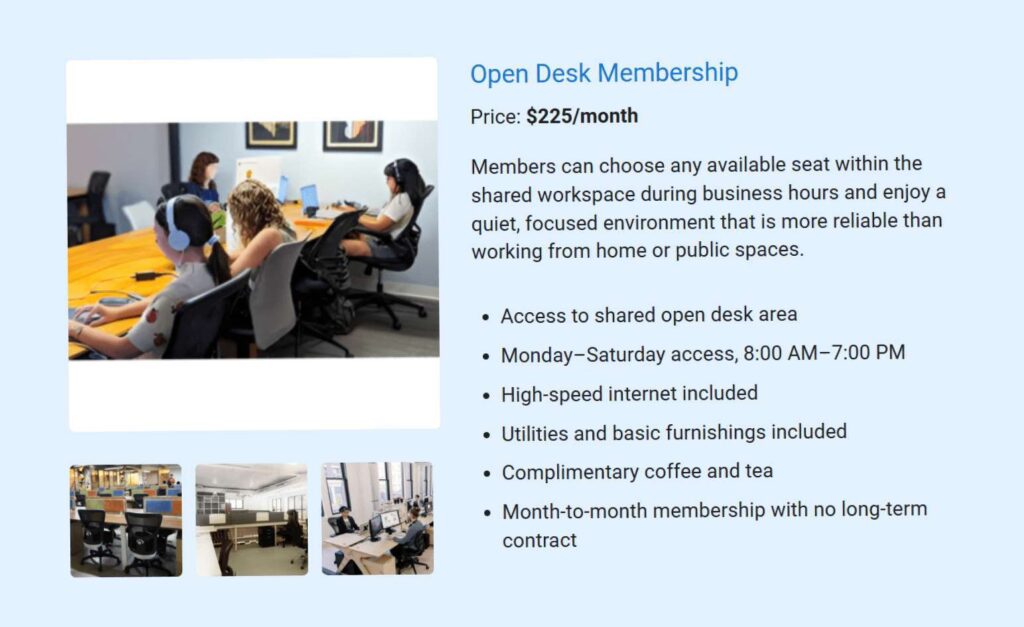
The open desk service is designed for freelancers and remote workers who need a professional place to work without committing to a fixed desk.
Dedicated Desk Membership
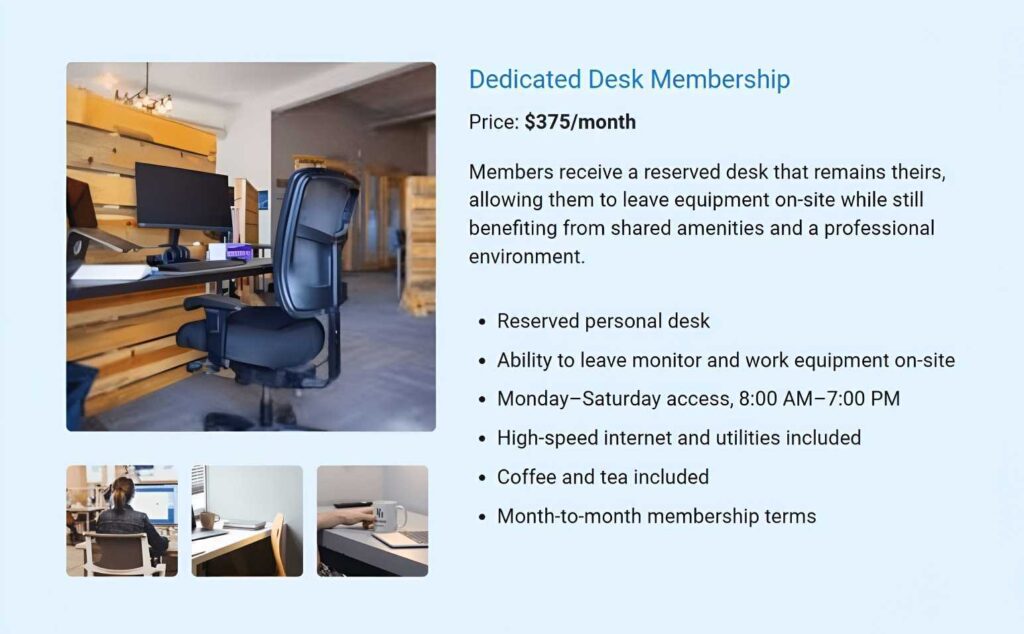
Dedicated desk membership is designed to accommodate professionals who want to have a consistent working table but are not interested in renting an individual office.
Private Offices
These are small teams or professional areas where individuals require privacy to work or hold client meetings.
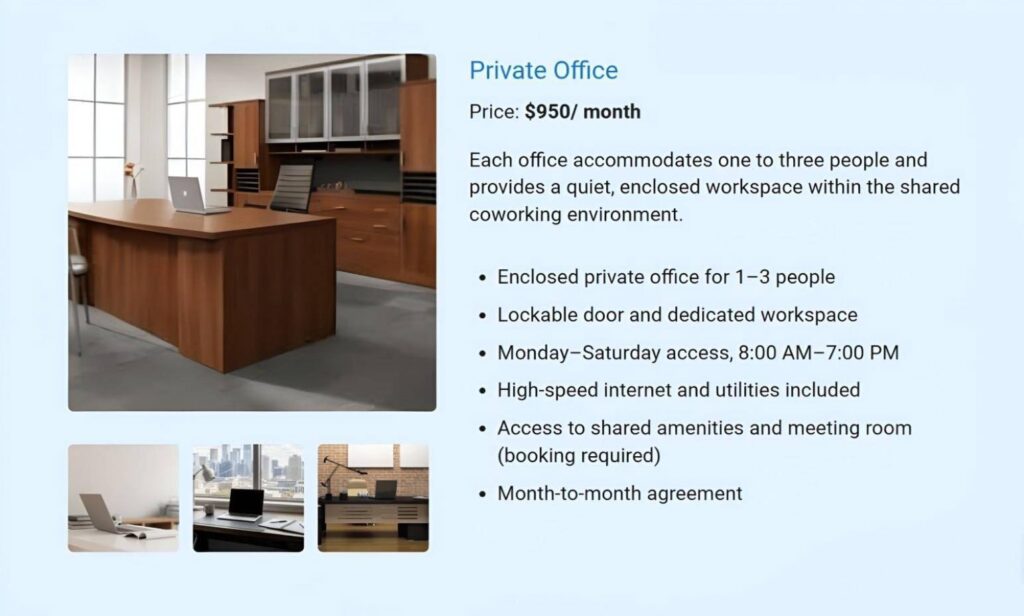
Add-On Services
Members can purchase additional services based on usage.
- Meeting room bookings: $40 per hour
- Printing and scanning services
These services generate supplemental revenue while supporting day-to-day workspace needs.
Pricing Structure
Pricing is built around simple monthly memberships designed to match how freelancers, remote workers, and small teams actually use coworking space. The same rules apply to all plans in order to have predictable and transparent costs.
| Pricing Element | Structure |
|---|---|
| Billing Cycle | Monthly, billed in advance |
| Contract Terms | Month-to-month, no long-term commitment |
| Price Variation | Based only on workspace type, not usage |
| Access Hours | Monday-Saturday, 8:00 AM-7:00 PM |
| Included Costs | Internet, utilities, furnishings, coffee, and tea |
| Setup/Initiation Fees | None |
| Enterprise/Bulk Pricing | Not offered |
| Short-term/Trial Access | Limited and offered selectively |
Included Amenities
All memberships include the following standard amenities, regardless of plan type:
- High-speed internet suitable for professional use
- Utilities and basic workspace services
- Desk access with standard furnishings
- Access to shared common areas
- Complimentary coffee and tea
- Mail handling for members
- On-site owner support during business hours
Services Not Offered
CommonDesk does not offer:
- Virtual office services
- Large event space rentals
- 24/7 access at launch
The business also does not support long-term enterprise leases or corporate office build-outs, allowing the space to remain focused on small-scale, flexible use.
Market Research
Local Work Patterns in Austin
The coworking demand in Austin reflects the way individuals work now. A large number of U.S. employees continue to work remotely or combine work and home. This implies that not as many people require full-time offices, yet they still require flexible spaces.
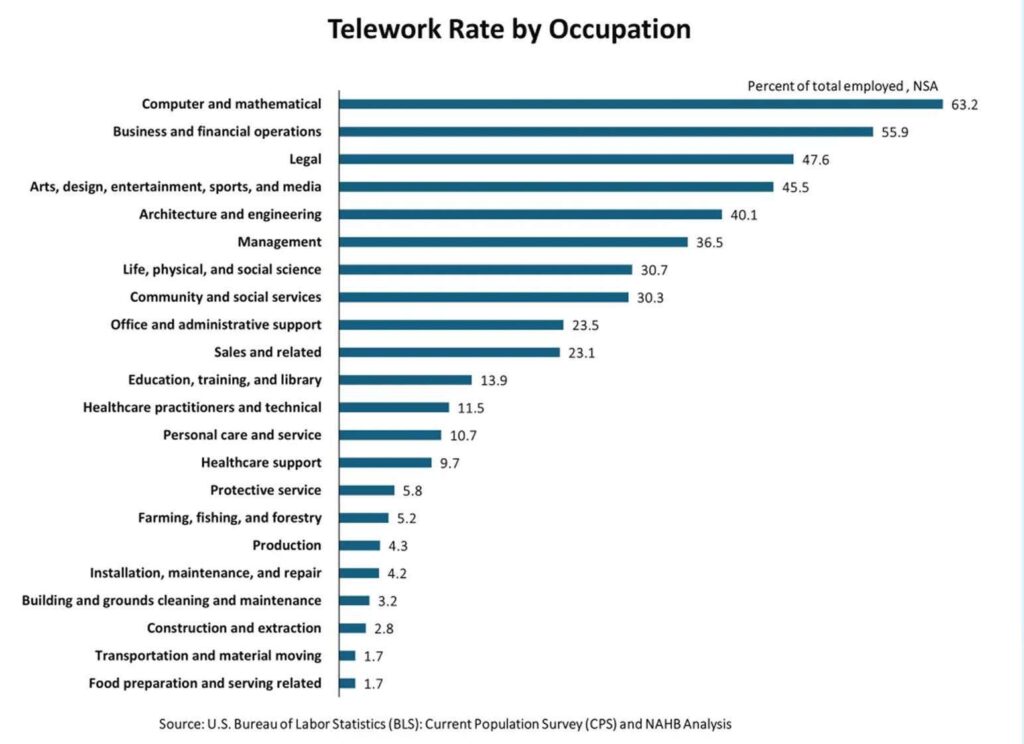
According to a survey conducted recently, 34.3 million Americans (approximately 21.6% of workers) will be paid to work at home in April 2025. Remote workers have remained roughly unchanged in the recent past, which indicates that it is a long-term movement and not a one-off spike.
Professional jobs requiring knowledge make remote work most prevalent. According to a recent BLS report, individuals in computer, math, business, finance, law, and design work from home most frequently. These occupations are befitting the market of Austin that is home to numerous tech companies, consultants, creative employees, and small service organizations.
Most home-based workers continue to need a well-organized, stable place to work with a coworking space such as CommonDesk. They generally do not require lengthy office leases.
Local Coworking Growth
According to a report by the Austin American-Statesman, which cited the Coworking Café study, Austin had 19 more coworking spaces added between 2023 and 2025, a 33% increase. This is what makes Austin one of the fastest-growing coworking markets in Texas.
It shows that the demand for flexible work areas is a long-term phenomenon, not a fad. The emergence of new coworking spaces means that freelancers, consultants, and small businesses continue to seek alternatives to the old office rental system.
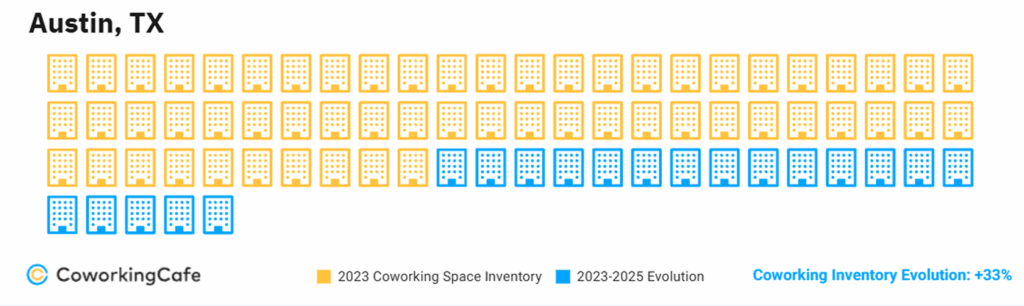
Many coworking spaces in Austin, including those established in 2023, maintain an average occupancy rate of around 75%. This shows that the demand for coworking spaces is strong and stable. The significant growth in coworking spaces, along with this high occupancy rate, suggests that professionals in the area are increasingly opting for flexibility. That validates the need for more spaces like CommonDesk.
Office Vacancies and Demand for Flexibility
The relevance of coworking can also be attributed to the regular office market in Austin. According to local reports, in late 2025, downtown office vacancy exceeded 22%, which means that there are numerous companies that are reducing or failing to sign long-term leases.
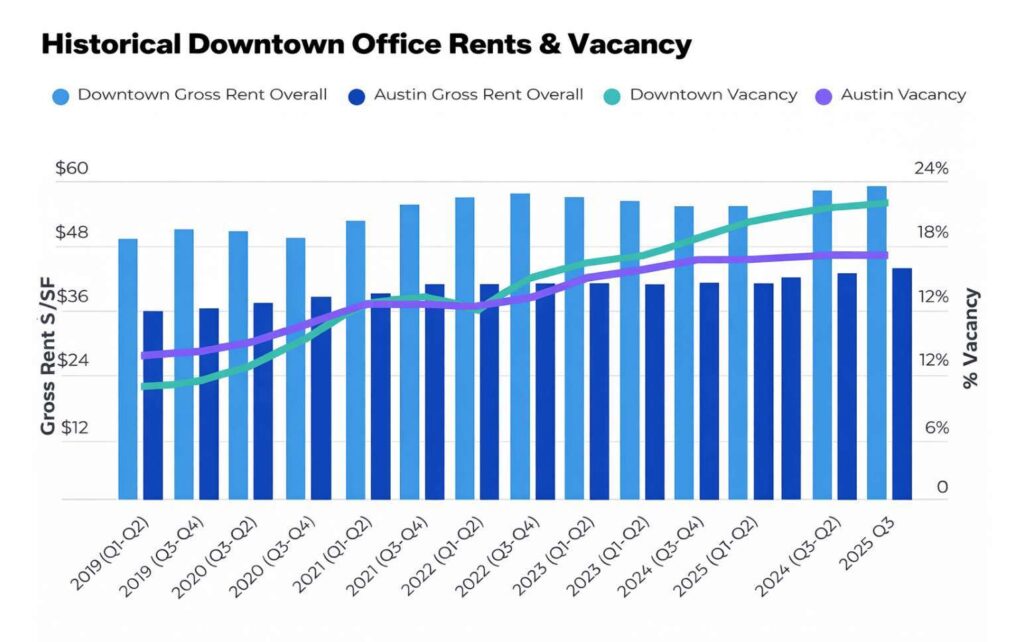
When companies and independent professionals hesitate to commit to office space, coworking becomes a practical alternative that fills the gap between home offices and conventional leases. This dynamic supports steady, everyday use rather than short-term or trend-driven demand.
Market Fit for a Small-Scale Coworking Model
CommonDesk’s market doesn’t rely on the overall workforce in the city, but on the number of local professionals who require a quiet place to work a few days a week.
With a small number of users, a building with a few desks and offices, which is only 3,000 square feet, is sufficient. It only requires a stable pool of local professionals who can easily commute, and Austin already has such.
The parking area is also very close to the location of CommonDesk, and the members who drive can easily park. There are cafes, lunch places, and a public library situated nearby, so the area is conducive to coworking.
The fact that a large number of individuals work in these locations remotely means that there is a high demand for flexible working spaces. All this makes the place quite appealing to individuals who intend to work long days without the need to drive their vehicle or find parking.
Target Customers
CommonDesk primarily serves independent professionals and small teams who require flexible workspace without long-term lease commitments. The target market is defined more by work style than by industry alone.
Primary Segments
- Independent professionals in technology, design, marketing, finance, and legal services who work remotely but need a professional setting for focused work or client meetings.
- Individuals employed by companies outside Austin or operating on hybrid schedules who require a structured workspace several days per week.
- Early-stage businesses or project-based teams that need shared workspace without committing to multi-year office leases.
Geographic Focus
The primary service area includes downtown Austin and nearby residential neighborhoods within a reasonable commuting radius. Members are typically located within a short travel distance and prefer central access over suburban office parks.
Customer Characteristics
- Value predictable monthly costs
- Prefer flexible, month-to-month terms
Competitive Landscape
The coworking development in Austin demonstrates that individuals continue to require this type of space, but operators are becoming more competitive. As availability increases, individuals evaluate location, pricing, work environment, and contract flexibility rather than brand name.
Direct Competitors
Direct competitors are local coworking spaces that offer similar desk and office-based memberships and target the same types of users as CommonDesk.
| Competitor | Location | Why They Compete | Strengths | Weaknesses |
|---|---|---|---|---|
 Capital Factory |
Downtown Austin | Offers coworking desks and offices for startups and independent professionals | Large facility, strong brand recognition, active startup network | High density, event-focused environment, less suited for quiet daily work |
 Createscapes |
East Austin | Serves freelancers and small teams with shared and private workspaces | Established local presence, creative community focus | Smaller availability, less emphasis on quiet or controlled capacity |
 Fibercove |
Central and South Austin | Targets independent professionals and small creative teams | Flexible options, multiple locations | Locations spread out, less centralized access for downtown users |
 Link Coworking |
East Austin | Provides flexible coworking options with month-to-month access | Flexible terms, community-driven model | Shared space density can vary, and noise levels are less predictable |
These spaces are head-to-head since members tend to compare them with each other. Location, price, noise, and general feel lead to a decision, and when someone can find another place that would fit their routine better or feel better, they may change their mind.
Indirect Competitors
These are the alternatives that are not the conventional coworking spaces, yet compete with the same work hours and user requirements.
| Competitor Type | Examples | Why They Compete |
|---|---|---|
| National coworking brands | WeWork, Industrious | Offer professional offices, but often with higher costs or longer commitments |
| Informal workspaces | Coffee shops and cafés | Used as low-cost alternatives by freelancers for short work sessions |
| Traditional offices | Short-term office suites | Considered by small teams needing private space |
They are indirect competitors as they fulfill the same basic need of workspace, but at varying levels. In the long run, a good number of professionals drop out of coffee shops when the job becomes more formal, and they do not go to national brands or lease an office because it is too expensive.
CommonDesk is between large high-density coworking facilities and informal workspaces. It’s small, quiet, locally owned, and flexible, appealing to professionals who require a dependable workspace every week with no distractions, high prices, or long-term contracts.
Stop searching the internet for industry & market data
Get AI to bring curated insights to your workspace
Marketing and Member Acquisition
CommonDesk Coworking’s marketing strategy is designed to attract a constant stream of local members and not to grow fast. Because the business is located in a 3,000-square-foot space in downtown Austin, most prospective members are already in the vicinity; they just need to be aware of the space and how it fits their working schedule.
Marketing focuses on making the space easy to find and understand, rather than relying on wide promotional campaigns.
Primary Member Acquisition Channels
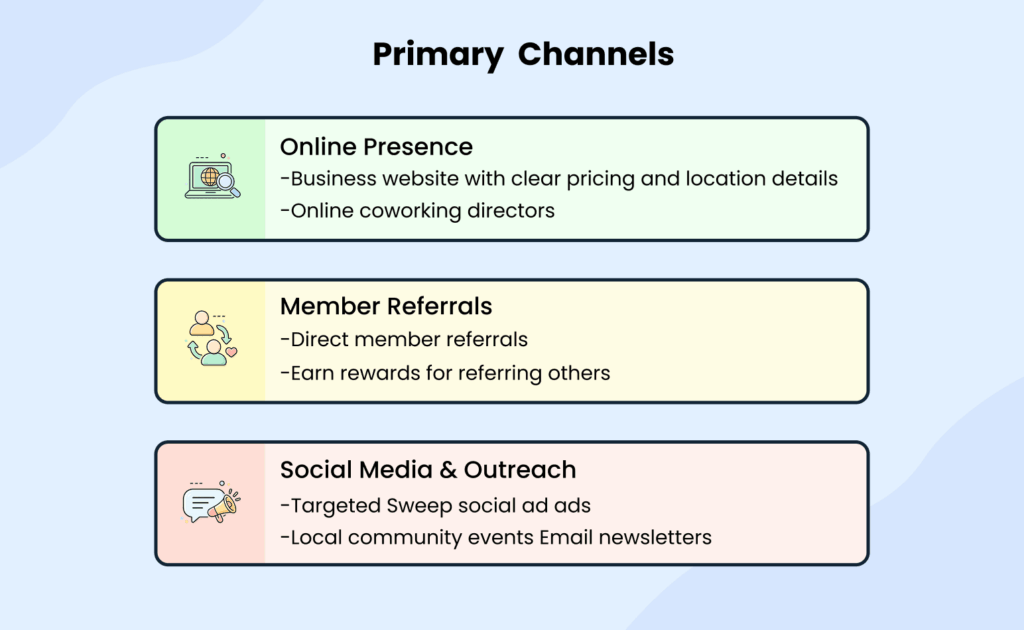
Most of the working professionals should find CommonDesk as they go on the hunt for coworking alternatives in Austin. Remote workers and freelancers usually scan the surrounding areas based on location, price, and the amenities of work daily. Therefore, search visibility and accurate listings are the most useful acquisition tools.
Primary channels include:
- Business website with clear pricing and location details
- Google Maps and local business listings
- Online coworking directories
- Direct member referrals
Secondary Marketing Channels
The exposure is further developed using a few secondary channels that promote awareness but do not incur unnecessary cost. Social media is primarily used to introduce the space and maintain credibility, and local professional networks help reach potential members through existing relationships.
Secondary channels include
- Social media presence
- Partnerships with local freelancers and consultants
- Selective paid listings or limited local ads
Influencer Marketing and Local Partnerships
To further engage the local community, CommonDesk will collaborate with local influencers and lifestyle brands that align with the target demographic. These influencers will represent the professional community CommonDesk caters to.
By partnering with 5-10 micro-influencers based in Austin, CommonDesk will offer one-month free memberships in exchange for vlog posts and social media content. This collaboration will generate organic exposure to a wider local audience.
Additionally, the business will launch referral agreements with local coffee shops and lifestyle brands. CommonDesk will offer members a 20% discount on future membership fees for every successful referral. These partnerships tap into already engaged local communities and help boost the business’s visibility through word-of-mouth.
Marketing Budget and Spend Control
CommonDesk keeps marketing spend focused on essential local visibility and avoids large-scale or high-frequency advertising.
It will invest $5,000 prior to the opening expense that will cover the cost of taking the business online, billboards, simple advertisement, and high-quality photos. This will help people get familiar with it before opening.
Once it is opened, Commondesk will invest approximately $500 monthly in marketing. This maintains the business in online searches, local directories, and local ads.
The owner will review spending periodically and adjust it depending on the number of members it actually obtains rather than how many are anticipated. This makes marketing reasonable and within the business’s size.
Local Visibility and Conversion
Since the majority of the potential clients are local, initial impressions are crucial in conversion. Well-placed signage, proper working information, and current photos will help potential clients quickly find out what is available in the space and whether it suits their purposes.
Referral-Based Growth
In the long run, CommonDesk expects that the referrals will result in incremental new memberships. Individuals who appreciate the peaceful, professional atmosphere will probably refer their colleagues with similar work preferences to the space. This will ensure steady occupancy and lower the churn rates.
The company’s marketing strategy, in general, favors slow and steady client onboarding. It will never rely on promotion, as it emphasizes search visibility, low expenditure, and referrals, keeping the acquisition strategy in check.
Operational Plan
The operations at CommonDesk are structured in such a way that they facilitate a low-friction, predictable work environment with routines and direct owner supervision. Instead of using layered processes or handing off staff, the business runs on simple, repeatable workflows that ensure that the space runs in a smooth day-to-day manner.
Operating Hours
CommonDesk operates Monday through Saturday from 8:00 a.m. to 7:00 p.m. These defined hours allow the owner to remain on-site during all active member use rather than relying on unattended access. By avoiding 24/7 entry at launch, the business reduces the risk of unauthorized access, after-hours incidents, and unnecessary utility consumption.
Daily Operating Rhythm
Each business day follows a consistent pattern to ensure members arrive at a ready, functional workspace.
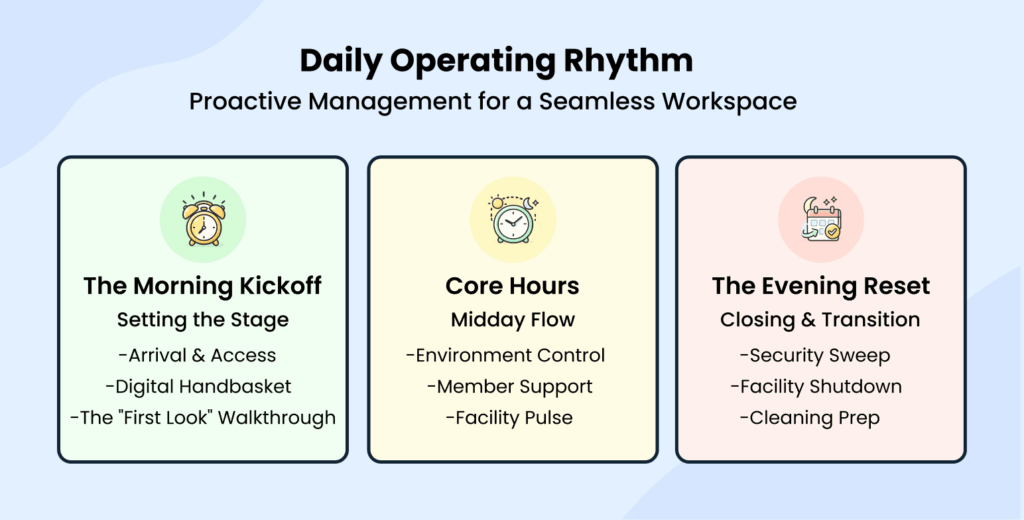
This routine minimizes disruption and allows issues to be addressed immediately rather than escalating into larger problems.
Member Access and Usage Control
CommonDesk limits member access to defined operating hours, which keeps supervision straightforward and day-to-day management under control. By setting clear access boundaries, the business reduces security and maintenance risks and allows the owner to stay closely involved throughout the day.
Meeting rooms require advance booking and are billed hourly. Guest access is limited to one guest per member at a time, and guests must remain with the hosting member during their visit.
Open desk areas operate under a quiet-use policy, and phone calls are restricted to designated areas. These guidelines maintain a quiet and professional working environment without adding operational complexity.
Billing and Administrative Controls
CommonDesk charges its members using an online payment platform such as Stripe and scheduling NPM. Monthly fees are paid in advance using stored credit or debit cards. The owner reviews the reports of the bills frequently to ensure that payments are made and that they are reconciled with receipts.
As soon as members switch their plan or cease using the space, the owner makes appropriate changes in the records in the system to ensure that nothing goes wrong.
Failure to make any payment within five business days after the due date attracts a late notice to the member. In case the payment is not received yet, the member’s access can be temporarily suspended until the balance is paid. The rule ensures that the cash of the company remains stable.
Auto-billing and direct check by the owner will help minimize errors and eliminate the need to employ additional office staff.
Oversight and Issue Resolution
With access and billing under direct control, the owner maintains full visibility into daily operations and responds immediately when issues arise.
If the internet goes dead, the owner would call the provider that same day, inform members when it is going to be fixed, and pull over a portable hotspot in case of necessity.
If there’s a heating or cooling issue, the owner calls the technician and alters the space usage to keep people comfortable until the issue is resolved.
In case of a security or safety issue like an intruder, the owner would address it during business hours and make a phone call to building management or the police in case of an emergency.
That way, the owner of CommonDesk minimizes outages and maintains a predictable, constant environment for the members by correcting minor issues promptly and relying on contacts to resolve larger issues.
Operating Discipline and Risk Control
CommonDesk mitigates risk by establishing strict guidelines and adhering to them. There is no unmonitored access, and the hours are limited to reduce illegal entry and after-hours liability. Members have written rules that outline how to conduct themselves, the workspace regulations, and rules on liability before anyone uses the space.
The owner maintains a good relationship with the internet, utility, HVAC, and cleaning vendors to seek immediate assistance in case something is wrong. The company is also insured against sudden events and has some general liability, property, and business interruption insurance.
As the memberships are monthly rather than long-term leases, CommonDesk is in a position to update the price, the number of people the space will accommodate, or the room configuration in case the demand changes. This allows the owner to respond promptly to changes in the market yet maintain the business intact.
Licensing, Compliance, and Insurance
CommonDesk adheres to the city of Austin and the state of Texas regulations for a commercial coworking space. Prior to opening, the owner registers the business with the state and obtains the necessary City of Austin business licenses.
The city issues the space with a Certificate of Occupancy before the commencement of operations to ensure that the building complies with the approved use, safety, and code requirements.
The facility complies with:
- Austin Fire Department safety requirements
- Building occupancy limits established by local code
- ADA accessibility standards
- Applicable Texas sales tax regulations for membership-based services
The owner maintains documentation of inspections and ensures continued compliance through periodic internal review.
To manage operational risk, the business maintains:
- General liability insurance
- Commercial property coverage for furnishings and equipment
- Business interruption insurance
These policies protect the owner, members, and the facility while aligning coverage with the scale of a single-location operation.
Financial Plan
Financial performance is modeled on gradual space utilization, beginning with an average occupancy of 45% in Year 1 and increasing in Year 2 as memberships build month over month. Under this structure, the business records an initial operating loss in Year 1, reaches operating break-even in Year 2, and generates positive cash flow as occupancy stabilizes.
Startup Costs
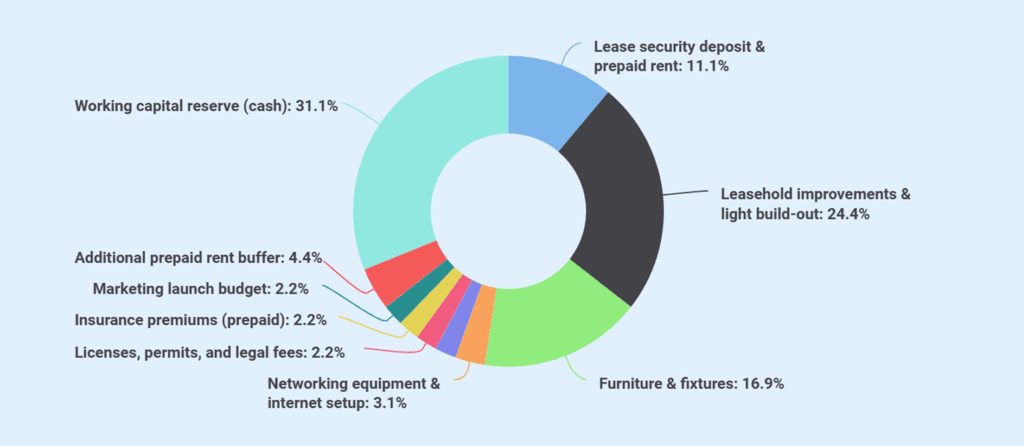
| Startup Cost Category | Amount (in $) |
|---|---|
| Lease security deposit & prepaid rent | 25,000 |
| Leasehold improvements & light build-out | 55,000 |
| Furniture & fixtures | 38,000 |
| Networking equipment & internet setup | 7,000 |
| Signage & branding | 5,000 |
| Licenses, permits, and legal fees | 5,000 |
| Insurance premiums (prepaid) | 5,000 |
| Marketing launch budget | 5,000 |
| Additional prepaid rent buffer | 10,000 |
| Working capital reserve (cash) | 70,000 |
| Total Startup Costs | 210,000 |
Treatment notes:
- PP&E capitalized: build-out, furniture, networking ($100,000 total)
- Deposits & prepaids recorded as current assets: $40,000
- No startup costs expensed before operations
- Opening retained earnings = 0
Source of Funds
| Source | Amount (USD) |
|---|---|
| Owner equity contribution | 90,000 |
| Bank term loan (Bank of America, N.A., 7-year, 8.25% fixed) | 120,000 |
| Total Sources of Funds | 210,000 |
Key Financial Assumptions
| Factor | Assumption |
|---|---|
| Business model | Membership-based coworking |
| Open desk capacity | 40 desks |
| Dedicated desk capacity | 12 desks |
| Private office capacity | 6 offices (1–3 people each) |
| Meeting room availability | 1 shared meeting room |
| Meeting room utilization | Year 1: 10 hrs/week; Year 2: 18 hrs/week; Year 3: 20 hrs/week |
| Owner compensation | No salary modeled |
| Staffing model | Owner-operated, no W-2 employees |
| Membership billing | Monthly, collected in advance |
Revenue Assumptions
| Item | Pricing |
|---|---|
| Open desk membership | $225 / month |
| Dedicated desk | $375 / month |
| Private office | $950 / month |
| Meeting room | $40 / hour |
| Printing | $0.15 / page |
Average occupancy assumptions
- Year 1: ~45% average per membership type
- Year 2: ~70%
- Year 3: ~75%
Revenue Forecast
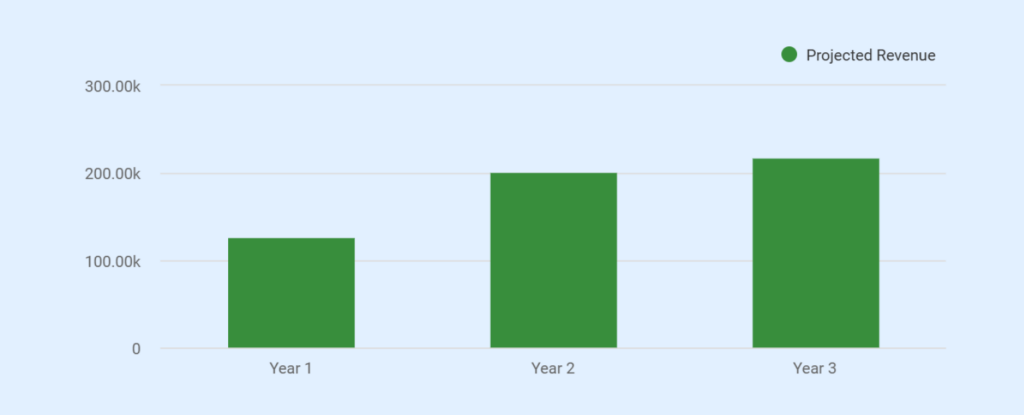
| Year | Projected Revenue ($) |
|---|---|
| Year 1 | 126,980 |
| Year 2 | 202,220 |
| Year 3 | 218,400 |
Projected Profit & Loss Statement (3 Years)
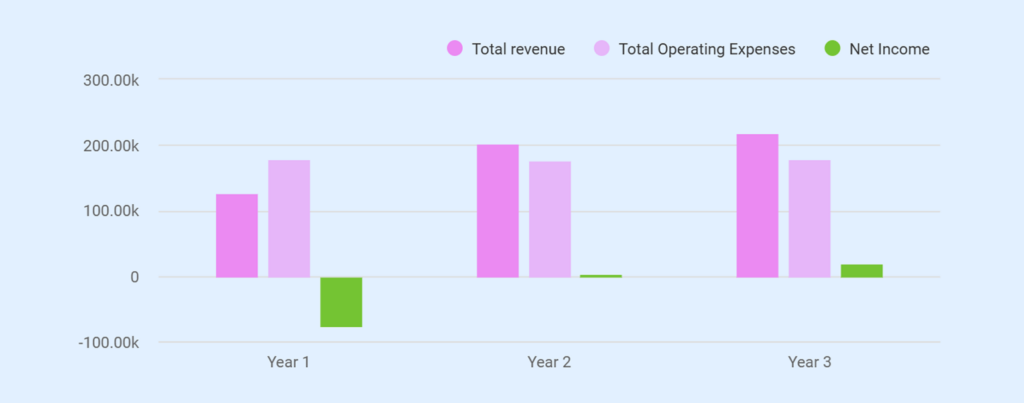
| P&L | Year 1 (in $) | Year 2 (in $) | Year 3 (in $) |
|---|---|---|---|
| Revenue | |||
| Open desk memberships | 48,600 | 75,600 | 81,000 |
| Dedicated desk memberships | 24,300 | 37,800 | 40,500 |
| Private offices | 30,780 | 47,880 | 51,300 |
| Meeting room bookings | 20,800 | 37,440 | 41,600 |
| Printing & misc | 2,500 | 3,500 | 4,000 |
| Total Revenue (Gross Profit) | 126,980 | 202,220 | 218,400 |
| Operating Expenses | |||
| Rent & CAM | 114,000 | 114,000 | 114,000 |
| Utilities | 14,400 | 14,400 | 14,400 |
| Internet | 4,800 | 4,800 | 4,800 |
| Insurance | 5,040 | 5,040 | 5,040 |
| Software & billing tools | 1,800 | 1,800 | 1,800 |
| Marketing (ongoing) | 6,000 | 6,000 | 6,000 |
| Marketing (launch, one-time) | 5,000 | – | – |
| Cleaning services | 16,800 | 16,800 | 16,800 |
| Coffee & refreshments | 7,200 | 8,400 | 9,600 |
| Supplies & minor repairs | 4,200 | 4,800 | 5,400 |
| Total Operating Expenses | 179,240 | 176,040 | 177,840 |
| EBITDA | (52,260) | 26,180 | 40,560 |
| Depreciation | 14,286 | 14,286 | 14,286 |
| Interest expense (loan) | 9,408 | 8,275 | 7,046 |
| Net Income (Pre-Tax) | (75,954) | 3,619 | 19,228 |
Cash Flow Statement
| Cash Flow | Year 1 (in $) | Year 2 (in $) | Year 3 (in $) |
|---|---|---|---|
| Operating Activities | |||
| Net income (pre-tax) | (75,954) | 3,619 | 19,228 |
| Depreciation (non-cash) | 14,286 | 14,286 | 14,286 |
| Net Operating Cash Flow | (61,668) | 17,905 | 33,514 |
| Investing Activities | |||
| Capital expenditures | – | – | – |
| Net Investing Cash Flow | 0 | 0 | 0 |
| Financing Activities | |||
| Loan principal repayment | (13,216) | (14,349) | (15,578) |
| Net Financing Cash Flow | (13,216) | (14,349) | (15,578) |
| Net Change in Cash | (74,884) | 3,556 | 17,936 |
| Opening cash balance | 70,000 | (4,884) | (1,328) |
| Ending Cash Balance | (4,884) | (1,328) | 16,608 |
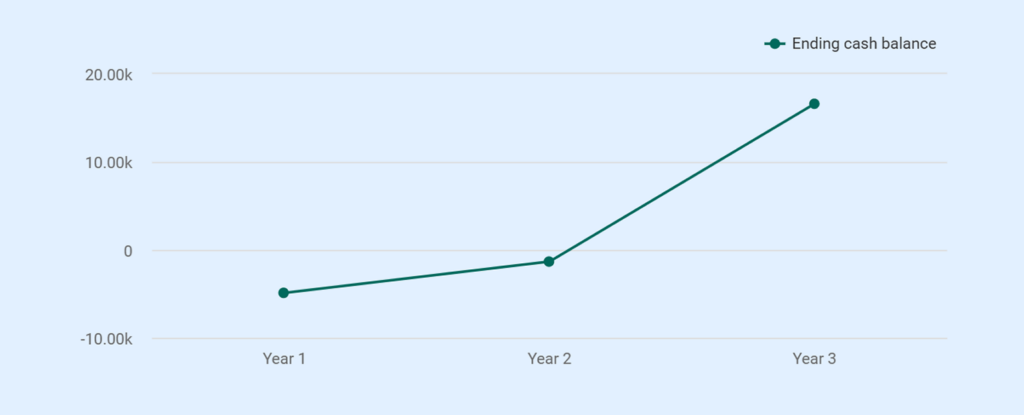
Here’s to note that the negative cash balances in Year 1 and Year 2 reflect initial investments in build-out, marketing, and working capital. While cash flow is negative in the early stages, the business is structured to manage these costs through owner equity and a bank loan.
As occupancy grows and membership revenue increases in Year 2, the business expects to reach positive cash flow by Year 3. The owner is committed to providing additional capital if needed to ensure liquidity during this phase.
Balance Sheet
| Balance Sheet | Opening (Start of Y1) (in $) | End of Y1 (in $) | End of Y2 (in $) | End of Y3 (in $) |
|---|---|---|---|---|
| Assets | ||||
| Cash | 70,000 | (4,884) | (1,328) | 16,608 |
| PP&E (gross) | 100,000 | 100,000 | 100,000 | 100,000 |
| Accumulated depreciation | – | (14,286) | (28,572) | (42,858) |
| Net PP&E | 100,000 | 85,714 | 71,428 | 57,142 |
| Deposits & prepaid expenses | 40,000 | 40,000 | 40,000 | 40,000 |
| Total Assets | 210,000 | 120,830 | 110,100 | 113,750 |
| Liabilities | ||||
| Term loan | 120,000 | 106,784 | 92,435 | 76,857 |
| Total Liabilities | 120,000 | 106,784 | 92,435 | 76,857 |
| Equity | ||||
| Owner equity | 90,000 | 90,000 | 90,000 | 90,000 |
| Retained earnings | 0 | (75,954) | (72,335) | (53,107) |
| Total Equity | 90,000 | 14,046 | 17,665 | 36,893 |
| Total Liabilities + Equity | 210,000 | 120,830 | 110,100 | 113,750 |
Loan Amortization Summary
| Year 1 ($) | Year 2 ($) | Year 3 ($) | |
|---|---|---|---|
| Opening balance | 120,000 | 106,784 | 92,435 |
| Principal paid | 13,216 | 14,349 | 15,578 |
| Interest paid | 9,408 | 8,275 | 7,046 |
| Ending balance | 106,784 | 92,435 | 76,857 |
Break-Even Analysis
| Item | Amount/Explanation |
|---|---|
| Average monthly fixed operating expenses | $14,700 |
| Annual fixed operating expenses | $176,040 |
| Variable operating expenses | Low and semi-variable (cleaning, coffee, supplies); treated as absorbed within fixed baseline for break-even purposes |
| Contribution margin | ~100% at the membership revenue level (no direct COGS) |
| Annual break-even revenue | ≈ $176,000 |
| Monthly break-even revenue | ≈ $14,700 |
| Break-even point achieved | Year 2 |
| Year 2 projected revenue | $202,220 |
| Break-even buffer (Year 2)** | ~$26,000 above break-even |
Funding Requirements
CommonDesk Coworking LLC is seeking $120,000 in bank financing to complete the startup and support early operations. This request sits alongside a $90,000 owner equity contribution, which is committed at closing and already reflected in the financial plan.
The amount of loan requested is sized to fund the initial construction and installation of the space and maintain the leverage moderate. The funding structure is also deliberately based on increased contribution of equity to minimize initial cash pressure and reinforce the total risk profile, as opposed to maximizing debt.
The initial capital package will supply sufficient funds to finish the build-out, finance the necessary deposits and prepaids, and keep sufficient working capital to cover the opening occupancy surge. Since operating expenses are relatively fixed and membership fees accumulate over time, this type of structure permits the company to survive without seeking outside funding within the stabilization period.
Overall, the funding request supports a controlled launch and steady path to break-even, without relying on aggressive assumptions or follow-on capital.
The Quickest Way to turn a Business Idea into a Business Plan
Fill-in-the-blanks and automatic financials make it easy.

Upmetrics
Upmetrics is the #1 business planning software that helps entrepreneurs and business owners create investment-ready business plans using AI. We regularly share business planning insights on our blog. Check out the Upmetrics blog for such interesting reads. Read more