


It’s not because they don’t know the competitors. They already know the obvious ones. But the trouble is knowing which ones actually matter and what to say about them.
- How many competitors would be enough?
- What details matter most?
- How to compare your business to theirs?
- How to explain your position in the market (without being overly optimistic)?
This often gets harder once you realize who’s reading it. Because when a lender, investor, or advisor reaches this section, they’re usually trying to answer one simple question: Do you really understand the market you’re entering?
They’re not looking for a long list of competitors. They want evidence that you researched the market, know where you fit, and have a realistic plan to compete.
And this is exactly where founders get stuck. Some write a long list of competitors with no real analysis. Others add details about their own business that never show how it stands out.
That’s what I’m going to help you fix. In this guide, I’ll walk you through how to identify the right competitors, gather the information that matters, and turn it into a competition section that’s clear and credible.
What is the competition section of a business plan, and why does it matter?
The competition section of a business plan is where you lay out who you’re up against, what makes your business different, and why someone would choose you over the other options out there.
A lot of founders mix this up with competitive analysis. The competitive analysis is the research process. The competition section is where you summarize the important findings from that research and explain what they mean for your business. You do the analysis first, then write the section.
A typical competition section covers:
- Your main competitors
- What those competitors offer
- How your business compares
- Your position in the market
- The advantages that help you compete
So why does this section matter? Mostly because it’s how readers judge whether your plan is realistic. Investors, lenders, and advisors don’t expect you to have zero competition. They want to see that you understand the market, know what options customers already have, and have a real plan to compete.
It helps you, too. Working through your competitors shows you the gaps in the market, the openings to stand out, and the spots where your assumptions don’t hold up. It’s better to catch that now than after you’ve launched.
A strong competition section answers all this clearly and backs it with research. A weak one leans on vague claims, skips over competitors, or never explains how the business fits.
How to identify and categorize your competitors?
Before you write anything, you have to decide which competitors really belong here. This is where people tend to go wrong, either counting only the businesses exactly like theirs or trying to name every last one.
Neither works. What you want are the businesses and alternatives most likely to pull your customer away. The easiest way to find them is to ask one question:
If my business didn’t exist, where would my customers go instead?
That’s really all a competitor is, another option your customer could pick. Asking it this way surfaces the ones you’d otherwise overlook.
So think about the exact customer you’re after. Before you came along, they were already handling this need somehow, and your job is to write down every way they do it.
Take a specialty coffee shop. Your customer’s options aren’t just other coffee shops. They might grab a cup at Starbucks, hit the Dunkin’ drive-thru, settle for the gas-station pot on the way in, brew at home, or just reach for an energy drink.
Every one of those is competing for the same few dollars, even if it looks nothing like your business.
How to actually find them
If you’re not sure where to look, search the way your customer would. Google, Google Maps, and review sites like Yelp turn up the local players. Social media and local directories fill in the rest, and competitors’ own websites tell you what they offer and charge.
It’s also worth asking a few potential customers what they use today, which often surfaces names you’d never find by searching your industry alone.
Once it’s all on paper, sort the list into two groups.
Direct competitors
Direct competitors sell more or less what you sell, to the same kind of customer.
For a specialty coffee shop, your most direct rival is usually another specialty café nearby serving the same crowd.
Starbucks can be direct too, if customers weigh you against it for convenience or habit. Dunkin’ is often less of a head-to-head match and more of a cheaper, faster alternative.
Indirect competitors
Indirect competitors solve the same problem differently.
That’s home brewing, energy drinks, convenience-store coffee, and even the free pot in the office. They’re not in your category, but they’re still pulling at the same customer.
Most founders fixate on the direct competitors and forget the indirect ones, and that’s a mistake. Indirect competitors often show you what customers do when they decide not to buy from a business like yours, and they point to gaps the direct players have missed.
For most plans, three to five competitors is plenty: two or three direct, one or two indirect. In a crowded market, you can add a couple more, but don’t list every business in town. Readers want the competitors that actually matter, not the longest list.
How to write a competition section in your business plan?
You’ve got your list of competitors. Now, you turn that into a competition section that reads well.
There’s a simple structure to follow. A strong business plan competition section introduces your main competitors, compares your business to them, shows where you fit in the market, and explains what gives you an edge.
Here’s how to work through them:
Introduce your main competitors
Start with the competitors that matter most, the few you picked earlier. For a specialty coffee shop, that might be the national chains like Starbucks and Dunkin’, a couple of local cafés, and the cheaper fallbacks like home brewing or gas-station coffee.
You don’t need a full profile for each one. Explain who they are and what they do in the market in two or three sentences. This would be enough for readers to understand who you’re up against.
Compare your business to competitors
Once your competitors are on the page, show how your business compares to them. I’ve seen many founders make the mistake of jumping straight to “we’re better” before showing how they’re different.
Don’t do that. Instead, compare the factors customers are more likely to think about before they buy, such as:
- Products or services
- Pricing
- Target customers and local presence
- Location or convenience
- Customer experience
- Strengths and weaknesses
For example, a local coffee shop won’t beat Starbucks on locations or speed. So it leans into what it can win on instead: specialty coffee, a more personal feel, and a quieter space for people who want to work or hang out.
A simple table makes those differences easy to see, especially with a few competitors side by side. Just keep it as a backup for what you write, not a replacement.
Here’s how that comparison might look:
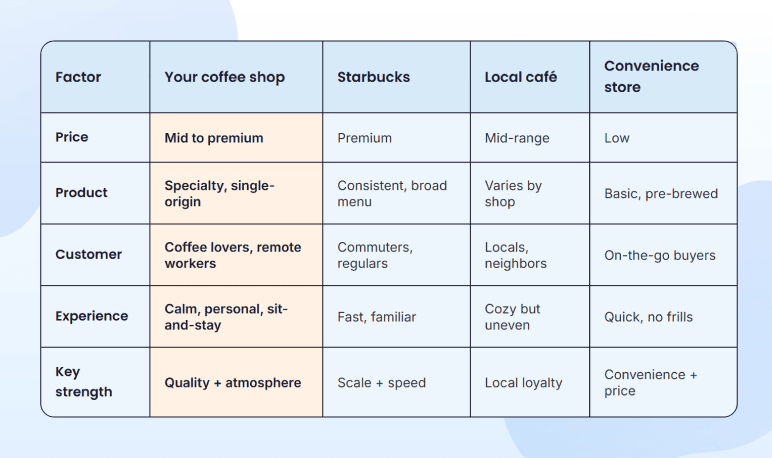
You don’t have to rate every competitor on every point. Stick to the factors that matter in your industry and that show how your business is different from the other options.
Explain your position in the market
Once you’ve compared everyone, the next step is showing where you fit. This is the part worth getting right, because it’s where you show how you really plan to compete.
Start with the patterns you noticed while comparing. What is everyone competing on? Price? Convenience? Product variety? Speed? Then look at what they’re missing.
Maybe they all serve a broad crowd, but skip a specific group. Maybe customers keep complaining about the same things: not enough options, poor service, uneven quality. Those gaps or weaknesses let you identify the position your business can take.
Back to the coffee shop example. You might notice the big chains are quick. The local cafés are cozy. But nobody’s pulling off great coffee and a calm place to sit at the same time. So, there’s the opening: a specialty shop with good-quality beans and a more personal feel to work.
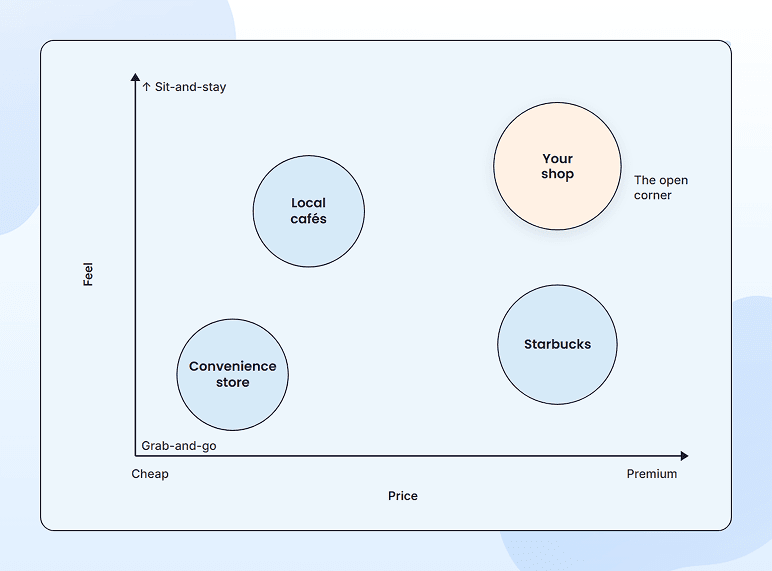
The goal isn’t to say you’re better than every competitor. It’s to emphasize the specific part of the market you’re targeting and explain why that position makes sense. A clear position answers a few simple questions:
- Who are you trying to serve?
- What makes you different?
- Which customer needs are you focused on?
- Why is that position a good one to take right now?
By the end, the reader should have a clear picture of where you fit in the competitive market and how you plan to attract customers.
What if your competitors are much bigger than you?
This concern comes up all the time, especially for local businesses and startups.
Maybe you’re opening a coffee shop and comparing yourself against Starbucks. Or launching software into a market full of large companies.
But here’s the thing: you’re not trying to prove you’ll outgrow them. No reader expects that.
What they want to see is that you know where the big players are strong and where you can compete on different terms. Big companies often win on scale, brand, and resources. Smaller ones win on focus, local know-how, personal service, speed, or just a better feel in the room.
So your job isn’t to argue that the big players don’t matter. It’s to show the part of the market you can serve better than they can.
Describe your competitive advantage
Last, spell out why someone would pick you over what they already use.
Be specific here. Skip the lines every competitor writes, the “better service,” “higher quality,” “best experience” stuff. They’re easy to say, and they prove nothing.
Go for advantages that are real, believable, and actually matter to your customers. Yours might come from:
- A unique product offering
- Specialized expertise
- Faster delivery or turnaround times
- A stronger local presence
- Better convenience
- A more focused customer experience
- Exclusive supplier relationships
Whatever you land on, tie it back to the customer. Don’t just say what’s different, say why it matters to them. “We roast in small batches twice a week, so your coffee is fresher than the chain’s shipped pre-ground” lands. “Higher quality” doesn’t.
A strong competitive advantage is what gives the reader a real, honest reason to pick you over a business that’s already out there.
So once you’ve covered your competitors, compared your business to them, explained where you fit, and spelled out your advantages, the core of your competition section is done.
But what you highlight in the section can shift depending on who’s reading it.
- Investors tend to focus on the market opportunity and what makes you different.
- Lenders care more about whether your position helps the business compete steadily and bring in revenue.
- An advisor or mentor wants to see the whole picture, gaps and all.
Either way, you’re trying to do the same thing: show you understand the market and have a real plan to compete.
Now let’s see what a complete competition section actually looks like.
Business plan competition section example
Here’s a sample competition section for Pour Origin Coffee, a specialty coffee shop opening in a mid-sized city. Use it as a reference while writing your own.
About the business
Pour Origin Coffee is a specialty coffee shop serving single-origin coffee, handcrafted espresso drinks, and light food in a welcoming space for professionals, students, and locals.
It’s entering the specialty coffee segment, the part of the market that’s growing fastest and where people really care about the beans and the place they’re sitting in, not just a quick caffeine hit.
Main competitors
Pour Origin competes in a busy market made up of national chains, local independent cafés, and the cheaper coffee options people fall back on.
(1) Direct competitors
- Starbucks: A household name with a store on every corner. Wins on locations, speed, and brand. But it’s pricey for coffee, plenty of people find it just okay, and it’s made for grab-and-go, not sitting around.
- Bean Theory (local café): An independent café two miles away and our closest rival. Loyal regulars and a nice feel, but the menu’s hit-or-miss, seating’s tight, and there’s no mobile ordering.
(2) Indirect competitors
We also compete with gas-station coffee and people brewing at home. They win on price and convenience, not quality, but they still pull customers on busy mornings.
How Pour Origin compares
| Factor | Starbucks | Bean Theory (local café) | Pour Origin Coffee |
|---|---|---|---|
| Pricing | $$ | $$-$$$ | $$ |
| Coffee Quality | Standardized | Premium | Premium Specialty Coffee |
| Customer Experience | Fast & Convenient | Community-focused | Personalized & Workspace-Friendly |
| Target Customer | Mass Market | Local Coffee Enthusiasts | Professionals, Students & Remote Workers |
| Atmosphere | Consistent Chain Experience | Community-Oriented | Modern Work & Social Environment |
| Key Strength | Convenience & Brand Recognition | Local Loyalty | Specialty Coffee Experience |
Market position
The chains compete on convenience and consistency. The local cafés compete on community. Pour Origin sits right in the middle: specialty-grade beans, drinks made fresh by trained baristas, and a space built for people who want to sit and work.
It’s for people who want more than what Starbucks offers but don’t want to pay fancy artisan-café prices for it.
Competitive advantages
Pour Origin’s edge comes down to three things:
- Quality beans: Single-origin coffee bought straight from growers, fresher than what the chains pour.
- Cozy place: Comfy seating, outlets, and Wi-Fi, built for people who linger.
- Trained baristas: Every drink comes out right, every time, no matter who makes it.
Together, these are tough for a fast-food chain or a generic coffee spot to match.
Don’t spend weeks on a plan that gets rejected
Finish your investor-ready business plan this weekend

5 Common mistakes to avoid when writing the competition section
Even businesses with strong ideas can weaken their business plans with a poorly written competition section. So here’s what to avoid:
1. Saying you have no competition
There’s nearly always another way people solve the same problem, even if it’s not a direct competitor. So don’t say you have none.
Name the alternatives and say why people use them right now. “We have no competition” almost always just looks like you didn’t research.
2. Listing competitors without explaining the takeaway
A long list isn’t the real problem. But a list with no thinking behind it is. Even three competitors won’t help if you don’t say what each one tells you. Where they’re strong, where they fall short, why people pick them, and where that leaves you.
Don’t just name them. Say what the reader should take from each.
3. Trashing your competitors
Calling them lazy or overpriced comes off as insecure, and it leaves the reader wondering about the rest of your section. Lay them out fairly, then point to where you’re different.
4. Only saying you’re “better”
“Better quality” and “great service” are what every plan says, so they slide right past the reader. Give them something concrete instead, like “we roast in-house twice a week, so the coffee’s fresher.”
5. Writing one version for everyone
As discussed, a lender, investor, or advisor looks for different things, so one generic version works for neither. Decide who’s reading the plan, then write the section for them.
Once your draft is done, read it back against this list. It takes a minute, and it’s usually easy to fix once you spot them.
The bottom line
The competition section isn’t about proving you’ll beat every rival. It’s about showing you understand the market, know where you fit, and have a clear way to compete. Get that right, and you’ve written a section that does its job.
The steps are simple enough to start: pick the competitors that matter, compare your business to them, explain where you fit, and spell out what makes you different.
If you’re creating your first business plan, Upmetrics can help. It guides you through every section of your business plan and makes the planning process much easier.
Its AI Research Assistant helps gather the market, customer, and competitor insights in minutes. You can use those insights in your competition section, market analysis, and overall business strategy while keeping everything organized in one place.
The more clearly you can explain your competition, positioning, and advantages, the more confidence readers will have in your business plan.
Know Your Competition. Plan Your Next Move.
Use market and competitor insights to build a clearer, more confident business plan.

Frequently Asked Questions
What's the difference between the competition section and a competitive analysis?
What if my business has no competition?
How many competitors should I include?
How long should the competition section be in the business plan?

Vinay Kevadia
Vinay Kevadiya is the founder and CEO of Upmetrics, the #1 business planning software. His ultimate goal with Upmetrics is to revolutionize how entrepreneurs create, manage, and execute their business plans. He enjoys sharing his insights on business planning and other relevant topics through his articles and blog posts. Read more