


 Download Now: Business Startup Checklist
I’ve seen many people think about starting a catering business because they already cook well, get compliments on their food, have taken a few informal orders, or want to launch a small business without opening a restaurant.
But turning that into a real business is a different thing. You need to know:
- What type of catering to offer?
- Will people in your area actually pay for it?
- Where are you legally allowed to prepare food?
- How much will it cost to start?
- How do you manage each booking without confusion?
In this guide, I’ll walk you through the practical steps to start a catering business. This will help you select your niche, meet legal requirements, build a profitable menu, determine your pricing, and manage bookings from inquiry to delivery.
Key Takeaways
- Starting a basic home-based catering service can cost around $2,000–$5,000 or more.
- Check local food rules before taking paid catering orders.
- Keep your catering menu simple, repeatable, and delivery-friendly.
- Track every order’s cost, payment, and profit from the start.
How much does it cost to start a catering business?
Starting a catering business can cost anywhere from a few thousand dollars to $50,000+.
Here’s a rough way to think about it:
| Catering setup | Rough starting cost |
| Home-based or cottage food setup | $2,000–$5,000 |
| Small drop-off or boxed-lunch catering | $5,000–$20,000 |
| Commercial or full-service catering | $20,000–$50,000+ |
These are approximate ranges only. This could be lower or higher depending on local rules, requirements of the kitchen, menu size, staffing requirements, and the number of orders you want to handle in the beginning.
How to start a catering business? (10 easy steps to follow)
Starting a catering business is not just about making great food for events. With the right planning, menu design, pricing, food safety process, and customer service, you can develop a business that customers will trust for small groups, office lunches, and special events.
Here are the steps you will have to follow to make your catering business a reality and utilize your food skills.
Step 1: Choose your catering niche and service model
First, decide what kind of catering you want to provide. This is important because a small office lunch, a birthday party, and a wedding are very different models in practice. They need different menus, equipment, staff, pricing, preparation time, and delivery support.
If you’re new, don’t try to serve every type of event. Begin with one simple offer you can handle well.
Here are a few catering models you can choose from:
| Catering model | Best for | Operational complexity |
| Boxed lunches | Offices, workshops, schools, and group meals | Easy |
| Drop-off catering | Small meetings, casual events, and local gatherings | Easy |
| Private event catering | Birthdays, family gatherings, and house parties | Moderate |
| Buffet catering | Larger casual events where guests serve themselves | Moderate |
| Specialty catering | BBQ, vegan food, desserts, Indian food, or healthy meals | Depends on demand |
| Full-service catering | Weddings, formal events, and larger private parties | Hard |
I’d say boxed lunches, drop-off catering, and small private events are usually safer starting points than weddings or full-service events. Once you understand your costs, portions, timing, and customer expectations, you can add larger or more complex services later.
Step 2: Research the local market and competitors
Before investing in equipment, ingredients, or a menu, check whether people in your area already order the type of catering service you want to offer.
Begin with those who you think will be your customers. When you’re thinking about providing boxed lunches, offices, clinics, schools, workspaces, and local businesses are likely your first customer targets. For catering private events, consider families celebrating birthdays, graduations, holidays, and small events.
Also, consider how frequently they might order. Catering might be needed just once for a private birthday. Whereas an office, school, or training company may require catering on a regular basis.
Next, find 3-5 competitors (caterers) in the area. Check their products, events they serve, prices/packages, minimum order, delivery areas, and their review process.
Reviews can give you insights into what customers are unhappy about and what customers are happy about. Watch for repeated issues of late delivery, conflicting quotations, small quantities, lack of communication, and/or dietary options. This could be a good opportunity for you.
Do not rely only on online research. Talk to the prospective buyers before making a big investment.
Ask questions, like:
- How many times do you place orders for catering?
- What type of food/catering service do you usually choose?
- How many people are there in your typical group?
- Do you have any problems with other caterers?
- What is the information you need prior to making a booking?
- What price range do you consider?
In short, this step should assist you with knowing who your initial customers may be, what they generally purchase, and where your catering business might stand out.
Step 3: Estimate your catering startup costs
Now, estimate how much it will cost you to take your first few orders. All you need is an approximate starting budget, so you don’t get stuck with a menu, kitchen, and equipment that you can’t afford.
Your startup costs depend heavily on your service model, menu, location, and kitchen layout.
I would recommend listing the main costs you need to cover:
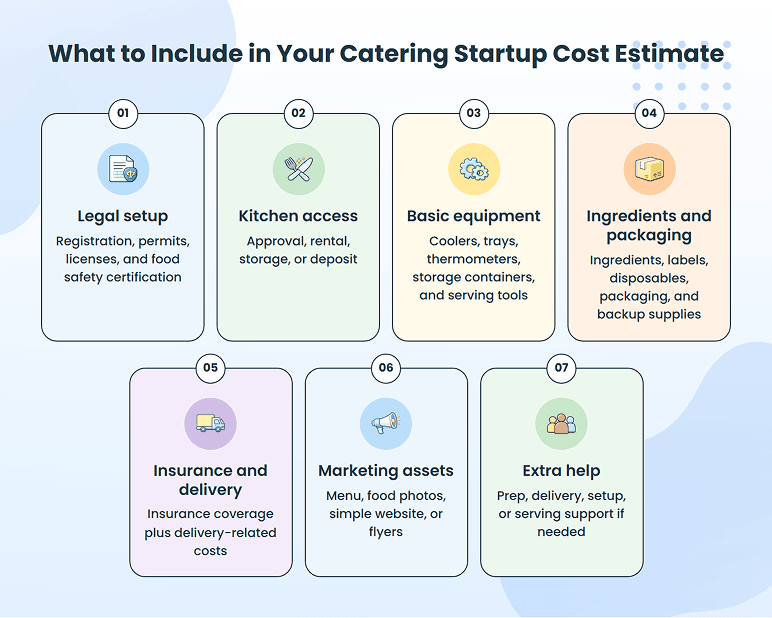
After that, add up the costs required to start your catering business.
Also, leave room for costs that first-timers often miss. These may include menu testing, sample meals, additional packaging materials, parking, tolls, cleaning supplies, backup ingredients, broken tools, last-minute replacements, or refunds and remakes.
Use local prices wherever possible. Check permit fees, obtain kitchen and insurance quotes, and estimate the costs of equipment, ingredients, and packaging required for your initial menu.
Here is a sample starting budget for a small drop-off catering business:
| Startup item | Example amount |
| Registration, permits, and certifications | $650 |
| Kitchen deposit and initial rental | $800 |
| Essential equipment and transport supplies | $1,300 |
| Packaging and labels | $300 |
| Initial insurance payment | $400 |
| Menu testing and samples | $400 |
| Basic website and food photographs | $250 |
| Cash buffer | $900 |
| Estimated starting cash | $5,000 |
Kitchen access may be one of your largest expenses. If local rules require a shared, commissary, or commercial kitchen, include rental fees, storage costs, and any deposit in your budget.
Also, decide how you will pay for these costs before you start spending. You might use personal savings, help from family or friends, a small business loan, or a government-backed loan if one is available where you operate.
Before you commit, be honest about how much money you can put into the business without putting yourself in a personal financial bind.
A common problem with many small businesses is that they begin spending without knowing what the total cost is going to be. So it’s better to begin with a smaller setup that you can afford yourself than take on more than the business can support.
Step 4: Create a simple catering business plan
Now, bring all your decisions into a basic working plan. This will allow you to determine if your ideas for catering are feasible before you lease a kitchen, invest in equipment, or start marketing your catering service.
It’s not necessary to build a 40-page-long business plan to begin a small catering business. Your catering business plan should simply answer these questions:
- What type of catering will you offer?
- Who will be your first customers?
- What will be on your starting menu?
- How will you price your services?
- What will it cost to start and fulfill orders?
- How many orders can you handle each month?
- How will you get your first bookings?
Writing these answers down helps you identify problems early before they become expensive. For example, you may realise your menu is too large, your prices are too low, or your business would need more staff or equipment than you can afford.
It also helps you keep an eye on your goals. You can set a target for the sales you would like to achieve each month, make the first marketing moves, estimate costs, and adjust targets as actual bookings are received.
If you need funding, a business plan becomes even more important. Lenders, partners, or investors will want to know how the catering business is going to generate income, what the startup costs are, who the customers will be, and how you plan to run the business.
Keep the first version short. You can expand it later when you apply for a loan, bring in a partner, or commit to a larger kitchen or facility.
Step 5: Register your business and handle legal requirements
Once your catering idea looks feasible, complete the basic process to make the business official.
Start by choosing a business structure. Depending on your location, this may be a sole proprietorship, partnership, LLC, or another structure. Consider how each option affects your taxes, personal liability, paperwork, and future plans.
Next, complete the basic business setup:
- Register your business name
- Get a tax ID or EIN (Employer Identification Number)
- Apply for a local business license (if needed)
- Open a separate business bank account
- Set up a simple bookkeeping system
You will need to follow the food-service rules in your area as you’ll be preparing and serving food.
Depending on the type of service model, location, menu, and kitchen setup, you will need a food-service permit, food safety certification, kitchen approval, or inspection.
Lastly, take business insurance into account. Since catering may involve food preparation, delivery, employees, and event setup, ask an insurance provider about general liability, food or product liability, delivery coverage, and workers’ compensation if you hire staff.
Step 6: Secure your kitchen, equipment, and suppliers
Once you understand the local food rules, arrange the basic setup needed to prepare and deliver orders safely.
First, choose the right kitchen. You can use an approved home kitchen, shared home kitchen, commissary kitchen, or leased commercial kitchen depending on your location and menu. Select the one that matches your order size, storage requirements, access hours, and budget.
Then, write down the equipment you need for your type of catering.
For instance, a drop-off lunch may require only simple cooking equipment, food boxes, thermometers, coolers, insulated bags, and delivery boxes. Buffet or full-service catering may require chafing dishes, serving trays, food warmers, carts, and setup supplies.
You do not need to purchase everything at once. Buy equipment you will use regularly and rent equipment for larger or infrequent events.
In addition to that, you’ll need reliable suppliers for ingredients, packaging, labels, disposables, and cleaning supplies. Keep backup options for important items so one missing ingredient or packaging size does not delay an order.
Storage and transport matter too. Ensure adequate space for receiving ingredients, packaging, equipment, and finished orders. Your delivery system should also keep food secure at the right temperature.
Use this setup check before taking bookings:
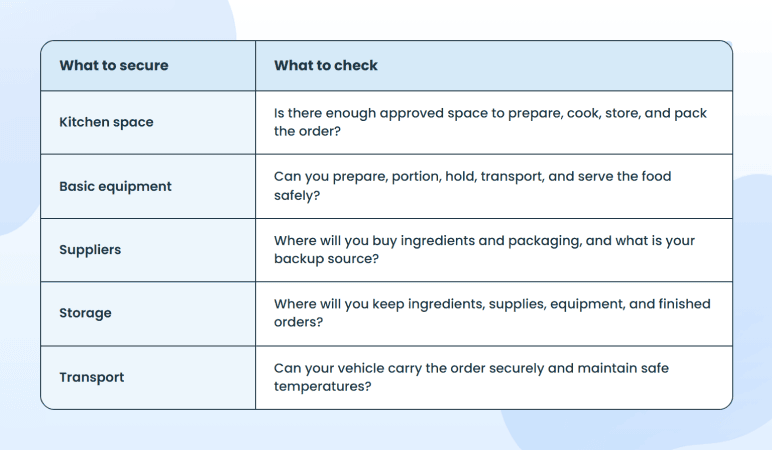
Before accepting a large order, do a small test run. Check how long it takes to prepare, how well food moves, whether the packaging stays secure, and whether you forgot any supplies. This will let you solve issues before serving a paying customer.
Step 7: Build a small menu and set your prices
Now, create a basic menu that you can repeat. Don’t start with too many dishes. A long menu can increase the cost of ingredients, take more preparation work, and lead to waste or pricing mistakes.
Pick a few items or packages that match the type of catering you want to provide. For instance, a boxed-lunch business might begin with three different lunch box choices containing the same side, dessert, packaging, and label structure. This helps you make the prep easier, and each order is simpler to price.
Therefore, before adding an item to the menu, check these four things:
- Can you make it in larger quantities?
- Will it still taste and look good after delivery?
- Can you prepare it without too much waste?
- Will it be profitable to sell?
Also, be clear about which dietary or allergy requests you can safely handle before adding those options to your menu.
Next, select a pricing model that fits your service:
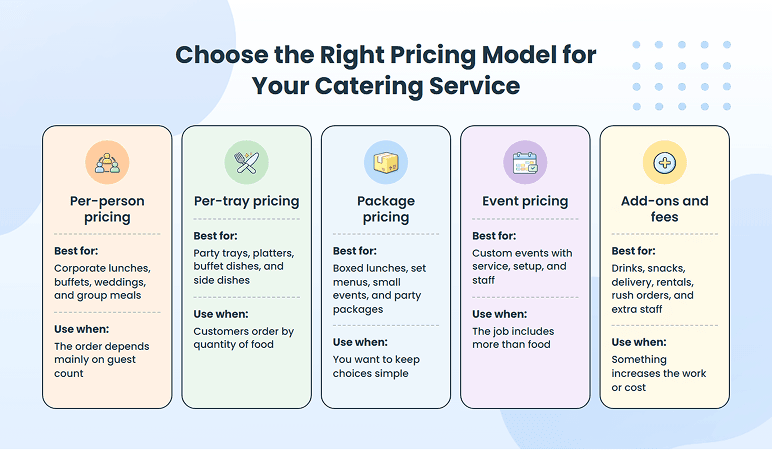
Don’t forget to set a minimum order size and state extra charges clearly. Delivery fees, setup costs, rentals, rush orders, custom menus, and deposits should be discussed prior to client confirmation.
Then, calculate the full cost of each package or order. Do not base your price on ingredients alone.
Let’s assume you are pricing a drop-off lunch buffet for 40 people. The estimated cost may look like this:
| Cost item | Example amount |
| Food and ingredients | $180 |
| Packaging and disposables | $45 |
| Labor or prep time | $150 |
| Overhead share | $50 |
| Delivery | $40 |
| Total order cost | $465 |
This $465 is the cost of completing the order. But it does not include your profit. So, you need to consider adding the profit margin you want to earn before setting the final price.
The right margin will depend on your market, order size, and service level. You can start with a target and test whether the final price is realistic for your market.
For example, if you want to earn a 20% profit margin on this order, you would charge about $581. This would leave roughly $116 after covering the estimated costs. This will make the booking worthwhile and support the business.
Step 8: Hire staff only when you need support
You might not need staff on day one. If you are doing small drop-off orders, boxed lunches, or simple private events, you may be able to handle prep, packing, and delivery yourself or with occasional help.
But as orders get larger, staffing becomes important.
Do not hire too early. First, understand what kind of orders you are getting and where you actually need help. A boxed-lunch business may only need part-time prep or delivery support. Servers, setup, and cleanup assistance may be required for a buffet, wedding, or full-service event.
Also, ensure everyone knows their role before each event. Decide who will pack the order, check labels, handle delivery, set up the food, and communicate with clients if needed.
If required, train food handlers on proper cleanliness, food sanitation, allergen awareness, and customer service. There must be no room for error, as it will impact the client’s trust.
The goal is not about building a large team right away. Start with the help you actually need, then build a reliable team as your bookings grow.
Step 9: Market your catering business and get your first bookings
Now, the next step is to reach people who are likely to place an order.
There is no need for a complicated marketing plan at this stage. You must have a clear offer, some nice food pictures, and an easy way to reach out to people.
Start by creating a basic online presence. This can involve a social media page, a Google Business Profile, or a simple website or landing page. Include your menu, service area, minimum order, contact information, and how your guests can ask questions.
Then focus on the buyers that fit your catering model:
| If you offer… | Reach out to… | What to share |
| Boxed lunches or drop-off meals | Offices, clinics, schools, and local businesses | Lunch menu, minimum order, delivery area |
| Private event catering | Families, community groups, local venues | Event packages, photos, and availability |
| Buffet catering | Event planners, venues, and local organizations | Buffet packages, guest count range, setup details |
| Specialty catering | Local groups, niche communities, social media audiences | Specialty menu, photos, dietary options |
| Wedding or full-service catering | Venues, planners, wedding vendors | Menu style, service area, availability, and proof of insurance if needed |
When reaching out to individuals, be clear with your offer. Describe what you provide, who it is for, where you deliver, and what the minimum order is.
For instance, you can say: “We cater boxed lunches for local offices and deliver for groups of 15 or more. Would you like me to send you our menu for the next team meeting or lunch?”, instead of saying, “I offer catering.”
Begin with one simple package and 15 to 20 local prospects. Speak with them personally, make one follow-up contact, and take a note of any questions or objections raised. Improve your menu, pricing, and sales message based on the feedback.
After each successful order, request a review/referral. Also save useful food photos with the customer’s permission. These early results will make the next booking easier.
Step 10: Set up your booking, prep, and delivery process
Getting a booking is only half the job. There is still a need for a clear way to keep track of the order: to confirm the details, to take payment, prepare the food, and deliver it in time.
Small mistakes in catering can turn into big problems. Small orders are usually easier to fix, since there are fewer guests and less to manage. But Big events like weddings, parties, or corporate functions leave more room for error, since there’s more food and more people.
That is why you need a simple process for all bookings, no matter the size.
Use this flow for each order:
Inquiry → Quote → Agreement and deposit → Final confirmation → Prep and packing → Delivery or setup → Follow-up
During the inquiry, ask for the event date, time, location, number of people, service style, food items, dietary considerations, budget available, and the individuals present on the day.
Next, send a written quote that outlines the menu, the number of guests, the services that are being offered, any extras, delivery/set up information, and the payment terms. If they agree, accept the payment and receive the contract in writing. This includes the confirmation and the deposit step.
Prior to the event, create a list of items to purchase, prepare, pack, label and/or carry along, such as utensils, serving equipment, packaging, and extra items.
On the day of delivery, confirm the route, food quantity, wrapping, food labels, temperature, and client details before driving away.
Once the event has happened, gather any remaining payment. Also, ask for feedback and then compare your expenses with your original quote. This will tell you what to improve for the next booking.
Overall, these 10 steps provide you with the fundamentals of what to offer, how much it will cost, how to process orders, and how to complete orders properly.
However, starting a catering business is not only about setting things up. It is also a matter of avoiding the mistakes that make it more difficult to manage an order or to make it more profitable than it could be.
Common mistakes that can make a new catering business unprofitable or risky
A catering business can look busy and still lose money. From what I’ve seen, the problem is usually not that people dislike the food. The orders may be underpriced, the terms are unclear, or the business accepts work that is too hard to deliver profitably.
Here are the mistakes to watch out for:
(1) Accepting orders beyond your capacity
It can be tempting to take on a big booking or a booking at the last minute if you are trying to build momentum. However, if there’s not enough kitchen space, staff, equipment, or delivery capacity, the order can rapidly turn into stressful and unprofitable.
Be realistic about the size and kind of orders you can handle. It’s better to turn down a booking than to risk a late delivery, bad food, or an unhappy client.
(2) Underestimating labor and delivery time
You are not only charging for the food. Shopping, customer communication, prep, packing, delivery, setup, cleanup, and invoicing all take time.
Include those hours in your quote. Otherwise, you may finish a busy order and realize there is very little profit left.
(3) Confirming bookings without written terms or a deposit
It might be easier to verify information over the phone or by texting when you’re just beginning. But with verbal deals, there’s a lot of potential for misunderstandings.
So provide all the menu, price, payment dates, final guest count deadline, delivery information, and cancellation terms in writing. Take a deposit prior to the booking date or purchasing materials.
(4) Mixing personal and business money
Avoid using a personal account to run catering payments. It’s easy to lose track of deposits, ingredient costs, packaging, delivery, and final payments.
Have a separate business bank account and a basic bookkeeping system. Write down how much each event earned, how much each cost, and how much profit was left over. This allows you to better control your cash, taxes, and future pricing.
(5) Failing to review profit after each order
After a busy event, you might just clean up and move on to the next booking. But that’s exactly when you need to stop and compare what you quoted to what actually happened.
Did prep take longer than you thought? Did you buy too much food? Did it go as far as intended? Did the client change things last minute?
Those details will help you to know what to adjust: price, minimum order, menu, or lead time, before you take on a similar booking again.
Conclusion
Before you start, you don’t need to figure out every part of the catering business. You just need enough clarity to take your first few orders without overspending, underpricing, or forgetting something important.
Pick one type of catering. Keep the menu small. Only take orders you know you can handle well. After a few bookings, you’ll start to see what people actually want, which dishes are easy to make again and again, and which orders just aren’t worth your time.
Before you spend money on equipment, kitchen space, or marketing, write the plan down first. Upmetrics can help with that. It’s a simple way to map out your service type, startup costs, pricing, sales goals, and how you’ll get your first customers.
That way you’re not guessing at every step. You’ve got a plan to start with, and you can improve it as real orders come in.
The Quickest Way to turn a Business Idea into a Business Plan
Fill-in-the-blanks and automatic financials make it easy.

Frequently Asked Questions
Can I start a catering business from home?
How long does it take to start a catering business?
Can I start a catering business with no money or experience?
What's the most profitable type of catering?

Vinay Kevadia
Vinay Kevadiya is the founder and CEO of Upmetrics, the #1 business planning software. His ultimate goal with Upmetrics is to revolutionize how entrepreneurs create, manage, and execute their business plans. He enjoys sharing his insights on business planning and other relevant topics through his articles and blog posts. Read more