


Anthropic is the company behind Claude, one of the most talked-about AI models in the world and, as of 2026, one of the most valuable private companies ever built.
So of course, when founders hear “Anthropic,” a lot of them go looking for the pitch deck. The one that started it all. The slides that convinced investors to back a brand-new AI lab.
But here’s the truth: Anthropic never released that founding deck. Most of what you’ll find online is a recreation or an AI-generated summary.
After some digging, though, I came across an Anthropic deck from early 2023. It’s not the seed deck or a cold investor pitch. It reads more like a company overview and recruiting deck, but it’s still pitching the company itself to future hires, partners, and the wider market.
And that’s what makes it worth a closer look, because there’s a lot founders can learn from it.
About Anthropic (then vs. now)
Anthropic started back in 2021, when a group of researchers walked out of OpenAI to build something of their own. It was led by two siblings, Dario and Daniela Amodei, who reportedly left over concerns that OpenAI was putting product speed ahead of safety.
Dario, OpenAI’s former VP of Research and a lead on GPT-2 and GPT-3, became CEO, and Daniela became President. From the start, they set the company up as a public benefit corporation, with one goal:
To build AI that’s safe, reliable, and easy to steer, not just powerful.
Investors liked what they saw. Anthropic raised about:
- $124 million in its Series A in 2021
- $580 million Series B in 2022
- $300 million Google-backed round in 2023
Around the same time as this deck, TechCrunch revealed a separate, investor-facing Series C document in which Anthropic laid out a roughly $5 billion, multi-year plan to build a next-generation model then code-named “Claude-Next.” (That was the real fundraising pitch. The deck we’re looking at today is a different, more public-facing presentation.)
Now fast forward to 2026, and the scale is almost hard to believe. Anthropic is now valued at around $965 billion and has raised roughly $125 billion in total, with Amazon and Google among its biggest backers. It’s even filed confidentially for an IPO.
And the business has grown just as fast. Anthropic now works with over 300,000 business customers, including 8 of the Fortune 10. Also, its revenue run rate climbed to around $47 billion by mid-2026, up from roughly $1 billion just a year and a half earlier. That’s one of the fastest climbs enterprise software has ever seen.
Here’s the part I find interesting, though. Even with all that money and scale, the same safety-first message from these 2023 slides is still front and center today.
So let’s get into it.
Detailed Anthropic pitch deck analysis (slide-by-slide)
Here’s the full slide-by-slide breakdown. For each one, I’ll cover what it shows, what works, where it falls short, and the takeaway you can apply to building your own deck.
1) Slide 1: Cover
The deck opens with just the logo, “Anthropic, PBC,” and the presenter, Daniela Amodei, Co-founder and President. That’s it.
The first thing I notice is that little “PBC.” It quietly tells you this is a public benefit corporation, a company legally tied to a mission beyond profit. For an AI safety company, I don’t think that’s an accident. It frames everything that follows.
Takeaway: Your title slide sets the tone. A clear name, a clean logo, and the person presenting is often all you need.
2) Slide 2: Introduction
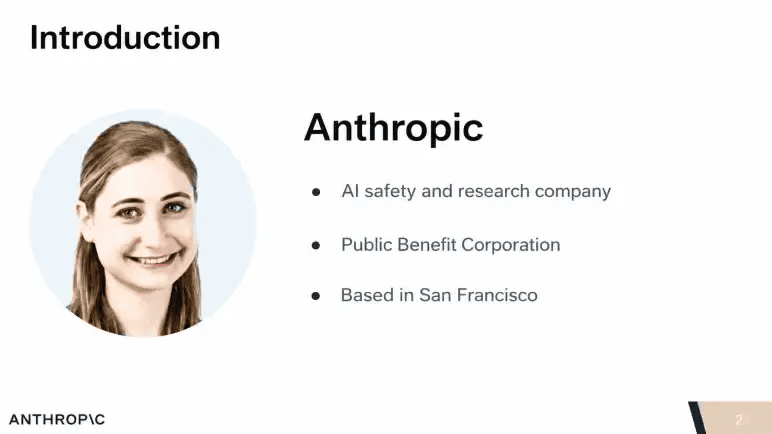
This slide answers the most basic question, “who are you?”, in three short lines: an AI safety and research company, a public benefit corporation, based in San Francisco. Paired with a photo of Daniela, it feels personal and direct.
What I appreciate here is the discipline. It would have been easy to cram in a mission statement and a wall of text, but they trusted three lines to do the job.
That said, the slide is plain, and the design isn’t much to look at, but the clarity wins out.
Takeaway: Before you explain what you do, tell people who you are in one clean line. If someone can’t summarize your company after your intro slide, it’s too complicated.
3) Slide 3: Anthropic’s Mission
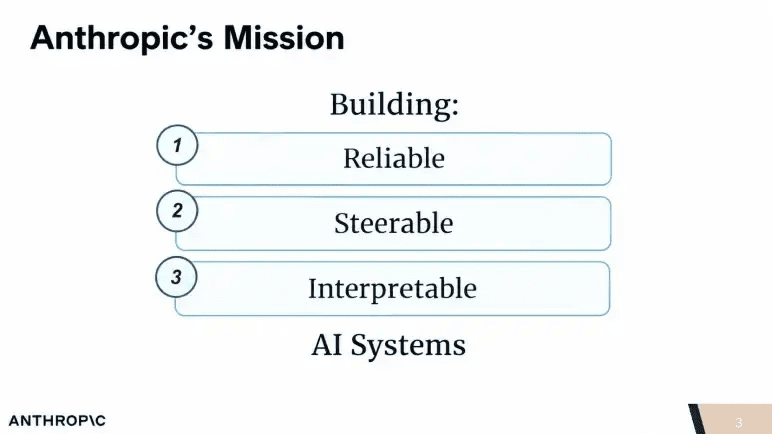
Here’s where the deck plants its flag. The whole mission comes down to building AI that’s reliable, steerable, and interpretable. Three words, one slide.
I think this is the smartest slide in the deck. Each word is a pillar the company is built around, and it’s simple enough that you could repeat it back after seeing it once.
Compare that to most mission slides I come across, stuffed with buzzwords nobody remembers, and this one does the opposite. If I’m nitpicking, it assumes the audience already knows why those three qualities are hard to achieve in AI, but for the room this was built for, that’s a fair assumption.
Takeaway: Distill your mission into a few words your audience can actually repeat. If it takes a paragraph to explain, keep cutting.
Ditch your old-school pitch deck creation methods
Make compelling pitch decks in minutes with AI
Plans starting from $14/month

4) Slide 4 & 5: Anthropic Is at the Cutting Edge
This is the credibility section, and to me it’s the strongest part of the deck. It runs across two slides.
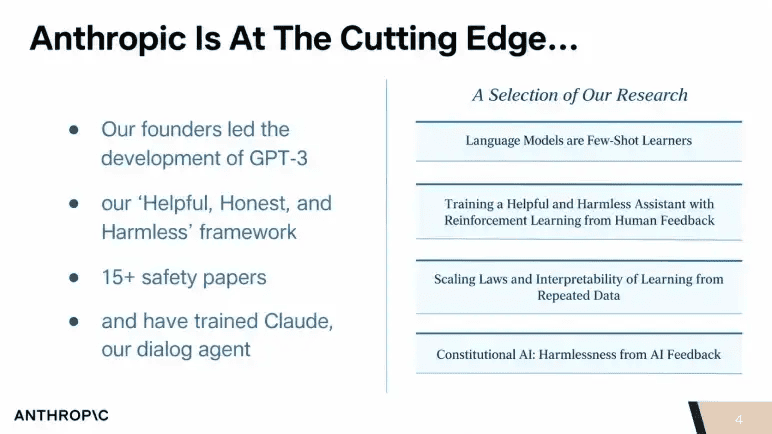
The 4th slide stacks up the technical credentials. The founders led the development of GPT-3. They created the “Helpful, Honest, and Harmless” framework. They’d published 15+ safety papers, and they’d already trained Claude.
Alongside that, they list real research papers, including Constitutional AI and RLHF. What I like is that none of this is hand-waving; it’s receipts. They’re not saying “trust us, we’re experts”; they’re showing the actual work.
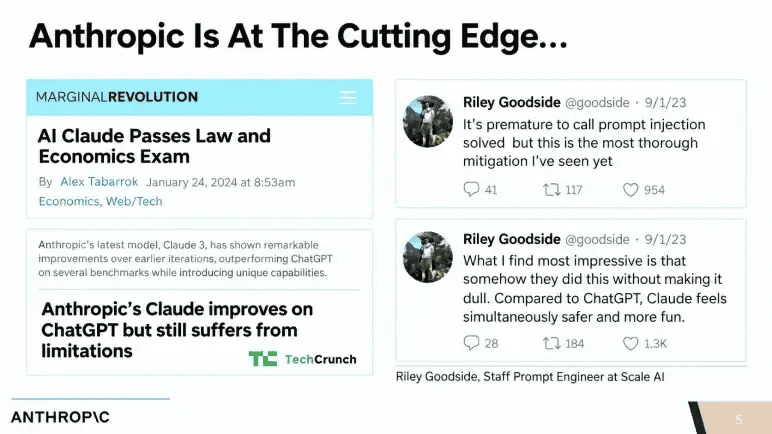
Slide 5 backs it up with outside voices—press coverage from the likes of Marginal Revolution and TechCrunch, plus praise from a prompt engineer at Scale AI who said Claude felt both safer and more fun to use than the alternative.
I think pairing the 4th & 5th slides is what makes the section land. First, they earn your trust with their own track record, then they hand it off to third parties to confirm it.
Takeaway: Credibility hits hardest when you pair your own credentials with outside validation. Show what you’ve built, then let press and users back you up. One without the other is weaker.
5) Slide 6: Momentum (Product)
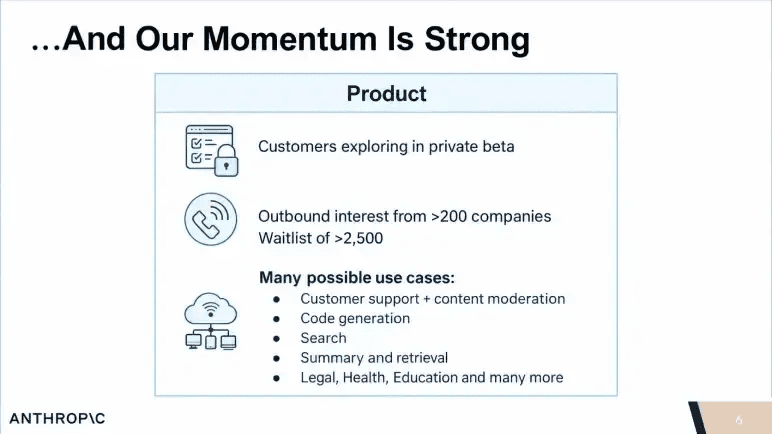
Now the deck shifts from “we’re credible” to “and it’s actually working.” The product slide shows Claude in private beta, organic inbound interest from more than 200 companies, a waitlist of over 2,500, and a spread of use cases, from customer support and code generation to search and summarization.
The word that jumps out at me is organic. Two hundred companies reaching out on their own isn’t marketing spend; it’s pull, and for an early product that’s about the most convincing signal you can put on a slide.
Takeaway: Show demand with real numbers, and call it out when it’s organic. Then give those numbers a clean background so nothing competes with them for attention.
6) Slide 7: Momentum (Fundraising)
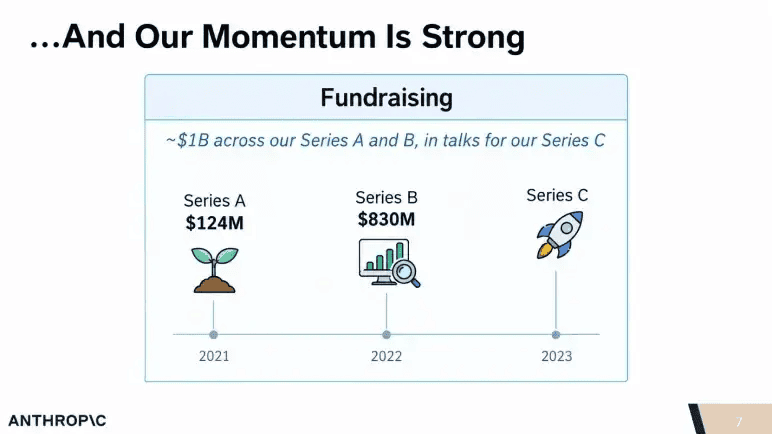
This slide lays out the funding story as a simple timeline: $124M Series A (2021), $580M Series B (2022), and a Series C in talks (2023).
Here’s what I find clever about it. The funding history isn’t being used as an ask. It’s being used as proof. The message reads as “look how much serious capital already believes in us,” which builds confidence instead of asking for a check. It’s a subtle but smart flip.
The one thing missing is context on what the money is actually for; there’s no line tying the raises to what they unlocked, which would have made the momentum feel even more purposeful.
Takeaway: Funding history can be a credibility signal, not just a request. Even better if you connect each raise to what it helped you build.
7) Slide 8: Opportunity Is Knocking
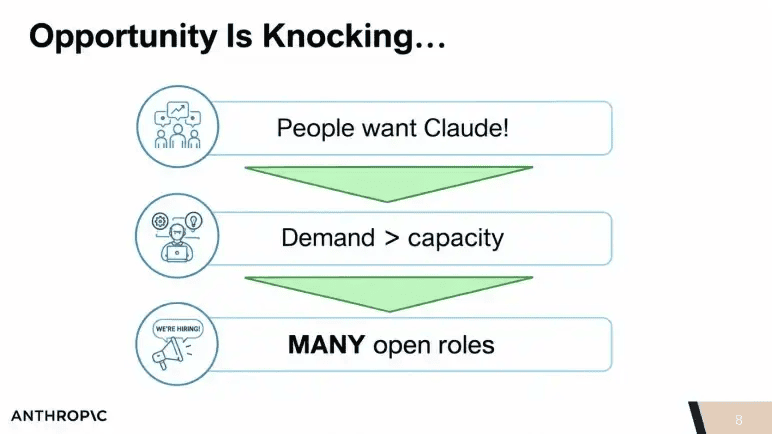
This one makes its whole argument in three steps. People want Claude, demand is greater than capacity, so there are many open roles. It reads top to bottom like a simple equation, and you get the point in about two seconds.
Instead of just announcing “we’re hiring,” I appreciate how it walks you through why they’re hiring with a clean cause-and-effect chain. This is also where the deck’s real purpose starts to show. It’s building toward a recruiting pitch, and it earns that turn rather than forcing it.
Takeaway: A simple visual argument beats a dense paragraph. Just anchor it with a real figure where you can, so the logic feels backed by evidence, not assertion.
8) Slide 9: Plant-Filled Office
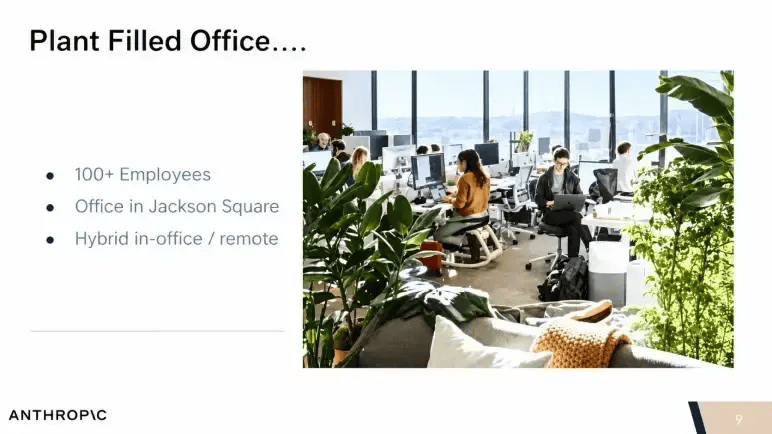
There’s a warm photo of the (genuinely very plant-filled) office, plus three facts: 100+ employees, an office in Jackson Square, and a hybrid in-office and remote setup.
After all the research and metrics, I think this slide is a nice change of pace. It sells the place, not just the work.
For a deck aimed at attracting talent, that’s smart, because people don’t only join missions; they join teams and rooms they’d actually want to spend their days in. It’s a soft slide, and in a pure investor pitch it might feel out of place, but it’s doing real work in a recruiting context.
Takeaway: Numbers and mission get attention, but culture is often what closes. Just make sure a “soft” slide like this matches your deck’s actual goal; it fits a recruiting pitch, less so a cold investor one.
9) Slide 10: We Are Hiring on All Cylinders
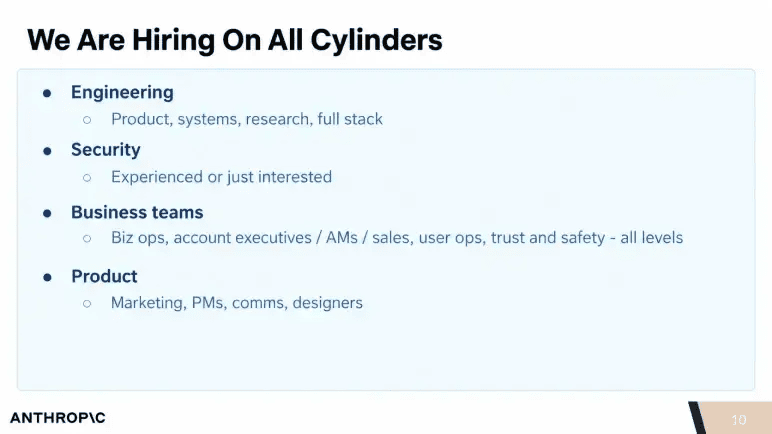
The last slide is the real call to action, listing open roles across the whole company.
What I like is how specific it is. Instead of a vague “we’re growing,” it tells you exactly where you might fit, which makes it easy for the right person to raise their hand. It’s a fitting close for a deck that, once you reach the end, was clearly built to bring people in as much as to inform them.
The only thing I’d add is a single line on how to apply or who to contact; the slide tells you the roles exist but doesn’t quite tell you what to do next.
Takeaway: End with a clear, specific ask. Whether you want investment, partnerships, or talent, tell people exactly what you need and how to act on it. A vague close wastes all the momentum you built.
And that’s the full deck. Ten slides, one clean arc: who they are, why they’re credible, their momentum, and what they’re asking for.
But notice what’s missing. There’s no problem slide, no market size, no competition, and no real ask for money; the things investors usually expect. That’s because this deck wasn’t built to raise money. It was made to attract talent and attention, for an audience that already knew the company and understood why AI matters.
So take the clear storytelling from Anthropic’s deck, but keep the slides your own audience will expect.
What I liked most about this deck
Even though this isn’t a traditional investor pitch, it gets the persuasion fundamentals right. Here’s what stood out:
- Layered credibility. It didn’t just claim expertise. It stacked the founders’ GPT-3 pedigree, 15+ safety papers, and real published research, then reinforced all of it with press coverage and expert praise.
- Momentum shown with real numbers. Instead of vague claims about demand, the deck leans on concrete traction and a clear funding timeline. Specifics build far more confidence than adjectives.
- Funding used as proof, not a plea. Framing the raises as evidence of confidence (rather than an ask) flips the usual dynamic in the company’s favor.
- Clean, minimal design. You can flip through the whole thing and understand the story without a single word of narration. That’s the mark of a well-built deck.
The overall shape of this deck is tight. Ten slides, no filler, one clear story arc. It respects your time and never makes you work to find the point.
Conclusion
Wrapping up! The big lesson from Anthropic’s slides is that you don’t need flashy design or 30 slides to be persuasive.
You need a clear story—who you are, why you’re credible, what momentum you have, and what you’re asking for—told simply and confidently. Anthropic nailed that arc in ten slides. You can too.
If you’re building your own pitch deck, Upmetrics’ AI pitch deck generator can help you get it right. It lets you turn your idea into an investor-ready deck in minutes. You also get a proven template and a clear slide-by-slide structure, so you cover everything that matters.
Hope you found this breakdown useful.
Turn Your Story Into a Powerful Pitch
Create an investor-ready pitch deck that brings your business vision to life.

Frequently Asked Questions
Is this Anthropic's original founding pitch deck?
Is Anthropic's deck a good template to copy?
How many slides should my pitch deck have?
Is this deck still relevant now that Anthropic is worth close to a trillion dollars?
More pitch decks, broken down
See all 26

Vinay Kevadia
Vinay Kevadiya is the founder and CEO of Upmetrics, the #1 business planning software. His ultimate goal with Upmetrics is to revolutionize how entrepreneurs create, manage, and execute their business plans. He enjoys sharing his insights on business planning and other relevant topics through his articles and blog posts. Read more