


In 2011, Barnes & Noble executive John Foley was pitching a company that did not exist yet.
There was no finished product, no revenue, and not even a final company name. Just an idea: bring instructor-led cycling classes into people’s homes through a connected bike.
Getting investors to believe in it was much harder.
For four years, Foley was pitching as often as three times a day. In total, he approached nearly 3,000 angel investors and around 400 investment firms. Almost everyone said no.
The 16 slides I’m about to go through take us back to the beginning of that journey, before Peloton was even incorporated.
Knowing what Peloton eventually became makes these early slides especially interesting. But I want to look at them as they were then, not with the benefit of hindsight.
So let’s go through the deck slide by slide and see what an investor was actually being asked to believe in 2011.
Before we start: which deck is this?
Search for “Peloton pitch deck” and you will find more than one version.
The one commonly shared online is a polished 23-slide deck often described as “the deck that raised $400k.” That description is misleading.
The deck I’m looking at is a much rougher set of roughly 16 slides that surfaced through a legal filing. It was created before Peloton was officially a company.
Peloton did later raise about $400,000 from angel investors, but there is no credible evidence connecting that funding to one specific deck.
So think of these slides as an early look at the Peloton idea, not as a receipt for the company’s first funding.
Peloton then vs. now
In 2011, Peloton had raised nothing and did not legally exist.
The company was founded in 2012 by John Foley with Tom Cortese, Hisao Kushi, Yony Feng, and Graham Stanton. (Source)
The funding came gradually. Peloton raised about $400,000 in seed funding, followed by a $3.5 million Series A later in 2012. In 2013, its Kickstarter campaign brought in $307,332. Then came a $10.5 million Series B in April 2014, led by Tiger Global Management. (Source)
Peloton went public in September 2019 at $29 per share, giving it an $8.1 billion valuation.
Revenue later peaked at $4,021.8 million in fiscal 2021. In Q4 FY2026, Peloton generated $608 million in revenue, bringing full-year revenue to $2.446 billion. The company ended the year with around 5.5 million Members after several years of restructuring and cost-cutting. (Source)
That is quite a journey from the rough slides we are about to look at.
Peloton pitch deck: slide-by-slide analysis
One thing to keep in mind throughout the deck: there is no team slide, no financials, and no funding ask.
This feels less like a complete fundraising deck and more like an early concept deck built to explain what Peloton could become.
Slide 1: The cover

The cover says “Peloton” with “place-holder brand” underneath.
I like the honesty, but the cover is one place where you want to look decided.
If the company name is visibly temporary, an investor may naturally wonder what else is still unsettled.
You can always rename the business later. But when pitching it, make the idea feel more concrete than this.
Takeaway: Your cover should look like a decision, not a draft.
Slides 2–3: Framing the market
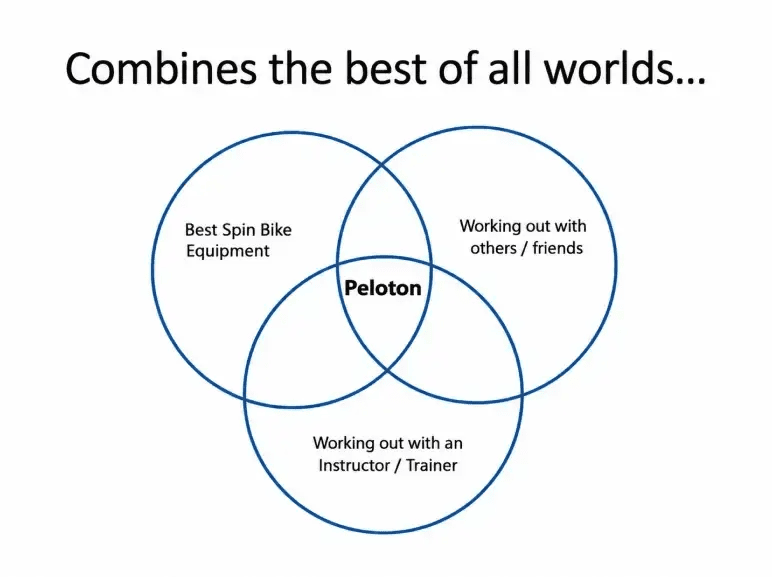
Slide 2 uses a Venn diagram combining three things:
- Spin equipment
- Working out with other people
- Working out with an instructor
Peloton sits in the middle.
Normally, I would not get excited about a Venn diagram. But this one works because Peloton really was combining several existing experiences into something new.
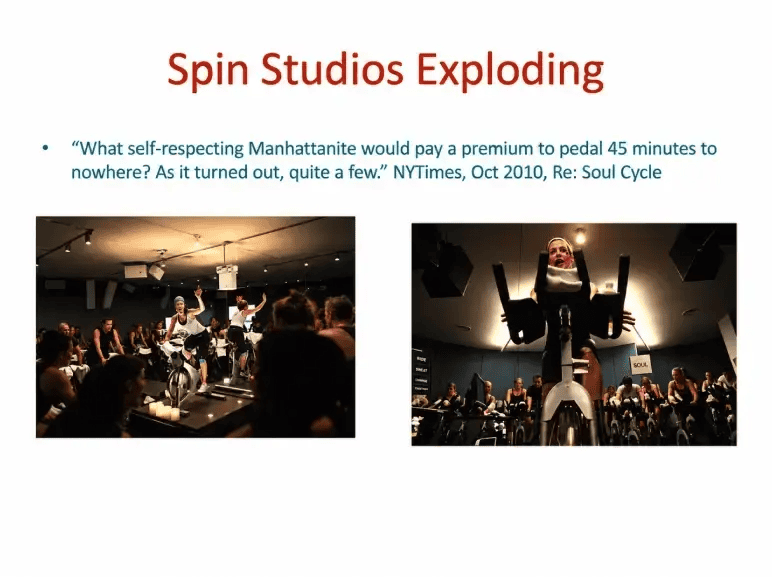
Slide 3 is even stronger.
Instead of simply claiming boutique cycling was becoming popular, Foley used a New York Times quote about SoulCycle. The article essentially asked who would pay a premium to pedal nowhere for 45 minutes, then acknowledged that plenty of people would.
That is smart pitching. Foley lets an outside source raise the obvious objection and answer it for him.
I would borrow that approach.
Takeaway: When introducing a new category, use credible outside evidence to answer the doubt investors are already thinking about.
Ditch your old-school pitch deck creation methods
Make compelling pitch decks in minutes with AI
Plans starting from $14/month

Slide 4: “Social status”
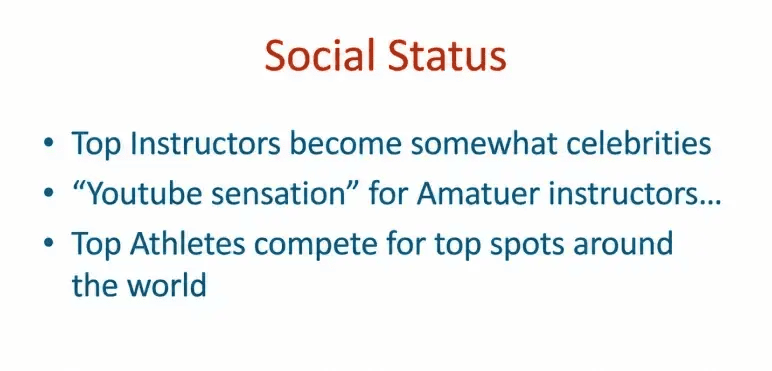
This slide makes three simple points:
- Top instructors can become minor celebrities.
- Amateur instructors can go viral online.
- Top athletes compete for top positions.
To me, this may be the most important slide in the deck.
The bike itself was never Peloton’s strongest long-term advantage. Competitors could build similar hardware.
The instructors were harder to copy.
Peloton eventually built something close to a talent and entertainment business inside a fitness company. People did not keep subscribing only because they owned a bike. Many came back for specific instructors.
Foley had already spotted that possibility in 2011, but gave it only a few bullets.
Takeaway: Your real competitive advantage may already be in your deck. Make sure you are giving it enough attention.
Slide 5: Music
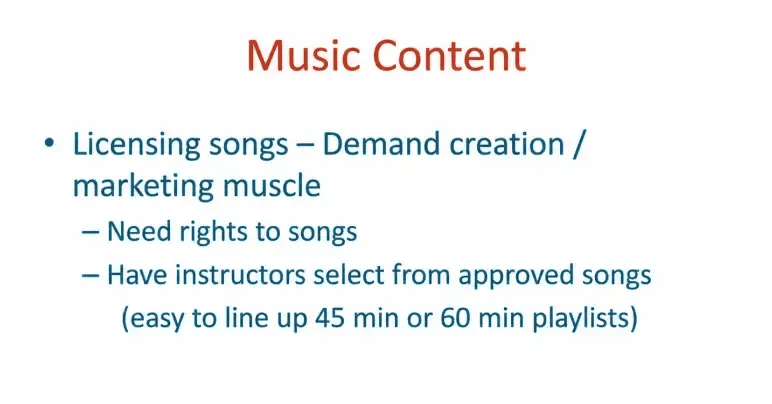
This slide includes two small notes: Peloton would “need rights to songs,” and instructors could choose from approved music.
At the time, it probably looked like Foley was simply covering an operational detail.
Years later, it looked much more important.
In 2019, ten music publishers sued Peloton over allegedly unlicensed music, seeking more than $150 million in damages. The claim later grew to $370 million before Peloton settled the case in 2020.
Foley had identified the risk eight years earlier. Writing it down did not stop it from becoming a major problem.
Takeaway: Identifying a risk is not the same as solving it, especially when that risk grows as the business scales.
Slides 6–11: The product mockups
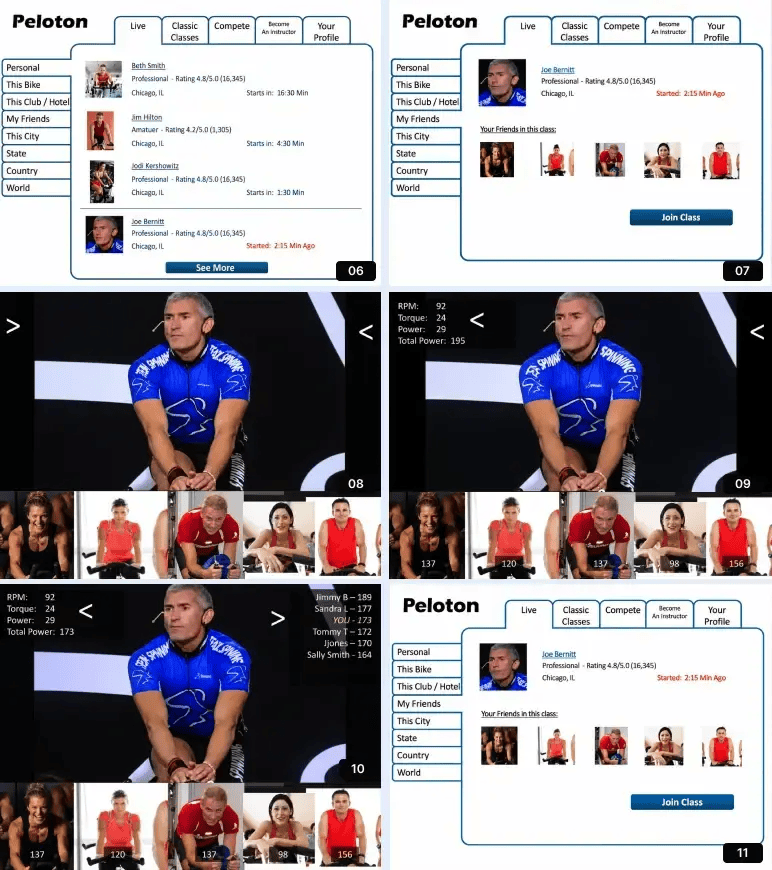
Six slides, nearly 40% of the deck, are devoted to product screens.
They show live classes, friends, instructors, viewer counts, a leaderboard, and a “Join Class” button.
For an unfamiliar idea, I think that was the right choice.
Investors first needed to understand what Peloton actually was. Screens could answer that much faster than a long explanation.
The leaderboard stands out most to me.
It was already in the concept before Peloton had a finished bike or even an incorporated company. Yet it later became one of the product’s most recognizable engagement features.
Takeaway: If people are unfamiliar with your idea, show them how it works before trying to explain everything in words.
Slide 12: The market slide
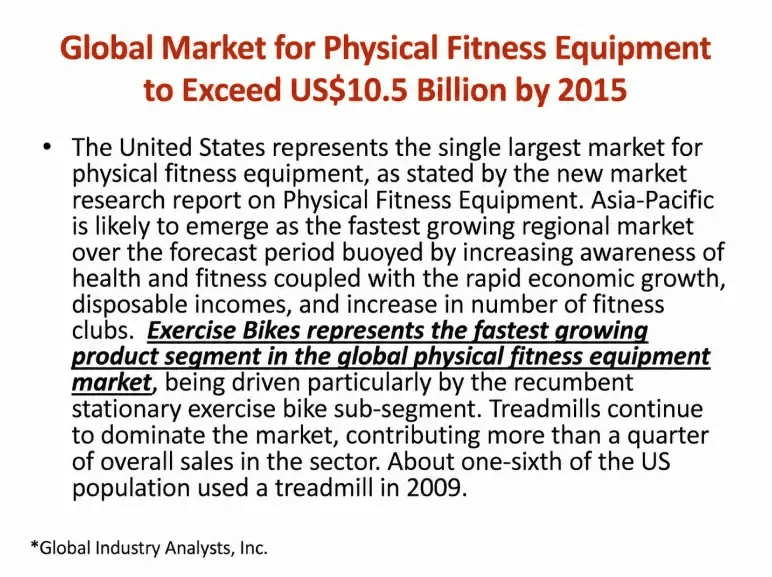
The slide estimates the global fitness equipment market at more than $10.5 billion by 2015 and says exercise bikes are the fastest-growing segment.
For me, this is the weakest slide in the deck.
First, it relies on one broad market number with little explanation. More importantly, I think it sizes the wrong market.
Peloton later made $4,021.8 million in revenue in fiscal 2021. That alone came surprisingly close to half the size of the entire market this slide imagined.
The reason is simple: Peloton was not just selling exercise bikes. It was combining hardware with subscription fitness content.
A useful test for any market slide is this: if your company becomes extremely successful, does your market estimate still make sense?
Here, it does not.
Takeaway: Size the opportunity your business is actually pursuing, not simply the closest existing market you can find.
Slide 13: “What is protectable?”
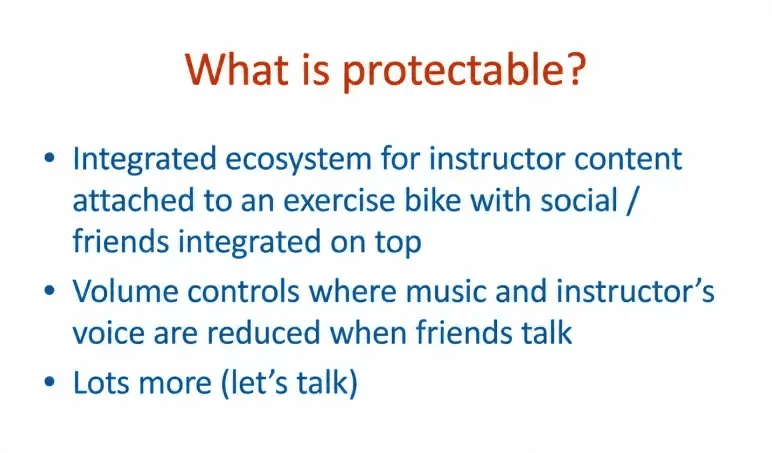
There is no traditional competition slide. Instead, Foley asks what about Peloton could actually be protected.
One answer is the integrated ecosystem. But I like the more specific example: music and instructor audio could automatically get quieter when your friends started talking during a class.
That detail makes the idea believable.
Anyone can write “network effects” or “ecosystem” on a slide. A specific product behavior shows that you have thought beyond the pitch.
The weaker part is the final bullet: “lots more (let’s talk).”
That may work in a meeting, but decks get forwarded. Without Foley in the room, it just looks unfinished.
There is also some interesting history here. Peloton later sued Flywheel over patent infringement and corporate espionage.
Takeaway: Show what makes your business defensible with something specific, and make sure the slide still works when you are not there to explain it.
Slides 14–15: The value chain
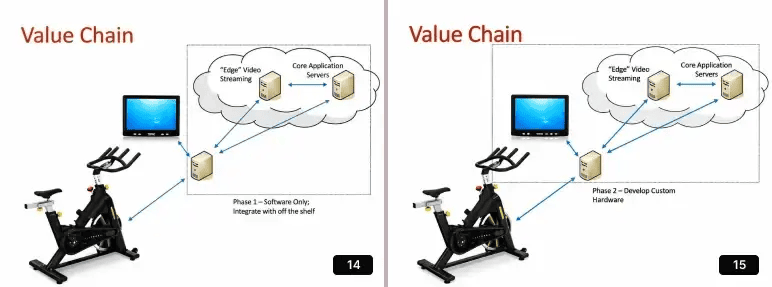
These slides show a two-phase rollout:
- Phase 1: Run Peloton software on existing bikes.
- Phase 2: Build custom Peloton hardware.
I think this is some of the strongest investor thinking in the deck.
Foley understood the obvious concern: hardware businesses require money, inventory, manufacturing, and a lot of execution risk.
So instead of ignoring that problem, he showed a way to reduce it. Start lighter, prove the idea, and move into custom hardware later.
Peloton eventually leaned heavily into its own bike, so the actual path changed.
That does not make the slides bad. At this stage, Foley’s job was to show that he understood the risk and had thought about how to manage it.
Takeaway: Identify what investors are most likely to worry about and show how you plan to reduce that risk.
Slide 16: The prototype
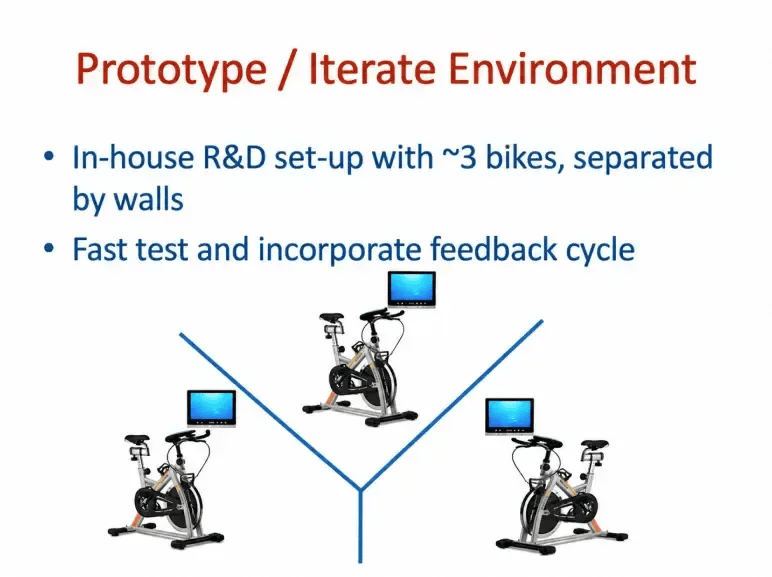
The final slide shows roughly three bikes set up behind walls and a simple cycle of testing and improving.
It may be the least polished slide. I also think it is the most convincing.
Everything before this is a claim about what Peloton might become. This slide shows that Foley and his team had already started building and testing something.
For a company that did not officially exist yet, that mattered.
Takeaway: Something rough that you have already built can be more convincing than a polished plan you have not tested.
That’s the whole Peloton pitch deck.
The product vision was clear. Many features Peloton later became known for were already here, including instructors, live classes, the leaderboard, and connected hardware.
But the fundraising story was incomplete.
There was no team slide, clear business model, financials, or funding ask.
That is especially surprising because Foley’s e-commerce experience at Barnes & Noble was highly relevant. Yet the deck barely used it to strengthen the case for why he was the right person to build Peloton.
The deck sells the idea well. It does much less to sell the team behind it.
What I like about the deck
Despite those gaps, there is a lot here that founders can learn from.
- It shows before it tells. The product screens come before the market numbers, which makes sense for an unfamiliar idea.
- It lets an outside source answer skepticism. The New York Times quote helps validate the market without Foley making every claim himself.
- It gets specific about defensibility. Foley does more than say the product has a moat.
- It acknowledges risk. The software-first plan shows he understood why hardware might worry investors.
- It ends with evidence. The rough prototypes make the idea feel more real.
The deck was not trying to make Peloton look like an established business.
Its first job was to make a strange new idea understandable. On that job, I think it did surprisingly well.
Conclusion
Peloton’s early deck shows that a strong idea is not always enough to make a strong pitch.
The product vision was clear, but investors were still missing important pieces about the team, business model, traction, and financials.
That is the real lesson for founders. Your deck should not just explain what you are building. It should also make it clear why the opportunity matters and why you are the right team to build it.
If you are putting those pieces together, Upmetrics’ AI pitch deck generator can help you organize the story and turn it into a clear, investor-ready deck.
Turn Your Story Into a Powerful Pitch
Create an investor-ready pitch deck that brings your business vision to life.

Frequently Asked Questions
What do investors want to see in a pitch deck?
Why did so many investors turn Peloton down?
What can founders learn from Peloton’s pitch deck?
More pitch decks, broken down
See all 26






Vinay Kevadia
Vinay Kevadiya is the founder and CEO of Upmetrics, the #1 business planning software. His ultimate goal with Upmetrics is to revolutionize how entrepreneurs create, manage, and execute their business plans. He enjoys sharing his insights on business planning and other relevant topics through his articles and blog posts. Read more