Executive Summary
HavenVista Interior Design is a sole proprietorship, owner-operated residential interior design practice based in Raleigh, North Carolina. Alina Mercer leads the business. She’s a residential interior designer with 9 years of hands-on experience in the local market. HavenVista operates as a home-based studio, serving homeowners across Raleigh, Cary, Apex, North Hills, Crabtree, and surrounding suburbs.
The business is intentionally structured as a focused, low-overhead practice. There’s no showroom, no leased office, and no employees in Year 1. The founder directly handles all design work, client communication, and project coordination.
Services and Value Proposition
HavenVista provides clearly scoped, design-only residential services aimed at mid-market homeowners who want professional guidance without committing to a full-service design studio.
Core offerings include:
- Paid design consultations
- Fixed-fee room refresh packages
- Design-only renovation support for kitchens and bathrooms
Services are packaged with defined deliverables, revision limits, and exclusions.
Our value proposition is simple: Practical layouts, clear selections, and actionable design direction that clients can confidently execute with their own contractors.
Target Market and Positioning
The target market consists of homeowners aged 30 to 60, primarily dual-income households with annual incomes between $90,000 and $180,000. Many are new homeowners or families updating existing homes who want functional design help without high-end studio pricing.
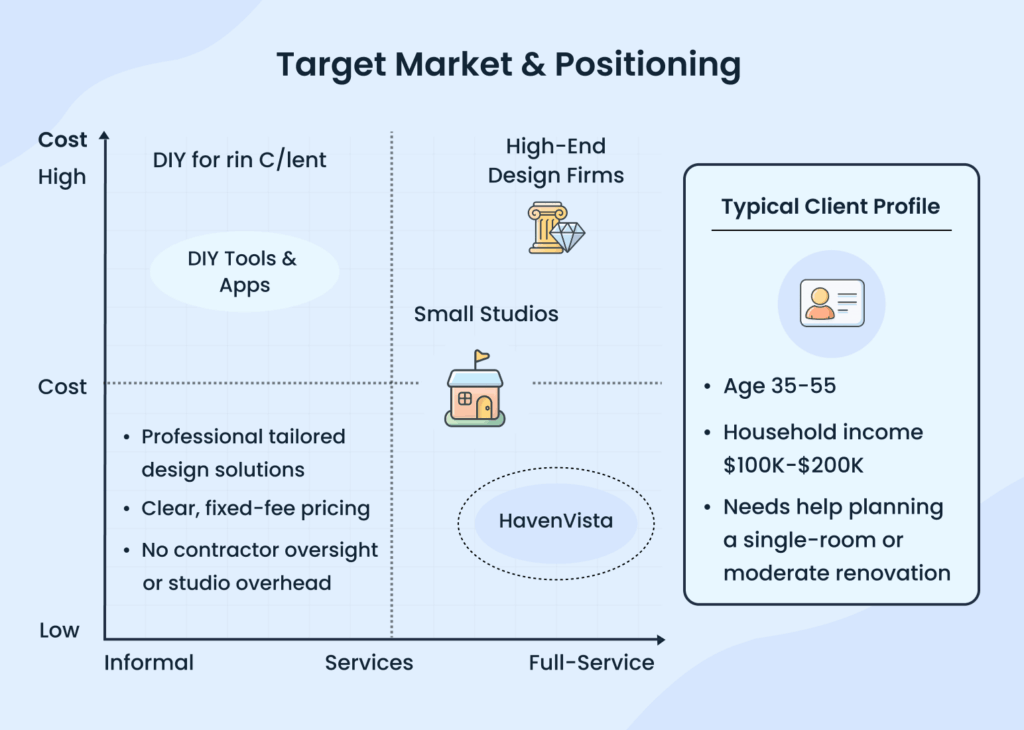
HavenVista is positioned between DIY design tools and traditional residential studios. Compared to larger firms, it removes studio overhead and layers of staff. Compared to informal or hourly designers, it provides structure through fixed pricing, clear scopes, and professional documentation. This positioning lowers buyer hesitation and supports faster decision-making.
Operating Model
We operate from a home office, with client meetings conducted virtually or in the client’s home. Project management, scheduling, and design delivery are handled directly by Alina Mercer. Freelance drafting or rendering support may be used selectively on a per-project basis, but there are no employees in Year 1.
This operating model keeps fixed monthly expenses low and allows the business to remain financially stable with a modest number of projects per month. Capacity is intentionally capped to maintain quality, responsiveness, and sustainable workload levels.
Marketing and Client Acquisition
Client acquisition relies on a small set of channels chosen for fit rather than reach:
- Instagram and Pinterest for visual discovery
- Google Business Profile for local search visibility
- Referrals from realtors, contractors, and past clients

Marketing spend is limited and controlled, with an emphasis on attracting qualified inquiries rather than high lead volume. Introductory consultation offers and referral credits support early traction and repeat business.
Financial Overview
HavenVista requires total startup funding of $28,000. The majority of this amount, $22,000, is provided by the owner, with a $6,000 credit line or equipment financing available. There are no bank loans, no long-term debt obligations, and no lease commitments.
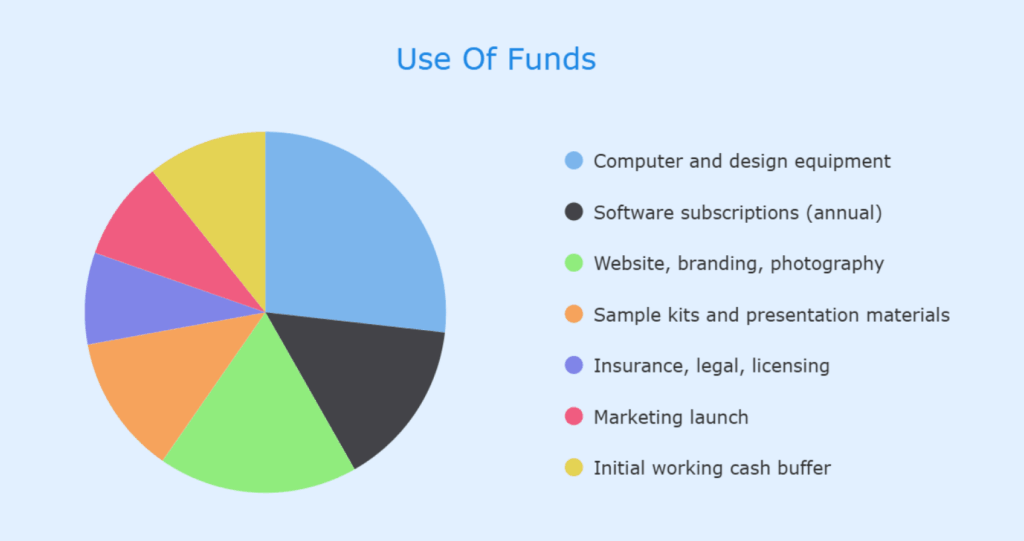
Startup funds are allocated toward essential equipment and software, website and brand launch, sample kits, insurance and legal setup, marketing launch, and a modest operating cash buffer. The business is designed to maintain a low cash flow in Year 1.
Revenue expectations for the first year is $90,000. Low fixed costs and controlled scope support early break-even and stable cash flow.
Year 1 Focus and Outlook
Success in the first year is defined by:
- Consistent monthly bookings
- Controlled workload within solo capacity
- Positive operating cash flow
- Growing referral activity
HavenVista isn’t built for rapid expansion in its initial phase. We designed it as a sustainable, founder-led professional practice that prioritizes predictability, financial discipline, and service quality. For lenders or reviewers, the business presents a low-risk profile grounded in experience, clear boundaries, and restrained spending.
Don’t spend weeks on your first draft
Complete your business plan in less than an hour
Business Overview
HavenVista Interior Design is a sole proprietorship, owned and managed by Alina Mercer. The business has no partners or outside equity holders, and all financial and operational decisions rest with the owner. The company is an owner-operated residential interior design business based in Raleigh, North Carolina. We operate as a home-based studio and serve homeowners throughout Raleigh, Cary, Apex, North Hills, Crabtree, and nearby suburban areas.
Our business is owned and led by Alina Mercer, who serves as the sole designer and operator.
The business is structured to provide practical interior design support to mid-market homeowners who want professional guidance without the cost structure or complexity of a traditional design studio. All client-facing work is handled directly by the founder, allowing the business to remain financially lean and operationally focused.
Design and Service Philosophy
HavenVista is built on a philosophy of clarity, restraint, and usability. The practice prioritizes functional layouts, clear selections, and actionable design guidance over stylistic or open-ended creative engagement. This philosophy reflects both the founder’s professional background and the preferences of the target market.
Each service is designed around a defined problem:
- Consultations address uncertainty and decision paralysis.
- Room refresh packages offer structured updates without disruption to renovation.
- Design-only renovation services support planning and selection without assuming contractor oversight.
By solving specific problems rather than offering broad creative services, the business maintains predictable engagement lengths and measurable outcomes.
Scope and Client Boundaries
A core operating principle of HavenVista is the scope of discipline. All services are packaged with clear deliverables, revision limits, and exclusions. The business doesn’t offer:
- Full construction management
- Ongoing site supervision
- Commercial or hospitality design
- Large, multi-room remodel oversight in Year 1
This discipline protects both client expectations and the founder’s time. It also allows pricing to remain transparent and fixed, reducing friction at the point of sale and limiting post-engagement disputes.
Scope control functions as an embedded risk management system. By refusing work that exceeds capacity or introduces uncertainty, the business avoids the most common failure points for solo design practices.
Operating Model and Cost Structure
We operate from a home office, with design work completed remotely and client meetings conducted virtually or in the client’s home. This model eliminates lease obligations, utilities tied to commercial space, and showroom build-out costs.
The cost structure is intentionally simple:
- No fixed real estate costs
- No payroll expenses
- Limited recurring software subscriptions
- Variable freelance costs are used only when necessary
Low fixed costs reduce the number of projects required each month to remain profitable, allowing the business to maintain flexibility during slower periods.
Founder-Led Execution
All design work, communication, scheduling, and project coordination are handled directly by Alina Mercer. There’s no delegation of core design decisions or client interaction. This ensures consistency, accountability, and quality control across all engagements.
When we need additional technical support, such as drafting or rendering, we may engage freelance professionals on a per-project basis. These relationships are transactional and don’t introduce ongoing overhead.
This execution model reinforces the business’s positioning as a personal, experience-led practice rather than a scaled studio.
Strategic Intent in Year 1
HavenVista isn’t designed for aggressive expansion in its first year. The strategic intent is to:
- Establish predictable monthly bookings
- Refine service delivery and pricing
- Build a referral base among homeowners and local professionals
- Maintain sustainable workload levels
Success is defined by stability, not size. This approach allows the business to adapt based on real demand rather than speculative growth plans.
Market Context and Local Demand Drivers
Local Residential Market Context
HavenVista Interior Design operates within the Raleigh metropolitan area, a region that continues to experience steady population growth and residential turnover. New home purchases, relocations, and incremental home updates create ongoing demand for residential design support, particularly for homeowners who want to improve functionality without committing to full-scale renovations.
In this market, a large share of homeowners seek targeted design guidance rather than comprehensive project management. Many are balancing renovation budgets, family needs, and time constraints. This creates consistent demand for design-only services that enable clients to make informed decisions while maintaining control over construction costs.
The Raleigh area also has a high concentration of newer housing developments alongside established neighborhoods. This mix produces two distinct but related design needs:
- New homeowners seeking assistance with personalizing builder-grade finishes and layouts.
- Long-term residents updating kitchens, bathrooms, and living spaces to suit changing household needs.
HavenVista’s service mix is designed to serve both use cases without expanding into high-risk or labor-intensive work.
| Demand Driver | Description | Relevance to HavenVista |
|---|---|---|
| Population Growth and Relocation | Ongoing inflow of new residents purchasing homes in Raleigh and nearby suburbs | Creates a steady demand for post-purchase layout and finish guidance |
| New Home Construction | Builder-grade homes with standardized layouts and finishes | Drives room refresh and consultation demand shortly after move-in |
| Aging Housing Stock | Established neighborhoods with homes requiring functional updates | Supports kitchen and bathroom renovation design services |
| Lifestyle Changes | Growing families, remote work, and space reconfiguration needs | Increases demand for practical layout planning |
| Budget-Conscious Renovation | Homeowners seeking to control building costs | Reinforces preference for design-only services |
Homeowner Decision Patterns
Mid-market homeowners often approach design with a clear problem rather than a desire for ongoing creative collaboration. Common triggers include:
- Uncertainty around layout changes during renovation
- Difficulty selecting finishes that work together
- Fear of making costly mistakes without professional input
- Desire to update a space without managing a full design firm
These clients are typically receptive to fixed-fee services with defined outcomes. They value clarity and responsiveness over extensive mood boards or iterative design phases. This preference aligns with HavenVista’s packaging strategy and helps shorten sales cycles.
Design-Only Services Demand
A defining characteristic of the local market is the preference among many homeowners to retain direct control over contractors and budgets. Design-only services allow clients to:
- Solicit multiple contractor bids independently
- Control construction timelines
- Avoid percentage-based design fees tied to build costs
HavenVista’s renovation design offerings are limited to layouts, selections, and contractor-ready drawings within a defined scope. This meets a clear market need without introducing scheduling or liability risks associated with construction oversight.
Referral Ecosystem and Local Networks
Local referral networks play a significant role in driving design demand. Realtors, contractors, and past clients often recommend designers when homeowners reach decision points during moves or renovations. Because HavenVista operates locally and serves a well-defined scope, it’s positioned to integrate into these referral flows without needing large marketing budgets.
As the business completes early projects, repeat work and referrals are expected to contribute to demand stability, particularly for consultations and room refresh packages.
Market Implications for Business Strategy
The local market context supports a restrained growth strategy. Demand is sufficient to support a solo practice without requiring aggressive marketing or expansion. The primary constraint isn’t market size, but founder capacity.
By focusing on clarity, defined scope, and predictable delivery, HavenVista aligns its offerings with real homeowner behavior rather than theoretical market potential.
Competitive Landscape and Positioning
The residential interior design market in the Raleigh area is highly fragmented. Rather than being dominated by a few large firms, it’s a mix of independent designers, small residential studios, and a smaller number of full-service firms focused on higher-end projects.
This creates a wide variation in pricing, service models, and client experience.
For mid-market homeowners, this fragmentation often leads to confusion. Options range from informal hourly consultants to full-service studios with overhead-driven pricing that exceeds the scope of a single-room update or modest renovation. HavenVista is designed to address this gap directly.
Primary Competitor Categories
HavenVista competes indirectly with 3 main provider types:
Independent Solo Designers
These designers often operate informally, offering hourly consultations or loosely defined services. While pricing may appear accessible, clients frequently encounter:
- Unclear deliverables
- Open-ended timelines
- Scope creep and billing uncertainty
HavenVista differentiates by providing fixed-fee packages with defined inclusions, revision limits, and documented outputs.
Small Residential Design Studios
Small residential design studios typically have multiple designers and support staff. They often offer full project oversight, which increases overhead and pushes minimum project sizes higher. For homeowners who only need focused design help, this approach can feel more than necessary.
HavenVista operates without studio overhead while maintaining a clear, professional process, making it a better fit for smaller, clearly defined projects.
Full-Service High-End Firms
These firms focus on large-scale renovations and luxury homes. They typically operate on percentage-based fees tied to construction budgets and require long-term client commitments. HavenVista doesn’t compete directly with this segment and intentionally excludes these projects.
Positioning Strategy
HavenVista is positioned between informal design help and full-service studios. The business emphasizes:
- Fixed pricing over hourly billing
- Defined scope over open-ended engagement
- Direct founder involvement over delegated work
- Design guidance over construction control
This positioning reduces buyer hesitation, especially for first-time design clients, and shortens the sales cycle by setting expectations clearly upfront.
Pricing and Value Perception
The pricing structure reflects both market realities and operational constraints. We designed our consultation fees and package pricing to be accessible to mid-market households while reflecting professional expertise. Pricing is communicated upfront, with no hidden fees or reliance on ongoing hourly billing.
For clients, value is perceived not only in aesthetics but in avoided mistakes, saved time, and increased confidence in decisions. For our business, fixed pricing supports predictable scheduling and revenue planning.
Competitive Advantages for a Solo Practice
Our advantages are rooted in simplicity and clarity rather than scale:
- Lower fixed costs allow flexibility in project selection
- Founder-led execution ensures consistency
- Clear service boundaries prevent margin erosion
- Local experience supports practical recommendations
These advantages allow the business to compete effectively without matching the marketing spend or infrastructure of larger studios.
Here’s one thing to note: Our business isn’t attempting to dominate the market. It’s designed to serve a defined segment well. The combination of fixed-fee services, local experience, and low overhead creates a defensible niche that doesn’t rely on aggressive growth or price competition.
Services and Pricing Structure
For HavenVista Interior Design, services and pricing aren’t just revenue drivers. They are the primary mechanisms used to control workload, protect margins, and maintain a sustainable solo practice. Every offering is deliberately scoped to solve a specific homeowner problem while remaining executable by a single designer without operational strain.
The pricing model favors fixed fees over hourly billing. This reduces buyer hesitation, shortens the sales cycle, and limits post-project disputes. From an operating perspective, it also allows Alina Mercer to plan her time more accurately and cap engagement lengths before work begins.
Risk control is embedded directly into service design. What is offered, what is excluded, and how revisions are handled all function as safeguards against scope creep and revenue dilution.
Core Service Categories
HavenVista’s services are organized into 3 primary categories, each aligned with a common homeowner decision point.
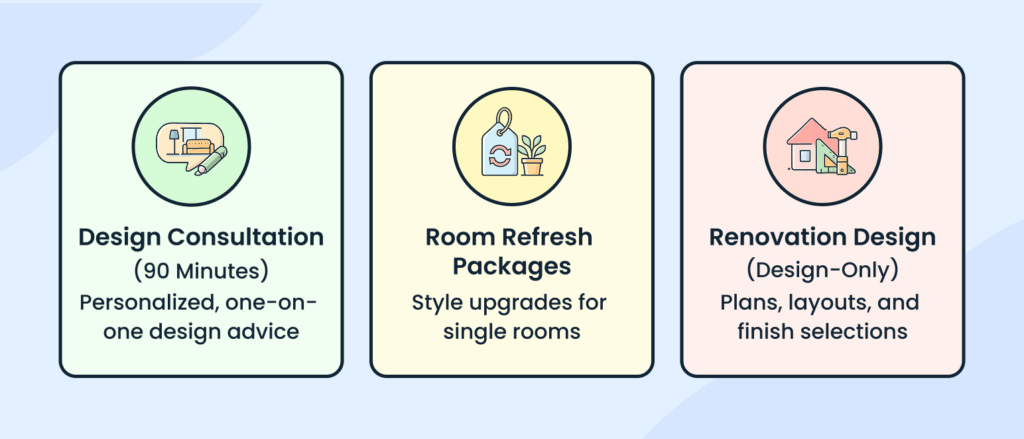
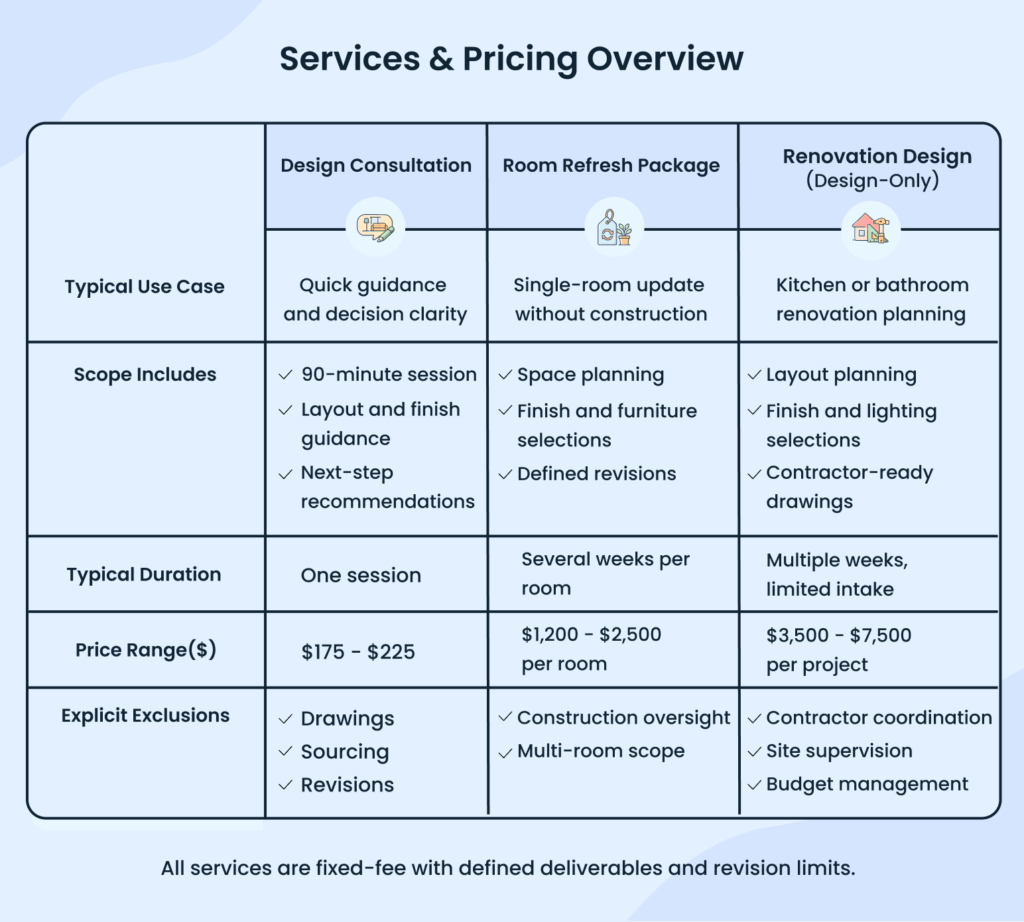
Design Consultation (90 Minutes)
Purpose: Serve as both a standalone service and an entry point for larger engagements.
Scope Includes:
- On-site or virtual consultation
- Review of client goals, space constraints, and budget considerations
- High-level layout guidance
- Direction on finishes, furnishings, or next steps
Pricing Range: $175–$225 per consultation
Why This Works:
Consultations generate immediate cash flow with minimal prep time. They also filter serious clients and frequently convert into room refresh or renovation design projects.
Embedded Controls:
- Time-limited session
- No drawings or sourcing included
- No post-consultation revisions without additional fees
Room Refresh Packages
Purpose: Provide structured design support for single-room updates without renovation-level complexity.
Scope Includes:
- Space planning and layout guidance
- Color palette and finish selections
- Furniture and decor recommendations
- Defined number of revisions
Pricing Range: $1,200–$2,500 per room
Typical Use Cases:
- Living rooms, bedrooms, home offices
- Post-move-in updates
- Functional reconfiguration without construction
Embedded Controls:
- Single-room limitation
- Fixed deliverables
- Revision caps are defined in the contract
- Clear exclusions for construction oversight
This package structure allows HavenVista to manage multiple refresh projects per month without overlap or timeline risk.
Renovation Design (Design-Only)
Purpose: Support homeowners planning kitchen or bathroom renovations, wanting professional layouts and selections without full project management.
Scope Includes:
- Layout planning
- Finish and lighting selections
- Contractor-ready drawings within a limited scope
Pricing Range: $3,500–$7,500 per project
Explicit Exclusions:
- Contractor coordination
- Site supervision
- Construction scheduling
- Budget management beyond design guidance
Embedded Controls:
- Limited number of active renovation projects at a time
- Defined drawing scope
- No on-site oversight obligations
These projects are taken selectively due to their higher time demands and are capped to protect overall workload balance.
Optional Add-On Services
Add-ons are designed to extend value without reopening scope. Available Add-ons:
- Virtual design support
- Additional revisions beyond package limits
- Limited furniture sourcing assistance
These are billed separately and approved in advance. They are not bundled automatically, ensuring the core service remains intact.
Services Excluded in Year 1
To preserve focus and avoid operational strain, we’ve intentionally excluded the following services:
- Commercial design projects
- Full construction management
- Multi-room remodel oversight
- Ongoing retainer-based design work
These exclusions reduce liability exposure and scheduling risk while keeping the business aligned with solo execution.
Pricing Logic and Market Fit
Pricing reflects:
- Mid-market household budgets
- Local competitive norms
- Time investment per service
- The absence of studio overhead
The goal isn’t to underprice, but to price transparently and sustainably. Fixed fees allow clients to budget confidently while allowing the business to plan workload without relying on volume.
Capacity Alignment
Each service type is designed to fit within realistic time blocks:
- Consultations fill short, predictable slots
- Room refresh packages occupy defined project windows
- Renovation design projects are scheduled selectively
This alignment ensures that revenue targets are achievable without exceeding personal capacity.
What This Means for Financial Predictability
By limiting service types and enforcing scope boundaries, HavenVista avoids the variability that often destabilizes solo creative practices. Revenue is driven by repeatable engagements rather than bespoke, open-ended work.
This structure demonstrates that pricing is not aspirational. It is operationally grounded and directly tied to how the business is run.
Marketing and Client Acquisition Strategy
For HavenVista Interior Design, marketing is designed to support consistent, qualified inquiries, not maximum visibility. As a solo practice with capped capacity, the objective is not to generate high lead volume, but to attract homeowners whose needs align with fixed-fee, design-only services.
Marketing choices are constrained by three realities:
- Limited monthly project capacity
- Modest, controlled marketing budget
- Founder-led execution with no sales staff
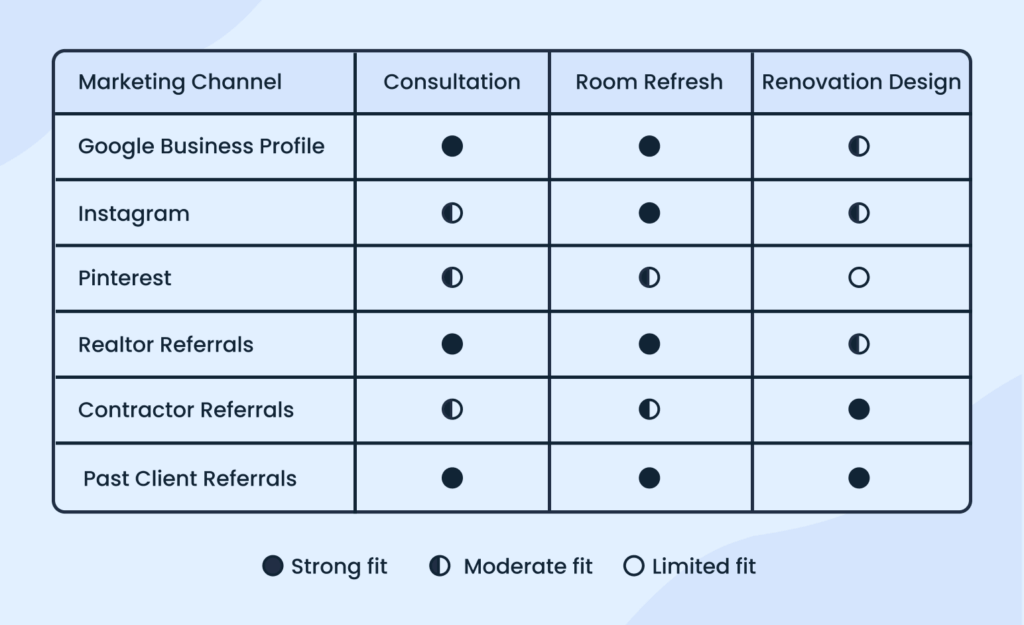
As a result, the strategy favors channels that reward credibility, visual proof, and local relevance over broad reach.
Core Marketing Channels
Visual Discovery Platforms
Instagram and Pinterest serve as primary discovery channels due to the visual nature of interior design.
These platforms are used to:
- Share before-and-after room refreshes
- Show layout improvements and functional changes
- Demonstrate design thinking rather than trend chasing
Posting frequency is paced to remain sustainable. Content is curated from completed projects and conceptual examples rather than produced at high volume. Paid promotion is used selectively to amplify strong-performing posts rather than run ongoing campaigns.
Local Search Presence
Google Business Profile is a critical channel for capturing intent-driven inquiries.
This channel supports:
- Local visibility for homeowners actively seeking design help
- Trust through reviews and completed project photos
- Direct contact without intermediary platforms
Maintaining accurate listings, consistent updates, and client reviews is prioritized over complex search campaigns.
Referral-Based Acquisition
Referrals from realtors, contractors, and past clients are expected to become a meaningful source of inquiries as the business establishes itself.
These relationships are built through:
- Clear service boundaries that partners can easily explain
- Reliable follow-through on referred projects
- Professional documentation that reflects well on referral sources
Referral-based acquisition aligns with the business’s capacity limits and reduces reliance on paid advertising.
Introductory Offers and Conversion
Our introductory incentives are used sparingly to encourage first engagement without discounting core services. Examples include reducing the first consultation fee and referral credits for repeat clients. These offers are designed to lower the barrier to entry while preserving pricing integrity for larger packages.
Monthly Marketing Spend and Control
Marketing spend is intentionally limited, with a monthly range of $200–$350 allocated across:
- Light paid promotion on visual platforms
- Local listing enhancements
- Basic content creation tools
Spend levels are reviewed regularly and adjusted based on inquiry quality rather than volume.
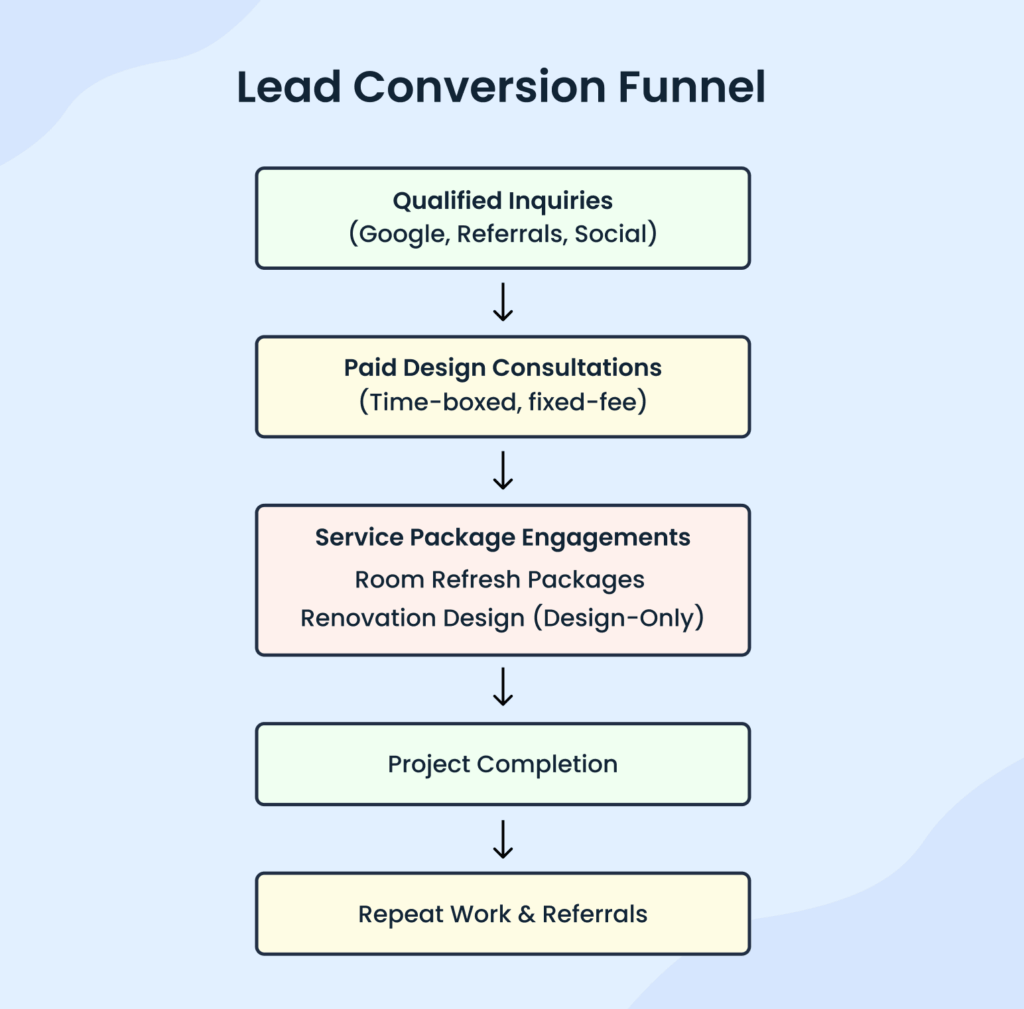
Lead Qualification and Fit Control
Marketing success is measured not by lead count, but by:
- Percentage of inquiries converting to paid consultations
- Alignment of inquiries with the defined service scope
- Minimal time spent on non-qualified leads
Clear service descriptions and pricing ranges are communicated upfront to discourage misaligned inquiries.
Embedded Risk Controls in Marketing
Risk is managed through restraint:
❌No dependency on a single channel
❌No high fixed ad spend
❌No aggressive discounting
❌No obligation to chase volume during slow periods
This approach ensures marketing supports operations rather than driving unsustainable demand.
What This Means for Growth
Growth is expected to occur gradually through:
- Increased referral activity
- Improved conversion efficiency
- Higher average project value within existing capacity
There are no assumptions of rapid scale or expanded staffing tied to marketing performance.
Operations and Solo Practice Management
Operating Model Overview
HavenVista Interior Design operates as a solo practice built around simplicity, flexibility, and cost control. The business is run from a home-based studio in Raleigh, North Carolina, with no leased office, showroom, or permanent staff.
This structure allows the business to remain operationally light while maintaining a professional standard of service.
All core functions, including design work, client communication, scheduling, and project management, are handled directly by the founder. This eliminates internal coordination overhead and ensures consistency across all client engagements.
Physical Setup and Tools
The home office setup includes:
- Dedicated workspace for design and planning
- Computer and design software necessary for professional deliverables
- Sample kits and presentation materials used during client meetings
This setup supports both virtual and in-home consultations without requiring a client-facing studio. Technology and software investments are made up front to ensure efficient workflow and reduce friction during project delivery.
Scheduling and Time Management
Operating hours are flexible and appointment-based. While standard availability is Monday through Friday, evening or weekend appointments are offered selectively to accommodate client schedules.
Time management is structured around:
- Blocking consultation slots
- Scheduling design work in defined project windows
- Avoiding overlap between high-intensity projects
This approach prevents overbooking and ensures each client receives adequate attention without extending timelines.
Capacity and Workload Assumptions
As a solo operator, capacity is intentionally capped. The business does not attempt to maximize volume. Instead, workload is managed to balance income, quality, and sustainability.
Key assumptions include:
- A limited number of concurrent room refresh projects
- Selective acceptance of renovation design projects due to the higher time demand
- Consultations scheduled to fill predictable time blocks without disrupting active projects
Capacity limits are a strategic choice. They protect service quality and reduce burnout risk while allowing the business to operate profitably at a modest scale.
| Service Type | Typical Engagement Length | Concurrent Projects | Monthly Capacity Assumption | Workload Control Mechanism |
|---|---|---|---|---|
| Design Consultations | Single 90-minute session | Not applicable | Several per month, scheduled in fixed time blocks | Time-boxed sessions; no deliverables beyond consultation |
| Room Refresh Packages | Several weeks per room | Limited number at a time | Core monthly workload | Single-room scope; fixed deliverables; revision limits |
| Renovation Design (Design-Only) | Multiple weeks, depending on the scope | Taken selectively | Occasional, not continuous | Capped intake; defined drawing scope; no site involvement |
| Add-On Services | Short, task-specific | Only tied to active projects | Infrequent and controlled | Pre-approved; billed separately; no automatic inclusion |
Use of Freelance Support
Freelance drafting or rendering support may be used on a per-project basis when needed. These engagements are:
- Short-term and project-specific
- Approved in advance based on workload
- Paid as variable costs
There are no long-term contractor commitments. This preserves flexibility and prevents fixed cost creep.
Compliance and Professional Standards
HavenVista maintains:
- Required local business licensing
- Professional liability insurance
- Standardized client contracts compliant with North Carolina regulations
Contracts define scope, deliverables, revision limits, and payment terms. This documentation supports professional credibility and protects both the client and the business.
Systems and Administrative Management
Administrative functions such as invoicing, bookkeeping, and document management are handled using standard software tools and external service providers as appropriate. The goal is to minimize administrative time while maintaining accuracy and compliance.
Embedded Operational Risk Controls
Operational discipline functions as built-in risk management:
- No lease or payroll obligations
- Defined capacity limits
- Variable cost structure
- Clear contractual boundaries
These controls ensure the business remains stable even during slower booking periods.
Overall, this operating model demonstrates restraint and realism. The business is designed to function efficiently without dependence on growth, hiring, or high overhead. This makes HavenVista resilient and adaptable as a solo professional practice.
Client Experience and Delivery Workflow
For a solo interior design practice, client experience isn’t a branding layer. It’s an operational system. A clear, repeatable workflow reduces time leakage, prevents scope creep, and protects the founder’s capacity while still delivering a high-touch experience.
HavenVista’s client journey is intentionally structured to move clients from uncertainty to decision clarity without extending engagement length unnecessarily. Every stage of the process reinforces expectations around scope, timelines, and deliverables.
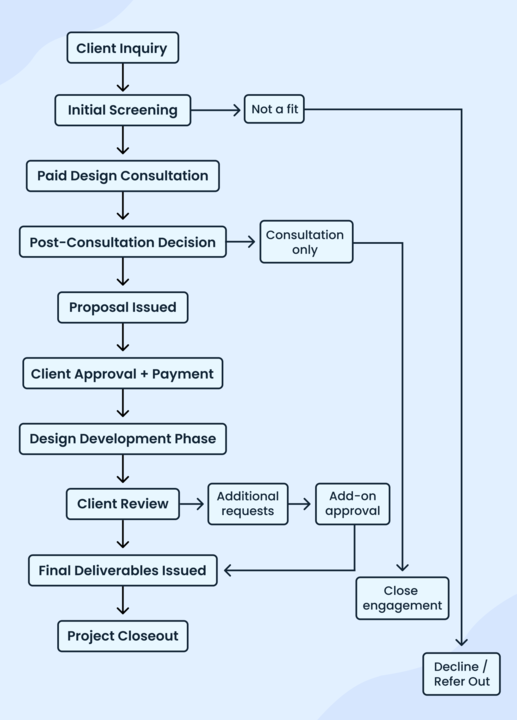
Inquiry and Initial Screening
Client engagement typically begins through:
- Direct inquiries via the website or Google Business Profile
- Social media outreach
- Referrals from realtors, contractors, or past clients
Initial screening is handled directly by Alina Mercer. The purpose isn’t to sell immediately, but to confirm fit. Key screening factors include:
- Project type and scope
- Timeline expectations
- Budget alignment
- Willingness to work within a fixed-fee structure
Projects that fall outside defined service boundaries are declined early. This prevents misalignment and protects the downstream workflow.
Consultation as the Entry Point
Most clients begin with a paid design consultation. This step functions as both a value-delivery service and a qualification mechanism.
During the consultation:
- Client goals and constraints are clarified
- Layout challenges are discussed
- Direction on finishes, furnishings, or next steps is provided
- Suitability for a room refresh or renovation design package is assessed
By the end of the consultation, clients leave with actionable guidance regardless of whether they proceed further. For the business, this step filters committed clients and reduces unpaid pre-work.
Proposal and Scope Confirmation
For clients moving forward, HavenVista issues a written proposal outlining:
- Selected service package
- Scope inclusions and exclusions
- Deliverables
- Revision limits
- Timeline expectations
- Fixed fee and payment terms
No work begins until the proposal is approved and payment terms are met. This formal checkpoint is critical for scope discipline and sets a professional tone for the engagement.
Design Development Phase
Once engaged, design work follows a structured sequence appropriate to the service type:
- Space planning and layout development
- Selection of finishes, lighting, furnishings, or materials
- Preparation of drawings or documentation as defined in the package
Communication during this phase is scheduled and purposeful. Feedback cycles are limited to the number specified in the agreement, ensuring progress without endless iteration.
Review, Revisions, and Final Deliverables
Client feedback is incorporated within the agreed revision limits. Any requests beyond the defined scope are discussed and approved as add-ons before work proceeds.
Final deliverables may include:
- Layout plans
- Selection boards or schedules
- Contractor-ready drawings for renovation projects
- Written guidance for implementation
All deliverables are presented clearly, with next steps explained so clients can move forward independently or with their chosen contractors.
Post-Project Closeout
At project completion:
- Final documentation is delivered
- Outstanding questions are addressed
- Clients are encouraged to reach out for future phases or additional rooms
There’s no expectation of ongoing retainer work. The relationship remains open but not operationally binding. This approach supports repeat business without creating long-term obligations.
Embedded Risk Controls in the Workflow
Risk management is built into the client experience rather than handled separately:
- Paid consultations prevent unpaid discovery
- Written proposals eliminate ambiguity
- Fixed fees and revision limits prevent scope creep
- Defined closeout prevents open-ended engagement
These controls are essential for maintaining profitability and quality in a solo practice.
Financial Plan
Financial Overview
HavenVista Interior Design operates as a solo, owner-led professional services business with minimal fixed overhead. The financial model is structured to prioritize cash stability, predictable workload, and conservative assumptions rather than rapid growth.
The business requires $28,000 in startup funding, primarily from owner capital. There are no lease obligations, no employees, and no long-term debt in the base operating case. Revenue projections are based on realistic service volume aligned with the founder’s time capacity and defined service scopes.
The Year 1 financial objective is to achieve stable cash flow and controlled profitability, rather than maximizing utilization. Profitability is driven by fixed-fee services, disciplined scope limits, and low recurring expenses.
Startup Costs and Use of Funds
Total startup funding required is $28,000, allocated as follows:
| Category | Amount |
|---|---|
| Computer and design equipment | $7,500 |
| Software subscriptions (annual) | $4,200 |
| Website, branding, photography | $5,000 |
| Sample kits and presentation materials | $3,500 |
| Insurance, legal, licensing | $2,300 |
| Marketing launch | $2,500 |
| Initial working cash buffer | $3,000 |
| Total Startup Costs | $28,000 |
Funding Sources
- Owner equity contribution: $22,000
- Optional revolving credit or equipment financing: $6,000
This facility isn’t required for baseline operations and is reserved for short-term flexibility only. No draw is assumed in the base case.
Capacity-Based Revenue Logic (Year 1)
Revenue projections are tied to feasible solo capacity:
| Service Type | Average Fee | Annual Volume | Annual Revenue |
|---|---|---|---|
| Design consultations | $200 | ~75 sessions | $15,000 |
| Room refresh packages | $2,000 | ~25 projects | $50,000 |
| Renovation design (design-only) | $5,000 | ~4 projects | $20,000 |
| Add-on services | Variable | — | $5,000 |
| Total Revenue | $90,000 |
Projected Profit and Loss Statement — Years 1 to 3
| Category | Year 1 | Year 2 | Year 3 |
|---|---|---|---|
| Revenue Streams | |||
| Design consultations | $15,000 | $18,000 | $20,000 |
| Room refresh packages | $50,000 | $65,000 | $75,000 |
| Renovation design (design-only) | $20,000 | $30,000 | $35,000 |
| Add-on services | $5,000 | $7,000 | $10,000 |
| Total Revenue | $90,000 | $120,000 | $140,000 |
| Cost of Services (Direct Costs) | |||
| Freelance drafting & rendering | $3,000 | $4,200 | $5,000 |
| Client travel & project materials | $1,450 | $2,000 | $2,600 |
| Payment processing fees | $1,500 | $1,800 | $2,100 |
| Total Cost of Services | $5,950 | $8,000 | $9,700 |
| Gross Profit | $84,050 | $112,000 | $130,300 |
| Gross Margin | 93.40% | 93.30% | 93.10% |
| Operating Expenses | |||
| Owner draw (salary) | $36,000 | $42,000 | $48,000 |
| Marketing (ongoing) | $3,300 | $3,600 | $3,900 |
| Software subscriptions | $4,200 | $4,400 | $4,600 |
| Insurance | $1,800 | $1,900 | $2,000 |
| Phone & internet | $2,400 | $2,500 | $2,600 |
| Professional services (accounting, legal) | $2,500 | $2,600 | $2,700 |
| Office supplies & miscellaneous | $1,600 | $1,800 | $2,000 |
| Total Operating Expenses | $51,800 | $58,800 | $65,800 |
| EBITDA | $32,250 | $53,200 | $64,500 |
| Depreciation | $1,500 | $1,500 | $1,500 |
| Interest expense | $0 | $0 | $0 |
| Net Income (before tax) | $30,750 | $51,700 | $63,000 |
Spreadsheets are exhausting & time-consuming
Build accurate financial projections w/ AI-assisted features

Projected Cash Flow
| Cash Flow Item | Year 1 | Year 2 | Year 3 |
|---|---|---|---|
| Cash Flow from Operating Activities | |||
| Net income (before tax) | $29,850 | $51,700 | $63,000 |
| Depreciation (non-cash) | $1,500 | $1,500 | $1,500 |
| Change in working capital | -$1,100 | -$2,500 | -$3,000 |
| Net Cash from Operations | $30,250 | $50,700 | $61,500 |
| Cash Flow from Investing Activities | |||
| Capital expenditures (equipment) | -$7,500 | $0 | $0 |
| Net Cash from Investing | -$7,500 | $0 | $0 |
| Cash Flow from Financing Activities | |||
| Owner capital contribution | $22,000 | $0 | $0 |
| Owner draw | -$36,000 | -$42,000 | -$48,000 |
| Debt proceeds/repayments | $0 | $0 | $0 |
| Net Cash from Financing | -$14,000 | -$42,000 | -$48,000 |
| Net Change in Cash | $8,750 | $8,700 | $13,500 |
| Beginning cash balance | $3,000 | $11,750 | $20,450 |
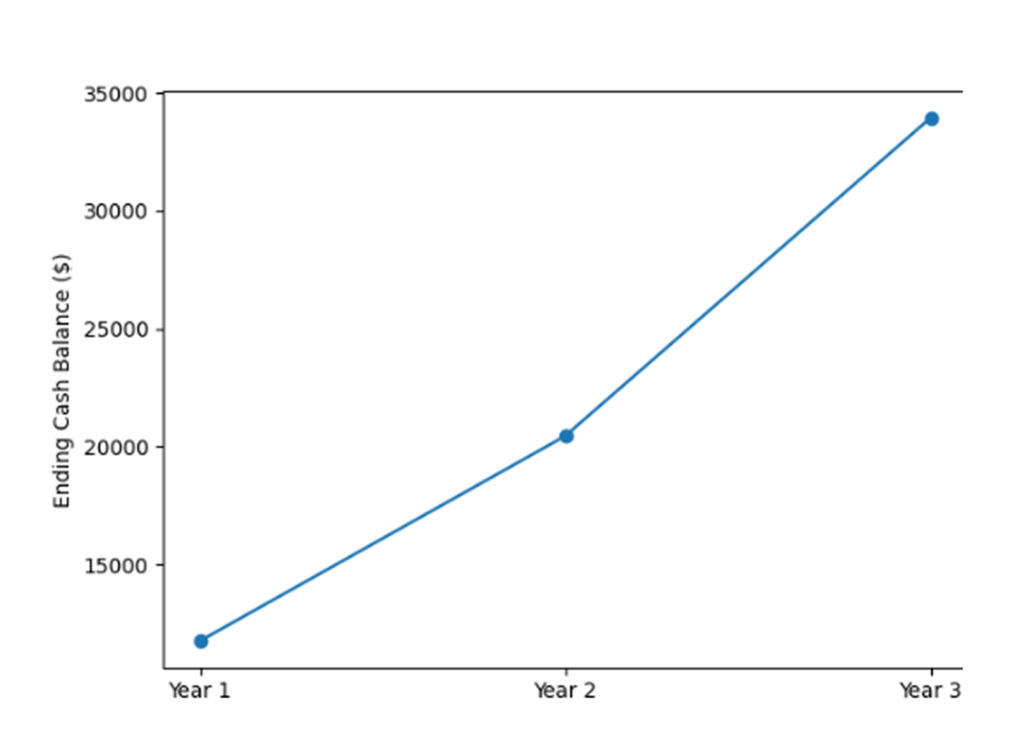
| Ending Cash Balance | $11,750 | $20,450 | $33,950 |
Projected Balance Sheet — Year-End, Years 1 to 3
| Items | Year 1 | Year 2 | Year 3 |
|---|---|---|---|
| ASSETS | |||
| Cash | $11,750 | $20,450 | $33,950 |
| Equipment (net of depreciation) | $6,000 | $4,500 | $3,000 |
| Other current assets | $0 | $0 | $0 |
| Total Assets | $17,750 | $24,950 | $36,950 |
| LIABILITIES | |||
| Accounts payable | $2,000 | $3,000 | $4,000 |
| Long-term debt | $0 | $0 | $0 |
| Total Liabilities | $2,000 | $3,000 | $4,000 |
| OWNER’S EQUITY | |||
| Owner capital contributions | $22,000 | $22,000 | $22,000 |
| Retained earnings (accumulated) | -$6,250 | -$50 | $10,950 |
| Total Owner’s Equity | $15,750 | $21,950 | $32,950 |
| TOTAL LIABILITIES + EQUITY | $17,750 | $24,950 | $36,950 |
Break-Even Analysis
- Monthly fixed operating costs: ~$2,375 (excluding owner draw)
- Average gross margin: ~93%
- Monthly break-even revenue: ~$2,600
This equates to:
- Approximately 1 room refresh per month, or
- 12–13 consultations, or
- A combination of smaller engagements
Financial Position Summary
We are structured for financial stability rather than scale. Our business reaches break-even at modest volume levels and remains resilient during slower booking periods due to its low fixed cost base and disciplined service scope.
The Quickest Way to turn a Business Idea into a Business Plan
Fill-in-the-blanks and automatic financials make it easy.

Upmetrics
Upmetrics is the #1 business planning software that helps entrepreneurs and business owners create investment-ready business plans using AI. We regularly share business planning insights on our blog. Check out the Upmetrics blog for such interesting reads. Read more